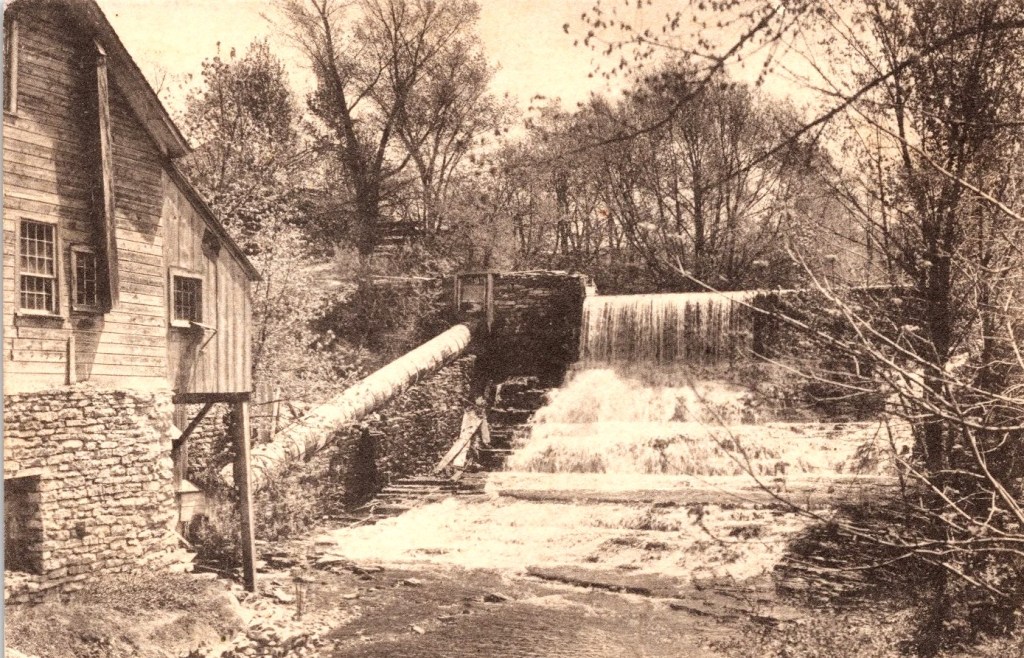
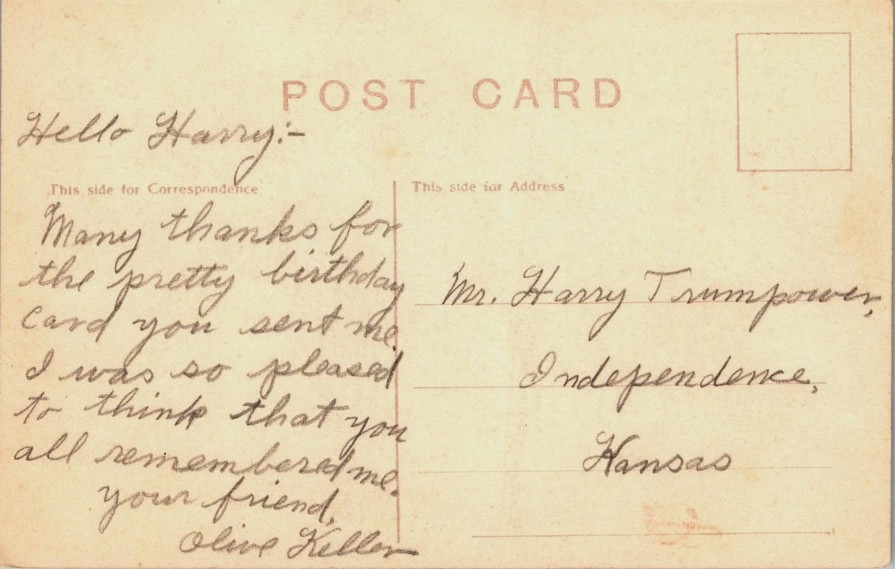
A vintage lithograph postcard, circa 1910, was sent or given to Mr. Harry Trumpower of Independence, Kansas, by Olive Keller. There’s no stamp or postmark on the card. On the front shows an old grist mill, with a polite and thankful message from Olive, reading,
“Many thanks for the pretty birthday card you sent me. I was so pleased to think that you all remembered me. Your friend Olive Keller”
Olive A. Keller was born on May 8, 1889, in Winston, Kansas. Her parents were Oliver and Daisy Keller. The family moved to Independence, Kansas, soon after she was born.
Olive married Harry Elliott in September 1913. The couple had three children. Sadly, Harry and Olive divorced in 1939, with Olive, at the age of 61, having to work as a maid for the Charles McGonikie family. Mr. McGonikie was a wealthy business owner. Olive died on December 6, 1977, at the age of 88. She’s buried in Independence.
The postcard recipient, Harry Bailey Trumpower, was born April 24, 1893. He was four years younger than Olive. The young man evidently took a liking to Miss Keller and gave her a special card. Things didn’t go his way romantically, perhaps, because Harry was only 17 and Olive was 21.
With things not working out as he planned, Harry married Edith Johnson on May 29, 1926. They remained together for life until Harry passed away on July 27, 1977. Ironically, this is the same year that Olive died. Olive’s ex-husband, Harry Elliott, died in 1965.
The grist mill on the front of Olive Keller’s postcard isn’t identified, but I believe it could be Sutphen’s Mill in Dickinson County. There’s no way to prove this, because I am not aware of a surviving picture to compare it with. Even if it’s not, the photograph is representative of how this mill might’ve once looked.
I visited the Sutphen’s Mill location in the 1980s with my father-in-law, and all that remained was a stone foundation. You might say we’re somewhat partial to the place, with Joleen’s dad and mom getting married in Sutphen Mill Church.
Sutphen Mill is a small unincorporated community, a ghost town, located in Dickinson County, Kansas. Though little-known today, Sutphen Mill has a unique history tied to the rural development of central Kansas and the importance of water-powered mills in the 19th century. A church and cemetery remain.
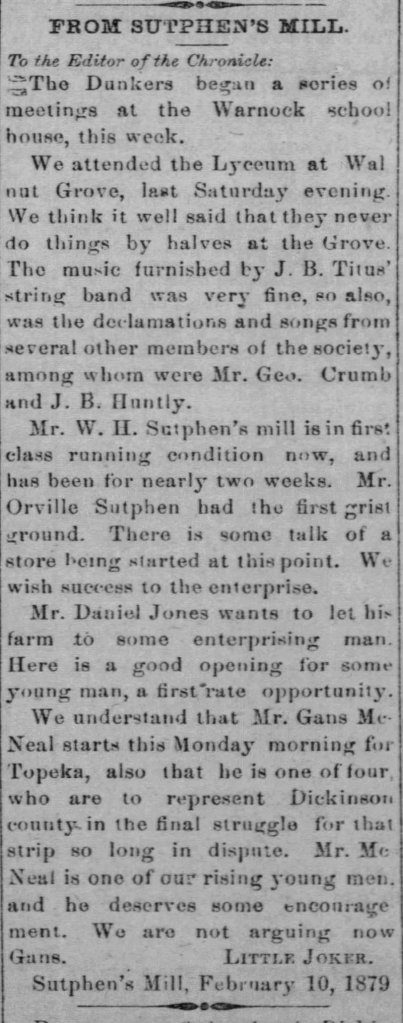
Sutphen Mill was established in the late 1800s by W.H. Sutphen and Orville Sutphen, during a period of intense westward settlement and agricultural expansion in Kansas. The community was named for its most significant feature: the Sutphen Mill, a gristmill built along Chapman Creek. This mill processed local farmers’ grain, serving as a central economic and social hub for the surrounding rural area.
Grain mills played a crucial role in the development of rural Kansas, providing local farmers with the means to process wheat, corn, and other grains into flour and meal.
The presence of a reliable water source, like Chapman Creek, was vital, and the construction of Sutphen Mill attracted settlers seeking both economic opportunity and community. The mill’s location near transportation routes also contributed to its early growth.
At its height, Sutphen Mill supported a small but active community. In addition to the mill, the area featured homes, a schoolhouse, and a post office. Like many rural Kansas communities, life revolved around agriculture, with social events often centered at the mill or local school. Local residents formed a tight-knit community, relying on one another for trade, labor, and socialization.
Over time, technological advancements and the consolidation of agricultural processing led to the decline of small local mills. The rise of railroads, improved roads, and larger commercial mills in nearby towns reduced the need for small, water-powered operations like Sutphen Mill.
By the early 20th century, the mill ceased operation, and the community’s population dwindled as families moved to larger towns in search of new opportunities.
Today, Sutphen Mill stands as a reminder of the many small, rural communities that once dotted the Kansas landscape. While few physical remains of the mill or community exist, Sutphen Mill’s legacy lives on in local histories and the memories of the families whose lives were shaped by its presence.
Sutphen Mill, Kansas, is representative of the pioneering spirit that shaped the American Midwest. Its history reflects the critical role of agriculture, water-powered industry, and community in settling and developing rural Kansas.
Though small and now largely forgotten, Sutphen Mill played a significant part in the story of Dickinson County and the wider region.
 I like to write junk...