When I lived in Alaska, I recall one winter in the 1980s when the winds caused a widespread power outage, including our neighborhood, that lasted for several days.
We still had natural gas to run the furnace, but no electricity to turn on the blower fan. Thankfully, I had a small generator installed the summer before to run it, including the refrigerator, lights, and even a television set.
During the early days, in rural Kansas, settlers relied upon wood, coal, and buffalo chips to burn for heat. Buffalo chips are remnants of buffalo dung containing mostly grass. These chips were gathered up in the summer when it dried out.
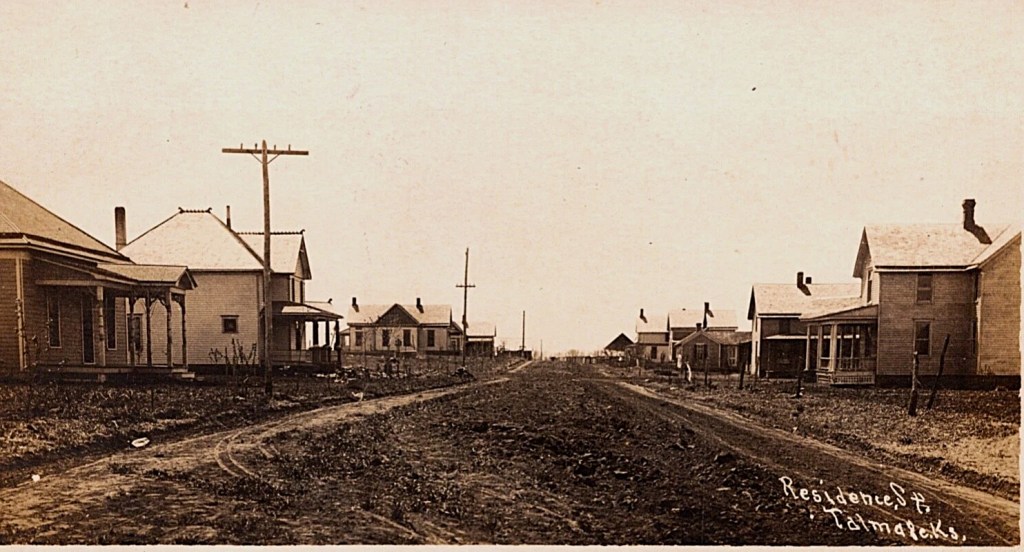
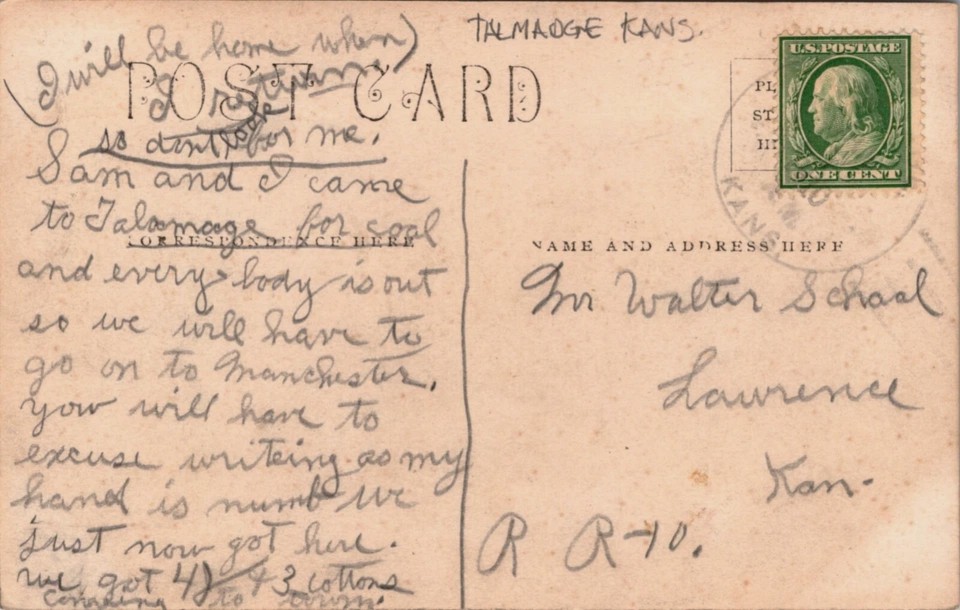
The winter of 1909 – 1910 was an especially bad one, lasting through March. Wood must’ve been scarce, with buffalo chips no longer found. The beastly animals been pretty much killed off by then. A postcard mailed from Talmage, Kansas, to Mr. Walter School in Lawrence highlights the trouble a couple of guys were having rounding up coal. I transcribed it as written:
“Sam and I came to Talmage looking for coal and every body is out so we will have to go on to Manchester. You will have to excuse writing as my hand is numb. We just now got here. We got 42 + 3 cottons coming to town. I will be home when I return so don’t look for me.”
There was no signature to the letter, and I had to do some digging in an attempt to find out who Sam and the other guy were. More on that later. Talmage, Kansas, is a place where I’ve been several times, but I know little about it.
It’s a small unincorporated community located in Dickinson County in the central part of the state. Established in the late 19th century, Talmage owes its origin to the expansion of the railroad, which played a significant role in shaping many rural Kansas towns.
The arrival of the railroad brought new opportunities for settlers, allowing local farmers and ranchers to transport their goods to broader markets. Over the years, Talmage became a modest hub for agricultural commerce, supporting grain elevators, general stores, and a post office that served the surrounding farming community.
While the population has remained small, Talmage has witnessed the evolution of rural life in Kansas, from the era of buffalo chips and coal heating to the modernization brought by electricity and improved infrastructure.
The town’s resilience can be seen in stories like the winter of 1909-1910, when settlers struggled to find fuel and faced harsh conditions, relying on resourcefulness and community ties to get through difficult times. The winter of 1912 was even tougher.
Today, Talmage stands as a testament to the perseverance of Kansas’ rural communities and their ability to adapt to changing times.
Walter Adam Schaal was born in Abilene, Kansas, on April 14, 1888. His parents were Adam and Elizabeth Schaal. Walter attended business college in Lawrence, Douglas County, and worked there afterwards in the banking industry.
On June 25, 1919, he married Goldie Fern Hyre, with no record of children. Walter passed away at the age of 70 on December 2, 1958. He’s buried in Lawrence. Goldie Fern Schaal died on February 26, 1974. She was 83.
Try as I did, I could not identify Roy, one of the two people searching for coal. I assume the travelers were friends of Walter, from Abilene, and knew that their pal would be concerned after not hearing from them.
The winter of 1909 – 1910 resulted in considerable snow, so it’s logical they eventually had to hunker down somewhere until the storm passed. Abilene is 11 miles from Talmage, with Manchester only 8 miles away, but either town would be quite a journey via horse and wagon in frigid weather.
If that was 45 pounds of cotton they were also picking up, the two guys could’ve sheltered under it.
 I like to write junk...