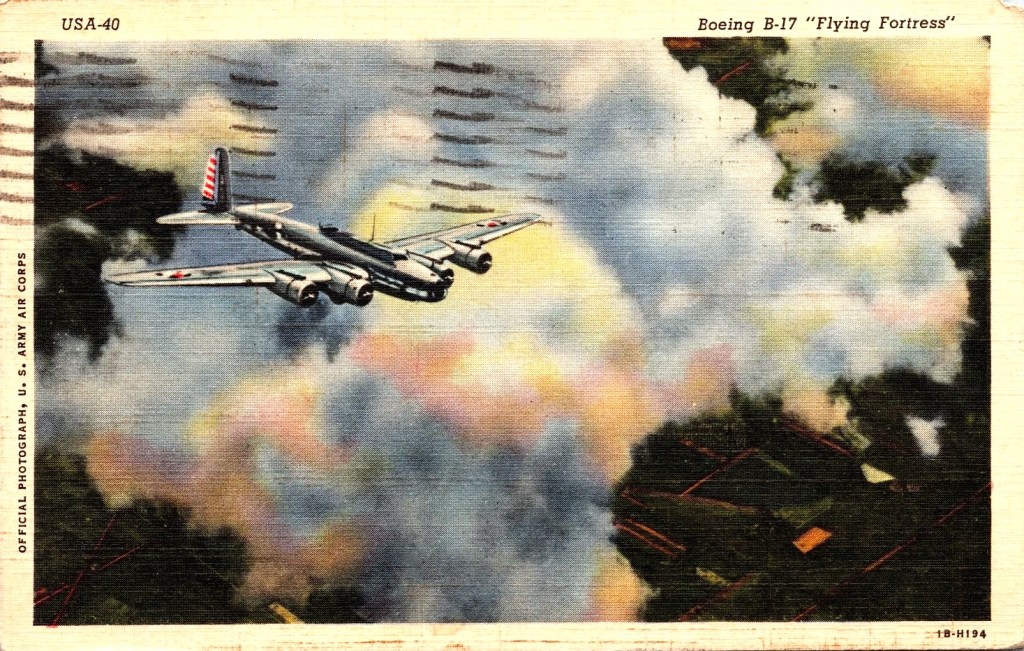
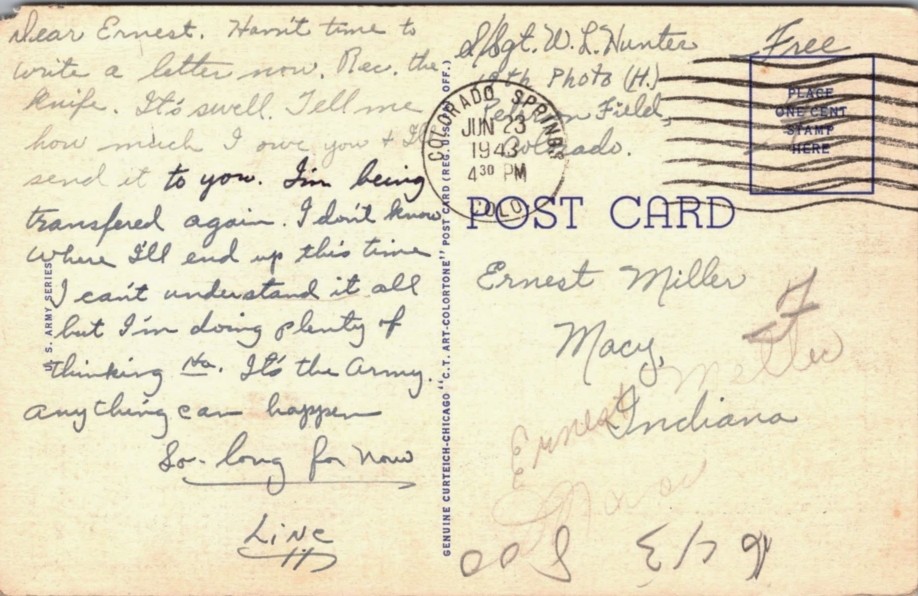
A 1940s WWII era postcard that I own was mailed from Colorado Springs, Colorado, on June 23, 1943, to a person in Macy, Indiana. The card sender was S/Sgt W.L. Hunter, assigned to the 19th Photo Headquarters at Peterson. The picture of the Boeing B-17 “Flying Fortress” on Hunter’s card is an official Army Air Corps photo. His letter to Ernest Miller says:
“Dear Ernest, Haven’t time to write a letter now. Rec the knife. It’s swell. Tell me how much I owe you and I’ll send it to you. I’m being transferred again. I don’t know where I’ll end up this time. I can’t understand it all but I’m doing plenty of thinking. Ha. It’s the Army. Anything can happen. So long for now. Line.”
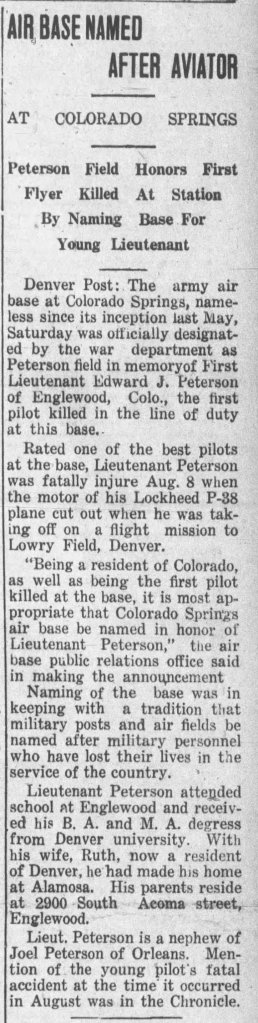
Colorado Springs Army Air Base, located in Colorado Springs, Colorado, was first established in 1942 as a military photo reconnaissance training facility during World War II, and was also used to train fighter pilots later in the war. Toward the end of 1942, it was renamed Peterson Field after 1st Lieutenant Edward J. Peterson.
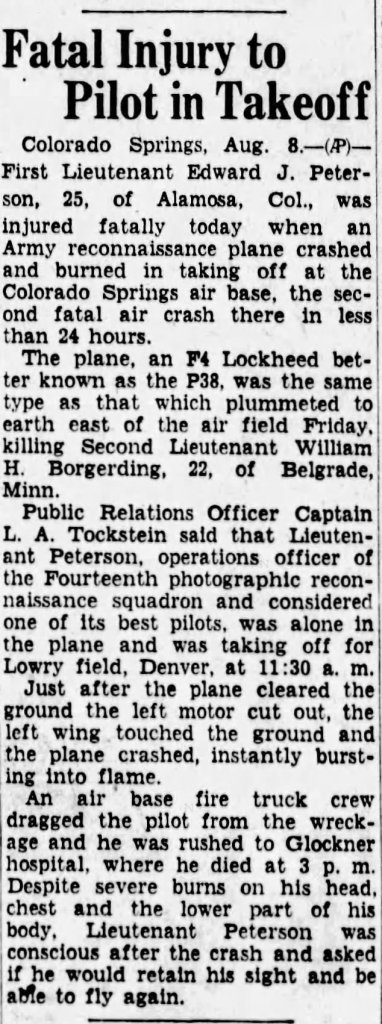
1st Lieutenant Peterson was assigned to the 14th Photograph Reconnaissance Squadron in Colorado Springs, where he was promoted to operations officer on July 26, 1942. On August 8, 1942, only 13 days after his new assignment, Ed Peterson was seriously injured when an engine on his Lockheed F-4 failed and he crashed shortly after takeoff. An F-4 is similar to the P-38 Lightning.
The pilot was burned over his head, chest, and lower body. Peterson’s last wish before he lost consciousness was that he would fly again. Per his wife’s request, he was cremated and his ashes scattered over Pike’s Peak with an F-4 airplane like the one he flew.
Peterson Field was closed after the war ended in 1945, yet it was reactivated several times for different reasons. Renamed Peterson Air Force Base, it is currently home to the US Air Force Space Command, although that is soon to change. President Donald Trump recently made the decision to move the headquarters from Colorado to the Redstone Army Facility in Huntsville, Alabama.
William Lincoln “Linc” Hunter was born on September 15, 1919. He enlisted with the Army Air Corps on April 13, 1942. S/Sgt. Hunter saw action during WWII, most likely snapping photos from a B-17 aircraft like that one pictured on front of the postcard.
Thankfully, he returned, as many B-17 crewmen didn’t. Perhaps this had something to do with William Hunter selling life insurance after leaving the service. He lived to be 88, passing away on September 3, 2007.
Ernest Miller was a close friend. Born in 1909, he was 9 years older than William Hunter. Entering the draft on October 6, 1940, Mr. Miller was never chosen to serve. Ernest Howard Miller worked as a city engineer before retiring, succumbing to heart failure on August 22,1969, at the age of 60.

 I like to write junk...