Several years ago, I wrote a story titled “Car Guy.” It basically detailed my life as a gearhead, this being what car aficionados are often called. Lake Havasu City is filled with these people, with more hot rods per capita than anywhere in the US. That’s one of the reasons my wife and I moved here, besides the blue skies and sunny weather.
Deciding to write another short automotive-related story, this piece is more in line with my two favorite car movies, “American Graffiti” and “Vanishing Point.”
Both movies premiered in 1971 and 1973, with 1972 being the year I barely graduated from high school. It’s hard to believe that these films are well over 50 years old and are still very popular; each is a cult classic.
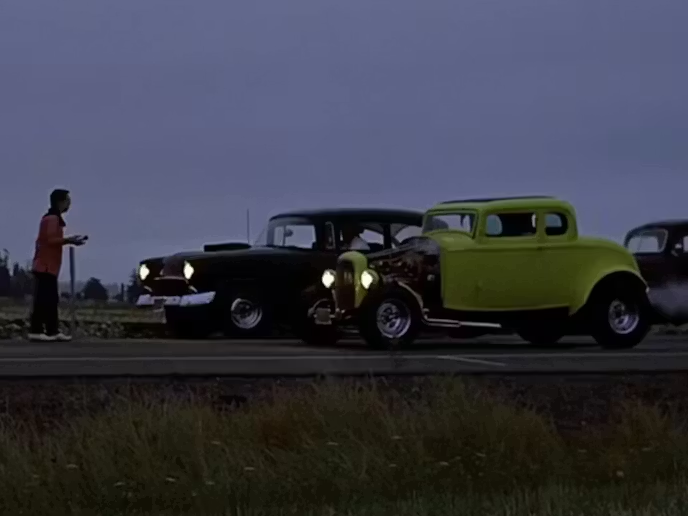
In the film “American Graffiti,” Bob Falfa (played by Harrison Ford) wrecks his car during a climactic drag race. The wreck occurs when Falfa goes up against John Milner, the reigning local street racer. Bob Falfa, no relation to Al, pushes his car too hard in an attempt to beat Milner.
As the race nears its end, Falfa loses control, causing his black ’55 Chevy to crash, flip over, and burn. The primary reason for the wreck is Falfa’s aggressive driving and desire to prove himself as the fastest racer, which leads him to take risks beyond his skill or the car’s capabilities. The film made no mention of Falfa having insurance.
This crash also serves as the film’s dramatic turning point, underscoring the themes of recklessness, youth, and the fleeting nature of bravado and competition. Both Bob Falfa and his passenger, Laurie Henderson, survive the accident. Laurie wisely decides at this point that Falfa is a loser in both life and racing.
The late actress Cindy Williams plays Laurie Henderson, Steve Bolander’s girlfriend. Ron Howard plays Steve; Paul Le Mat plays John Milner; and Richard Dreyfuss takes on the role of Curt Henderson, Laurie’s brother. Candy Clark is a blonde bimbo named Debbie Dunham. Perhaps that’s a bit too strong, but no other word comes to mind for her.
Charles Martin Smith perfectly portrayed a nerdy character nicknamed Terry “The Toad” Field. The late Wolfman Jack and Suzanne Somers are also in the movie. The real stars of this show are the cars, especially the yellow ’32 Ford Deuce Coupe and 1955 Chevy.
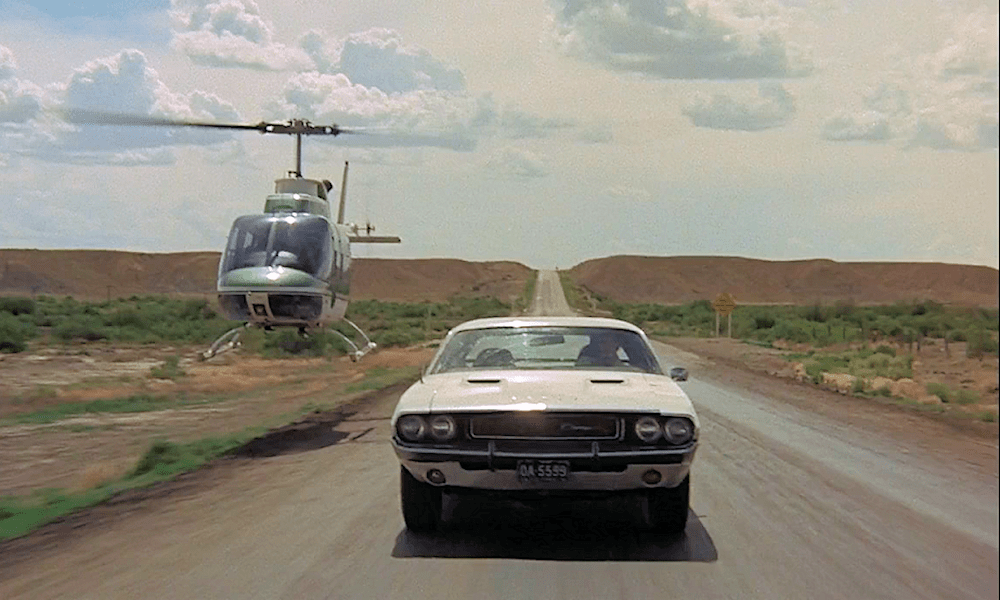
There were two stars in “Vanishing Point,” with the late actor Barry Newman, portraying Jimmy Kowalski, a former racecar driver and cop. His co-star was a 1970 Dodge Challenger R/T with a 440 Magnum and a 4-speed manual transmission.
The central plot in “Vanishing Point” was Kowalski attempting to deliver his new Challenger to San Francisco from Denver in 15 hours, under the influence of speed, both in pill form and miles per hour. Had it not been for two D-8 Caterpillars deliberately parked in the middle of a highway, he would’ve made it.
I’ve jokingly told friends and strangers that had Kowalski been driving a faster 426 Hemi Charger, he might’ve been able to successfully outrun the police helicopter and cruisers, and then drift graciously around the Cats. No one believes this except me.
Watching both movies at least ten times, I have a favorite scene in each, with the police car in “American Graffiti” having its rear axle chained to a signpost, a huge gut-buster, where laughter is concerned.
When the cops quickly take off after an outlaw group called ‘The Pharaohs,’ they’re in for a big surprise. There was a similar scene in “Leave it to Beaver” where Eddie Haskell and Wally Cleaver put a chain around friend Lumpy Rutherford’s old car axle, ripping it loose from the frame. Director George Lucas, of “American Graffiti,” admits this is where he got the idea.
In “Vanishing Point,” Kowalski stops to pick up a recently married gay couple who’ve encountered car trouble. They quickly push their vehicle into a ditch and climb inside the white Dodge. The pair then attempts to hijack Kowalski’s car using a revolver. A classic line from this scene, uttered by one of the men, is, “What are you looking at, Mary?”
The language and some of the frames in the original film have now been edited to make it less offensive. I couldn’t find a mention of the hijacking on Google, which doesn’t surprise me. A brief nudity scene of a girl riding a motorcycle was also axed. I’ve observed much worse in “Forrest Gump,” which is considered a family movie by some.
Thankfully, somewhere in my boxes of packed-up worldly goods are an unedited VHS copy and a DVD of the same. They’re now permanently saved for my kids and grandchildren. They’ll need players for both as ours bit the dust years ago.
Vintage Western movies have been treated the same as “Vanishing Point” by the WOKE generation, mostly in terms of racist language being cut. If you’ve never watched “Vanishing Point,” make sure to get an unedited copy. They’re readily available on eBay.
I’ve sat through several car movies over the years, but none come remotely close to these two, in my opinion. There’s nothing like a good car movie to get my heart pumping, other than perhaps a large raspberry mocha with two coffee beans on top.
I’d love to see another”American Graffiti” filmed right here in Havasu. McCulloch Boulevard is the perfect setting for cruising, with plenty of cool cars parked in garages ready to light up the screen.
For actors, look no further than the CARS N Coffee gang in our hometown. Jim, Bob, Diane, Paul, Laura, Esther, Larry, Shel, Phil, plus others. They’d make up the cast. All we need is for George Lucas to agree to this sequel and produce the next. George, if you’re still in town, shoot me a text!
 I like to write junk...