PASSING THROUGH SELMA

“Citizens were encouraged to write the soldiers for encouragement and to lift their spirits.”

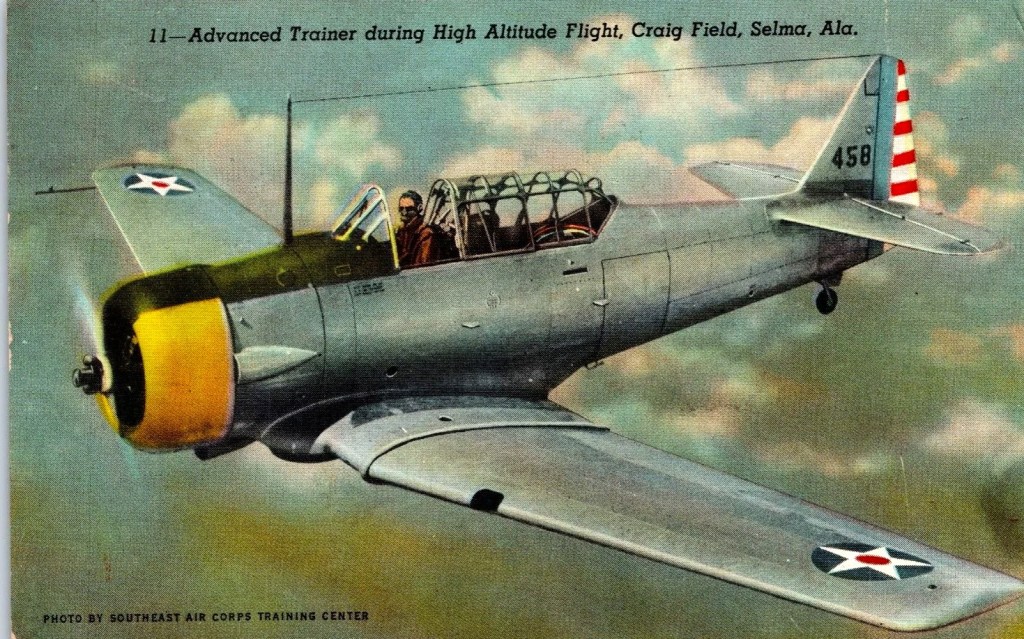
Craig Field AT-6 trainer

A picture postcard showing an Army Air Corps training airplane on the front was sent to Miss Sue Howard of Mt. Vernon, Illinois, on September 16, 1942. The sender was Private Anthony “Tony” J. Infantino, who was at the base during this time. Infantino’s postcard has a Selma postmark. His message to Sue was a polite and cordial one.

“Stopped here and will soon be on our way to Texas by plane. Will write later. Your pal, Tony”

Craig Field, located near Selma, Alabama, was a significant military airfield during World War II. Established as part of the United States’ rapid expansion of air training facilities, Craig Field played a vital role in preparing pilots for combat and supporting the broader war effort. This overview explores the history, operations, and legacy of Craig Field during the WWII era.

The base was constructed in 1940 as the threat of global conflict grew and the United States recognized the need to train a vast number of aviators. Named in honor of Lieutenant Bruce K. Craig, a military aviator who lost his life in service, the field became operational in early 1941. Its primary mission was to serve as an advanced pilot training base under the Army Air Forces’ Southeast Training Center.

During WWII, Craig Field was primarily dedicated to advanced flight training. Cadets, having completed basic flight instruction elsewhere, arrived at Craig for rigorous, comprehensive training on advanced aircraft.

The base specialized in transitioning pilots to operate single-engine fighter planes and multi-engine bombers, crucial to the Allied air campaign. Training included instrument flying, formation maneuvers, navigation, and aerial combat tactics.

Thousands of American and Allied pilot trainees passed through Craig Field during the war. The influx of personnel brought economic growth and increased activity to the surrounding Selma community. The base employed both military and civilian workers, fostering a sense of shared purpose in the national war effort.

Craig Field operated a variety of aircraft, including the North American AT-6 Texan, which was widely used for advanced pilot training. The field was equipped with modern runways, hangars, and support facilities, reflecting the technological advancements of the era. The curriculum emphasized proficiency in the latest aviation technology and combat readiness.

The pilots trained at Craig Field went on to serve in every theater of World War II, flying missions over Europe, the Pacific, and North Africa. The field’s rigorous training programs ensured that aviators were well-prepared for the challenges they would face in combat. Craig Field thus played a pivotal role in the overall success of the U.S. Army Air Forces during the war.

With the end of WWII, Craig Field continued to serve as a training and operational base, adapting to the needs of the emerging U.S. Air Force. Its contributions during WWII are remembered as a key chapter in the history of American military aviation, and the field’s legacy endures in both the region and the broader context of air power development.

Craig Field’s history during World War II is marked by its critical function as a center for advanced pilot training, technological innovation, and community involvement. Its legacy reflects the determination and teamwork that underpinned the Allied victory in the air war.

At Craig Field for a brief time, Pvt. Anthony Infantino was probably on his way to Randolph Field near San Antonio for further training. He was born on July 22, 1919, in New York. Enlisting in the Army at the age of 23, tragically, Tony was killed in action (KIA) while parachuting into enemy territory in the Netherlands.

This happened on March 24, 1945, with his remains not brought back to the States until 1948, where it was interred in his hometown of Pawling, New York. Flags were lowered to half staff, with quite a few residents turning out for the service. Tony’s young friend may have never known.

Sue Howard was much younger than Tony, and judging by the context of the postcard message, their relationship was strictly one of friendship. Perhaps she was more of a pen pal than anything. Citizens were encouraged to write the soldiers for encouragement and to lift their spirits. This nationwide campaign was called V-MAIL, or Victory Mail.

Miss Betty Sue Howard married Eugene L. Delves on March 27, 1954. The couple stayed together until their deaths. Eugene passed away in 2011, and Betty Sue, seven years later, in 2018.

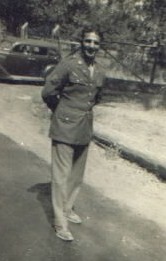
Private Anthony “Tony” Infantino
Betty Sue Howard-Delves
1954

BLYTHE

“The word Blythe alone doesn’t conjure up an oasis or vacation destination for me.”

Lonely and desolate

During WWII, there were several airfields in and around our neck of the woods. My mother always used that term when describing her hometown in Alabama. Works for me here in Arizona, although there are no woods within sight; only rocks and sagebrush out my back door, along with the lake.

Lake Havasu City had yet to become a dream in developer Robert McCulloch Sr’s eyes when a military airfield was built on what’s now called “The Island.” That facility was simply named Site 6 and was used as a recreational site more than anything. On occasion, a civilian airplane experiencing engine trouble landed there for repairs.

Yucca had a military base, as did Kingman and Yuma. What some people don’t realize is that an Army Air Base at Blythe, California, played a significant role during World War II as a training and operational facility for the US Army Air Corp.

Established in 1942, the base was strategically located in the desert of Riverside County, which provided an ideal environment for flight training due to its generally clear weather and vast open spaces.

Blythe Army Air Base primarily served as a training ground for bomber crews, including those assigned to fly B-17 Flying Fortresses and B-24 Liberators. The facility was part of the larger West Coast airfield network, supporting the war effort by preparing air crews for combat missions overseas. Personnel stationed at Blythe underwent rigorous training in navigation, bombing techniques, and aerial gunnery.

In addition to its training functions, Blythe Army Air Base supported various operational units and hosted several temporary deployments. Its airstrips and facilities were also used for aircraft maintenance and logistics operations. The base contributed to the overall readiness of the Army Air Forces, helping to ensure the effective deployment of trained airmen to the European and Pacific theaters.

After the end of World War II, Blythe Army Air Base was deactivated and eventually repurposed for civilian use, becoming Blythe Airport. Today, its legacy endures as a reminder of the region’s contribution to the nation’s wartime aviation history.

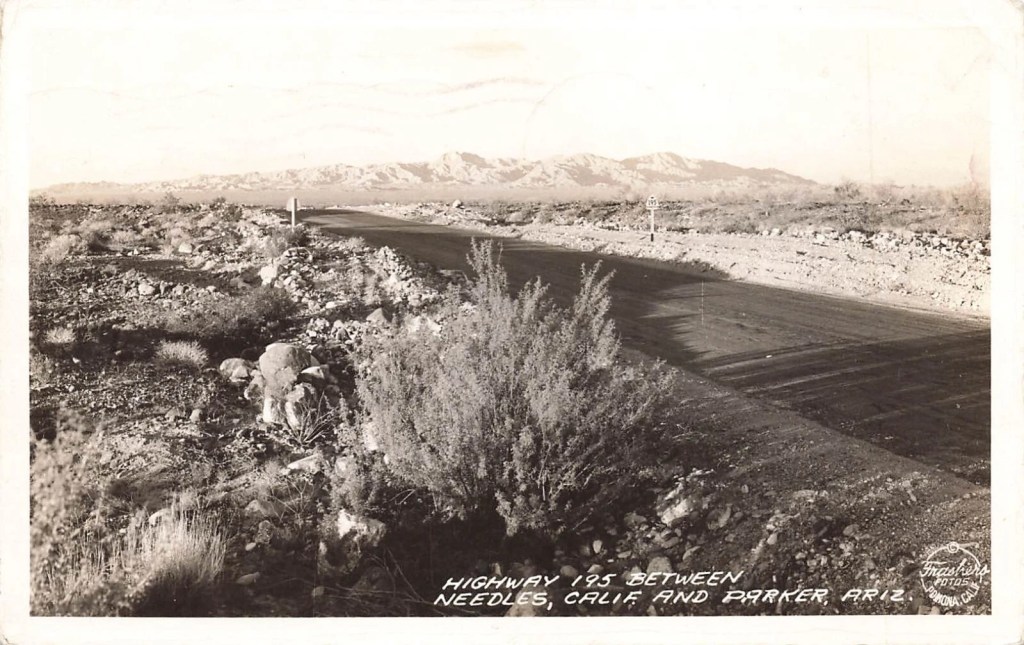
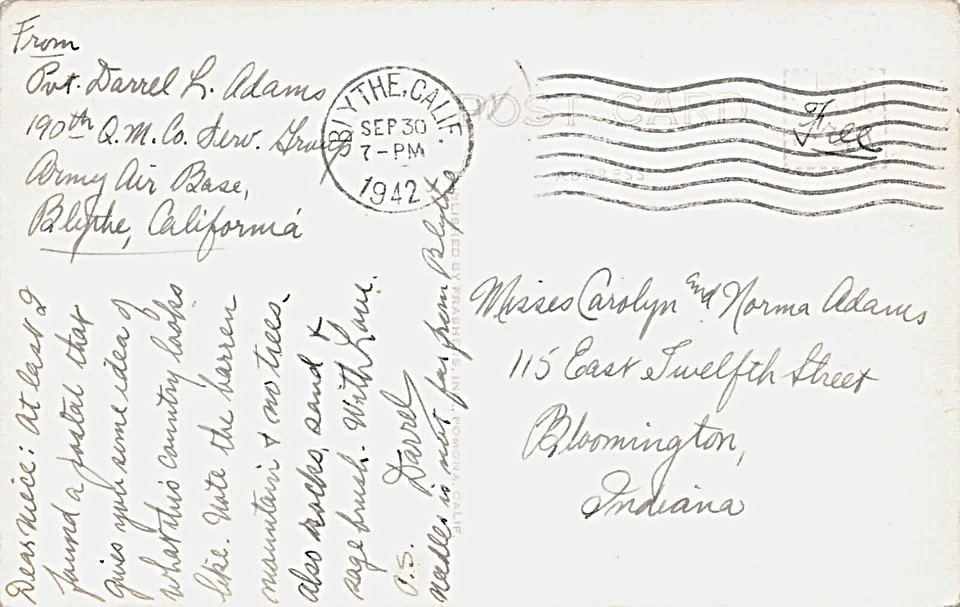
A postcard I acquired was sent by Pvt. Darrel L. Adams to his two nieces in Bloomington, Indiana, Carolyn and Norma Adams, while the private was stationed at Blythe Army Air Base in California. The message on this card briefly describes his surroundings:

“Dear Niece: At last I found a postal that gives you some idea what this country looks like. Note the barren mountain & no trees, also rocks, sand, & sage brush. With love, Darrel. P.S.  Needles is not far from Blythe.”

Darrel’s black & white postcard shows a picture of a bleak section of Highway 195 from Needles to Parker. The word Blythe alone doesn’t conjure up an oasis or vacation destination for me. This vintage postcard was postmarked in Blythe on September 30, 1942, with the return address being,

Pvt. Darrel L. Adams

190th. Qm. Co. Serv. Group

Army Air Base

Blythe, California

I wasn’t sure what I’d find regarding the card sender and recipients, greatly hoping that Pvt. Adams made it through the war alive. Thankfully, things turned out well for all three people.

Private Darrel Adams was honorably discharged from the US Army in 1945 after WWII ended. Adams went on to become a custodian for an office building. Previous to enlisting in the service, he declared his occupation on a 1940 census report as a professional projectionist. Born in 1921, Darrel Lewis Adams died in 1988 at the age of 77.

Carolyn June Adams was born August 24, 1925, and would’ve been 17 when Uncle Darrel sent that postcard to the girls. Carolyn’s sister, Norma, was only 14, having been born on March 7, 1928.

Carolyn married Roy Henry Torbit on May 5, 1944, while her sister Norma wed a guy named Ted Lee Fox in 1948. A previous marriage for Norma had failed. Carolyn died in 2000 at the age of 75, with younger sister Norma outliving her, passing away in 2012 at the age of 84.

I found nothing outrageous or controversial about Darrel, Carolyn, or Norma Adams. Their lives were what I call routine where ‘postcard people’ are concerned—much unlike “The Adams Family” of television fame.

Postcard people is a new terminology I’ve given to the sender and recipients of vintage postcards. If things catch on, there’s a very slight chance it’ll go viral!

WAC

“Pvt. Mary Charlotte Wallace was one of these valuable personnel.”

A vintage WWII postcard that I came across was mailed from Mitchel Field, Schenectady, New York, to Ottumwa, Iowa. The card recipient, Agnes Dorothy Kittleson, has limited information available regarding her life. She was born in 1894, became a school teacher, and never married. Agnes died in 1973.

Pvt. Mary Charlotte Wallace, the card sender, was born on November 1, 1920, and enlisted in the Women’s Air Corps on November 11, 1943. She worked in the 1st Service Command Unit as a typist and a typesetter. These were important jobs to keep the paperwork flowing, essential tasks in the war effort.

It seems safe to say that Mary was Agnes’s student at one time and also a friend. Mitchel Field was a large training base during the war, and undoubtedly, Pvt. Wallace picked up Miss Kittleson’s card at the Mitchel Field BX store.

Mary Charlotte Wallace composed the following message within it:

“Pvt. Mary C. Wallace

A 702710

1st S.C.U.

Mitchel Field, N.Y.

Dear Kitty,

Decided it was time to let you know where I finally landed.

This is a grand field and I really like it here. My work is very interesting.

Have managed to see part of N.Y. already. There is so much to see.

I hope you are well. I imagine you are plenty busy with everything.

Maybe I will see you when I get a furlough. Charlotte”

Some women became pilots, but Mary wasn’t one of them. Private Mary C. Wallace was honorably discharged from military service in 1945. She was involved in an automobile accident on August 19, 1958, that killed two people. Mary Wallace was not seriously injured.

For the rest of her short life, Mary worked as a secretary for the Standard Oil Company. Miss Wallace died of bladder cancer on December 4, 1964, at the age of 44. She was buried beside her sister, Irene, in New Sharon Friends Cemetery in New Sharon, Iowa.

The Women’s Army Corps (WAC), established in 1942, enabled women to serve in non-combat roles within the U.S. Army during World War II. Members worked as clerks, mechanics, radio operators, and in many other essential positions, freeing men for combat duty and supporting the war effort. The WAC paved the way for greater inclusion of women in the military. Pvt. Mary Charlotte Wallace was one of these valuable personnel.

Thank you for your service!

Agnes Dorothy Kittleson
Mary Charlotte Wallace

PETERSON AIR FIELD

“Perhaps this had something to do with William Hunter selling life insurance after leaving the service.”

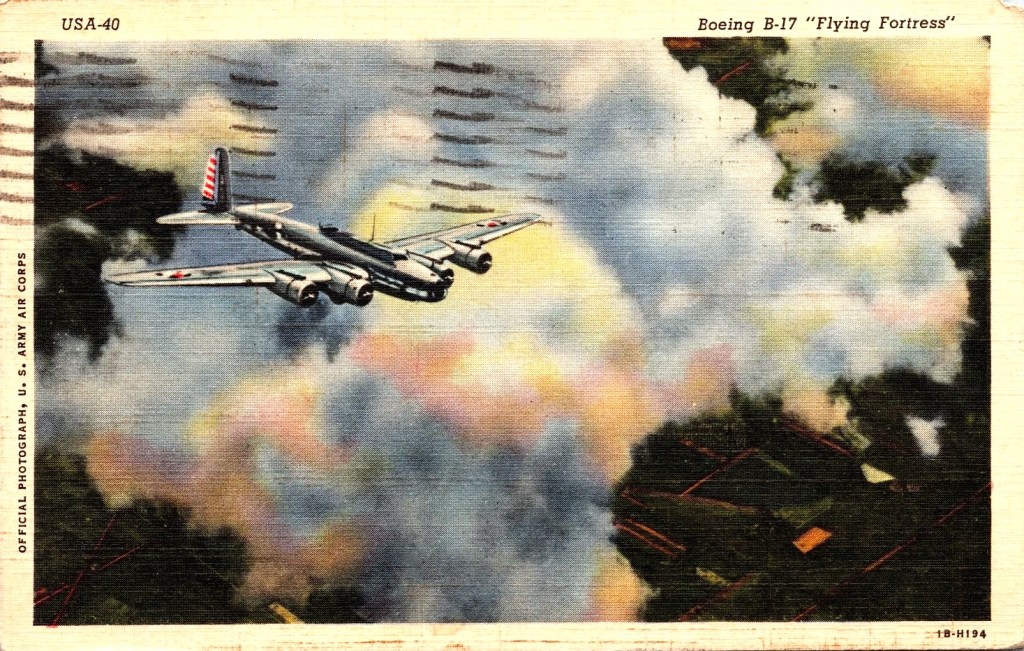
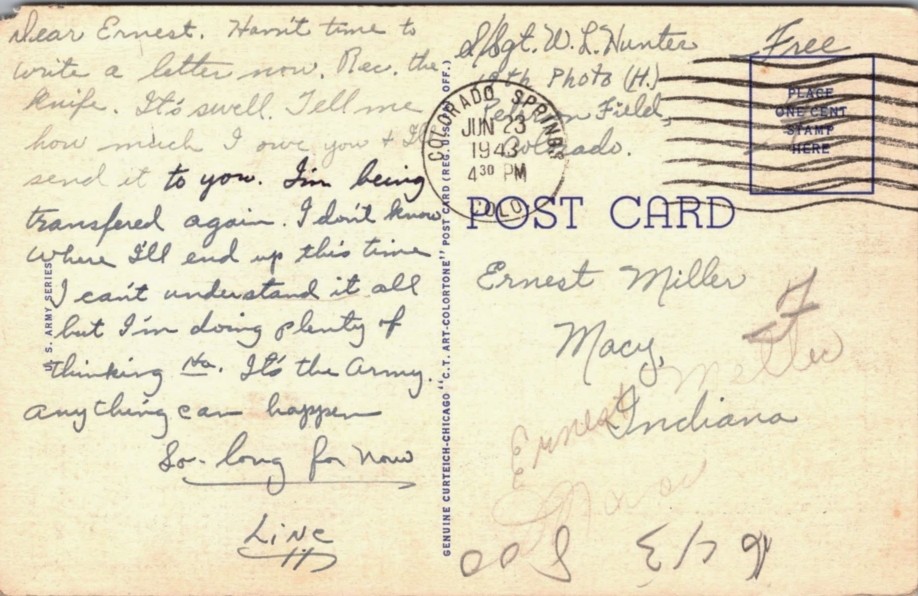
A 1940s WWII era postcard that I own was mailed from Colorado Springs, Colorado, on June 23, 1943, to a person in Macy, Indiana. The card sender was S/Sgt W.L. Hunter, assigned to the 19th Photo Headquarters at Peterson. The picture of the Boeing B-17 “Flying Fortress” on Hunter’s card is an official Army Air Corps photo. His letter to Ernest Miller says:

“Dear Ernest, Haven’t time to write a letter now. Rec the knife. It’s swell. Tell me how much I owe you and I’ll send it to you. I’m being transferred again. I don’t know where I’ll end up this time. I can’t understand it all but I’m doing plenty of thinking. Ha. It’s the Army. Anything can happen. So long for now. Line.”

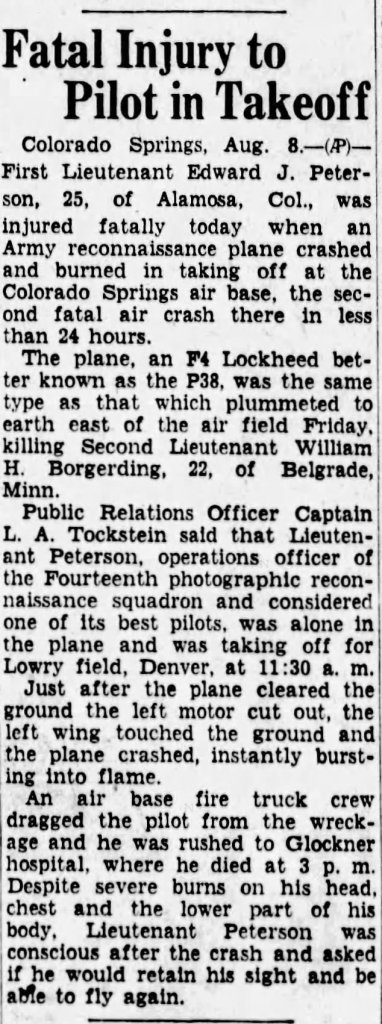
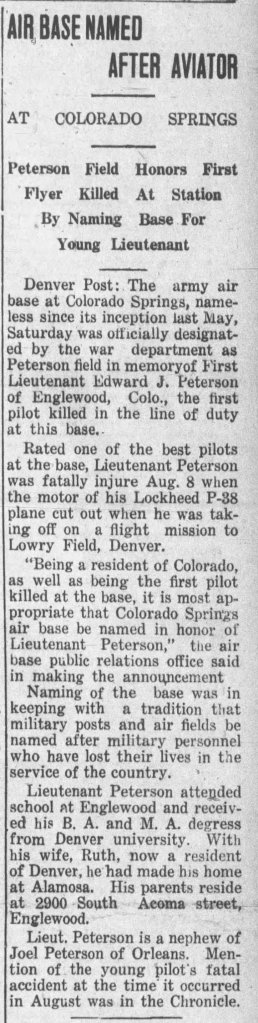
Colorado Springs Army Air Base, located in Colorado Springs, Colorado, was first established in 1942 as a military photo reconnaissance training facility during World War II, and was also used to train fighter pilots later in the war. Toward the end of 1942, it was renamed Peterson Field after 1st Lieutenant Edward J. Peterson.

1st Lieutenant Peterson was assigned to the 14th Photograph Reconnaissance Squadron in Colorado Springs, where he was promoted to operations officer on July 26, 1942. On August 8, 1942, only 13 days after his new assignment, Ed Peterson was seriously injured when an engine on his Lockheed F-4 failed and he crashed shortly after takeoff. An F-4 is similar to the P-38 Lightning.

The pilot was burned over his head, chest, and lower body. Peterson’s last wish before he lost consciousness was that he would fly again. Per his wife’s request, he was cremated and his ashes scattered over Pike’s Peak with an F-4 airplane like the one he flew.

Peterson Field was closed after the war ended in 1945, yet it was reactivated several times for different reasons. Renamed Peterson Air Force Base, it is currently home to the US Air Force Space Command, although that is soon to change. President Donald Trump recently made the decision to move the headquarters from Colorado to the Redstone Army Facility in Huntsville, Alabama.

William Lincoln “Linc” Hunter was born on September 15, 1919. He enlisted with the Army Air Corps on April 13, 1942. S/Sgt. Hunter saw action during WWII, most likely snapping photos from a B-17 aircraft like that one pictured on front of the postcard.

Thankfully, he returned, as many B-17 crewmen didn’t. Perhaps this had something to do with William Hunter selling life insurance after leaving the service. He lived to be 88, passing away on September 3, 2007.

Ernest Miller was a close friend. Born in 1909, he was 9 years older than William Hunter. Entering the draft on October 6, 1940, Mr. Miller was never chosen to serve. Ernest Howard Miller worked as a city engineer before retiring, succumbing to heart failure on August 22,1969, at the age of 60.

Lockheed F-4-1-LO Lightning