I’ve written a few stories about my metal detecting forays. Now’s the time to add to this saga with a couple more neat discoveries. First of all, in a nutshell, I’ll reiterate how this fun and exciting hobby came to be for my wife and me.
Purchasing our earliest detector, a White’s hip mount unit, in 1976, from Stewart’s Photo in Anchorage, the boxy looking machine saw limited use in Alaska. It was mainly put to work in Kansas and Arizona.
I spent far more time looking for old bottles in Alaska—with the detector seldom brought along on lengthy hiking, boating, or flying trips in the 49th state.
The first major find with it was a glass piggybank in Kansas having a rusted metal lid. That tin lid is the only reason the detector sniffed things out. The 1930s-era relic would still be buried on the Wackly farm near Chapman had it not caused our machine to loudly beep.
The old Wackly place is a deserted homestead owned by my wife’s Uncle Jay and Aunt Wava Schweitzer, with its original occupants long deceased.
Inside this piggybank, some 85 years after having been placed there, are several plastic Kansas sales tax tokens issued from 1937 to 1939. Made of thin plastic, heat somewhat warped the round coins, making them bent but still easily readable.
Since that time, the vintage detector has found numerous copper and silver coins in old school playgrounds and dirt parking lots, yet never detected anything made of gold. It’s doubtful school kids had gold coins back in the day let alone teachers and parents.
I retired the White a few years back because of its weight. Swinging that heavy coil made for tired arms after only so many hours. It now spends it’s time gracing a wall of my garage as a conversation piece. White’s metal detectors are no longer made thus it’s now a collectible on its own.
Our new Garrett detectors are much lighter and makes for more enjoyable metal detecting, especially while walking in the desert. These treasure hunting expeditions take us to Yucca and Kingman, and as far south as Parker. We’ve never been skunked on any of our searches; knock on Arizona Desert Ironwood.
With the Garrett, Joleen and I have uncovered hundreds of WWII bullets and brass casings, a pocket watch, chain necklace, Mercedes-Benz emblem, an early cell phone, Harley Davidson pendant, large machete, loose change at a couple of campsites, along with in the desert sand of an often used trail. These are just a few of the unusual recoveries.
We come across aluminum pop-tops and other such trash all the time, bringing them back with us to dispose of in our recycling bin. In a way we’re helping clean up the desert, especially by getting all of those lead bullets out of the ground.
Some things we’ve found using only our eyes are a number of golf balls with little teeth marks indented into them, including intact stuffed animals with a few ripped to shreds. Undoubtedly, the golf balls were taken from area golf courses and the stuffed toys stolen from neighborhood yards by coyotes.
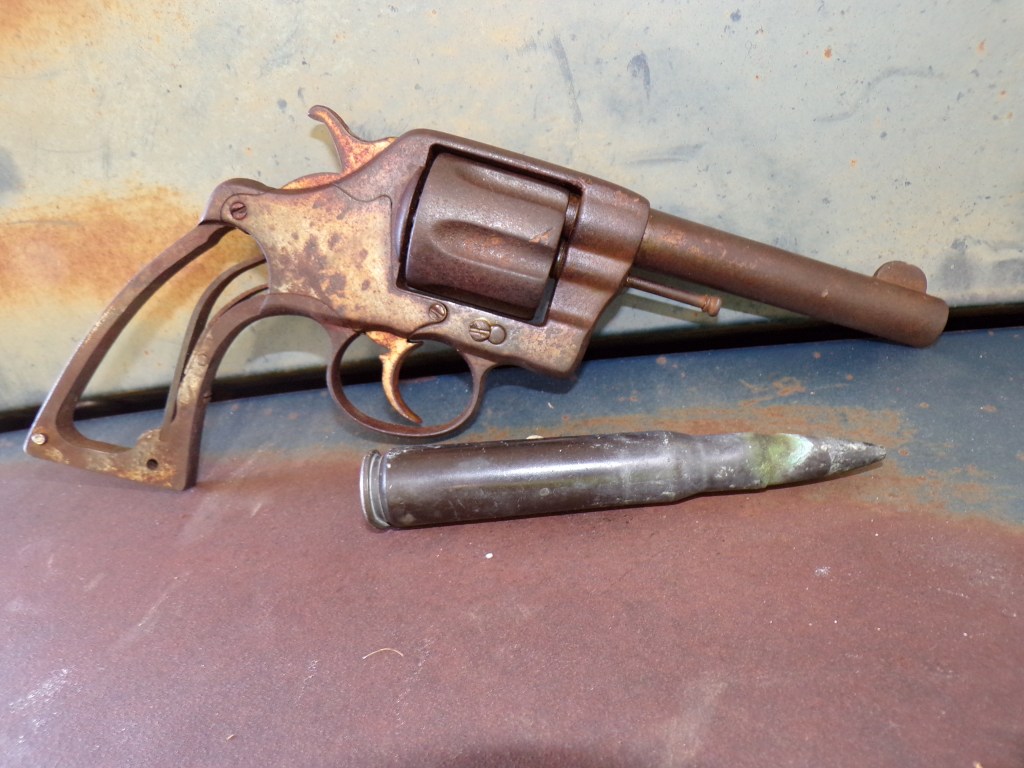
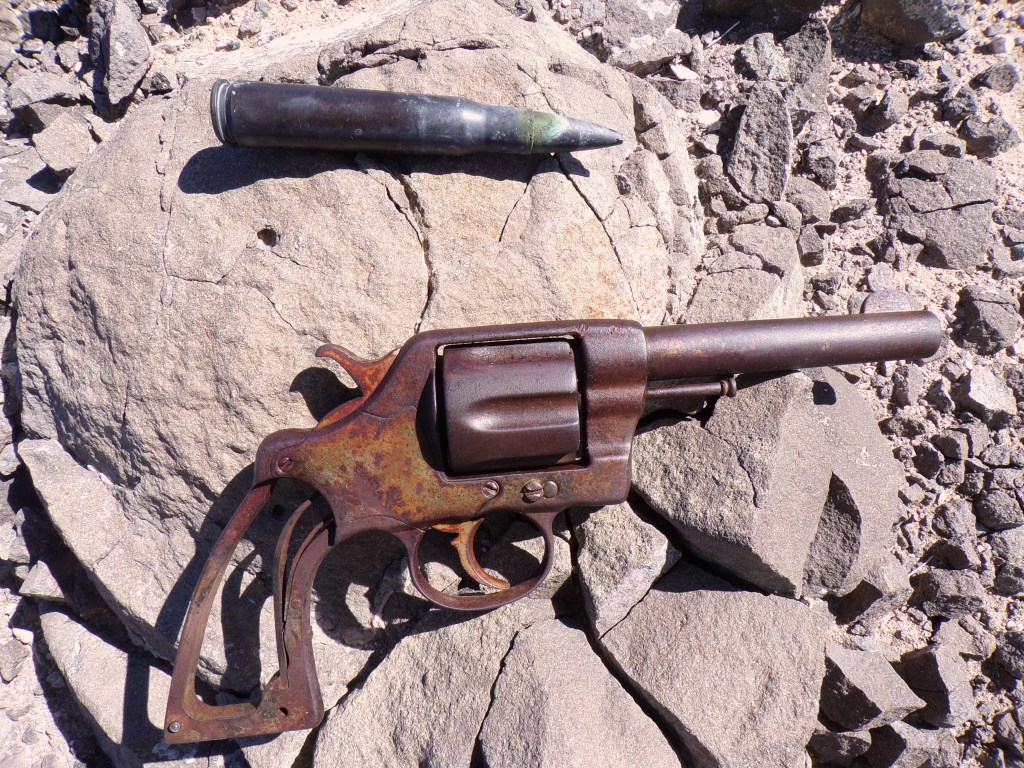
Two weeks ago, a still-loaded vintage Colt revolver was discovered along with an unfired, 1943, 50 caliber bullet. These two items make up our best discoveries to date where desert searching is concerned. The area where both were found is private property with permission to be there.
Rusty and inoperable, the Colt pistol was immediately soaked in Marvel Mystery Oil to free things up. After some time and gentle persuasion, I was able to swing the cylinder out and remove six, 38 caliber shells. Thankfully, the serial number was still visible, with that sent to Colt along with several pictures for positive identification.
From what I’ve been able to discern based upon comparing it to photos of early revolvers, the artifact dates to somewhere around the early 1900s. I believe it’s a 1908 model, but won’t know for sure until Colt does their assessment. That will take at least a month according to them.
A few people have asked how the gun ended up out there. All kinds of imaginary mystique comes to mind, such as the Colt being used in a bank robbery by notorious gangster, John Dillinger. Dillinger and three of his gang were arrested in Tucson in 1934.
Hoping that the serial number points to Dillinger, or perhaps shows that it’s a former Army pistol owned by General George Patton, I logically believe the Colt is a simple case of “desert dropsies.” Some absent-minded-miner or cowboy let it fall out of their holster unnoticed.
There’s all kinds of weird stuff in the desert around Lake Havasu City, either accidentally dropped or intentionally left behind. For the most part, you have to step off the beaten trail like we do to find the good treasure. Ravines, gulley’s, and washes are our favorite places to look. Of course, that’s where the snakes like to hide on warm sunny days.
Without question, the 50 caliber bullet was dropped, yet unlike the antique Colt, this large shell came down from high in the sky. During WWII, Army Air Corps pilots practiced shooting at targets towed by other airplanes, with their bullets, cartridges, and clips falling to the ground.
This particular cartridge is damaged at the very bottom, close to the primer, which is the heaviest part. It was fortunate not to have discharged after striking extremely rocky soil. The cartridge was buried some four inches under the earth. Stamped on the bottom are numbers, 43, standing for the year, and letters, SL, designating it was made in St. Louis.
My wife and I were part of the RZR off road vehicle scene for several years, but sold our side-by-side, deciding that walking was better for our health. It also slowed us down while out in the desert, enabling old eyes to spot small things that we didn’t see while driving.
The treasures we find are not worth that much from a dollar perspective, yet time spent searching for them is priceless. With Joleen now hooked on metal detecting, it gives us something to do as a couple besides watch TV or gripe about things we have limited control over, such as increased utility bills, cable, and our president.
While hiking in the desert, we deliberately toss our complaints into the open surroundings, much like irresponsible folks do with their tires, cans, bottles, and trash.
Our verbal bellyaches and gripes eventually wind their way back home. Unfortunately—human litter doesn’t follow the same path!