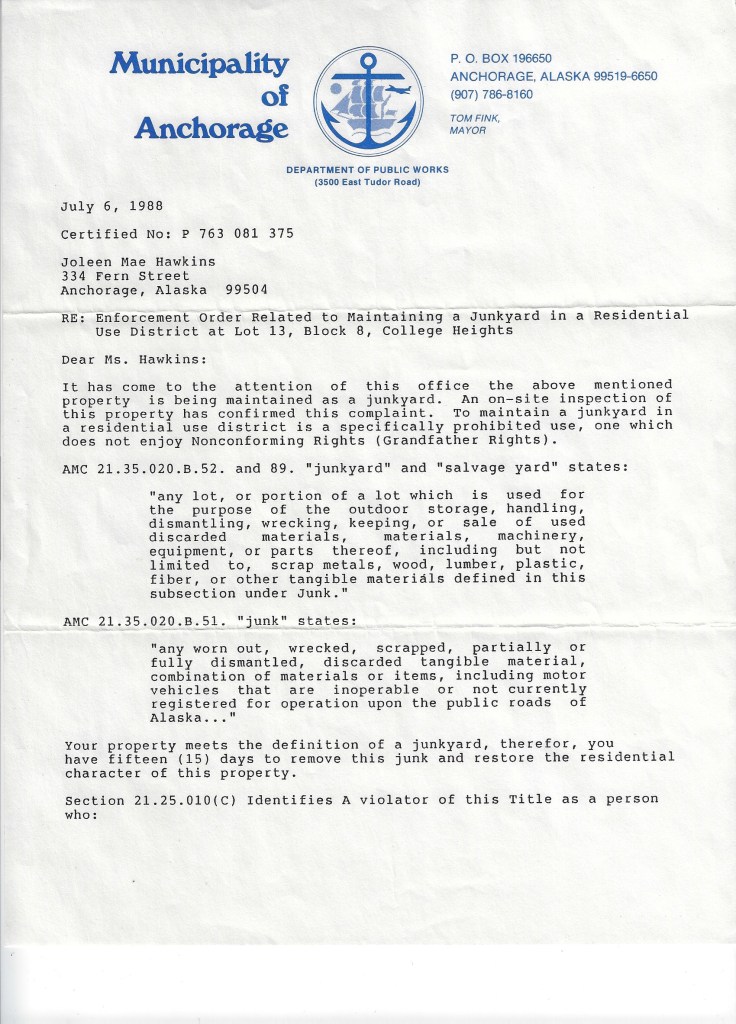
“The day I came home from work and my wife handed me a certified letter from the Municipality of Anchorage will never be forgotten.”
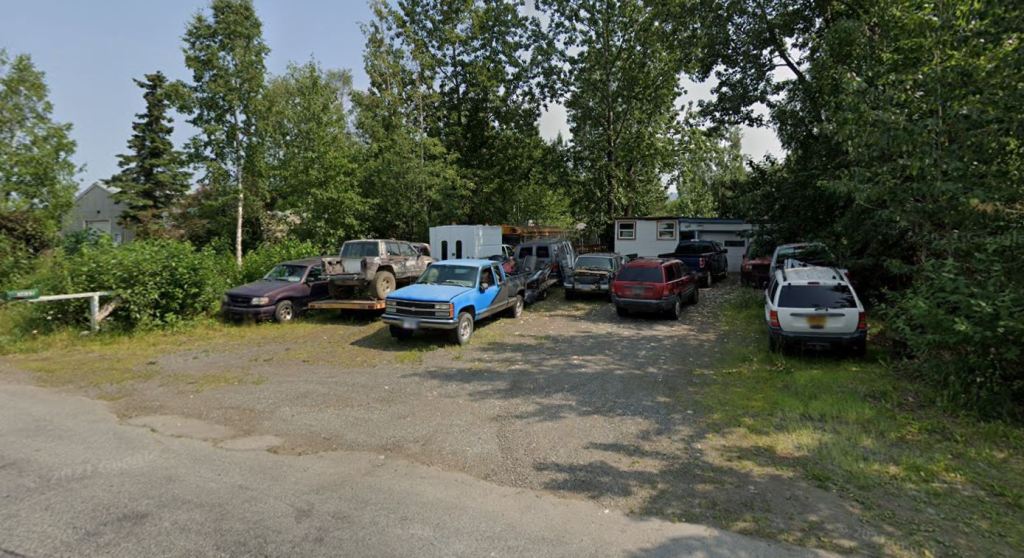
3035 Rose Street as seen today
I told the story of 3035 Rose Street in my book, Ordinary, Average Guy – Uncensored Memoirs of a Trailer Park Refugee. The chapter is titled, “Nightmare on Rose Street.”
It’s one of those life adventures that wasn’t so funny back then, but now I chuckle each time I think about it. I’ve repeated this story countless times with some listeners undoubtedly believing I exaggerated things. Not so. You can’t make this stuff up. Somewhere in a box are pictures to prove such.
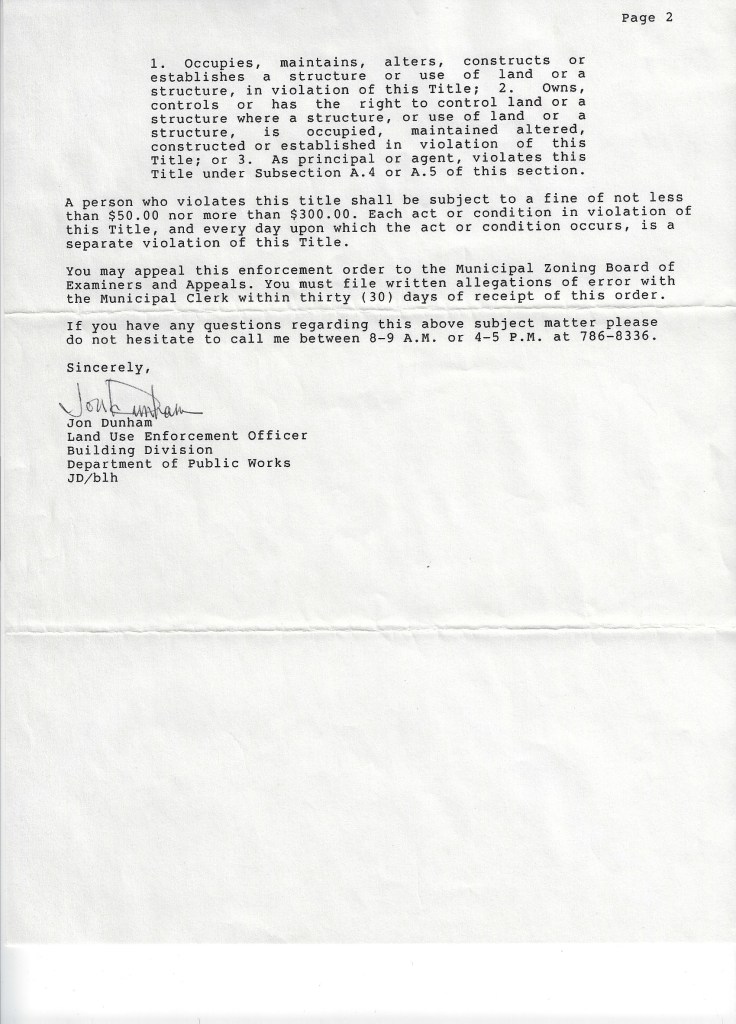
The day I came home from work and my wife handed me a certified letter from the Municipality of Anchorage, stating that she was operating a junkyard will never be forgotten. The expression on her face is priceless.
A follow up letter from the city with pictures claimed there were 37 vehicles in all states of disrepair on the property. Driving over to investigate, I counted 49.
This residence still exists as the attached photo shows. We were half owners for fifteen years until selling to our partner, Tom Oswald. Tom still owns and rents the trailer out, having done so for 48 continuous years now.
I recently calculated that this 1960s Schult mobile home generated approximately $691,200.00 income over those 48 years. The original purchase price for trailer and R-3 lot in 1974 was $25,000.00.
Tommy went on to acquire an additional 48 rental properties, mostly condos and single family homes. The seed money needed to get the ball rolling came from 3035 Rose Street. Who says trailers aren’t good investments. This one has undoubtedly set a record!
“The congregations of most Baptist churches would undoubtedly be labeled right wing extremists by this crowd and CNN.”
I’m always picking news articles apart where a reporter’s unquestionably “leaning to the left.” I’ve done a lot of that here lately. It’s been getting worse over the past five years. I’m sure those on the other side of the fence are claiming just the opposite.
I suppose it’s tough being a reporter and leaving personal opinion out of things. I couldn’t do it. Walter Cronkite came across as unbiased on his daily television news show. So did Huntley and Brinkley. I’m dating myself here. It would’ve been interesting hearing those fellows after they had a good dose of truth serum.
There are subtle ways a person can get their thoughts across without uttering a word. For me, most every time I hear someone mention the name, Joe Biden, I shake my head in disgust. The person doing the yapping generally sees I’m not a fan and shuts up. On the other hand, if they believe as I do, that opens up flood gates to a rant.
Should I say out loud what I truly believe about our current political situation, some would label me an extremist. That’s what the leftist crowd does to folks not adhering to their ideology. The congregations of most Baptist churches would undoubtedly be labeled right wing extremists by this crowd and CNN. Other churches perhaps not so much. Many of them are weak and “go with the flow” instead of preaching the Bible and stepping on toes.
I try not to argue politics or religion with anyone. It’s a waste of time. My opinion is my opinion and the WOKE crowd isn’t going to change it.
If I were a reporter, it would have to be in sports. Bias is welcome with open arms in that arena. Everyone knows, or should know, that the Arizona Cardinals is the best NFL football team in the league. Arizona Diamondbacks without question is the top National League baseball team. Where high school football and basketball teams in Mohave County are concerned, the Havasu Knights lead the pack.
For those not believing as I do on this, I’ll stay mum and simply shake my head.
Most writers have their own unique writing process. I suppose some stuffy literary experts would say one version is better than another. They’d definitely shake their heads at mine. I don’t listen to those people anyway. I’ll now quote, out of context, former first lady, Hillary Clinton, “What difference does it make?”
I use the term“writer quite loosely in “writer” quite loosely when describing myself. I’m strictly a hobbyist and struggle putting words to paper, using dictionaries, spellcheck, and writing guidebooks to help me along. Some authors I know, like Helen Hegener and Professor Michael Burwell, are naturals and know their stuff. If you were to ask what I’d like to be called, “Master Mechanic” comes to mind.
My mechanic friends will laugh at this self-bestowed title because they know it isn’t true. An okay technician at best, I eventually get the job done. The master mechanic misnomer goes back many years.
A mechanic working in Bethel, Alaska, was notorious for never completing his maintenance work. He was an expert at filling out paperwork, saying that it was. I won’t mention the fellow’s real name because that wouldn’t be kosher. We’ll simply call him Ajax Warthog.
My boss flew me to Bethel to take care of the work Ajax was supposed to do. He’d documented that everything was finished, yet when I started checking things out, it was only pencil-checked and not actually completed.
A good week was spent in Bethel finishing up some of his projects. After I left, other Anchorage mechanics went out there to do the same. On the man’s toolbox was a fancy sign saying, “AJAX WARTHOG – MASTER MECHANIC.” I took a photo, and the picture went viral in our shop. Ajax was eventually relieved of his duties.
Getting back to my writing process and how it relates to mechanics. I use this site strictly as a tool for perfecting my work, including storing it. An idea is first composed in my head, and then written down via Microsoft Word. I have a hard time editing stuff there, so it’s copied and pasted to WordPress.
The literary mechanics of this process allow me to examine sentence and paragraph structure from multiple angles. It’s kind of like installing drum brakes on a car. Just because all of the springs go on doesn’t necessarily mean they’re in the right holes. Both literary composition and mechanical repairs often need tweaking.
When I finally publish a story, article, or whatever on WordPress, it immediately goes to all that subscribe via email. That initial publication is never totally free of typos or mistakes. I’ve been asked by some subscribers about such.
The blunders are eventually corrected, but unfortunately, those corrections don’t appear unless a reader visits http://www.michael-hankins.com afterward. That’s just the way it works, and I can’t change things.
I sometimes spend weeks “reworking” the same article. There are nights when I wake up, suddenly thinking of a better word to use. I’ll quickly turn on the computer and change things out. It’s an unorthodox process but one that works for me.
Unlike Ajax and his mechanical assignments, I eventually get my literary compositions perfected and ready to send out to publications. Even at that point they’re not 100% error free. I know editors will take care of the ones I missed, or at least I hope they do.
A book of mine that was recently published contains some deliberate grammatical errors. I advised the editors to leave them as is because they align with the book title, “Ordinary, Average Guy – Uncensored Memoirs of a Trailer Park Refugee.” No one reading a book by that name would expect to find perfection.
If I were to label the type of writer I am, fledgling comes to mind. Call me, “Fledgling Writer.” To my mechanic friends having never heard this term, it simply means, brilliant.
“No person, animal, or lawnmower should have to retire in Texas!”
When I first came to Lake Havasu City in 1981, there were two things standing out above all others. Magnificent, London Bridge, being number one. The second jewel in the desert was discovered purely by accident.
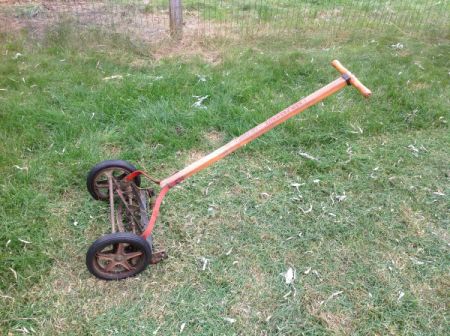
We were driving around town slowly looking at houses, hindering traffic at the same time, when all of a sudden, an old push mower popped into view. It was sitting in a manicured gravel yard with a “Rust in Peace” sign hanging from its handle. I immediately jumped out of our rental car and took a picture.
To this day, I’ve never come upon that lawnmower again. I have no idea as to the street it was located nor what part of town. Havasu has a diverse mixture of road names and unfortunately I forgot this one.
Non-motorized push mowers are something I’m well acquainted with. My brother and I cut lawns for a couple of years pushing one of the labor-intensive contraptions. That’s how we made money besides other enterprises, such as collecting pop bottles and returning them to stores for nickel deposits.
Our mower worked fine on short grass, but add some length to the turf plus a little rain, and this chore became torture.
We learned how to adjust a circular blade for better mowing, along with correctly filing it down when rocks dinged up the cutting edge. Keeping things clean and well lubricated was a necessity.
Seeing that old mower in Havasu put out to pasture gave me a laugh. I’m sure the machine my brother and I owned didn’t fare so well as to end up in Arizona. I believe we sold it at a Texas auction after purchasing a used, gas-powered unit. No person, animal, or lawnmower should have to retire in Texas!
While living in Alaska, a good friend gave me a push mower. It was a Sears brand and had barely been used. I never intended on putting the thing to work, so in our shed it went for 30 years.
I eventually hauled the mower out and placed it for sale in a Penny Saver periodical. That’s something akin to White Sheet here in Havasu.
A woman called right away, saying it was exactly what she was looking for. Stopping by the house, she was in her early thirty’s and undoubtedly “green.” I say this respectfully because the lady mentioned wanting to get away from fossil-fuel burning lawn equipment.
She told me that her husband advised against buying one because she’d regret it. Fortunately for me the gal didn’t listen to him. Stuffing $25.00 in my wallet, I happily loaded the lawnmower into a small SUV. It rains cats & dogs in Alaska and grass grows fast. Without question, she soon returned to gas.
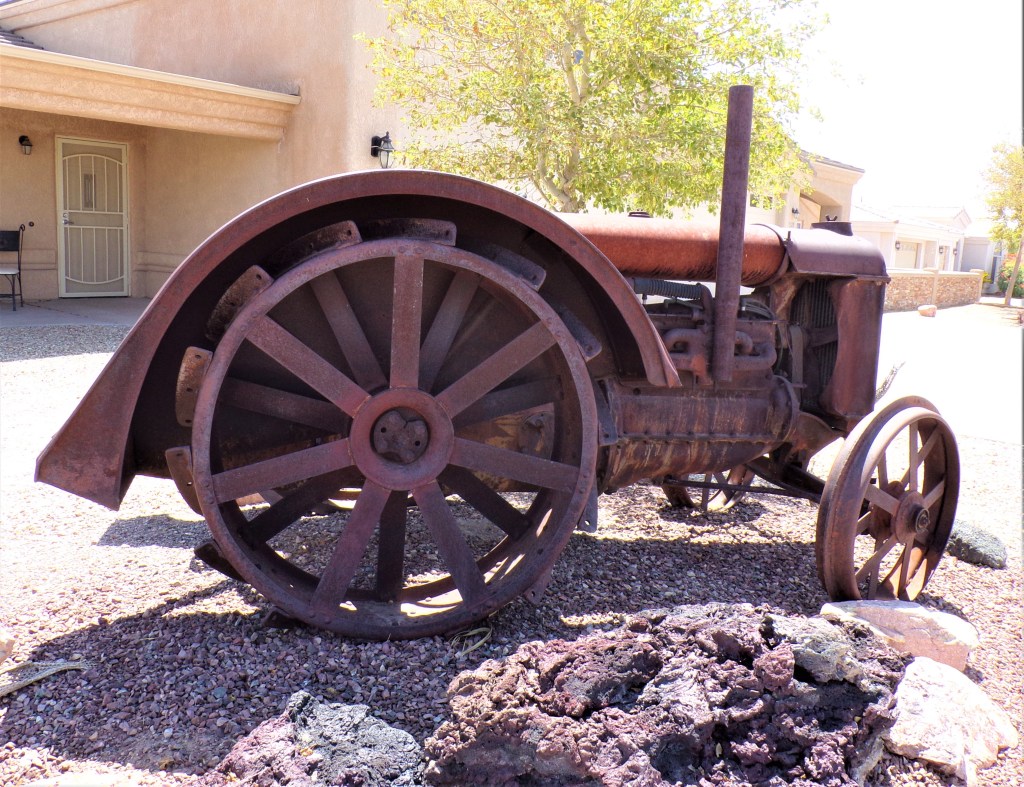
I’ve often wanted to add “yard art” to the front of our home much like that old lawnmower. A gentleman living around the corner has a vintage Fordson tractor parked in his. I love it! Wanting to be original with my project, replicating either mower or tractor is out of the question.
When we lived in Texas there were devices called jack pumps throughout the state. A generic term for them is oil well pumps. All day and night they rocked up and down like giant teeter-totters. I was intrigued by the machinery and still am.
A used oil equipment dealer in Oklahoma has several small ones for sale. Photos show them to be fairly rusty and the rustier the better where patina is concerned.
I’ll hook up a small electric motor to keep the arm moving and make it appear operational, plus install an aged chain link fence. A “Rust in Peace” sign will definitely be part of the package.
So far, the only obstacles I know of are concerned neighbors, city code enforcement officers, and my wife. If I can circumvent those small roadblocks, it’s a done deal.
“Even at that age, I viewed this event more as a carnival side show than anything else, and still do.”
Two-headed-goat
When I was in fifth or sixth grade at Reese Elementary in Lubbock, Texas, students were informed that an Oddities of Nature Show would be stopping by the following day. This would’ve been around 1964. Kids wanting to view the exhibit were told to bring a quarter. I suppose school administrators believed it’d be educational for the children. Undoubtedly, some teachers agreed to things because the show, if you can call it that, was free for them to attend.
We were at recess when the old bus rolled to a stop in a cloud of dust. It had writing painted on both sides like a traveling circus. One large sign stated that a two-headed-goat was onboard. We’d been previously told this by our teacher, and that being the main reason some kids wanted to attend. I was somewhat excited to see a two-headed-snake.
I don’t remember all of the static displays, only a few select ones stick in my mind like sore thumbs. Several classes formed a long line and entered the front of the converted school bus, exiting from the rear. I recall double-headed-snakes, toads, and strange mutated bugs in glass jars. They were floating around in some type of clear liquid, undoubtedly alcohol or embalming fluid. It was a bizarre sight.
None of the animals or insects were still breathing. I had my fill within a couple of minutes and quickly left. Even at that age, I viewed this event more as a carnival side show than anything else, and still do.
After our session was up the vehicle slowly left in another cloud of dust. Having a gravel-parking-lot at the school building, every vehicle coming and going created this pollution. Believing the show was creepy, I was happy to see it gone.
That event left scars on my mind for some time. I wouldn’t remember details if it hadn’t. Some kids claimed that the animals and reptiles had been made to look strange. The two-headed-goat was stuffed by a taxidermist, and a few boys mentioned it as having both heads sewn together.
I never studied the animal up close, yet believe it was authentic. One thing was for sure, those animals and reptiles weren’t normal.
The other day I was in the pool trying to stay cool. It was 118 degrees outside. Mr. Lizard was intently watching me and “Bob” like he always does. This tiny reptile, about the size of my wife’s pinky, takes up residence under one of the decorative pots. Every so often, he’d raise his body to get a better look. I suppose me and Bob were strange sights to him.
Bob is the name Joleen and I gave our blue and white chlorine dispenser. The device is always bobbing up and down and seemingly follows us around the water. When Bob drifts too close to where the decorative pot sits, Mr. Lizard scurries over to investigate.
If only I could take the little guy to Rotary Beach and Bridgewater Channel on a crowded holiday weekend. At times, it’s a festive carnival atmosphere down there, and I’m not talking two-headed-goats and snakes. This show far exceeds the one I saw as a kid on a bus 58 years ago.
Mr. Lizard would definitely get his beady eyes full, having much more things to tell his scaly buddies than mundane stuff about me, Bob, and Joleen.
“Just recently, I came across Gillispie’s dusty bottle sitting on an office shelf and decided to further investigate before relegating it to a packing box.”
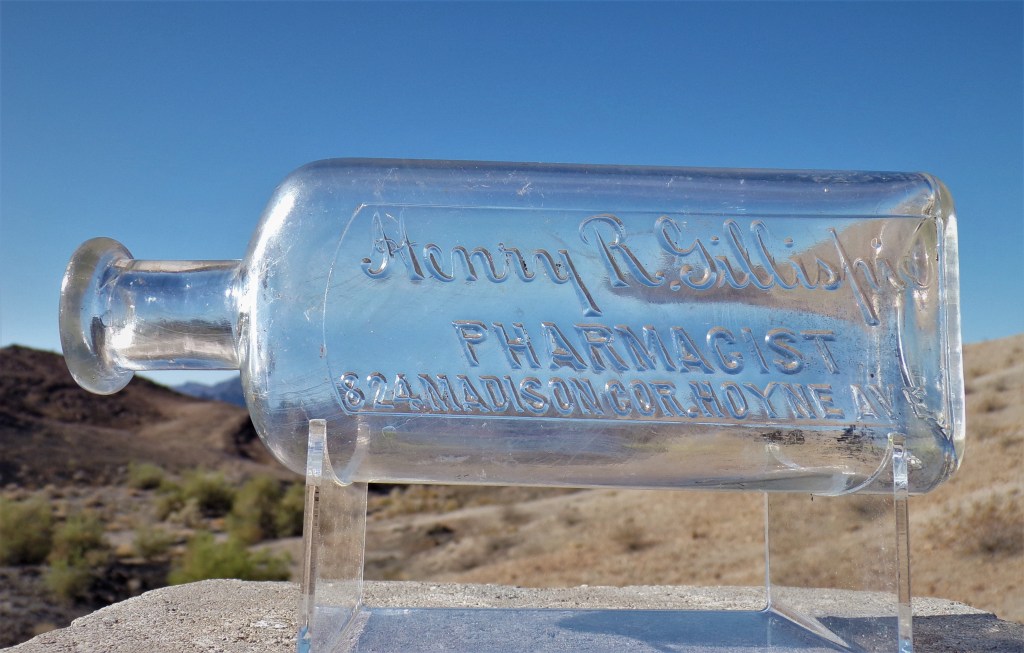
Henry R. Gillispie – Pharmacist
I suppose some folks would question how I can relate an early 1900s Chicago medicine bottle to Hiawatha, the Mohawk Indian Chief, and Hiawatha, Kansas, a beautiful little town named after him. It’s actually quite simple.
I’m a bottle digger and collector. There are probably two hundred bottles in my collection. At one point there were three times that many, but I’ve sold or given away a slew.
One large bottle that I’ve never paid much attention has the following wording embossed on front glass,
HENRY R. GILLISPIE – PHARMACIST – 824 MADISON, COR. HOYNE AVE.
Ten years ago, searching online for that address, I pinpointed it to Chicago, Illinois. Pharmacist bulletins from back then confirmed that Henry R. Gillispie was doing business at this locale from 1901 – 1910. I wasn’t too excited on the discovery, as there were hundreds of druggists in Chicago back then.
Just recently, I came across Gillispie’s dusty bottle sitting on an office shelf and decided to further investigate before relegating it to a packing box. I uncovered quite an interesting story during this research.
Henry Gillispie was born in Hiawatha, Kansas in 1864. Hiawatha, Kansas is named after the famous Indian leader. Henry’s father, Henry Gillispie Sr., was one of the most beloved citizens of the Hiawatha community. Just about everyone addressed him as, Uncle Henry.
In 1886, Henry Gillispie Jr., one of eleven children, was partners with Dr. John Milton Cecil in a Hiawatha drug store, Cecil & Gillispie Drug. Young Henry Gillispie was also a college student in Lawrence at this time.
Gillispie was not a licensed pharmacist and was working alongside Dr. Cecil to learn the trade. In 1888, Dr. J.M. Cecil and Henry Gillispie sold their business, with the doctor first moving to Hays City, KS., and then heading back to his ranch in Muscotah, KS. He continued to practice medicine in Reserve and Muscotah even with a bad heart.
Henry Gillispie completed his studies at Kansas State University; academically being first in his class. Gillispie then ventured to Pennsylvania to finish up his education at Philadelphia College of Pharmacy. He had the highest honors at this university as well.
By 1900, Henry Gillispie Jr. was managing a store in Chicago, and records show that in 1901, he had his own pharmacy, Henry R. Gillispie Drug.
Sadly, Henry contracted tuberculosis and passed away in 1910, at the age of 46, leaving behind a wife and young child. His father accompanied the body back to Hiawatha from Chicago, where it was taken to Reserve for burial. Henry Gillespie Sr. died two years later in 1912. They’re buried in the same cemetery.
Dr. John Milton Cecil died in 1904 and his remains are interned in Hiawatha.
“Doctors were writing prescriptions for whisky, rum, and other liquors and they were being filled Sundays, contrary to blue laws in effect.”
Gunn Drug Company
I’ve always said that some antique bottles have a story to tell. You have to initiate research in order to get them to speak.
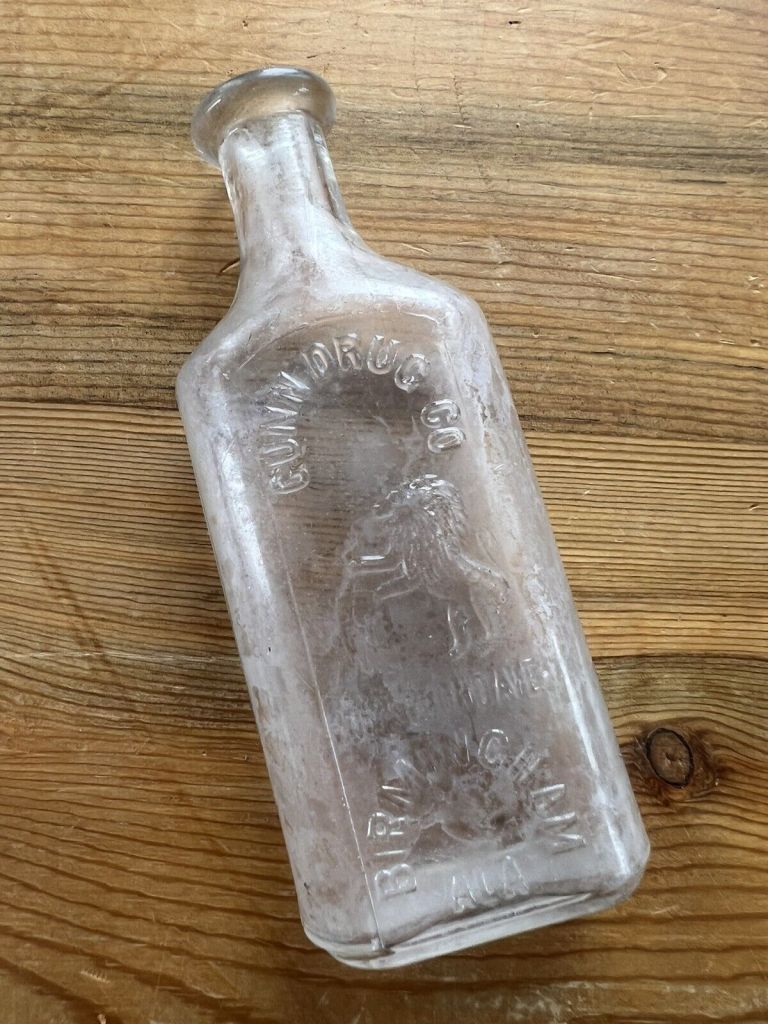
An early 1900’s GUNN DRUG COMPANY bottle that’s been in my possession for years is a prime example. The embossed logo on front indicates this firm was in Birmingham, Alabama and located at 2017 2nd Avenue. That’s an easy start for priming the information pump.
The bottle was dug, and I’ve yet to take time to clean or tumble it. Tumbling is a process, where a bottle’s placed in a machine that uses polishing compound to remove stains and small imperfections such as scratches.
Dr. W.R. Gunn’s name is first mentioned in a Birmingham newspaper in 1894. He was elected to a seat on a Democrat political committee that year.
GUNN DRUG COMPANY began life around 1902. The gentleman would’ve been 32.
In 1905, the front of his building at 2017 2nd. Avenue collapsed. Three women standing nearby were not hurt.
1905 article
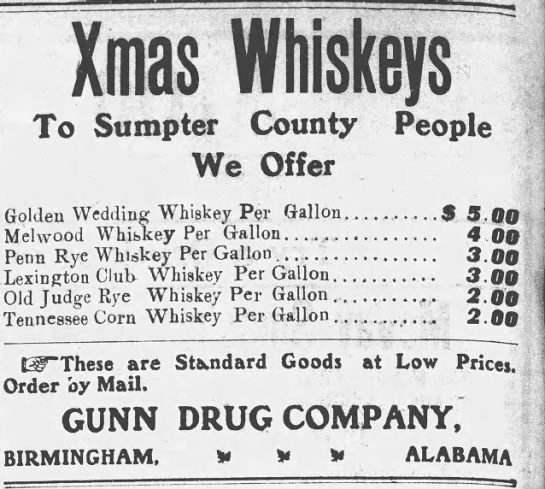
In 1906, Dr. Gunn touted the virtues of a magical elixir called, Warner’s Safe Cure. He claimed that the liquid could cure most all ills. Of course, this wonder medicine was sold in his store along with other alcohol-based products.
Two additional drug stores were purchased by him in 1910.
On September 19, 1911, Dr. William Robert Gunn applied for a liquor license. This is most interesting because Gunn Drug Company was selling alcohol from day one, both through the mail and in his stores. City authorities had come down hard on him about this time, including other drug store owners, for selling booze on Sundays. Doctors were writing prescriptions for whisky, rum, and other liquors and they were being filled Sundays, contrary to blue laws in effect.
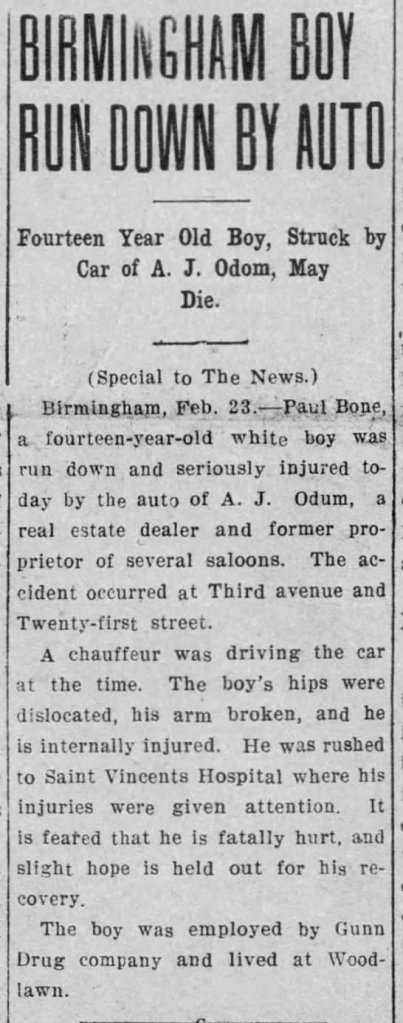
An employee of his, 14 year old Paul Bone, was run down by a car driven by a former saloon owner in 1912 and nearly killed while making deliveries. Newspaper accounts mentioned that he might not live.
1912 article
In 1913, Dr. Gunn moved his original store to 4th. Street and 3rd. Avenue. This locale was in a new building considered quite upscale for the time.
Paul Bone survived his accident and had one of his own. He hit an African American woman on a motorcycle in 1914, killing her. Manslaughter charges were filed against the youngster.
1914
The first World War was going on at this time, and somehow Paul Bone ended up serving his time over there instead of behind bars. Records show he returned home safely and was a respected citizen in Attalla, Alabama, dying there in 1976.
Reorganization paper were filed for Gunn Drug Company in 1915 and by 1916 the businesses was bankrupt. Evidently, Dr. Gunn had overextended himself.
I found no mention of Gunn Drug Company being reopened in Birmingham after the bankruptcy. W.R. Gunn tried his hand at selling real estate after that but it was short lived.
In all of my research, I never found where William Robert Gunn Sr. was an actual doctor. An obituary stated that he was a retired druggist at his death.
1935 obituary
The medicine bottle that I own is quite rare, in that Dr. Gunn’s store was only at 2017 2nd. Avenue for a brief time. Later bottles would have the new address. Now that I know the history this specimen, it will be properly cleaned and tumbled. This never to be published story will be printed off and then attached to it before packing away for posterity’s sake.
Different variation of Gunn Drug Company bottle that sold for $189.00 in 2021.
“Totally unlike Patches’ hurt in the song, my pain lay in different areas.”
A Grammy award winning song called, Patches, came out in 1970 sung by blind musician, Clarence Carter. It tells the tearful story of a poor black boy that was forced to provide for family after his father passed away. I love the words to this wonderful tune, and Carter’s soulful voice makes things come alive.
I was born and raised down in Alabama On a farm way back up in the woods I was so ragged that folks used to call me Patches Papa used to tease me about it ‘Cause deep down inside he was hurt ‘Cause he’d done all he could
Patches was the oldest child, and thus it was expected of him by a dying father to help support his mother and younger siblings. The ending of the ballad lets listeners know that the young man was successful.
The beginning lines mention that Patches came by his name because of tattered clothing. His folks were evidently so poor that they couldn’t afford new ones. When holes appeared, cloth patches were sewn over them. He didn’t openly complain about his nickname, yet his father disliked it, feeling bad that he hadn’t better provided for the family. I can relate to the ripped clothing part of this tale only.
My brother and I sported patches on our jeans and shirts during school years. Mom would sew up the torn elbow area in shirts, and when knees started showing through blue jeans, she’d do the same there. Somewhere during the 1960s, iron-on patches became available. Totally unlike Patches’ hurt in the song, my pain lay in different areas.
Mom’s iron-on patches were so stiff and coarse, they rubbed and chaffed my hide to the point of bleeding. She ironed them to the inside of the fabric which was like putting sticker briars down there. Patches, in Clarence Carter’s song can be thankful he didn’t have to endure this misery!
Mom tried softening those patches to no avail. She might as well have glued sandpaper to cloth. It got so bad that I’d go to the school restroom and stuff paper towels or toilet paper between patch and skin. Sitting in a classroom and being tormented like this may be one reason that my grades suffered.
This torture lasted for perhaps 10 years. There came a point when I started wearing corduroy jeans, and thankfully no patch material was available for them. By then, my folks were better at making ends meet and new clothing was no big problem.
My life was not nearly as traumatic as that poor kid in the song. I never had to work the fields or chop wood like the lyrics mention him doing. On the other hand, he didn’t have to suffer the pain of swinging or playing games at recess with an emery board rubbing against knees and elbows. It was a torture that I’ll never forget!
Just recently, my wife mentioned that she could repair several pair of my jean shorts with patches where the crotch and back pockets had worn through.
Hearing such, I quickly rounded up these items and disposed of them at the bottom of a large trash receptacle. Just the thought of what she wanted to do injected fear into my whole body.
I know Joleen’s intentions were frugal and good, but she didn’t have a clue what damage her patch job would do to delicate areas. Patches and I know, and we ain’t goin’ there!
“The glory of such an accomplishment was easily visualized by me.”
Forty years ago, I was secretly writing poetry at night or at least trying to. Somewhere during this time, I came across an entry form for a poetry contest. I believe it was stuck in some women’s magazine that my wife subscribed to.
Winners were promised that their poems would be printed in a glitzy, hard-cover book of, Upcoming American Poets, or something to that effect. I no longer remember the exact title. The glory of such an accomplishment was easily visualized by me.
Mailing in what I thought were three of my best works, a month went by before a letter came back saying all were accepted. I’d just become a Poet Laurette in my own mind. The reply stated that each book was $25.00, and that I’d want to purchase several for family and friends.
“Of course, I would!”
Instantly, I thought of eight names. Sending them each a book would prove that I’d finally made something of myself. Dad and Mom would be proud of their son and my wife would have something to brag about. They say pride goeth before fall and this became a prime example.
Sending in payment for $200.00 plus shipping, my check was deposited as soon as the company got it. The publishing firm seemed legit and was in Detroit, Michigan. From that point on I sat back and eagerly waited. I was told in the letter that it’d take a year before any books were printed and shipped out. I made sure to tell all of my family and friends about the accomplishment.
After a year passed, I tried contacting the firm finding it didn’t exist. The address I’d mailed everything to was a P.O. Box and no longer valid. A Michigan based phone number was disconnected as well. Postal authorities eventually got involved, saying I wasn’t the only one scammed. More than two-thousand wannabe poets had been lassoed by these con artists to the tune of hundreds of thousands of dollars.
After being informed by a postal investigator that every poem submitted to the fraudulent outfit was accepted, my once inflated ego lost all air. Poetry starting with roses are red, violets are blue, evidently made the cut.
I kept my lips closed for months about being duped because it was embarrassing. Eventually, seeing the humor in such, I fessed up.
There’s an old saying that fits things just perfectly here:
“Fool me once, shame on thee!
Fool me twice, shame on me!”
I’m pleased to say I learned after this first time and it’s never happened again. I’ve had similar offers since then, and passed them by like long-haired hitchhikers on a desolate stretch of highway.
Dad always preached that if it sounds too good to be true, it probably is. Sadly, I didn’t quite get the message some forty years ago. In spite of this costly experience I still consider myself a poet, yet don’t go around advertising such.
“Simple logic tells me that the meals I’m consuming are actually healthier than those from 1865.”
Fried bologna
I ate a slew of bologna sandwiches while growing up. They had a unique smell after sitting in a lunchbox or brown paper sack. It was a much different aroma than that of a peanut butter & jelly sandwich. Both versions were quite tasty by noontime. Lunch hour of course varied at different schools.
Fried bologna sandwiches were my favorite. The hardest part on making them was trying to keep the bologna flat in a frying pan. It wanted to rise up like a meat balloon.
My brother, Jim, sectioned a slice of bologna with his fork into four pieces, with this method preventing bologna bloating as we liked to call it. I preferred mine intact and devised a way to make sure it was completely fried on both sides.
Initially, I’d stand there with a fork and push the meat down, but that got to be tiresome. Being creative, I found that you could take a large spatula and sit it on top of things. That did the job effortlessly.
I ate bologna sandwiches up until my mid-adult-years. At that point, someone told me they were bad for my health.
“That stuff will kill you!” a friend claimed.
The number two line repeatedly preached was,
“That stuff will plug your arteries!”
I didn’t want to die an early death, so I quit eating bologna sandwiches cold turkey after receiving this bad news. A friend insists that hotdogs are the worst out of all processed meats. Never mind that family and friends supplying me this information have zero nutrition or medical backgrounds.
They most likely got their knowledge from self-described experts on television and magazines. You’ve seen those medical entrepreneurs. They’re the sharply dressed men and women hawking pills, creams, and books, all having Dr. in front of their name.
Vienna Sausages and Armour Potted Meat were favorite snacks when placed between Ritz crackers. Too many horror stories about what was actually in the stuff drove me away from it.
Since that time, I’ve been advised that diet pop’s bad for you including regular soda. It came a little late. I recently did some math ciphering with a SONY calculator finding that I’ve drank 3,000 gallons of both, give or take a gallon.
More than one individual I’ve bumped into fired off the following warning,
“Sugar is what cancer thrives on!”
So much for Coco Puffs in the morning. I loved this cereal, and especially liked drinking the bowl of chocolate milk afterwards. It was a quick breakfast and one that sent me blasting off to work.
These days my wife and I spend more time eating chicken and salad than anything. It’s supposed to be a healthy alternative. Sometimes we mix the two together just to be creative. Squirting on ample salad dressing can spice things up. Thousand Island is my favorite because it adds a touch of upscale restaurant flavor.
Recently, I read where bagged salad using Romaine lettuce from another country was laced with e-coli bacteria. I can’t mention this country’s name because the article didn’t provide it. They merely used the word, “imported.” I’m thinking that balsamic vinaigrette would be a better choice dressing here over Thousand Island or Ranch.
I did some online research finding that men in 1865 had a life expectancy of 40.1 years. Folks in 1865 were eating fruits and vegetables raised without unnatural fertilizers and pesticides. Meat was uncured, coming from animals that hadn’t been pumped full of hormones. Most all food back then was natural in origin. I believe the buzz word now is, organic.
Supposedly, certain food items today, compared to those back then, are not as healthy because of all the added junk. The life expectancy for a male in 2022 is 76.6 years. Simple logic tells me that the meals I’m consuming are actually healthier than those from 1865.
Countless armchair experts will testify that longer life expectancy is due solely to better medical technology. On the other hand, these are the same folks telling me that medical and big pharma are out to get us, financially speaking. Some go so far as to say, doctors don’t want to find a cure for cancer because of all the money being made. Really?
Using their flawed philosophy, I’d say that increased life expectancy is derived from one thing alone: preservatives. A can of Spam has lots of preservatives. There’s no expiration date on Spam, only a best used by label.
If we can figure out how to place Spam preservatives into some kind of pill or liquid, expiration for humans will be a thing of the past. I can see some slick-talking salesperson making a killing off that brilliant idea.
Of course, it’ll be a sharply dressed man or woman with Dr. in front of their name!