FLORENCE PATRICE’S HAND

“Valdez has changed considerably since this postcard was made.”

Valdez, Alaska street scene – circa 1915

Researching Valdez, Alaska, during its early years, I came across an old postcard showing a street scene, which I believe to be either early morning or late at night, during the summer when the sun hardly goes down. Enlarging the picture, I was able to count only 4 people walking on the boardwalks in front of businesses.

My mother had a saying that fits this picture well. “They roll the sidewalks in at night!” As a kid, I didn’t know the meaning until I finally asked her. Mom’s reply was that after 6 o’clock, activity in small towns all but dies as the people seemingly disappear. She was talking about small towns in Alabama, not Alaska, as this postcard depicts, yet I suppose the same principle applied anywhere.

This vintage postcard was mailed from Ketchikan, Alaska, to a J.E. Steyer in Westminster, Maryland. It’s postmarked February 19, 1915. On the correspondence line, the following was written nicely in cursive:

“This is a street scene in Valdez Alaska

Florence Mercer

PO Box 127

Ketchikan, Alaska”

I researched Florence Mercer, finding she was the daughter of Anson Cary Mercer and Myrtle May Mercer. Florence Patrice was born in Spokane, Washington, on January 20, 1900. She lived in Ketchikan for a while, including Juneau, where she attended school. The young lady would’ve only been 15 when she mailed her postcard off.

In 1919, at the age of 19, Florence married George Francis Forrest Jr. Her spouse’s father, George Francis Forrest Sr., was one of early-day Juneau’s movers and shakers, being involved in many business endeavors as well as local politics.

The elder Mr. Forrest eventually sold all business interests in Alaska, relocating to Seattle, where he had a new business going there. His son and daughter-in-law eventually followed.

Unfortunately, not long after moving, the elder Forrest died of a heart attack at the age of 56, on July 31, 1925. His death certificate says that the cause was acute indigestion, but the man was known to have serious heart trouble.

George Francis Forrest Jr. evidently didn’t have the business savvy of his dad, not taking over where the old man left off. The younger son worked as a stevedore at the Seattle docks until retirement. Florence Patrice Forrest died in 1954, with her husband passing 2 years later in 1956.

Valdez has changed considerably since this postcard was made. The Good Friday, March 27, 1964, earthquake all but destroyed Old Town Valdez. My family visited in 1967, still able to see the massive destruction. The city was rebuilt in another location.

The memory of Florence Mercer still lives on courtesy of this postcard and my research. As to the recipient of the card, J.E. Steyer of Westminster, Maryland, there are too many possibilities to pin any one person down here. I guess it’d be safe for me to say—J.E. is the young man who didn’t get Florence Patrice Mercer’s hand.

CLAY CENTER SPINSTER?

“That may be a good reason she never married.”

I came across an old picture postcard from Norton, Kansas, that had me giving it a second look. The photo on the front of the card shows the largest assemblage of horse-drawn buggies that I’ve ever seen. Today, one might think it’s a meeting of the Amish or Mennonites, or perhaps an early Amway convention.

Norton, Kansas, was founded in 1872 by a man named N.H. Billings. The town name came from Captain Orloff Norton, who was in Company L – 15th Regiment- Kansas Volunteer Cavalry. Captain Norton was killed at Cave Hill, Arkansas, in 1864. Today, it is a laid-back community of approximately 1,700 residents.

The only explanation for the mass group of carriages is a printed caption on the front, which reads: “A busy day, Norton, KS, photo by Reed.” That information tells me little. After conducting some research based on the sender of the card, I concluded that it was a religious gathering of a large proportion, as Amway wasn’t founded until 1959.

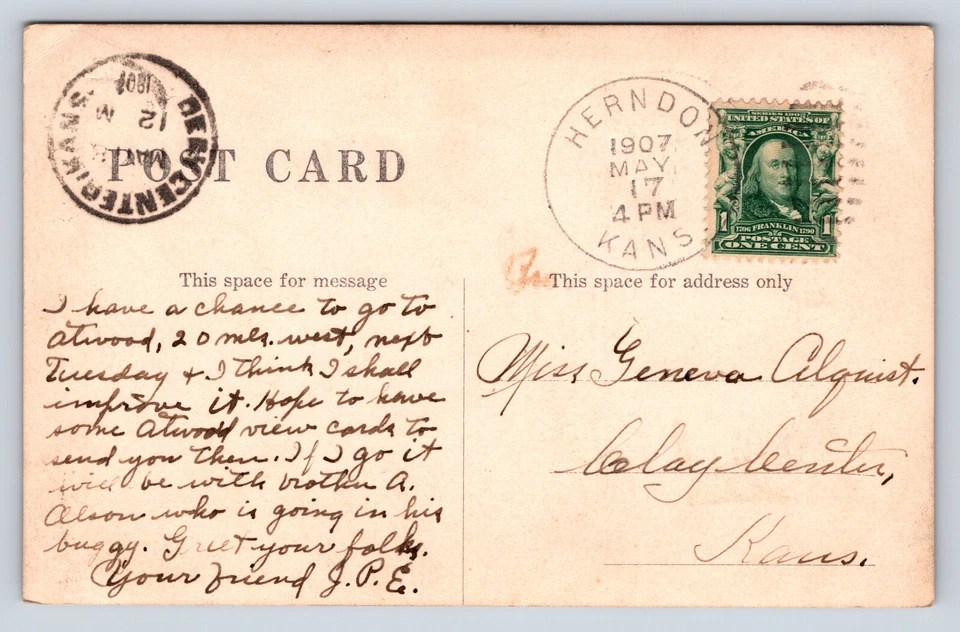
What’s even more intriguing is that both sides of the postcard were written on with double postmarks, one from Herndon, Kansas, and the other from Clay Center.

Backside of the card is addressed to:

 Miss Geneva Alquist

 Clay Center Kansas

The Clay Center postmark is 12 AM, May 12, 1907, while the Clay Center is 4 PM, May 17 of the same year. The correspondence section of the card reads without grammar correction:

“I have a chance to go to Atwood 20 miles west next Tuesday + I think I shall improve it. Hope to have some Atwood view cards to send you there. If I go it will be with brother A Alson who is going in his buggy. Greet your folks. Your friend J.P.E.

The front reads as follows, on top of the photograph, with the handwriting being the same as the flipside:

“Dear friend, Your card received. Thanks. I was very much pleased with the papers. I appreciate your thoughtfulness. I’ve been out for an eight mile drive this afternoon to see a very sick man. He is not a Baptist but said that he is prepared to die. I thank god for this.  Have now been here a week and haven’t had a touch of lonesomeness yet. That’s doing fine isn’t it?”

Carla Geneva Alquist was born in Kansas on September 13, 1882. Her parents had come to the area from Sweden, belonging to the Swedish Baptist Church, as did their daughter and three sons. The family owned Alquist’s Grocery in Clay Center; thus, they were well-to-do. Two of the sons were businessmen, while another became a dentist.

Miss Geneva Alquist was heavily involved in the ministry at an early age, with newspaper reports of her attending youth church meetings in towns throughout Kansas. There are 1,559 newspaper entries for her from 1891 all the way up until she died in 1965. She was a church women’s organizer while also holding down various bookkeeping jobs for various firms.

Geneva Alquist was a staunch supporter of the American Women’s League and undoubtedly suffered much flak from the opposite sex for doing so. That may be a good reason she never married. There are other valid explanations why, yet this one seems most plausible to me.

The American Women’s League pushed for areas of equality for women, especially where women’s suffrage was concerned, as well as having a strong political voice. Miss Alquist attended quite a few political meetings, judging by the many newspaper accounts of such with her name attached.

Records show that she lived with her parents until their deaths, with some folks undoubtedly negatively calling her a spinster behind her back. Was she actually a spinster or a soft-spoken Carrie Nation?

After reading about her involvement in religious, community, and national policies, I believe she was a woman of independence, with strong opinions and a calling from God. She seems to have had a drive for her cause much on the same level as Mother Theresa.

I found no plaque or statue in Clay Center for Miss Geneva Alquist’s contributions to the city, yet she wouldn’t have expected this. Geneva was justly rewarded when she got to Heaven in 1965, having spent 83 years as a voice for women in Clay Center.

So who was the mystery writer of the card, a person with the initials J.P.E.? They made absolutely sure that they acknowledged Miss Alquist in a friendly, yet serious, religious tone.

After much research, I came to the conclusion it could have only been Reverend John P. Endacott Jr. He’d come to Clay Center during this time as a minister with his wife, Ellen, both from England, preaching at other churches throughout the state until retiring and then passing away in 1934 at age 69. Mystery solved!

LAKE HAVASU CITY – 1970

“Regardless of no such amenities, the Smiths indicated they loved this place.”

Lake Havasu City isn’t an old community by any means, yet there were postcards mailed from here that are now over 50 years old. I came across a vintage one the other day, sent on August 22, 1970. We’re fast approaching the 55th anniversary of it leaving town.

The colorful picture postcard shows several boats fueling up at a “Site 6” Lake Havasu dock, with another one just leaving. It looks like a small convenience store is also located there.

A large van with the word ICE emblazoned in large letters on the side sits in the background with what appears to be a Karmen Ghia Volkswagen parked in front of it. Being a bit facetious here, I didn’t spot any federal agents standing outside with masks. Some of you will get the pun, if it can be called that.

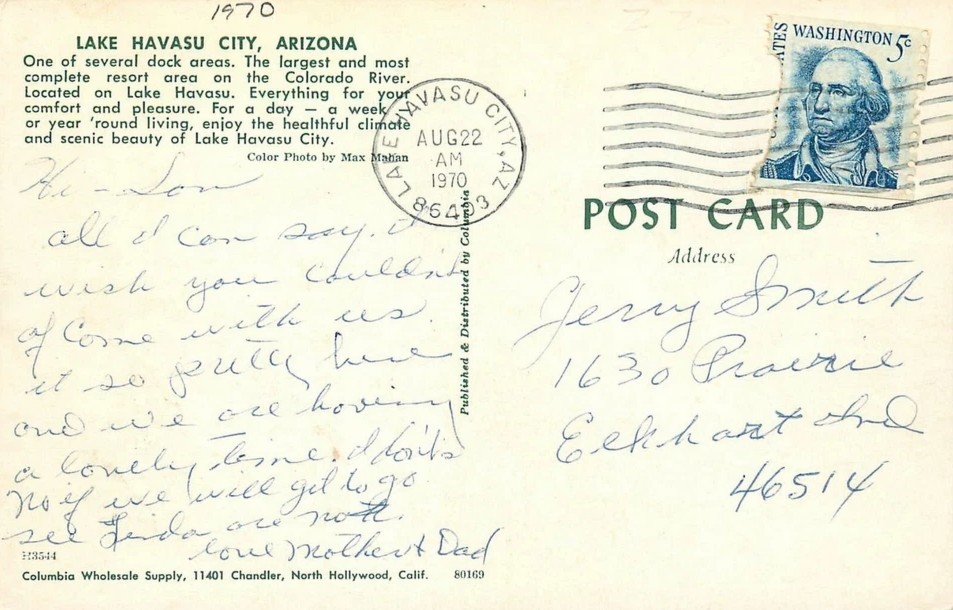
The postcard I mentioned was sent to Jerry Smith at 1630 Prairie in Elkhart, Indiana. A stamp was only a nickel back then. It was mailed by his parents with a short note written in ink. I’ve left the language exactly as it is with no corrections. Look closely and you’ll see some humor in the wording. I’m sure it wasn’t intentional.

“Hi Son – All I can say I wish you couldn’t have come with us. It is so pretty here and we are having a lovely time. I don’t no if we will get to see Linda or not. love Mother & Dad”

The Smiths passed through town just as the London Bridge was being finished. There were no Shugrues or Mudshark Pizza at that time, nor Holiday Inn Express. The closest McDonald’s was in Phoenix. Regardless of limited amenities, the Smiths indicated they loved this place.

I researched the couple, and it was Jerry Garnett Smith Jr. and his wife Irene Margaret Smith who visited LHC. They were impressed with the scenery, as most people are, and it piqued my curiosity to see if they might’ve eventually relocated to our city like so many snowbirds do.

Research shows they remained in Indiana, as did their 18-year-old boy, at that time, Jerry G. Smith III. Sadly, all three of the Smiths have since passed away, with their son succumbing to cancer in 2022. He was a year older than me.

When my wife and I first began visiting Havasu, we purchased a few pieces of property from those folks who had flown here on one of Robert McCulloch Sr’s free flights. These people had plans to build their dream homes, yet things never materialized.

Selling their prized lots to us, with them holding the note, a couple of older sellers passed away before we paid things off and obtained the titles. Our monthly payments then went to beneficiaries.

Rotary Park is loaded with memorials to these “early visitors,” and I often take time while walking through to read their plaques. It’s sobering to see so many, knowing that someday Joleen and I will be joining them.

With no way to stop time, realizing that we’ll be leaving paradise for an even grander place, this knowledge always puts my mind at rest.

BOGUS STUFF

“He sounded above board, at least for a few minutes.”

The Cardiff Giant

My wife and I sat down the other evening and came across a YouTube video titled, “17 Miners Vanished – The Truth No One Wanted Told.” Further explanation went on to claim, “In 1962, 17 miners walked into the Blackwater coal mine and never came back. The official report said that it was an accident.”

This headline was written strongly enough to draw us in, with the person doing the storytelling supposedly a sheriff in some rural West Virginia town. Sheriff Danny Morrison sounded above board, at least for a few minutes.

The fellow, in an authoritative voice, said that he’d always wanted to dig into the mine disaster, because he had suspicions that there was more to the tale than what he’d been told. Continuing on, he mentioned that while doing research on the accident, he discovered that there was a cover-up.

The miners hadn’t been in an explosion—they’d been murdered! At this point, I told Joleen that this video was BS. “Really?” she replied. Before I go further, my meaning of the acronym BS is bogus stuff and not cowpies, as most would think.

For someone who didn’t look into how this could’ve happened, which I immediately did, they might’ve sat there and come away misinformed. I had it pegged as make-believe when he told viewers that the miners’ families were paid $5000 each by the Blackwater Mining Company as compensation. Going online, I found nothing about 17 miners losing their lives in 1962. The only site that relayed such news was YouTube.

Just for grins, we continued watching until the end. It turned out that Sheriff Morrison’s grandfather had been one of those killed. He, along with 16 others, had been murdered by government henchmen because they saw that there was something far more valuable in that hole besides coal. I won’t tell the ending because, for those wanting to watch the whole video, the entertainment value alone is worth the wasted time.

I’m a skeptic of things seen on television. The other day, a fellow was hawking a device the size of a briefcase that he claimed could cool down a sizable room. Supposedly, the inventors were former NASA engineers who’d come across the idea during their research. I told my wife, “Ching ching!” using that saying quite often to highlight bogus stuff. It’s the sound of coins dropping into a cash register.

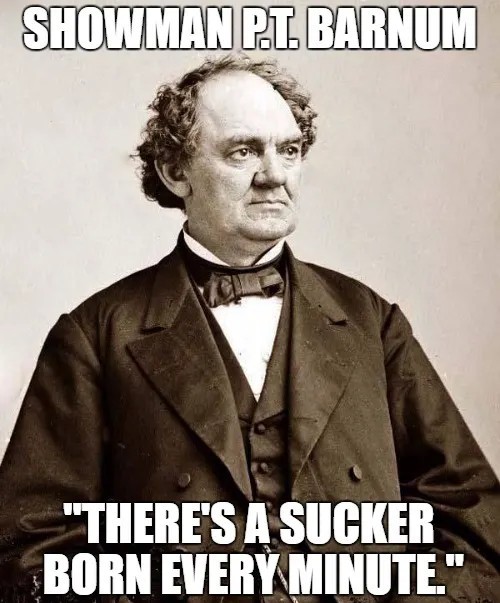
There are many such advertisements, designed to lure in suckers and lighten up their purses and wallets. P.T. Barnum had a description for these folks, claiming that, “A sucker is born every minute.” While many folks believe P.T. Barnum coined the popular phrase, Professor Nicholas DiFonzo of the Rochester Institute of Technology says that it was a cigar manufacturer named David Hannum.

In 1869, the clever Mr. Hannum took a large block of coal and chiseled the petrified corpse of a 10-foot giant man from it. His creation was named, Cardiff Giant, and it was so realistic that folks bought into the hoax. Things haven’t changed in this arena, as there are people out there believing those infomercials claiming that a certain facial cream will erase wrinkles.

I’m perhaps the world’s biggest skeptic about most anything I see on mainstream media. Much of what they say is nothing more than hot air. Sharks are operating within these organizations with one primary motive: to mislead and sway the public with biased reporting and inaccurate facts. For that reason alone, I don’t believe everything I read on Wikipedia or Snopes either.

These two think tanks have been proven to be polluted with leftist philosophy. Even the co-creator of Wikipedia, Larry Sanger, claims that his site has become a propaganda platform for the “left-leaning” establishment and can no longer be trusted. I believe Sanger because I’ve seen this with my own two eyes.

My good friend Jeff Thimsen’s dad, Dean, used a saying that I haven’t forgotten. It’s helped me more than once to wind my way through all of the misinformation and lies out there, “If it sounds too good to be true, it probably is!”

Dean Thimsen had a lot of good advice back then; only Jeff and I were teenagers, believing that we knew much more than our parents. It wasn’t until we became much older that we recognized their wisdom.

SEARCHLIGHT, NEVADA

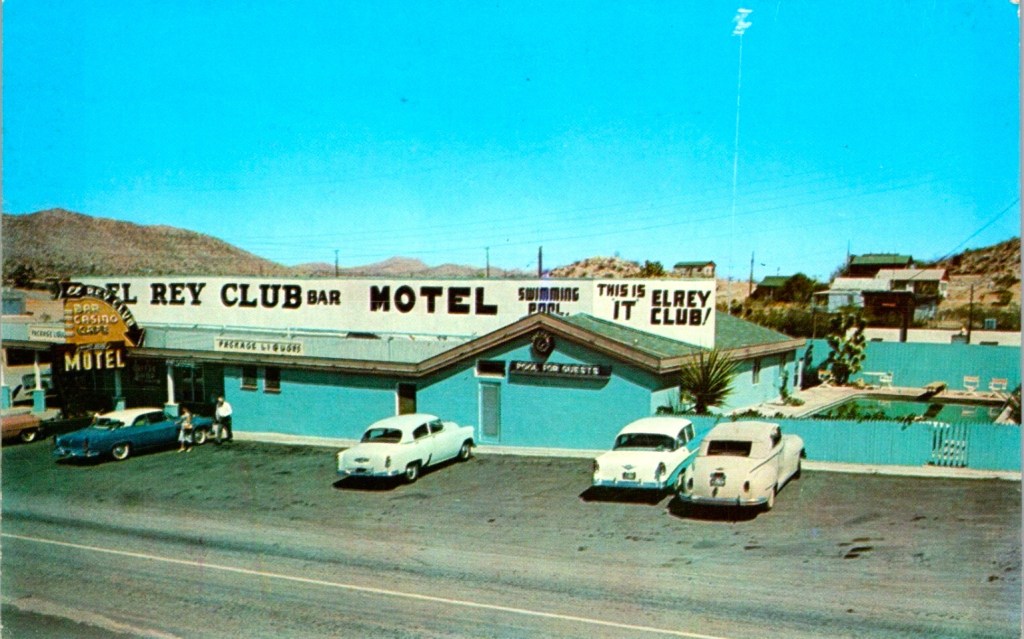
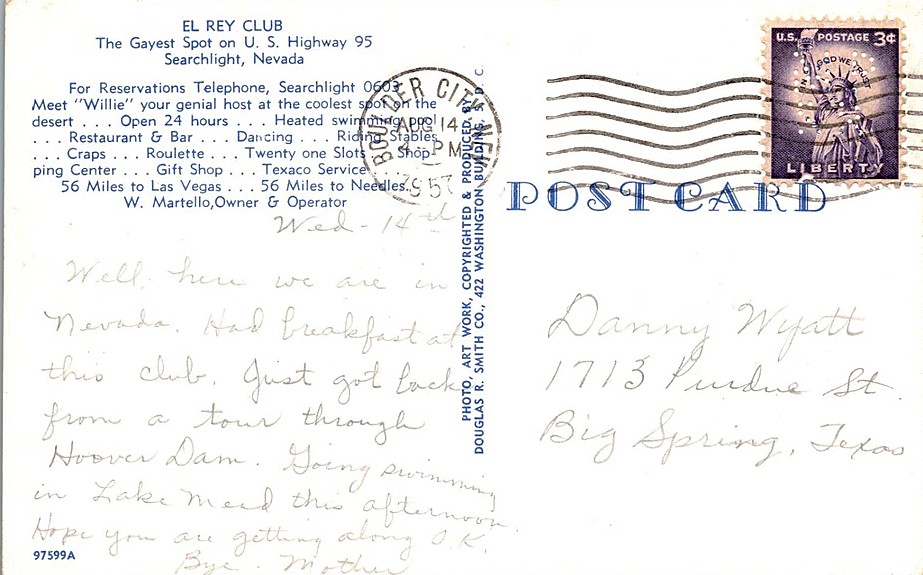
“When Lenora Wyatt wrote her 21-year-old son, Danny, on a picture postcard purchased from Searchlight on April 14, 1957, she didn’t tell him that the club where they ate that morning was also a brothel.”

Willie Martello’s El Rey Club

Searchlight, Nevada, has a wild and crazy reputation. It was founded as a mining town in 1897, after miner George Colton discovered a vast amount of gold there. By 1907, 5,000 people were reported living in the area.

Respectable businesses were thriving, with women of ill repute quickly setting up shop, along with shady characters of all kinds trying to cash in on the action. Crime, as it always is with boom towns, was close at hand.

When a massive flood destroyed the railroad to Searchlight and gold and silver ceased to be pulled from the ground, by 1927, only 50 people still resided there. It was as close to being a ghost town as it could get.

When Lenora Wyatt wrote her 21-year-old son, Danny, on April 14, 1957, a short note on a picture postcard purchased from Searchlight, she didn’t tell him that the club where they ate that morning was also a brothel.

It’s probable, Thornton and Lenora Wyatt didn’t know it, as the El Rey Club in Searchlight, Nevada, owned by William “Willie” Martello, didn’t advertise the fact. Local residents knew, including those desperate men in need of such activity.

Lenora only mentions in the postcard that they dined there, but most likely they also stayed the night unless they were pulling a camper. Searchlight was a good 50 miles from the next closest communities, Boulder City. That’s where the card was mailed.

Whether or not the couple gambled was taken to their graves, but most folks walking through a casino cannot resist the urge to pull a slot machine handle, at least once. I see that on the same gambling level as buying a lotto ticket twice a year.

Willie Martello, a somewhat shady character himself, opened his El Rey Club shortly after World War II, in 1947. It quickly became a success, especially when he started flying people in for free from Las Vegas and Palm Springs.

Entrepreneur Robert McCulloch Sr. used this same marketing tactic in bringing prospective buyers of property to Lake Havasu City. It worked for him because these days, there’s hardly any vacant building lots to be had.

Willie Marcello raised the ire of East Coast mobsters with his gambling establishment, as well as the Nevada Gaming Board. Several complaints of rigged slot machines were reported, and Marcello was investigated for such. Mobsters were said to have harassed Willie Martello on occasion.

Hollywood elite came to Searchlight to gamble and party, with money rolling in hand over fist from the party crowd. This all came to a screeching halt 5 years after the Wyatts visited, when a fire on January 20, 1962, completely destroyed the El Rey Club.

It was rebuilt across the street, but unfortunately, Willie Martell didn’t get to enjoy the gala opening for very long. He died of a heart attack while playing golf on January 3, 1968.

On the positive side of this story, all seems to have turned out well for the Wyatts. Danny Wyatt wed Glenda Rose Batson in 1956, one year before getting his mom’s card. They remained married until he died in 2004.

Glenda passed away in 2024, with her obituary mentioning that she had 5 children, 78 grandchildren, great-grandchildren, and great-great-grandchildren.

As far as the two Wyatt parents visiting Searchlight in 1957, Thornton Wyatt died on March 6, 2004, with Lenora passing away exactly 20 years later on March 6, 2024. The loving couple shares the same month and day, as if God intended things that way.

Searchlight now appears to be booming and is likely to remain that way for a long time. With new asphalt and a widened Highway 95 leading to and from the old mining community, traffic through town is reduced to 25 MPH. On average, I drive this direction three times a year, only stopping at McDonald’s for a Coke and to use their restroom.

For those folks still wanting to gamble, Terrible Herbst has a sizable casino. Food and fuel are also available, including approximately 50 motel rooms to spend the night. Where brothels are concerned, I wouldn’t know.

ANN SANDERS-MYSTERY MAIDEN OF OPHIR, ALASKA

“During my research, I found Patricia Perry to be a professional dancer, while at the same time she owned the Patricia Perry School of Dance.”

Hay bales in Ophir, Alaska

I decided to try my investigative skills on an Alaska ghost town postcard, this vintage piece of paper featuring Ophir, Alaska. Ophir is an old gold mining town that’s now deserted, other than during the summer months.

A few outfits still mine gold in the area, with Ophir offering up the best airstrip for miles around. A friend and I landed there in his Aeronaca back in 2000. I haven’t returned since.

The Iditarod Sled Dog Race goes through Ophir every other year, where the checkpoint is a private cabin formerly belonging to Dick and Audra Forsgren. Their grandson, Kyle, now owns the rustic dwelling. That cabin has changed little since it was first built over 100 years ago.

Ophir was a bustling center of mining activity starting around 1906, but by 1955, things had pretty much come to a grinding halt. The abundant gold found there slowed to a dribble during the last 10 years as miners left for other locales. Because of this, businesses folded from a lack of customers, with imaginary ghosts taking over the dwellings.

The Ophir postcard I’m researching was postmarked on Sunday, March 30, 1941. This post office was permanently closed 16 years later in 1955, with letters and postcards having an Ophir postmark quite desirable amongst collectors.

A picture on the front shows stacks of hay covered with snow, along with an unusual title: Belated Harvest. Hewitt’s Drug Store in Anchorage was the postcard seller. On the back is written:

“Miss Ann Sanders – Ophir, Alaska. Dearest Miss Perry, At last I’ve found time to write to you and give you my address so that you can send me my shoes. Do you remember Barbara Weatherall a former student of yours. I met her brother yesterday. I’ll close hoping this finds you well and happy. Sincerely Ann Sanders Ophir Alaska”

The recipient address is:

Miss Patricia Perry

Textile Tower

Seattle, Wash.

During my research, I found Patricia Perry to be a professional dancer and performer, while at the same time, she owned the Patricia Perry School of Dance. Undoubtedly, those shoes Ann Sanders asked for were fancy dancing shoes. Of all places, Ophir wasn’t a dancing city like Seattle. Ann must have known she wouldn’t remain there long.

Barbara Weatherall went on to wed her high school sweetheart, Ivan Raymond Stafford, in 1957, only to become a widow by 1963. She then married Rick Mason, two years later, in 1965, and they stayed together until she died in 2012. Barbara’s brother, whom Ann mentioned in the letter, was George Weatherall. He has the most significance in Alaska’s mining and transportation history, where this postcard is concerned.

George Weatherman owned a freighting company based in Talkeetna, where he used dog teams, barges, and trucks to transport people and goods to places such as Ophir, Flat, Iditarod, Fairbanks, and other locales. The entrepreneur also had mining claims that he worked on with his son. Ann Sanders must’ve encountered the hard-working man when he passed through Ophir.

Finding out just who Ann Sanders is has been a tough nut to crack and still remains unbroken. She evidently tutored under Patricia Perry, only to move to Ophir soon after. Was she the daughter of a miner, or someone going there to help cook in the mining camp? Unlike other people I’ve searched for, so far, all of my resources have failed me here.

Single women were scarce in Alaska during the early years, with men competing for their hearts. As sexist as this may seem, if Ann could cook and keep a tidy cabin, that was more than enough to woo a lonely miner’s fancy.

When WWII began in 1941, mines throughout the country were ordered to shut down by the US War Production Board, with those mines in Alaska no exception. Many of the men who came to Alaska to work in the field soon left the state, leaving no forwarding address. Ann Sanders seems to fit that mold as well.

I’ll continue searching, believing that other newspapers in Alaska will eventually come online. Right now, there are only a few that are archived for review. Some of those that aren’t, languish in places that need to be personally visited.

For now, Ann Sanders will have to remain the mystery maiden of Ophir, Alaska.

SASCO

“Turning to my AI helpmate for assistance, “Miss Purdy” had things figured out in seconds.”

Arizona ghost towns are perhaps the most celebrated of all, especially in old western movies. I’ve been hooked ever since I saw my first tumbleweed blowing through a deserted main street, always passing in front of an empty saloon. There’s just something ominous about the sound of whistling wind and rolling tumbleweeds on the big screen.

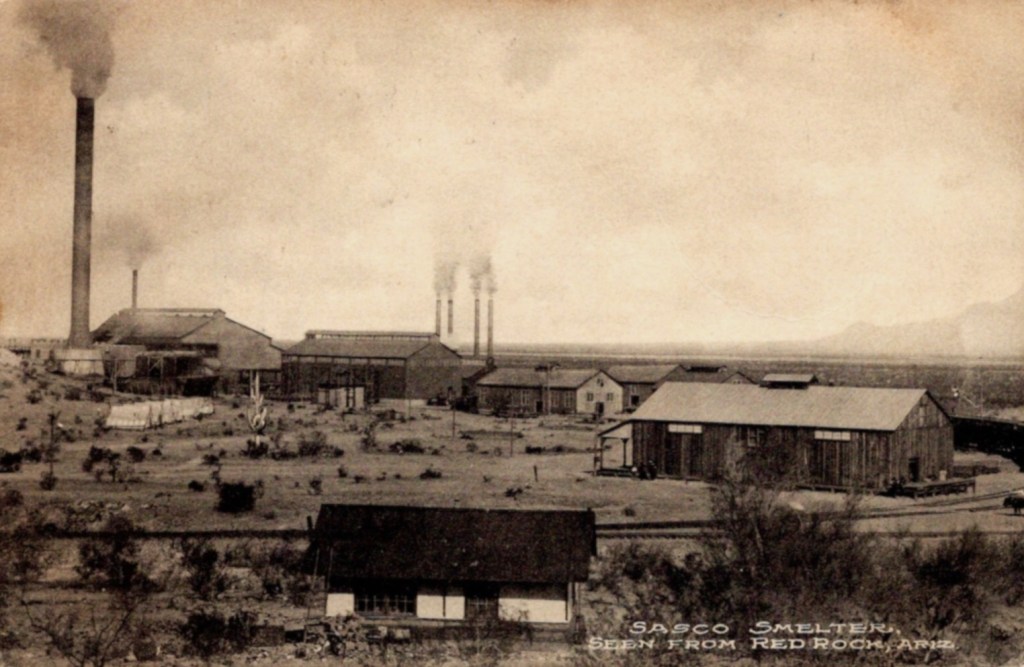
Sasco, Arizona, has its share of tumbleweeds these days. At one time, a thriving town in conjunction with a large smelter operation, designed to process the silver ore from Silver Bell Mine, both places are now reduced to a few crumbling structures sprayed with graffiti. The former town is located 35 miles northwest of Tucson.

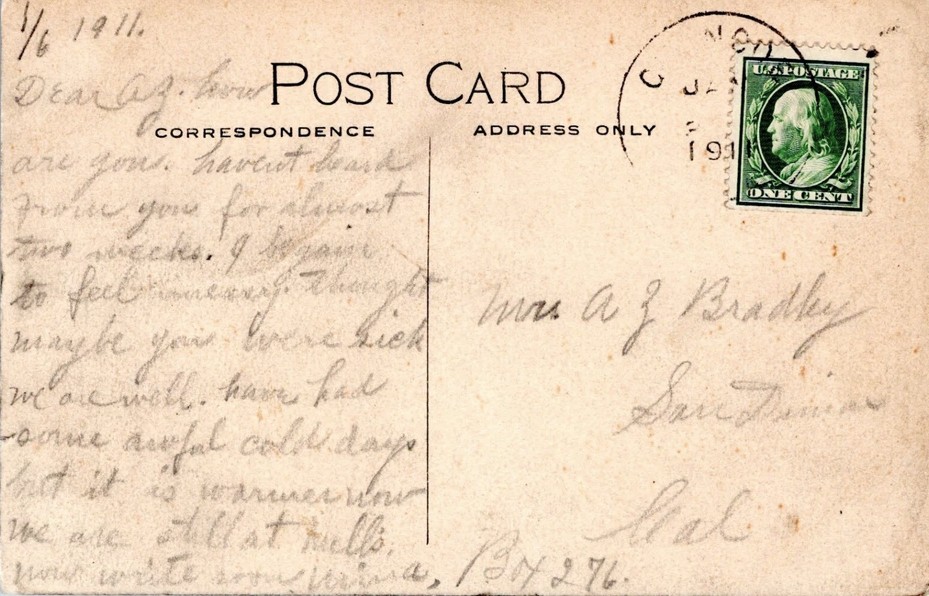
Someone named Mina mailed a postcard with a picture of the Sasco smelter to Mr. A.Z. Bradley in January of 1911. The forwarding address says, A.Z. Bradley. Box 276. San Dimas, Cal. The correspondence was short and inquisitive:

 “Dear Az, How are you. Haven’t heard from you for about two weeks. I began to feel uneasy. Thought maybe you were sick. We are well. Have had some awful cold days but it is warmer now. We are still at Arrell’s. Now write soon. Mina”

The front of this postcard shows a picture of the large silver ore smelter with nomenclature underneath saying: “Sasco Smelter seen from Red Rock, AZ.” Smoke can be seen billowing from six smokestacks. Sasco is an acronym for the Southern Arizona Smelting Company. Sasco was basically a company town with a few stores and a saloon. Red Rock was a short distance away.

The place came to life around 1906, but by 1921, it was deserted. Sadly, the Spanish flu swept through the area in 1918 and 1919, with many people dying. Sasco Cemetery is said to be filled with folks who succumbed to this terrible disease. Ruins of the Hotel Rockland are still visible.

Finding out who Mina and A.Z. Bradley were was quite simple. Both Alfred Z. Bradley and Mina Ellen Honeyman were born in Kansas. The couple married in Payne County, Oklahoma, on December 19, 1900, living in this area for a short time before moving to San Dimas, California. There, they owned a ranch and farm where they had a small dairy, grew cotton, nuts, fruit, and other crops.

The Bradleys had one daughter, Lena. Mina died in 1954, while A.Z. outlived his wife, passing away in 1968. They’re both buried at Hillcrest Cemetery in Porterville, California.

The mystique of this Arizona ghost town postcard lay in where it was mailed. The cancelled postmark contained only three letters that I could make out: G, N, and E. There were gaps between each. I searched for hours through Arizona towns and cities, including those from California, Nevada, and Kansas, finding nothing.

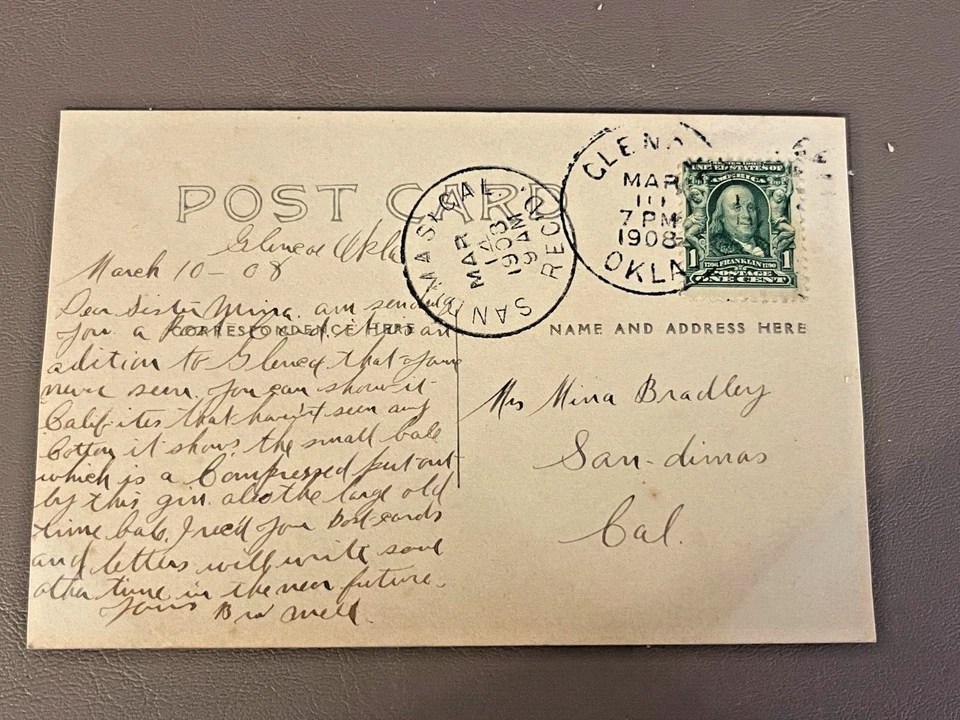
Turning to my AI helpmate for assistance, “Miss Purdy” had things figured out in seconds. Glencoe in Oklahoma fits like a golfing glove, with the farming town located in Payne County, Oklahoma, where the Bradleys were married. They still had family there, and Mina was undoubtedly visiting them.

Ironically, I typed in Glencoe, Oklahoma, and another postcard popped up with the complete Glencoe, Oklahoma, postmark, sent to Mrs. Mina Bradley in San Dimas in 1908, from her brother, Brad Arrell.

I found my research interesting for a couple of reasons. I love Arizona ghost towns, and we have a well-known Bradley family living right here in Lake Havasu City. It makes me wonder if perhaps the two families aren’t related. That research, I’ll leave for someone else to perform.

SAYER SPRINGS

“On August 11, 1909, a shotgun that George used for protection accidentally discharged, killing him.”

I’ve been on an Arizona ghost town tangent here lately, and was given another assignment related to such. For those who are up to speed on my ghost town writings, I take vintage postcards mailed from these places and attempt to identify who the sender was, as well as the recipient.

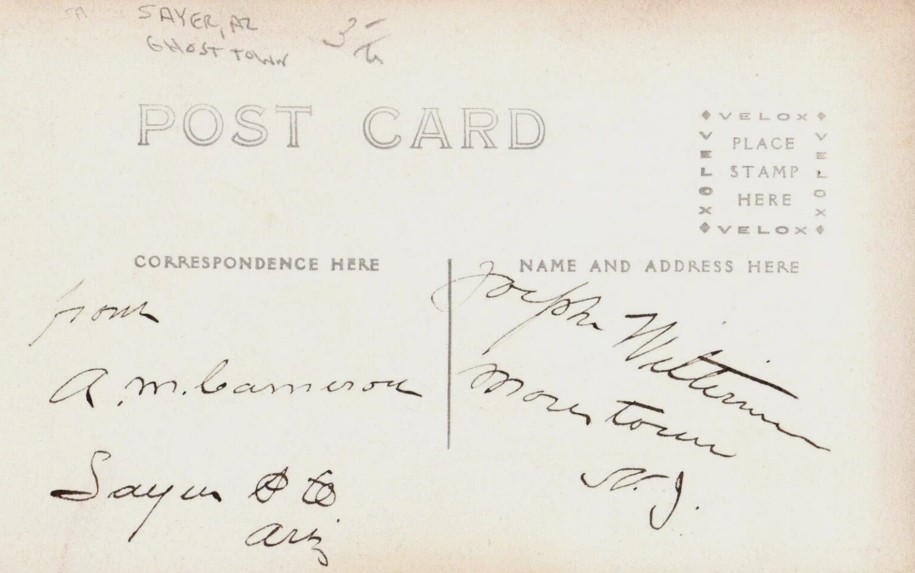
I use archived newspapers to do my research, along with genealogical data, including historical records found online. Thus far, I’ve found some interesting tidbits of information, but nothing that’ll touch the latest postcard find. This card was going to be sent from a man calling himself A.M. Cameron, yet for reasons unknown, it was never mailed.

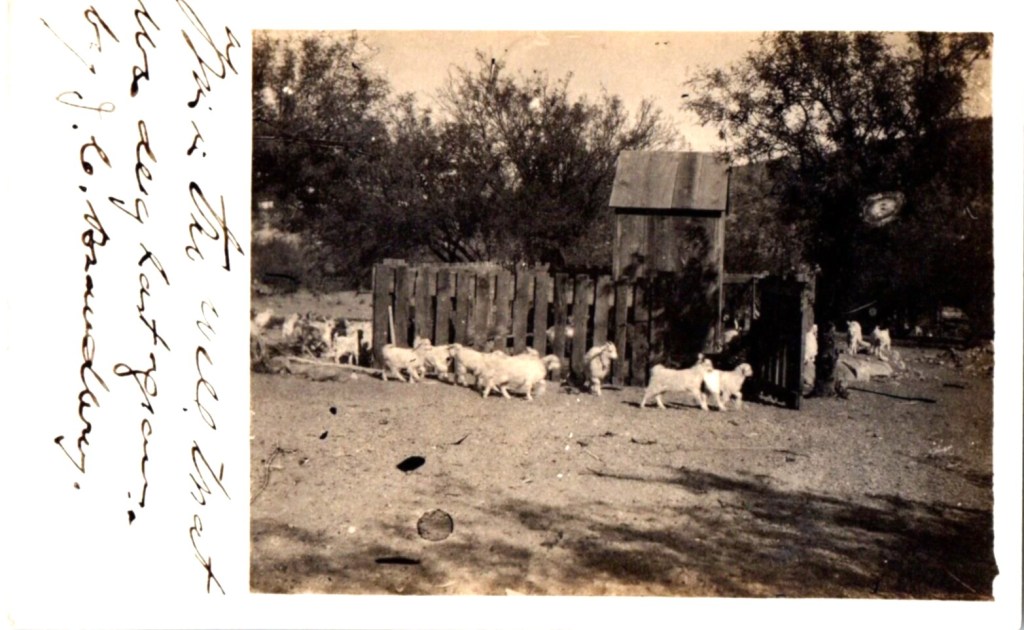
Mr. Cameron had written a name and address on a photo postcard that showed a recently constructed water well in Sayer with a group of goats standing around it. Having water readily available was a big deal back then, as it is now.

Next to the picture is written, “This is the well that was dug last year by J.C. Bradbury.” Water was important to Mr. Bradbury because he had several mining interests in the area. He was also the former county recorder for Yavapai County for several years.

The card is made out to someone named Joseph Witterman in Montrose, New Jersey. It was being sent from the now ghost town of Sayer, Arizona, yet a stamp was never placed on the back.

Sayer, Arizona, or Sayer Springs, as it is often called, was a small supply depot for mines in and around the Wickenburg area. George Sayers had a store there, and thus the town name. On August 11, 1909, a shotgun that George used for protection accidentally discharged, killing him. Sayers is supposedly buried near Sayer Springs, although no tombstone has been located.

Researching A.M. Cameron, his full name is Allen Myers Cameron. Allen’s father, John F. Cameron, was captain of the 154th regiment, Tennessee Zouave Guard, during the American Civil War.

Allen Myers (A.M.) Cameron left Tennessee as a soldier in the Union Army to serve in the Philippines, and for a short time became a US Cavalry pony soldier in Arizona. Leaving the service because of poor health, he quickly recuperated and went in search of gold.

Initially working at Crown Point Mine for Governor Brodie, Cameron found a vein of the precious metal on his own near the Black Rock District of Wickenburg, and then, after staking a claim, he sold his mineral rights to a larger mining outfit for a good price.

Relocating to Sayer, A.M. Cameron accepted a job as caretaker of the Walnut Grove Water Supply dam, while he also began raising goats. His neighbor was a man named Leonard White. Mr. White was a miner, well-liked, and had many influential friends. White’s mining ventures lay all along the dammed-up Hassayampa River.

Leonard and A.M. Cameron didn’t see eye to eye, and newspaper accounts had them arguing over frivolous things. One thing not mentioned is that A.M. Cameron undoubtedly had some control over how much water was released from the dam for mining interests. This would’ve been a hot topic for all miners as it is today.

A practice that Leonard didn’t approve of was Cameron setting poisonous bait throughout the area. This poison had killed more than one of Leonard’s dogs. Undoubtedly, it killed other animals and birds besides the dogs and coyotes.

A lawsuit was filed by a man named Howard Draper after one of his pet dogs died, with A.M. Cameron admitting in court to setting at least 2500 of the traps in a 3-mile radius of Sayer, as a means of killing off coyotes and dogs. He told the court that these coyotes and dogs had been after his goats. Allen Myers Cameron was found guilty and fined $50.

On June 16, 1913, Leonard White unexpedtedly confronted Cameron in front of the Sayer post office and shot him dead. Six witnesses said that A.M. Cameron was unarmed. White was arrested and taken to jail, where he awaited trial. Allen Myers Cameron was 45 years old, while Leonard White was 48.

After the court proceedings ended, and nearly 40 hours of deliberation by the jury behind locked doors, on September 18, 1913, Leonard White was found not guilty. Newspaper accounts of the ruling make it seem as if even White couldn’t believe the outcome.

The Sayer postcard I mentioned was never stamped and mailed. I believe Allen Myers Cameron wrote it right before he was killed. Stretching things a bit here, it might’ve been on him at the time of death, because there appear to be a few spots of blood on the picture.

The card was undoubtedly found in his possessions afterward and packed away by who knows who, only for me to discover it 112 years later on eBay.

I never located the intended recipient, a Joseph Wilterman living in Moorestown, New Jersey, and it’s highly possible, this name is wrongly transcribed. I’ll keep working on the spelling with a high-power magnifying glass.

What I find most intriguing about this card is the picture of the simple water well. Water is still a precious commodity in not only the Sayer and Wickenburg area, but Arizona as a whole, including Lake Havasu City.

In a 1941 song by the Sons of the Pioneers, titled “Cool Water,” the beginning lyrics go like this: “All day I’ve found a barren waste, without the taste of water, cool water.” That tune was written with Arizona in mind because the songwriter, Bob Nolan, composed it in high school, while he was living in Tucson.

Water’s such a valuable resource that the time will soon arrive when it outshines gold. Perhaps we’re already there!

June 21, 1913 – “The Parker Post” – They had Cameron’s age wrong.

SMILE AND WAVE

“How many of you have watched someone attempt to pull a large boat through a drive-thru?”

Boat trailer hitting the curb at Starbucks

It’s almost time for RVers to start rolling through town. For some folks, the “er” in RVers simply means “Errrr!,” as in being upset. I’m not one of those people. Even though I don’t own a business, I still view RVs as a boost to the local economy.

These RV owners, depending on the size of the rig they drive or tow, toss cash out to retail establishments like Santa Claus does candy in a parade, with Lake Havasu City no exception. If fast food joints in town had larger parking lots, you’d see them patronizing these places more.

During the summer months, trucks pulling boats would do the same, which brings me to this question. How many of you have watched someone attempt to pull a large boat through a drive-thru? It happens more than you think.


My wife and I sat in the Del Taco parking lot one day, eating our In-N-Out burgers, when a young fellow from California attempted such a stunt. He shut that drive-thru down for close to an hour, trying to maneuver his way back out. It was only after someone else took the wheel that they were successful.

Back to RVs, I watch to see how many side-by-sides and boats these vehicles can pull. Some of the rigs tow two trailers. In the 18-wheeler world, this is called a “double.” Many truckers hate RVs with a passion. I know this because I’m a member of a trucking group on Facebook, having joined a bunch of groups, 305 to be exact, just because they asked me to.

I’m a member of the Professional Trucker’s Group, Newbie And Fulltime RVers Group, Checker Cab Group, Hardy Boys Fan Club, Oilfield Professionals, Hondo Boats, Canadian Things, Hellcat Community, Kansas Barns, Life In Alabama, The Official Leave It To Beaver Fanclub, Old Junkyards, AZ Jeep Junkies, Historic Route 66, Sweet Home Alaska, to name a few.

The comments left in the Professional Trucker’s Group are how I know they have a disdain for RVs and especially RV drivers. Most of the complaints revolve around them having to maintain a CDL driver’s license, while the driver of a million-dollar Prevost coach pulling a trailer full of off-road vehicles doesn’t. Griping seems to be an inherent trait for some people, with truckers no exception.

Getting back to RVs wheeling through Havasu, headed to Quartzite, Bouse, and Yuma. I watch to see what states they’re from, and try to read the many decals dotting the backsides of their vehicles. Good Sam Club is seen on a good many. I attempted to join a Good Sam Club on Facebook to see what they’re all about, but this particular club had disbanded.

Searching online, I found that Good Sam was founded in 1966 to foster camaraderie and mutual assistance amongst RVers. It’s now the world’s largest RV club, offering places to camp, fuel discounts, products, and services with substantial savings. It was started by a guy named Art Rouse, and I can only assume that Sam was his dog.

My wife and I have an old RV that we use for road trips. I looked to see what it costs to join the Good Sam Club, and for no more than we stay in designated RV parks, it’d be better to just buy a decal off eBay and act like we belong. Taking time to look through the website, eBay has many different types of RV and trucking decals for sale.

I saw one that’d be perfect for that guy attempting to back out of Del Taco. For only $5, he can have a yellow and black sticker that says: Caution – Driver Does Not Know Which Direction Trailer Will Go When Backing Up.

I’ll be watching for that snowbird caravan as it winds its way back through town. Rather than give it the middle finger salute like so many folks, I’ll just smile and wave like Skipper the Penguin does from the cartoon movie, “Madagascar.”

AUNT GRACE

“Sadly, that vow doesn’t seem to mean as much as it did 100 years ago.”

I mentioned in an earlier column that I like to take vintage postcards and attempt to resurrect the history between the person who sent it and the recipient. It’s like putting a puzzle together, although the missing pieces are obtained from old newspapers, internet history, including genealogical data.

The last one I successfully mastered was a 1911 postcard sent from Oatman, Arizona, by a young lady named Rae, to her mother in Michigan. Over 12 hours were spent attempting to find Rae’s maiden name, including her married name, or in this case, names. That story can be found in its entirety on my blog under “Out Oatman Way.”

Being a fan of ghost towns, Oatman piqued my interest more so than if the card was sent from Phoenix or Tucson. When my wife asked me to try and do the same with an old 1923 postcard she came across from Jerome, Arizona, I hesitated at first.

Observing that this card showed a horse-drawn wagon going down a steep hill, while hauling passengers from the town center in Jerome to the rail station, one mile away, caught my immediate attention. The picture’s not in the greatest shape, with plenty of folds, cracks, and blemishes, but thankfully, I could still read everything on the opposite side.

This postcard is addressed to Mr. Glenn Henninger, Brooklyn Station, RFD #1, Cleveland, Ohio, Box 400. The short message is as follows: “Dear Glenn, I guess this blob means a big kiss for you.  How are you and little sister. Aunt Grace.”

Knowing that it came from Jerome, a notable ghost town like Oatman, and the sender was named Grace, I agreed to give things a whirl. You see, Grace is the name of one of my granddaughters.

The blob that Aunt Grace mentions is ink, and appears to be deliberate, perhaps first made in the shape of a heart until it muddled into an ink puddle. That’s what helps make this card so unique to me.

Glenn Henninger was quite easy to find, and from there on, everything pretty much fell into place. Glenn’s little sister was named Janice, while Aunt Grace was Glenn’s mom’s only sister. Glenn was born in 1918; thus, he would’ve been 5 when he received the card. His sister, Janice, was the only sibling. She’d just turned one.

Grace was born in 1893, and her maiden name was Woolf until she married Clayton Heideloff in 1921. Clayton served as a first sergeant during WWI. He died in 1949 at age 54, while Grace Woolf-Heideloff lived to be 88, passing away in 1981. She never remarried.

I didn’t find anything controversial about Grace’s life, like I did Rae’s in that Oatman postcard. Undoubtedly, she was in Jerome with her husband on a sightseeing trip. WWI ended in 1918, so perhaps they were making the most of his coming back alive.

The most interesting thing I found during my research was that the Henninger men knew how to pick not only beautiful, but faithful wives. Glenn’s father, Edwin, married Nellie Woolf, a former beauty pageant winner, in 1912. Edwin and Nellie remained together for 64 years.

Glenn’s wife, Evelyn Marie Bertlesbeck, was Miss Cleveland in 1938, including winning other Ohio beauty contests. She was a freelance model and a stewardess for Pennsylvania Central Airlines. The couple married in 1941 and remained together for 66 years.

Father and son believed in the marriage vow, “Until death do us part.”

Sadly, that vow doesn’t seem to be used as much during wedding ceremonies. Where marriage is concerned, perhaps things will once again return to the way they were in the old days, when couples at least tried to stay together. There’s nothing fuddy-duddy about that!