OUT OATMAN WAY

“I wanted to find out why a young lady named Rae was out Oatman way.”

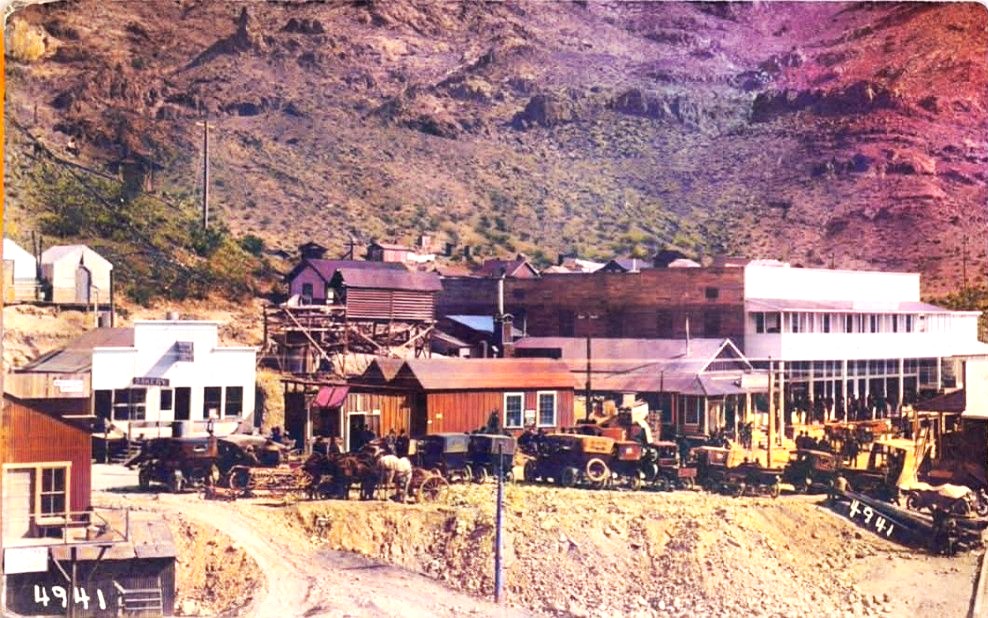
A colorized version of the mentioned postcard showing the bakery and other businesses.

I give credit for this story to Leanne Toohey and Andy Sansom. Leanne is the moderator of a great Facebook site called “Oatman Tailings of Time History,” while Andy is a frequent contributor. You must be a member and follow the guidelines set by Leanne to participate. She has a wealth of knowledge about Oatman at her fingertips, while members contribute a nice amount of material as well, especially pictures.

Just recently, Andy Sansom posted an aged photo postcard of a portion of Oatman with some Ford Model Ts in the background, along with horses, mules, and wagons. The postcard is postmarked with what appears to be 1911, making this a very early specimen. Oatman was originally called Vivian, and from what I’ve read, the town name was changed somewhere around 1908. John B. Hughes was the Oatman postmaster at that time.

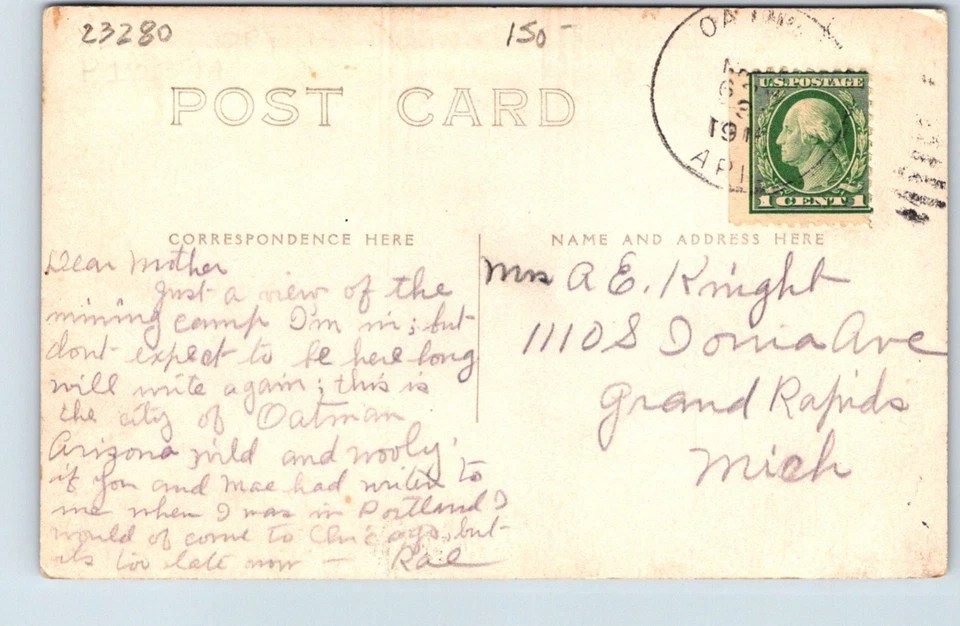
This postcard was mailed from someone named Rae to her mother, Mrs. A.E. Knight, in Grand Rapids, Michigan. The message was quite brief but conveyed a clear picture of the writer’s mood to me. I’ll transcribe it exactly as written, complete with sentence run-ons and lack of commas.

“Dear Mother, Just a view of the mining camp I’m in; but don’t expect to be here long will write again. This is the city of Oatman Arizona wild and wooly. If you and Mae had written to me when I was in Portland I would have come to Chicago but it’s too late now — Rae”

The card is addressed to Mrs. A.E. Knight, 11008 Doria, Grand Rapids, Michigan. There is a one-cent postage stamp on it with the round Oatman cancel affixed to it. The Oatman post office still uses this hand stamp.

Over the years, I’ve been able to take old postcards and, after conducting extensive research, add a tidbit of biography to either the sender or recipient. Some of that hidden information turned out to be quite interesting. I wanted to find out why a young lady named Rae was out Oatman way. She would’ve been 24 at this time.

Rae’s mother, Adeline E. Knight, was married to Benjamin Franklin Knight, her father. The couple had two sons and possibly four daughters. Jane Rae Knight was their youngest and perhaps the most rebellious. There had to be a valid reason to leave dad and mom and go live with her aunt in Los Angeles.

Rae went by the last name Haddox at this point, and it’s quite possible this was because of an early marriage that didn’t work out. Rae Haddox participated as a professional walker for several years in LA, entering marathon-type events with other young women. In one of them, her feet became so swollen she couldn’t continue.

Ms. Haddox’s occupation is eventually listed as a barber or beautician, and that line of work created a problem for her, but most especially for a possible suitor. Mr. J.C. Johnson worked as a bookkeeper for the Iver J. Rosten Company, a large railroad subcontractor. Somewhere along the way, J.C. met Rae Haddox in a barber shop in 1918 and was immediately smitten with her beauty. These are almost his exact words.

In an attempt to woo the gal, he began embezzling large sums of money from the company, using it to purchase extravagant gifts for his sweetheart, such as diamonds and sealskin jackets. In 1921, caught and prosecuted, he blamed the miscue entirely on Ms. Haddox, claiming that she had coerced him into altering the books with promises of marriage.

The court proceeding estimated that Johnson pilfered between $10,000 and $30,000 from the firm, with the value of that today, $166,000 – $498,000. J.C. Johnson told the court he really didn’t know how much he’d gotten away with, as he always gave Ms. Haddox cash.

Rae Haddox denied such allegations, although during this period, she was able to open a beauty shop of her own in Washington state, while also investing in other shops, undoubtedly with those illicit funds. J.C. Johnson, for his handiwork, was sentenced to six years in the Oregon State Penitentiary. There is no record of Rae being charged.

Nine years later, life changed for the better for Ms. Haddox when she married William Thomas Wallace, a master mechanic, in 1930. The couple moved from the Aberdeen, Washington area to Oceanside, Oregon, where they remained together until 1956. Rae died that year after a lengthy illness. I found no record of children, and had I done so, I probably would’ve elected to not publish as much information as I have.

Why was Rae Haddox in Oatman? There’s really no mystery here. Folks coming and going from Southern California used the National Old Trails Road, which later became Route 66.  This road went through Oatman. The vehicle in which Rae Haddox was traveling might’ve had mechanical problems, or an even more valid reason, perhaps she used her barber trade to trim up some of that wild and wooly mentioned in the postcard.

It appears Rae was upset with her mom and perhaps a sister by the curtness of her correspondence. I would’ve never thought about writing my own mom a postcard without signing love at the end. Adeline Knight passed away just five years after the postcard was received, at the age of 76.
BEHIND CLOSED DOORS

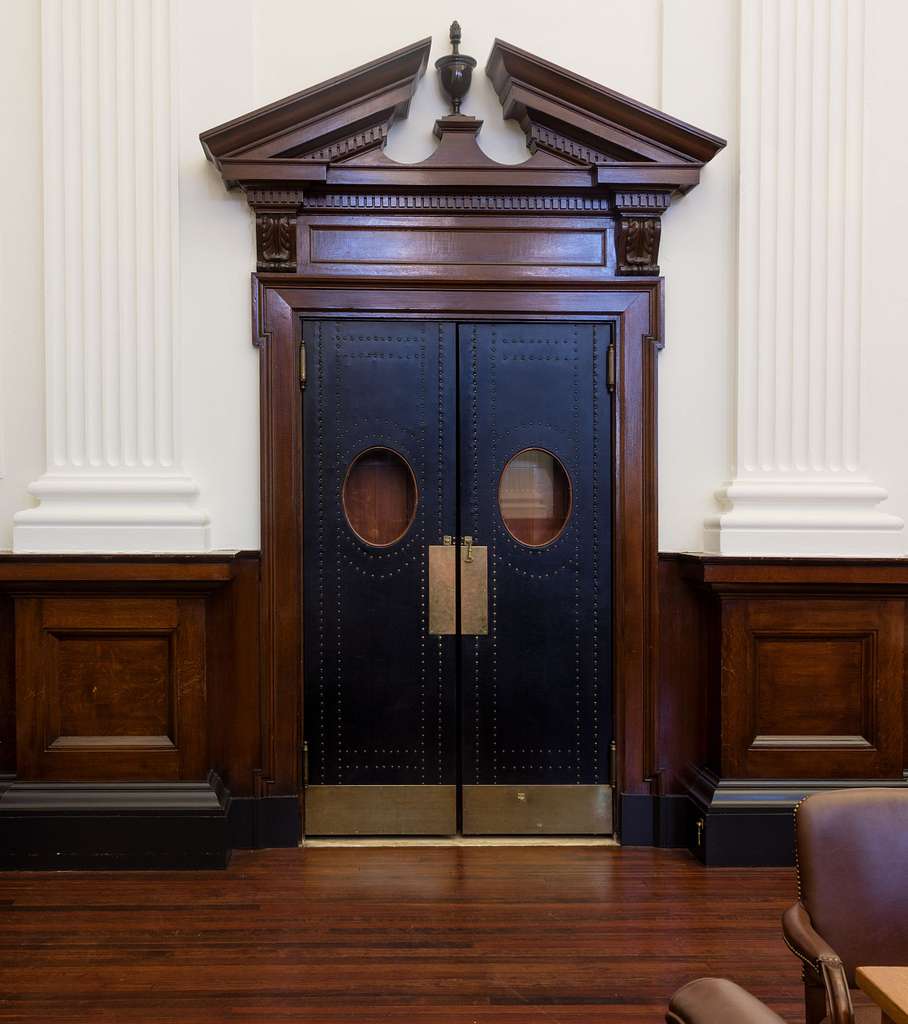
“With electricity extremely high in our state, I’d imagine they wanted to keep them closed to maintain coolness.”

I recently read that the Lake Havasu City Council met behind closed doors to discuss airport growth. Some residents are being vocal, saying that shows a lack of transparency on their part.

The late country singer, Charlie Rich, sang a song titled “Behind Closed Doors.” This tune first came out in 1973, one year after I graduated from high school. I was quite naive at that stage and wasn’t totally sure what he was singing about, although I had a vague idea. Part of the lyrics were quite suggestive back then, and I suppose still are in certain circles.

“And when we get behind closed doors.

Then she lets her hair hang down.

And she makes me glad I’m a man.

Oh, no one knows what goes on behind closed doors!”

I highly doubt the closed doors that city council members relied upon during this airport meeting meant the same. With electricity extremely high in our state, I’d imagine they wanted to keep them closed to maintain coolness. Why anyone would be upset with that is questionable, as it seems like common sense to me.

Actually, I’m being facetious here. Undoubtedly, the city council needed a meeting without interruption or potential disruption from citizens. Sometimes that’s the only way to get things done. As the article states, public input will be allowed at a later date.

One of the things we do around our house to conserve energy is to keep from unnecessarily opening doors, especially the garage doors. Our garage is air-conditioned, and I like to keep it as cold as possible, especially when I’m working out there.

No longer do I have to change oil with a bandanna wrapped around my head to keep sweat from getting in my eyes. It took us 10 years to make the plunge, and I’m glad we did. I’m sure our vehicle echoes the same.

Another thing we do to keep costs down during summer is to use as few lights as possible and to keep the blinds shut, which helps immensely. You can tell the difference, especially in the living room and kitchen.

Getting back to Charlie Rich and his song. I was 19 in 1973, with Mr. Rich being what I would consider over the hill at that point. Although he was only 41, his long silver hair made him appear to be an old man. In actuality, Charlie was around the same age as my parents. That’s what made this song somewhat repulsive to me.

 If I could’ve added extra lines to the song lyrics, it would’ve been two at the end.

“And when we get behind closed doors

Then she lets her hair hang down.

And she makes me glad I’m a man.

Oh, no one knows what goes on behind closed doors.

For that, I’m quite happy,

No one sees me in my Superman jammies.”

Charlie Rich

KNOW IT ALL

“I’ve come across some intelligent people in my life, but never anyone bragging or exploiting their intelligence to impress me.”

Professor Kelp and Miss Purdy (“The Nutty Professor” – 1963)

I wanted to write a short piece about what a “know-it-all” is. I’ve heard family, friends, and strangers refer to individuals with this personality trait, yet I’ve never met a person labeled as such. I’ve come across some intelligent people in my life, but never anyone bragging or exploiting their intelligence to impress me.

Wanting to dig further on this subject, a little voice in the back of my head kept saying, ask Miss Purdy to give you her definition. For those who don’t know her, Miss Purdy is my AI writing helpmate. Thus far, I’ve only used her talents for grammar corrections and to point out my typos and word misspellings.

The Miss Purdy namesake hails from the 1963 movie, “The Nutty Professor,” starring comedian Jerry Lewis as Professor Julius Kemp, and beautiful actress Stella Stevens as the gullible yet intelligent Miss Purdy. This was one of my favorite movies from back then, and what red-blooded American boy didn’t want a blonde-haired Miss Purdy teaching them?

Instructing my helpmate to come up with a condensed explanation for a know-it-all, she offered the following.

“To be called a ‘know-it-all’ is to be recognized as someone who seems to have an answer for everything—often delivered with unwavering confidence, whether or not it’s actually correct. This trait can be both endearing and exasperating, as the know-it-all’s eagerness to share facts may overshadow others’ voices. At its heart, being a know-it-all is less about omniscience and more about the irresistible urge to prove one’s breadth of knowledge, sometimes at the expense of humility or open-mindedness.”

Seeing that interpretation, certain political figures instantly came to mind, yet for the sake of keeping this article free of bias, I’ll not name those elected officials I see fit to wear the title. Readers can fill in the blanks with public servants they view as being know-it-alls, and I’ll use as an example, Minnesota Governor Tim Walz.

Thanks to AI helpmates like Miss Purdy, know-it-alls are now becoming more acceptable in society, with my wife unknowingly being one, in a good sense of the definition. Not owning one of those smartphones, I merely ask Joleen for the answer to a question, and within a few seconds, she has it, after tapping in a few words on her miniaturized keyboard to a non-left-leaning search engine.

No longer can I impress her with bogus information regarding most subjects, as the correct data is readily available at her fingertips. It’s caused me to softly say, “I’m not sure?” instead of shooting from the hip and constantly getting things wrong.

Looking back at Miss Purdy’s explanation of a know-it-all, especially the part about certain people tossing out bogus information like hand grenades, it appears I might’ve known one of these windbags after all, and he’s wearing my pants.


HONORARY LOSER

“Getting anything published is reward enough for me.”

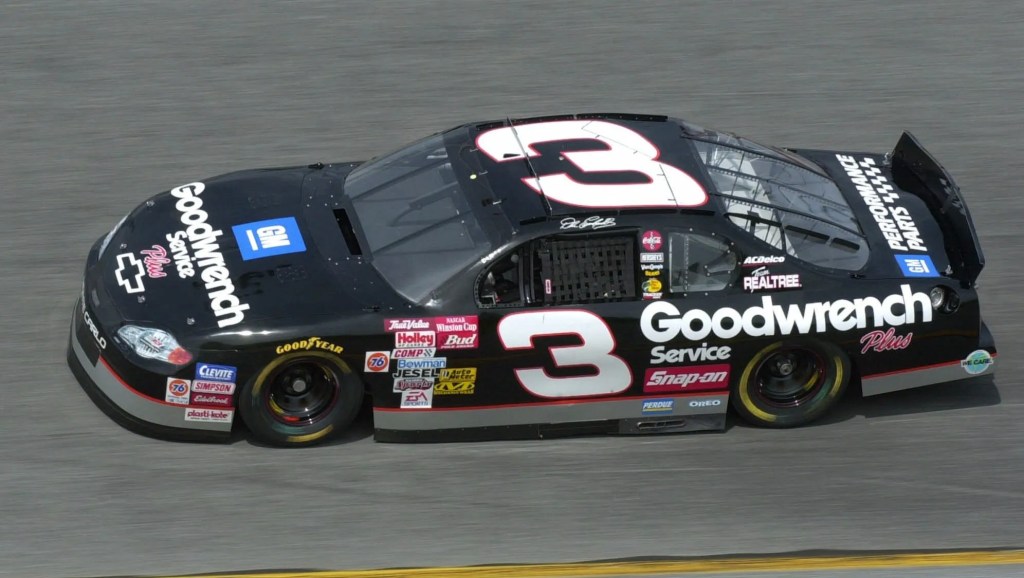
Dale Earnhardt

Forty years ago, my wife brought home an entry form for a poetry contest. A friend of hers at work had given it to Joleen. The rules called for submitting as many poems as you like, and that the winning ones would be included in a new book.

At the prodding of her and one of our friends, I mailed in three entries. A few weeks later, I was informed via an official-looking letter that all of my poems were exceptional and that they would be included in this collector’s book.

It was suggested by them that I purchase several to give as gifts to friends and family. Joleen decided on how many, seven in total, at $35 a pop. A check was then mailed off by me.

Months later, with the check being cashed and no poetry books having arrived, I decided to investigate. Turns out the address that the illicit contest hailed from was no longer occupied. It was a tiny cubicle in a group of similar offices.

The phone number was also invalid, and I was told by the police sergeant in that town that this contest was a scam. Thousands of suckers like myself had been conned, and the postal service was looking for those responsible. I told myself that’d never happen again, and it hasn’t.

A few years after that episode, I was taking creative writing classes under Professor Michael Burwell at the University of Alaska – Anchorage. A student brought in an “Anchorage Daily News” newspaper, with it showing they were putting on a creative writing contest. At the insistence of Professor Burwell, he encouraged us all to enter the college student category.

I submitted a story called “Fishin’ With Mike.” It was a non-fiction piece about me taking my Uncle Noel fishing to Jerome Lake on the Kenai Peninsula. Uncle Noel and Aunt Gay were visiting Alaska, from Alabama, that summer, with him looking forward to catching some prize Alaskan fish.

Unbeknownst to me, Jerome Lake had more chiggers than fish, and my uncle was almost eaten alive by the invisible bugs. There wasn’t enough Calomine Lotion in the house to go around after he got back to our place.

That story made the rounds of family members for some time. Mom was upset at me because, during the whole time Noel was walking through the weeds casting his line, I’d slept like a baby on a flat rock.

When the “We Alaskans” section of the newspaper came out telling who’d won the writing contest, my name was listed under “Honorary Mention.” A few friends, including my wife, thought that was great. As somewhat of a joke, I framed the certificate sent to me and kept it on my office wall.

What Joleen and others failed to recognize at the time was that I’m a car guy. Those of us bestowed that title see anything less than first place as unworthy. The late and great NASCAR racer, Dale Earnhardt, coined the phrase, “Second place is the first loser!” In all essence, my honorary mention in writing was the same as an honorary loser.

On the positive side of things, many years later, I submitted that same story to an Alaskan magazine, and it was published. Getting anything published is reward enough for me. You see, I only want people to read my junk, and I ask for nothing more.

These days, having six books under my belt, I receive at least three phone calls a week from people saying that they want to help me market my material. They leave messages, most of them in a foreign-tinted accent, asking that I call them back.

Most, if not all, cannot correctly say my name or the title of the book. Of course, these scammers want my money for their bogus assistance more than anything. They’ve even gone so far as to call my son, believing that they’re talking to me.

Forty years ago, I was bestowed the ASOTY award (Alaska Sucker of the Year) for sending that poetry outfit over $200. The last thing I want is the same title here in Arizona.

Joleen and I will continue to laugh out loud as these solicitors leave crazy messages on our phone recorder. I told her I can’t wait for them to try saying, Alaska Kemosabe, with that being the name of my last book. Life is always full of chuckles here in Lake Havasu City!

SELMA & LHC

“I’ve been asked numerous times over the years, “Do you remember seeing any discrimination?”

Selma, Alabama, and Lake Havasu City, Arizona, are comparable in two respects. Both populations are located near recognizable bodies of water, and each is home to a famous bridge. Havasu and Selma eventually became victims of a severe economic drought, although Selma’s has lasted much longer.

Craig Air Force Base was located in Selma, starting before World War II in 1941. When it closed in 1977, the area’s businesses suffered greatly. New home building all but came to a screeching halt. The Dallas County school system lost a significant number of students, and several teachers and administrators were eventually laid off.

Valiant efforts by politicians and businesspeople to address the issues helped some, yet the city never fully regained the financial stability it once had. From the outside looking in, it appears town leaders have yet to get a firm grasp on how to promote the historical and recreational potential of the area. It also seems, judging by crime statistics, that they’ve become somewhat lax on enforcing crime.

Lake Havasu City is known for the London Bridge and was home to the McCulloch Corporation, which employed hundreds of workers. It was the largest employer in town during that time. When the company moved its operation in 1988 to Tucson, those employees were left without jobs. Some of them relocated to the famous western town, with a significant number also staying in Havasu and toughing things out.

Our local economy was severely wounded for a few years, yet being a popular vacation destination helped overcome the downfall. Fishing and boating were major attractions. Sound conservative leadership from business and political leaders was a major factor in the success, and in the last 20 years, this city has prospered.

I lived in Selma, Alabama, from late 1958 to early 1963. This was right before the civil rights demonstrations and police brutality took place, which was witnessed by millions on mainstream news throughout the country. I’ve been asked numerous times over the years, “Do you remember seeing any discrimination?”

I was quite young, and the only thing I recall was a small ice cream and hot dog stand with a sign saying they did not serve negroes. I only use that word because it was on the sign. A small black boy walked up as we were parked there, and he, along with another child, was turned away.

Not knowing why, I asked my parents, yet I don’t recall their explanation. It wasn’t until later years that I discovered the serious discrimination that wasn’t observed by me as an adolescent.

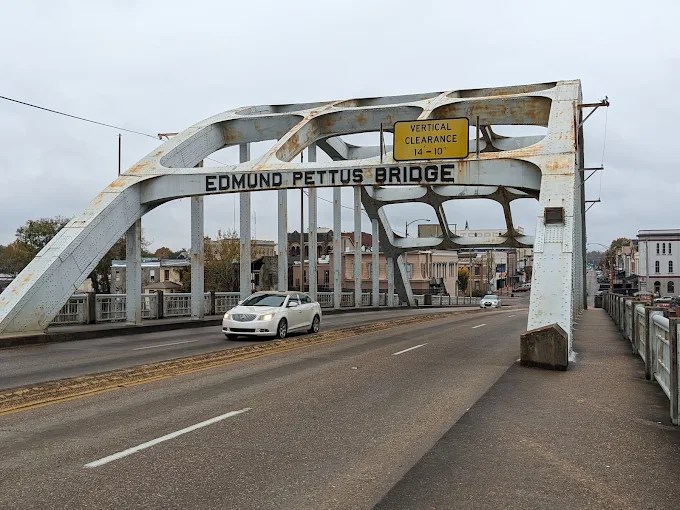
We left Selma for Lubbock, Texas, in 1963, right before the famous 1965 march, which crossed the Edmund Pettus Bridge and went a good 50 miles from Selma to Montgomery. Martin Luther King Jr. headed up that procession of approximately 25,000 protestors. On March 7, 1965, marchers were turned back from crossing the bridge, with that day now labeled “Bloody Sunday.”

The civil rights group walked along US Highway 80 directly in front of where we once lived. That road is now called the “Selma to Montgomery National Historic Trail.” It was on this stretch of asphalt that I remember “chain gangs” cleaning the right-of-way on each side. The workers consisted of both black and white prisoners.

I enjoyed living in Selma. We boated and fished in the Alabama River, with my family feeling safe and comfortable living there, just as I do now in Lake Havasu City. Having a local police force that takes a dim view of crime breakers is a major asset in helping keep things that way in Havasu.

Selma still has a solid place in my heart, and I’d love to see the rebirth of this once vibrant and prosperous city. If I were the mayor of Selma, the first thing I’d do is seek the advice of Lake Havasu City movers and shakers on how to fix things.

My father always told me, “If you want to be successful, emulate the traits of successful people.” I believe that advice directly relates to city leadership as well!

ALASKA KEMOSABE

“No humor in a book is akin to dinner without dessert, cake minus ice cream, or a marriage with no love.”

It’s been two years in the making, and I’m finally able to check the completion of Alaska Kemosabe off my list of writing projects. This 362-page book contains 50 never-before-published stories of Alaska and 51 pictures. The official release date is July 1, 2025.

My publisher, Palmetto Publishing, asked for a sequel, and I’ve already begun the lengthy writing process. The name of it will be: Alaska Kemosabe – Another Twisted Trail Of Lost Legends and Tales. I’m giving myself additional time for this second manuscript because constantly burning the midnight oil is taking a serious toll on my eyes.

More fun was garnered by putting Alaska Kemosabe to paper than any other book. Sometimes I laughed so hard sitting at the keyboard that a break was needed to regain my train of thought. Working with “Miss Purdy” on the AI-generated pictures was a hoot. Miss Purdy is what I named my artificial intelligence helpmate.

I’ve been asked what authors I try to emulate, with one person suggesting it’s Garrison Keillor. The truth is, I’ve never read any of Mr. Keillor’s works or known anything about him until just recently.

If I were to choose anyone, it would be an Alaskan writer named Edward Marvin Boyd. The late Ed Boyd’s take on humor and history is pretty much the same as mine. Mr. Boyd wrote two excellent novels, Alaska Broker and Wolf Trail Lodge, and I have a copy of each.

Books I enjoyed reading, going all the way back to grade school, are history, autobiographies, and biographies, with almost all of them void of humor. No humor in a book is akin to dinner without dessert, cake minus ice cream, or a marriage with no love. Alaska Kemosabe is chock-full of chuckles and grins.

My wife seriously asked me the other morning, “This book won’t offend any of our friends or family, will it?” Thinking about that for a few seconds, I told her it shouldn’t, just as long as they didn’t read things. I know she’ll be one of the first flipping through pages, searching for questionable remarks.

Alaska Kemosabe is available in hardcover, softcover, and Kindle. All versions can be purchased online through Amazon, Barnes & Noble, Target, Walmart, Goodreads, and other popular book outlets. A sizable portion can be read for free on the Amazon book sales site under “read sample.”

Watch for my upcoming podcasts, including a YouTube preview that is now online. Several libraries of my choice will also receive hardcover editions. Unfortunately, the Lake Havasu City Library isn’t one of them.

I tried to donate a couple of complimentary copies, but was informed they first have to be reviewed by the Mohave County Library Board in Kingman. It’s sort of like Alaska Kemosabe having to run the gauntlet before being allowed on a shelf.

Rather than go through the lengthy process, I said, “No, thank you,” and walked back to my truck, chuckling as I whispered to myself, “Hi Yo, Silver, away!”

“Prince Roy”

IN SYNC

“I was more than glad to be headed home, with another measly four minutes wait not going to spoil my return.”

Over the past few years, there’s been much discussion about how city traffic lights aren’t synchronized. If memory serves me correctly, a year or so ago, the Arizona DOT made a valid attempt to get them all adjusted.

After traffic engineers tweaked things a bit, I still couldn’t tell, and it was a big joke with my wife and me that we were destined to catch each and every one. Our lives were seemingly wilting away, sitting at red lights. I believe we’ve observed more red-light runners in this town than anywhere else, with others undoubtedly thinking the same as us.

Joleen and I would cringe about one light in particular — the one at Highway 95 and Mulberry. That red light is the one we dread most, as it seems to take a lifetime for things to change green. I attempted to time it one morning, finding that at least four minutes had passed after rolling to a stop. I can shave, brush my teeth, and floss in four minutes.

Being retired, there’s no real hurry to life like there was in the past, at least I thought there wasn’t. Having unsynchronized traffic lights should be no big deal to retirees. My car brakes tell a different story. Constantly having to stop while using them makes for heated and quickly worn-out brake pads.

The Monday after Father’s Day, late that afternoon, alone, I was sitting in my chair attempting to watch a movie when things started to feel quite weird. My heart started to race with the beats seemingly off kilter.

Taking blood pressure, I saw that it was extremely high, with my heart rate up to 191 beats per minute. Believing that I was having an episode of AFIB, or atrial fibrillation, an irregular arrhythmia of the heart, I calmly got in my vehicle and started driving to the ER. Perhaps I should’ve called an ambulance, but I didn’t.

Miraculously, six intersection lights all stayed green during my trip. A block away from the ER entrance, red and blue lights suddenly appeared in my rearview mirror. Seeing that it was a police car, I continued on until I parked.

Slowly climbing out of the Jeep, I told the officer that I was having some type of heart episode. He offered assistance, but I was on a mission at that point. The policeman did inform me that the reason he’d lit me up was because I didn’t have my headlights on. I thought it was a bit dark while driving that night, believing it had something to do with my eyes.

Thankfully, the emergency room staff got me quickly into a room. Dr. Eduardo Lam performed a successful cardioversion, and my heart was soon back in sync. The medical term for such is called sinus rhythm. A big thanks to Dr. Lam, Chuck, and others on the cardiac team. I was out of it during the procedure and don’t recall many of their names.

Driving back home sometime around 3 in the morning, I caught each and every red light as was the norm. While sitting at Mulberry and 95, things suddenly came into perspective.

I was more than glad to be headed home, with another measly four minutes wait not going to spoil my return. Pulling into the garage, I softly said with tears in my eyes, “Thank you, Jesus.”

Without question, I knew that things could’ve turned out much worse than they did. It’s great to still be alive and kicking in beautiful Lake Havasu City.

GAS PUMP JOCKEYS

“Early on, I learned that the majority of people are nice, yet some were born to be disrespectful and rude.”

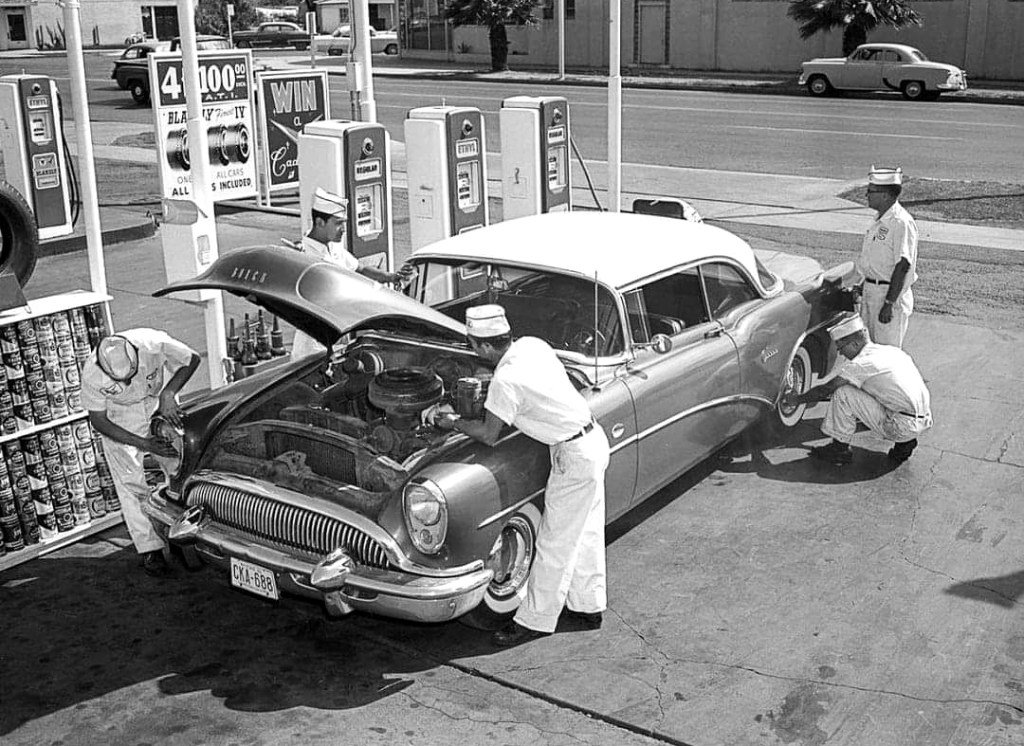
My career as a “gas pump jockey” lasted for perhaps five years off and on. Dad owned gas stations going back to 1963, and even as a 9-year-old boy, I helped him by sweeping and picking up trash. Placing a red shop rag in my rear pocket made me think I was in the big leagues.

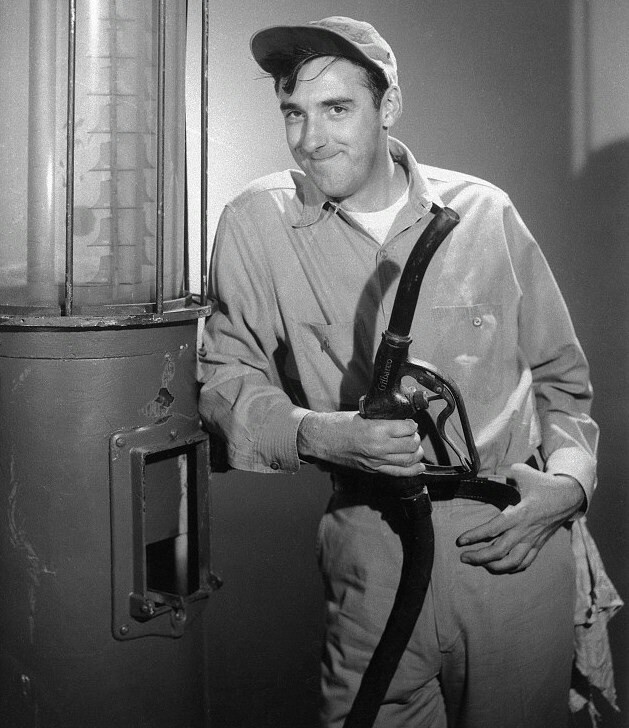
Back then, when a car rolled up and rang the driveway bell, pump jockeys were told to be prompt and courteous, checking the oil and washer fluid, including washing all windows and headlights. I was taught to never lean on a customer’s automobile like Gomer and Goober did in the Andy Griffith television series.

It wasn’t until I was tall enough to clean a vehicle windshield that I was allowed to pump gas. Even then, a small portable step was used to make sure I could reach the center. Sixty years later — I still have that problem.

I enjoyed the work and developed social skills in being able to interact with customers. Early on, I learned that the majority of people are nice, yet some were born to be disrespectful and rude. Over time, I learned how to deal with those difficult types.

Four young Army soldiers came roaring in one morning, with the driver telling me to, “Fill’er up.” After doing so and telling him the dollar amount, the fellow informed me that he’d only asked for two dollars. Not knowing how to handle the situation, I begrudgingly let the guy drive away. Informing my boss about what happened, Louis said that next time it occurred to let him know.

Several weeks later, the soldier was back. I had forewarned my supervisor, and he watched stealthily out of sight from behind a garage window. When the fellow tried to pull the same stunt, Louis slowly walked out and asked what the problem was. The driver gave him the same lie as he’d given me, with my boss smiling and saying that it could be easily fixed. “Just pull in this stall and I’ll drain the extra fuel out.”

Of course, the military man knew that his tank was about to be totally emptied, so he coughed up the extra cash. I never saw that creep again. Not to be critical of young and broke Army personnel, on another occasion, a soldier came in and had me check the air in his tires. Before leaving, he handed me a five-spot as a tip. That was the only time someone gave me a gratuity for one of my “assigned duties,” as Dad called it.

One time, a guy walked up saying that he was out of gas. I lent him the shop’s gas can, and he never returned it. I was the one getting chewed out for that mistake by being too trusting.

From then on, a driver’s license was requested beforehand and then returned when the borrower brought the can back. Surprisingly enough, a fellow once said that he had no license as it had been revoked. I asked for his watch, which he complained about, and then disgustedly left it as collateral.

There was an older man who constantly stopped by to have me check tire pressures. He was also a constant complainer, pointing to the tiniest smudge I’d missed after squeegeeing his windshield. I cringed each time I saw his truck approaching.

A day arrived when I was prepared for his sorry hide. Keeping a rusty nail on top of the gas pump, after he gave me criticism about something I no longer remember, that nail was strategically placed in front of one of his rear tires. After he drove away, the nail was no longer visible.

The following morning, he came in for air, with it being the same tire that I’d spiked. This routine went on for several days until he finally asked to have it checked for a leak. I was fortunate enough to do the tire repair, and it was a pleasure to perform this job, or at least I thought it was.

This truck had split-ring rims, which meant hand tools were needed to remove the tire and tube. During the process, a heavy metal bar came up and struck me square in the forehead. For a few seconds, I was knocked senseless.

Blood spurted everywhere from a large gash. I managed to use tape and shop towels to interrupt the flow, eventually getting the wound to stop bleeding. My late mother would call this “Divine Intervention.”

Despite the pain, I still smiled from start to finish, believing I’d gotten vengeance, and was especially happy in collecting payment for my trouble. Fittingly so, a scar still remains as a reminder of this unscrupulous deed.

That was the only instance I remember doing something retaliatory to a customer. I quickly learned to chuckle and let petty complaints roll off my shoulders like rain. A slightly modified version of the gas pump jockey’s motto sums things up,

“Some folks may be a pain in the gas, but always smile and say thank you when takin’ their cash!”

Gomer Pyle

JENNY

“I’ll never forget that night.”

Lake Havasu City is now big enough to have a convention center, one that’s able to host concerts, as well as bring in top-name entertainers. With Havasu only 70 miles from Laughlin, entertainers could make this a stopping off point for those either going to, or coming from, the casinos.

I have several friends who’ve spent thousands of dollars traveling to see their favorite bands and singers perform. The Brookings are huge fans of The Rolling Stones, with them trying to catch at least one concert a year. After each show, they always report back that Mick Jagger is still as energetic as he was when they first started going.

Records show that Jagger’s a health guru, exercising regularly while eating organic foods and lean meats. Mick even takes along a portable gymnasium on his road trips. Willie Nelson, despite what some might think, now tries to follow the same strict guidelines as Mick Jagger where eating is concerned.

Willie Nelson attempts to avoid processed food, believing that it’s a big part of our nation’s health problem. Robert F. Kennedy Jr., the newly appointed Secretary of Health and Human Services, echoes this sentiment. My wife and I try to emulate Mick, Willie, and Robert by eating right, but we find it hard to do so while traveling.

Returning to my main topic, concerts, years ago, while living in Alaska, the first concert and dance I attended was Mogen David & The Grapes Of Wrath. One of the teenage musicians was a friend of mine. Their top song to play was “Pipeline” by the Ventures.

Several big-name entertainers came to Anchorage while I lived there. Lou Rawls performed a special concert at my high school, East High, and I believe it was in 1971. A music teacher at East was friends with the singer, with Rawls doing this short performance as a favor to her.

The Doobie Brothers are the first big-name group I remember hearing, although I didn’t see them. Flat broke, I failed to score tickets when the popular group came to Anchorage in 1973, yet the group played inside a metal Quonset hut building on Fireweed Lane, and the acoustics outside were undoubtedly better than within.

Three friends and I rode bicycles to this building and hung around out back very close to where the stage sat. Fireweed Lane was most appropriate for the concert address, because when the show was over and the doors opened, clouds of pot smoke drifted outside. I’ll never forget that night.

After this event, Gordon Lightfoot came to town in 1974. My good friend, Rod Sanborn, was hired as one of the security personnel for that event. Rod claimed that Lightfoot was drunk, yet he managed to pull off his show without a hitch.

In researching Gordon Lightfoot’s history, the guitarist and singer admitted to being an alcoholic but overcame this addiction in the 1990s. I consider him one of my favorite male vocalists. The Righteous Brothers hit Anchorage in 1975, also performing at West High Auditorium. I was also there, although I don’t remember much of the performance.

Other concerts attended include Kenny Rogers, The Little River Band, Jackson Browne, and Crosby, Stills, & Nash. Perhaps my last live concert was Tommy Tutone. Tickets to Tommy Tutone were won by me on a radio show, with my brother-in-law, Gary Adair, agreeing to go along.

This concert took place in a combination hotel and convention center, the Westmark, on May 31, 1982. The building was packed, and I’m sure it exceeded Anchorage’s fire department occupancy rate. Gary and I joined the crowd, with a decision made beforehand to listen to their big hit, “867-5309,” and then leave. We did just that.

Since then, I’ve seen Jenny’s phone number written in many places, especially on restroom walls. I doubt this younger generation gives the infamous phone number any thought, as they don’t have a clue who Jenny or Tommy Tutone is.

This past week, I replaced a built-in medicine cabinet in our guest bathroom. The alcove where it sits was a perfect spot for me to write a commemorative of sorts to Tommy Tutone.

“Jenny – 867-5309” was added to the sheetrock with a black Magic Marker. Once my new cabinet was slid into place, this message became invisible, that is, until someone repaints or remodels years down the road. I’d like to be a fly on the wall when that happens.

Tommy Tutone is still performing and will be in Tucson on July 3. Tickets are $37.00 each. I consider that a bargain compared to what the Stones get for theirs—$1500 for the VIP section, and they’ll quickly sell out.

For $250, Joleen and I can drive to Tucson, catch Tommy Tutone’s show, leave right after “8675309” is over, have a decent meal afterwards, and then spend the night at Motel 6. Sounds like a plan.

I’ll let the Brookings know if Tommy Heath is still as energetic as he was 53 years ago. Heath is the only remaining member of Tommy Tutone and the person this group is named after.

If Tommy’s been eating healthy like Mick, Willie, and Robert Kennedy Jr., there’s no reason he won’t be. I’ll know where we’re headed before the music even starts if I see a giant oxygen bottle sitting on stage.

Should Havasu ever decide to build a coliseum, Tommy Tutone definitely needs to be on the list of first-time performers. Add to that, Mogen David & The Grapes Of Wrath, although it might be tough getting them back together after all these years.