“This postcard was likely purchased in Fairbanks, Alaska, by the person sending it.”
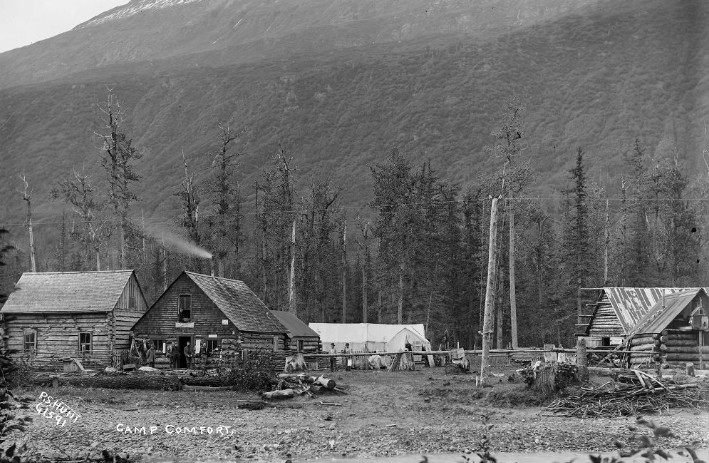
Camp Comfort
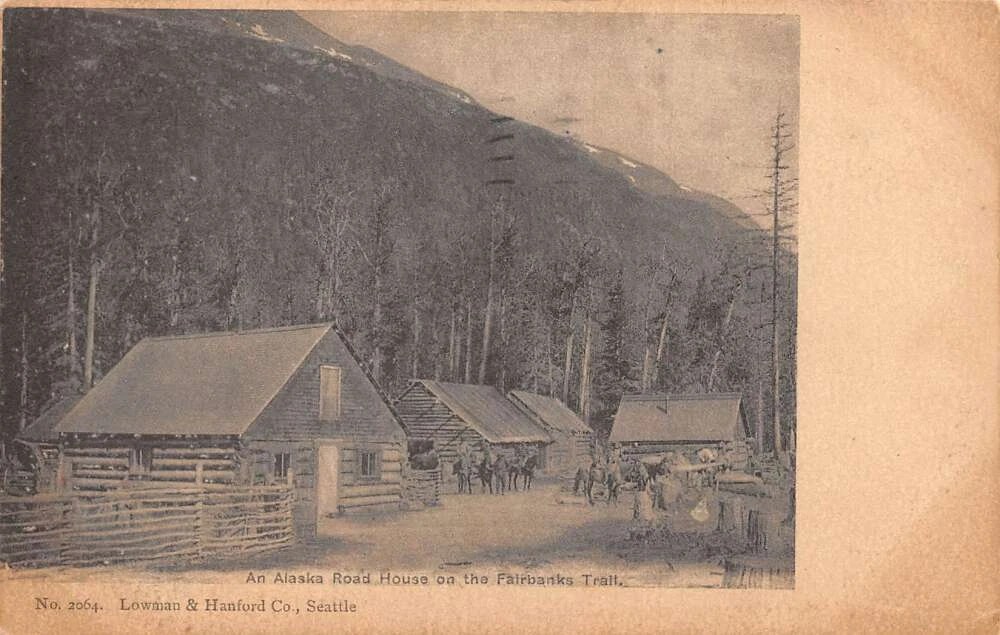
An old picture postcard mailed from Seattle, Washington, on November 3, 1910, to Miss Ela Boyd in Rogers, Arkansas, shows several rustic log cabin structures on the front with five riders on horses. The description underneath says:
“An Alaska Road House on the Fairbanks Trail”
I tried to identify the name and exact location of this roadhouse using the book “Alaska Roadhouses” by Helen Hegener, along with other online sources. Poring over this information, I eventually came up empty. An expert on the subject, thankfully, renowned Alaska author Helen Hegener, came to my rescue. The pictured roadhouse is named Camp Comfort.
Fairbanks Trail refers to historic and recreational paths in the Fairbanks region of Alaska. Fairbanks, situated in the heart of Alaska, is renowned for its rich history, gold rush heritage, and vast wilderness. Trails in this area are significant for both their historical context and their modern use for outdoor recreation.
The term “Fairbanks Trail” is often associated with early routes used by gold prospectors and settlers in the late 19th and early 20th centuries. These trails were crucial for transporting supplies, mail, and people between key locations such as Fairbanks, Nenana, and other remote settlements. Some trails followed ancient paths used by indigenous peoples long before the arrival of Europeans and Americans.
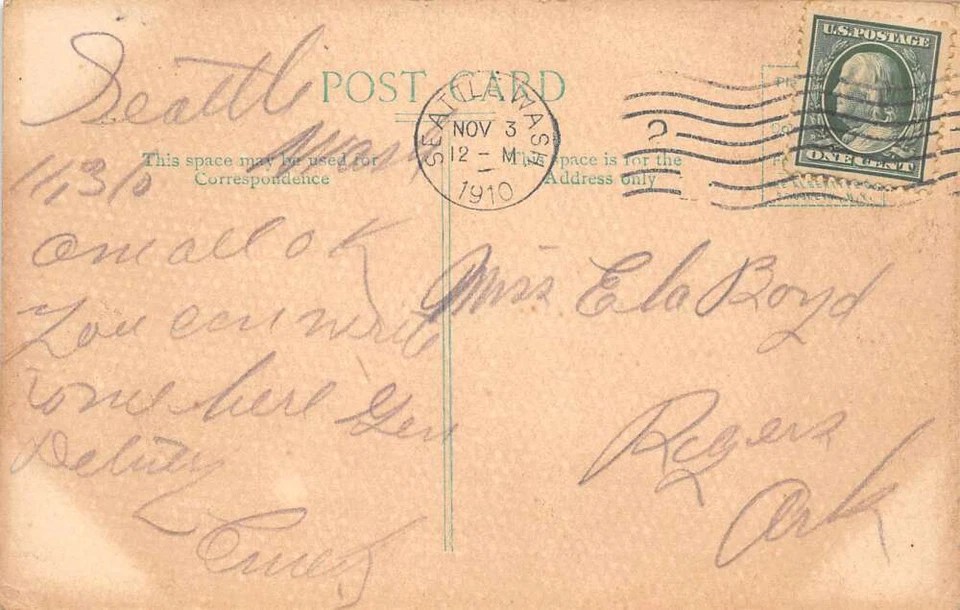
This postcard was likely purchased in Fairbanks, Alaska, by the person sending it. I was able to partially decipher his fancy yet sloppy handwriting with the simplistic message to Miss Ema Boyd, reading as follows:
“Seattle 11, 3, 10
Am all ok. You can write to me here gen delivery.
Crue”
Unfortunately, the postcard sender, whom I believe the name to be spelled Crue, will remain a mystery, although I found sufficient personal information on the card recipient, Miss Ema Boyd. She was only 16 when she received the message.
Ela was born in Tennessee on June 12, 1894, to parents John and Leona. On February 9, 1912, she married Lester Trueblood, but that marriage didn’t last. On January 8, 1916, Ela wed William Harvey Compton. A child was born on February 3, 1917, to the couple, but sadly, one day later, little John Elmer Compton passed away.
On February 4, 1920, Ela Boyd-Compton died an unfortunate early death. Her obituary in the “Rogers Republican” newspaper, where she worked, tells a sad story.
“Mrs. Ela Compton died last Wednesday afternoon at New Orleans, the result of pneumonia following a severe attack of the grippe. Her father, John R. Boyd of Rogers, who had reached New Orleans that morning, brought the body back to Rogers, arriving here Saturday. Funeral services were conducted by the pastor, Rev. C.C. Cunningham. Mrs. Compton was a well-known young woman of Rogers. She was especially popular in the Baptist church circles, where she was superintendent of the primary department and a willing and efficient worker in all departments. She had worked for several years in the newspaper offices of Rogers as a compositor and at the time of her death was in New Orleans in the special school of the Merganthaler Linotype Co., studying to become a machine operator. She was a member of the Eastern Star and the Rebekah orders. He untimely death, she was only 26, was a great blow to the family and to the many friends.”
From another angle – Camp Comfort – P.S. Hunt – RPPC postcard
“I generally take a nap after lunch as part of my daily regimen.”
Undoubtedly, I’m not the only senior citizen in town claiming that certain drugs make them dream about weird things. When I say drugs, I’m not talking recreational, as in coke, pot, LSD, or smack. The prescription pills playing tricks on my mind are used for lowering high cholesterol, blood pressure, including aches and pains.
This past year, I’ve found myself in unrelenting dreams, most of them having me back at work doing what I did before retiring. I’d even wake up and then return to sleep, the same mundane hallucination coming back to haunt me. I jokingly told my wife I should mail in a time sheet to my former place of employment and see what happens.
Passwords have become a topic of conversation here lately between Joleen and me, with them eventually entering my dream world late one afternoon. I’ll get to that in a minute.
My wife and I keep our computer passwords written down in a spiral notebook, changing them out every so often, but not often enough. It’s getting harder and harder to create new ones that are easy to remember, with some sites wanting a certain selection of words, special characters, numbers, and in some cases, upper and lower case letters.
Years ago, I used the words ‘Hocus Pocus’ on all of my accounts. Abracadabra should’ve been the key to unlock things, but it was too hard to spell.
Our Verizon account couldn’t be opened the other morning because I’d changed the password and forgot to write down a new one. As I’d done time and time before, I hit the ‘forgot password’ button, yet when I entered what I thought was a unique password, it wasn’t accepted. Turned out I’d used that one before.
Not remembering passwords takes me back to my school days and the notorious hallway combination lockers. I can recall having a ‘senior moment’ even back then and forgetting the opening sequence of only three numbers.
The custodian easily got inside while I unsuccessfully attempted to watch. I was told by other students that there’s a secret master combination that unlocks all lockers, although none of the kids knew it. I’m sure those good at mastering a Rubik’s Cube could do so if they tried.
With me now emulating a trait from a man, John Miscovich of Flat, Alaska, who nearly made it to 100 years of age, I now take a nap after lunch as part of my daily health regimen. A week ago, while napping, I began dreaming that I was at the gate of Heaven—desperately needing a password to get in. It was not a good dream because I couldn’t crack the code.
Quickly waking, I told myself to remember this dream because it was good writing material. There’s a notebook and pen on my nightstand just for that, but I didn’t use them this time. Falling back asleep, when I awakened again, I had no idea what my dream was about. Spending several minutes trying to recall things left me scratching my head.
Today, while entering a password for my Lowe’s account, and it being the wrong one, that lost dream was suddenly rekindled in my head. This time, I wasted no time jotting things down in my notebook.
Some folks I’ve met along the way seem to believe that all people automatically go to Heaven after they die. I’m not sure where they get this idea, but it definitely isn’t from the Bible.
There’ll be no password needed, unlike in the dream I had, but they will have to have their name written in the Lamb’s book of life. Revelation 21:27 tells us that much. I asked Miss Purdy, my AI helpmate, how one gets their name in this book, and she came up with an answer, as she often does.
“According to God’s promise, substantiated through Biblical scripture, we get our name written in the Lamb’s book of life by sincerely repenting of our sins and believing in Jesus Christ as savior.” Miss Purdy went on to say that this can be done through a simple prayer performed in no specific place. I dedicated my life to Christ in the front seat of a 1965 Chevrolet.
Thankfully, there’ll be no need to remember complex passwords to enter Heaven, unlike the one required to access my Lowe’s account. Standing at the pearly gates shouting, “Hocus Pocus,” isn’t going to cut the mustard.
Life’s password, for those still desiring to call it that, is merely our name, permanently written down by God in the Lamb’s book of life at the exact moment we made that life-changing decision to follow Jesus Christ.
“Looking back at this event, Charlie Kirk would’ve been proud of me.”
Cattail Cove State Park
Last weekend saw a slurry of activities in Lake Havasu City. The “Run to the Sun” car show took center stage from Thursday to Sunday, while an anti-Trump protest, called “No Kings,” along with a counter rally by President Trump supporters, made McCulloch Boulevard come alive on Saturday morning.
Sunday morning, besides church services being held throughout the city, “Havasu CARS N Coffee” was back at Rotary Park well before some churchgoers took their pews. Even though I was camping at Cattail Cove State Park, time was taken early Saturday and Sunday morning to drive back to town and take part in all venues.
The last rally I remember going to was my high school football homecoming game some 54 years ago. If I remember correctly, the East Anchorage High School Thunderbirds lost to the West Anchorage Eagles in that contest by five points. East had never lost a homecoming game for 12 years until finally going down to defeat.
The “No Kings” rally was something I wanted to attend, mainly because I was curious as to what it was about. At the beginning, I proudly stood with my US flag on the north side of McCulloch with other President Trump supporters. There were very few of the other team, but eventually a significant group showed up all at once. They were still far outnumbered.
One participant, eyeing my political shirt, abruptly attempted to start an argument, yet I was in no mood for such. Scurrying away from his profanity-laced comments, I found a spot as close to the road as possible. A fellow named Ed quietly walked up, saying that he lived in Needles, California, before politely asking why I supported Donald Trump.
Ed and I had a most friendly conversation. After learning that he’d been an engineer on the Burlington Northern-Santa Fe Railroad for 43 years, our conversation quickly shifted from politics and religion to work, with me mentioning that my late friend, John Ballard, had also been employed by BNSF, as was his father.
We shook hands before departing, but not before seeing a few Lake Havasu Police Department officers professionally orchestrate crowd control, calmly, yet sternly telling protestors to stay off the street. That was interesting to watch, with me making sure not to cross the road at that point, as my vehicle was in the old K-Mart parking lot. Looking back at this event, Charlie Kirk would’ve been proud of me.
“Havasu CARS N Coffee” meets in the parking lot behind the Aquatic Center in Rotary Park on the first and third Sunday of each month. This event takes place from 7 – 9, and admission is free. I decided to take my wife’s seldom-driven Dodge Hellcat as my old Chevy truck battery was dead.
A good number of vehicles were on hand to gawk at while I spent several minutes talking to Phil, one of the regular attendees. I didn’t bring cash, with Phil picking up the donation for a donut and coffee. I’ll pay him back at the next get-together. Besides Phil’s orange VW bug, my two favorites were a black 1954 Porsche 356 and an unmolested 1953 MGTD.
Lake Havasu City, this time of year, has activities each and every week. I have to say, though, that returning to the peace and quiet of Cattail Cove was something I needed, especially after attending that loud political rally on Saturday.
I’m thankful to live in a country where ‘peaceful demonstrations’ are legal—although I see little good they do. I’ll continue protesting at the ballot box and not with my mouth.
Unlike the 1971 East High Thunderbirds homecoming game, I’m glad my political team won this past election. As the late and great Kansas City Chiefs football coach Marty Schottenheimer often said, “Every point counts!” The same holds true regarding votes.
On July 4, 1911, 114 years ago, someone named Lula wrote a simple yet somewhat complex message on a black and white picture postcard of the Wrangell Narrows. It was mailed from Hoonah, Alaska, four days later, on July 8. The brief note says,
“7/4/11
I wonder where you are to-day. Thinking of the good time we had last year makes me want to be there too. Geo. & the children are shooting crackers on the beach. This picture is a scene on the way up to Hoonah & Juneau. Lula”
I can only assume that Lula was referring to a Fourth of July celebration she had celebrated with Mrs. John F. Good, the previous year. What the lady meant by George and the kids shooting crackers is somewhat puzzling, although I believe I have finally figured things out.
No, the family wasn’t lining up Nabisco saltine crackers on the beach and plinking them with a .22 rifle, this before hungry seagulls swooped down and inhaled the remnants. Lula was merely talking about shooting off firecrackers. Unfortunately, they didn’t have bottle rockets as well.
Why she was going to Hoonah and Juneau after passing through the Wrangell Narrows is a mystery in itself. Was she going fishing for tuna in Hoonah and Juneau? The most plausible explanation is that the woman was on a steamer taking a cruise.
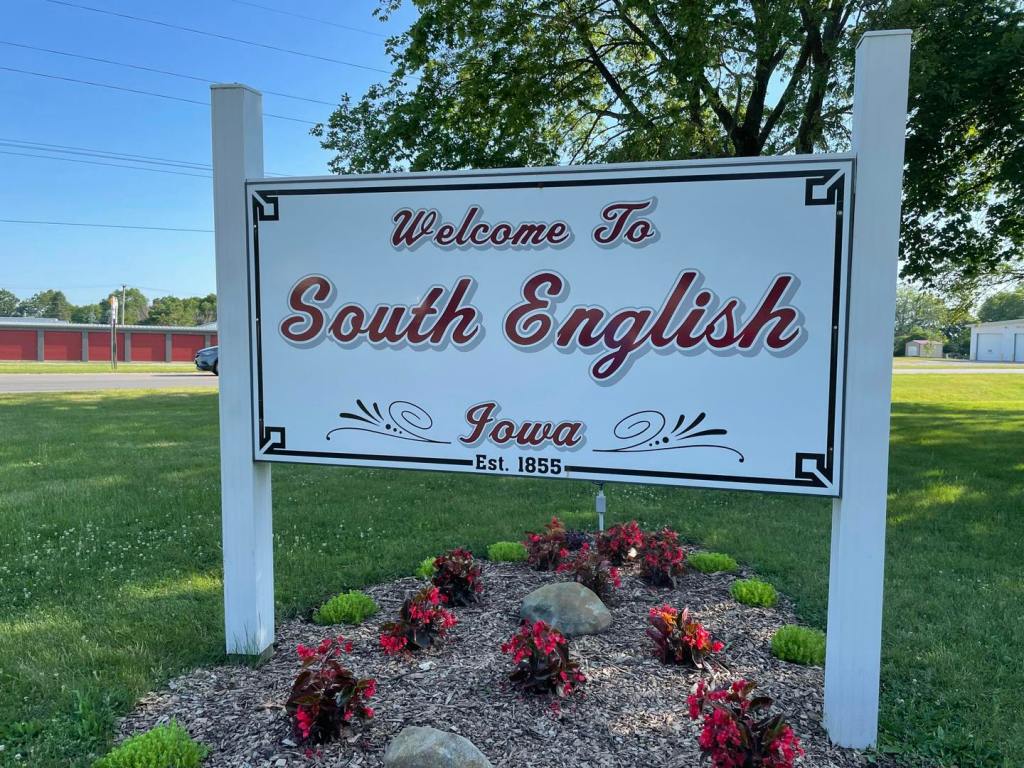
Lula was undoubtedly glad to get out of Dodge (South English, Iowa). That statement didn’t come along until Marshall Matt Dillon and Miss Kitty made it popular on “Gunsmoke,” but it works just fine here.
Before I tell you who Lula and Mrs. John F. Good were, South English, Iowa, Wrangell Narrows, and Hoonah, Alaska, have to be briefly explored first.
South English, Iowa, is a small farming community named after the nearby English River. In 1910, its population was just 338 residents, reflecting its rural character and close-knit atmosphere. Located in southeastern Iowa, the town is surrounded by fertile farmland and has traditionally relied on agriculture as its economic foundation. Life in South English was marked by a strong sense of community and the rhythms of the farming calendar, making it a quintessential example of early 20th-century rural Iowa.
Wrangell Narrows is a scenic and essential waterway located in Southeast Alaska, known for its narrow channel, strong currents, and importance to both local communities and marine traffic. This passage has served as a lifeline for the region’s transportation, commerce, and culture.
This body of water stretches approximately 22 miles (35 kilometers) between the towns of Petersburg and Wrangell, Alaska. It lies between Mitkof Island to the east and Kupreanof Island to the west, forming part of the Inside Passage—a network of protected waterways renowned for safe navigation and stunning scenery.
The narrows are well-known for their winding curves and variable widths, at some points narrowing to less than 300 feet across. Depths also fluctuate, requiring careful navigation, especially for larger vessels.
Wrangell Narrows is famous among mariners for its complex navigation. The channel is dotted with more than 60 navigational aids—buoys and markers—that help vessels avoid shallow areas, rocks, and other hazards. Currents can be strong and tidal shifts significant, making timing and skill essential for safe passage.
Large cruise ships typically avoid Wrangell Narrows due to its tight bends and shallow spots, but ferries, fishing boats, and freight vessels frequently traverse the waterway, connecting regional communities and supporting the local economy.
The towns of Petersburg and Wrangell depend on the Narrows for their connection to the rest of Southeast Alaska. The Alaska Marine Highway ferry system and other local vessels use the passage regularly, making it a crucial route for passengers, goods, and services.
The Narrows is surrounded by lush temperate rainforest, home to Sitka spruce, western hemlock, and abundant wildlife. Visitors may see bald eagles, harbor seals, sea lions, and even humpback whales in the surrounding waters. The shoreline is dotted with small islands, tidal flats, and forested hills, offering breathtaking views for travelers and photographers.
While Wrangell Narrows is not typically navigated by large cruise ships, its scenic beauty and accessibility make it a favorite for smaller expedition vessels, private yachts, and kayakers. Petersburg, often called “Little Norway” due to its Norwegian heritage, and Wrangell, one of Alaska’s oldest towns, are both popular stops for visitors exploring the Inside Passage.
Hoonah, Alaska, is a small city located on Chichagof Island in the Alexander Archipelago of Southeast Alaska. Its history is deeply rooted in the traditions of the Tlingit people, who have inhabited the area for thousands of years. Originally a seasonal camp for fishing and gathering, Hoonah became a permanent settlement as Tlingit families established more substantial homes and communities.
In the late 19th and early 20th centuries, Hoonah saw increased interaction with non-Native settlers, missionaries, and traders, which influenced its development. The town was officially incorporated in 1946, but its cultural heritage remains strong, with many residents tracing their ancestry directly to the region’s original Tlingit inhabitants.
Hoonah’s economy has traditionally relied on fishing, logging, and subsistence activities, though tourism has grown in recent years, particularly following the development of cruise ship facilities at Icy Strait Point. Today, Hoonah preserves its unique blend of traditional culture, natural beauty, and community resilience, making it an important hub in Southeast Alaska. For those still wondering, there are no tuna in Hoonah.
Mrs. John F. Good is actually Mrs. Ida Parnell-Good. She married John on July 24, 1895, becoming his second wife. John’s first spouse, Hannah, died in 1892 after 18 years of marriage. Ida Good was born in 1857 and passed away 80 years later in 1933. They were farmers.
It took some time-consuming sleuthing to uncover Lula’s history, as she also went by the name Lulu. Born on April 18, 1866, to Merritt and Margaret Brown, Lula married Jacob Doll on February 17, 1887. When Jacob died four years later in 1891, she wed George Franklin Marshall. This took place on October 2, 1892. Between both marriages, the couple had eight children.
Lula Belle Brown-Doll-Marshall passed away at the age of 59 on February 12, 1924. The Marshalls, like the Goods, listed farming as their sole occupation. Both families were quite well-to-do in their endeavors, with this allowing for George, Lula, and four of their children to make the Alaska trip.
John F. and Ida Parnell-Good are buried at English River Church of the Brethren Cemetery in South English, Iowa, while Lula Belle and George Marshall are interred at Keota Cemetery in Keokuk County.
“Today, Flat stands as one of Alaska’s best-preserved ghost towns…”
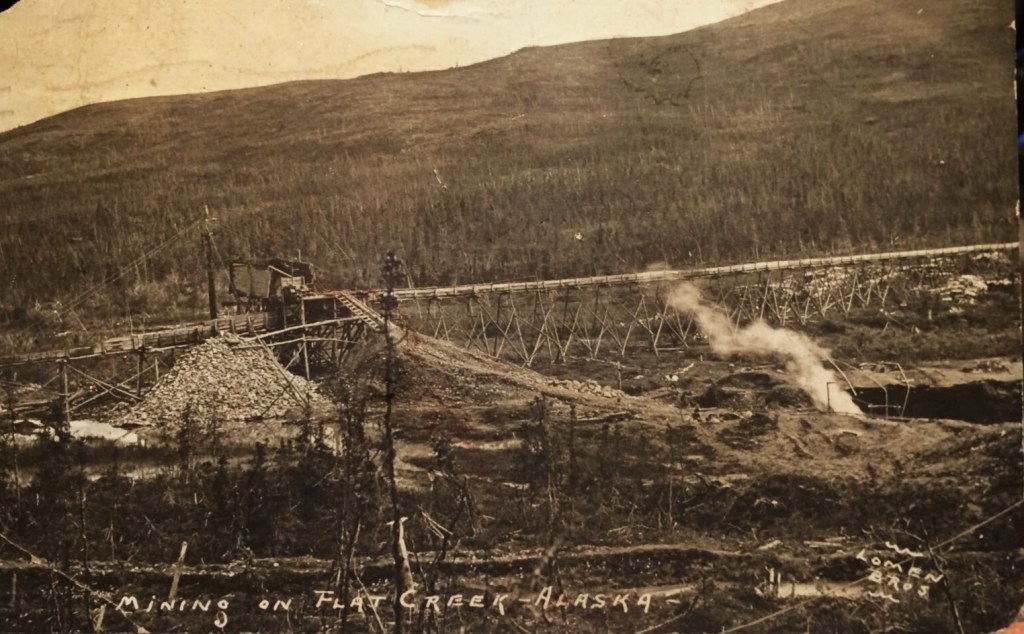
Gold mining just outside the town of Flat, Alaska
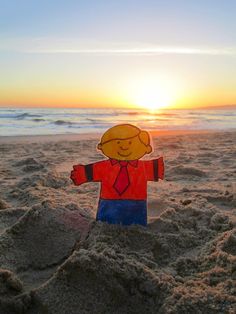
Flat, Alaska, is one of my favorite places to visit. There’s something about the name that intrigues me, almost as much as that affable character, Flat Stanley.
I’m not sure the thin-faced Glat Stanley has ever been to this ghost town, but perhaps he hitched a ride there on a plane, boat, dogsled team, or snowmachine at some time. There are no drivable roads to Flat, so he couldn’t have come via car or truck. For those not knowing who Flat Stanley is, let’s just say he’s a famous world traveler.
Once a bustling gold mining town, Flat sprang to life during the early 20th-century gold rush. Founded in 1908 after gold was discovered along Otter Creek, Flat quickly grew as prospectors and entrepreneurs flocked to the area in hopes of striking it rich.
At its peak, the town boasted several thousand residents, complete with schools, hotels, stores, and even its own newspaper. However, as the gold deposits dwindled and mining operations slowed, Flat’s population declined just as rapidly as it had risen.
Today, Flat stands as one of Alaska’s best-preserved ghost towns, offering a glimpse into the state’s gold rush era and the adventurous spirit of those who once called it home.
In 1920, H.J. Landwehr sent a picture postcard to Sidney Svensen in Fond du Lac, Wisconsin. This postcard shows mining on Flat Creek, which runs right beside the town. It appears they are thawing frozen tundra using wood fires to get at the rich paydirt.
The postcard was postmarked in Seattle on February 26, 1920. Mr. Landwehr possibly picked up the black and white card on a trip to Alaska. I hoped my research would show this as being true.
The short message reads”
“Feb 26/20
Dear friend, just a line to let you know I got your letter. Was shure glad to hear from you. I will write you a letter later.
H.J. Landwehr
2341 E Lake Seattle”
It took almost a day of careful searching to find out who Landwehr and Svensen were. Having last names like theirs, I figured they were of German and Norwegian descent. The problem I had was that there are different ways to spell each, and the handwriting was hard to read.
Heinrich Jacob “Henry” Landwehr was born in Iowa on July 28, 1876. His parents were from Germany, with H.A. and Louise Landwehr immigrating to America for a better life. Farming was their occupation.
Census records indicate that the youngest son, Henry, transitioned into a carpenter after working in a bar and being a policeman as well as a boomman. This final change in occupation might’ve had something to do with a December 25, 1920, newspaper article I found. Transcribed word-for-word, it reads like this.
“Raising a chair in the air, Tom Curtain, 39, recently released from the federal penitentiary at McNeil Island, smashed H.J. Landwehr, an employee of the Our House bar at 151 Washington St., into unconsciousness late Friday evening.
According to Landwehr’s statement to the police, the attack was brought on by Curtain’s belief that Landwehr had ‘squealed’ and sent him to the penitentiary.”
It’s possible, early on, that Henry had high aspirations to strike it rich in the gold fields of Alaska, perhaps even mining in Flat or Iditarod. After combing through archived newspapers, I found a record of the man being there.
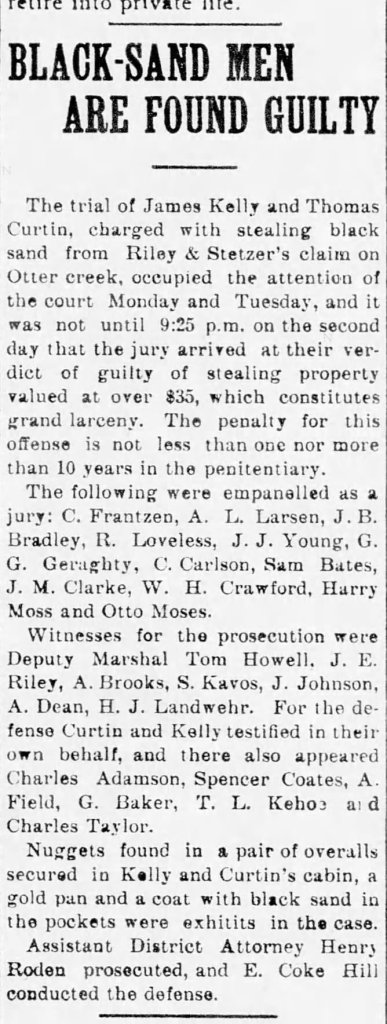
H.J. Landwehr is mentioned in the July 20, 1912, edition of the “Iditarod Pioneer” as a witness to individuals stealing gold-laden black sand from another prospector. After a proper trial, the men were found guilty by a jury, thanks in part to Henry Landwehr’s testimony.
Gold mining must not have been as prosperous as he thought it would be, with Henry returning home to Washington before 1920. Records show Henry Landwehr was a respected member of the Order of the Moose lodge in Seattle, with Mr. Landwehr passing away at the young age of 47 on March 21, 1924. It appears he was not married.
The postcard recipient, Sidney Svensen, is best described by his graphic obituary—as they don’t write them like this anymore. It goes into a little more detail than what I would see fit to print, especially the cause of death. I was correct once again in Svensen’s parents being of Norwegian descent.
“Longview Daily News, Monday, Sep 28, 1970:
Sidney Svensen, 81, of Puget Island, died Sept. 27 in a Longview hospital. He was born Aug. 16, 1889, on Puget Island.
Son of Sven and Servina Johnson Svensen, he married Esther Vog in 1914, was a commercial fisherman, lived at Rt 1 Box 55 Cathlamet, died in Cowlitz General Hospital of ventricular fibrillation with arrest, cancer of the duodenum with metastases, pulmonary emphysema due to asthma, per death certificate 20037, whose informant was his wife. Buried Sep 30, 1970.
He was a member of the First Lutheran Church on Puget Island, was a retired commercial fisherman, served three years as deputy sheriff, two years as town marshal of Cathlamet, and had been a fish buyer.
Surviving are his widow, Esther; two sons, Elroy of Puget Island and Eugene of Camano Island; two daughters, Mrs. Lorraine Bailey of Seattle, and Mrs. Selma Olsen of Longview; 14 grandchildren; six great-grandchildren; and a sister, Mrs. Garda Sherman of Portland.
Services willbeat 2 pm on Wednesday at his church with Rev. Karl Berg officiating. Interment will be in Greenwood Cemetery.”
From the July 20, 1912, “Ididarod Pioneer”“Flat Stanley” in Maui, Hawaii
“I just don’t like the idea of someone going through our mail and then writing a story about what they found.”
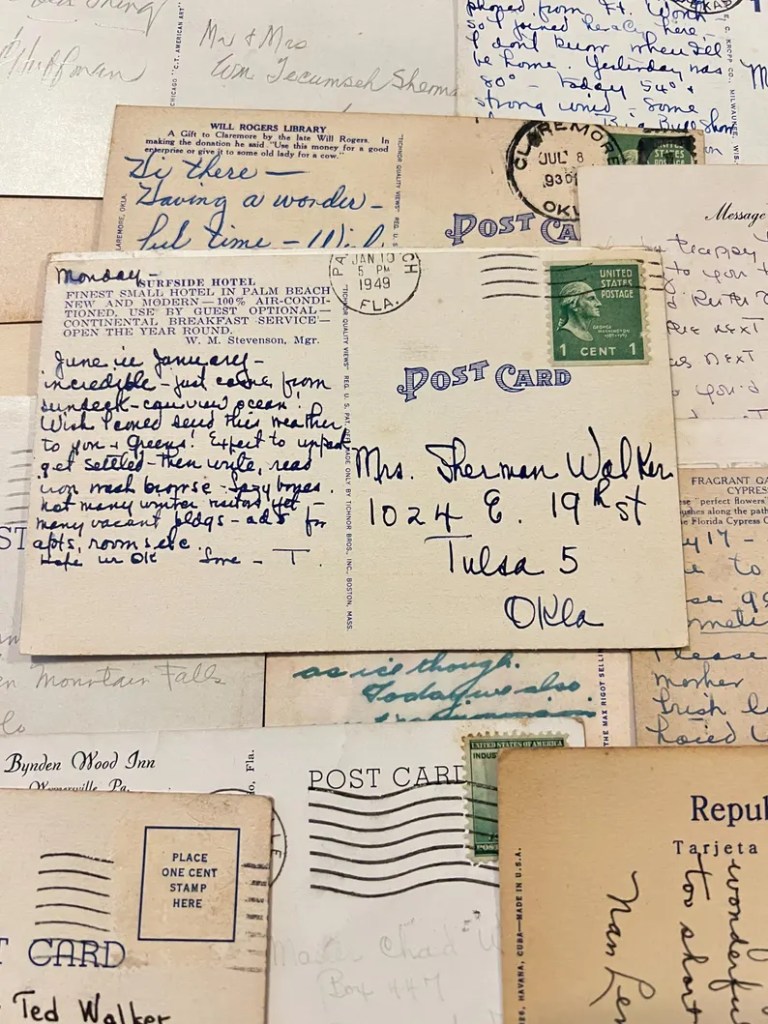
A while back, I started compiling vintage postcards and then researching the people who had sent them, including those on the receiving end. My goal was to dissect 50 postcards and then stop, which I did. Since stopping—I’ve been asked to continue my work with a book offer on the table.
There are postcard books out there, yet none that I’ve found where the book author went so far as to do background searches on people mentioned in the cards. “Postcard People,” as I call them. I’m sure someone will come along and do exactly that, but it won’t be me.
I get more satisfaction out of people reading my discoveries for free rather than trying to make an extra dollar hawking this material. Folks read my blog by the thousands, with payment being a like, thumbs up, or nice comment. Those gestures alone keep me writing.
The pressure of compiling another book turns me off more than anything, especially with book marketing almost non-existent for the little guy or gal. “Who you know” plays a big part in the literary field just as it does in music.
Some celebrities, sports stars, and politicians hawk their latest books on late-night television, although the finished product might stink. That global marketing reaches millions of people and sells tons of books.
A best seller doesn’t always mean it’s a good read—only that it was well promoted. I’ve purchased a couple of expensive best-sellers and stopped reading them less than halfway through. With that said, it’s time to get back to talking postcards, or is that postcards talking?
The act of sending postcards has long been a cherished tradition around the world. From the late 19th century to the present day, postcards have captured moments, shared stories, and connected people across distances. I’ll lightly touch upon how postcards evolved from simple pieces of mail into treasured keepsakes that reflect social, cultural, and technological changes throughout the years.
The concept of the postcard emerged in the mid-1800s as postal services expanded and literacy rates increased. The first known postcard was sent in 1840 by writer Theodore Hook in London, but it was not until 1869 that the Austrian postal service officially introduced the “Correspondenz-Karte.” This innovation offered a cheap, convenient way for people to send short messages without the need for an envelope, revolutionizing personal communication.
The idea quickly spread across Europe and beyond. By the 1870s and 1880s, countries such as Germany, France, and the United States had adopted postcards as part of their postal systems. Early postcards were typically plain, but soon, decorative illustrations and photographs appeared, turning them into miniature works of art. The Golden Age of Postcards, spanning from the 1890s to the 1910s, saw millions of postcards exchanged annually, capturing travel scenes, local landmarks, holidays, and personal messages.
Postcards played an important role in social life, offering a quick and accessible method for people to stay in touch. Travelers sent postcards to family and friends as souvenirs or updates from their journeys. Soldiers used them to communicate with loved ones during wartime, providing comfort and maintaining connections across great distances. Postcards also became tools for advertising, political campaigns, and public service announcements.
The rise of telephones and, later, digital communication methods such as email and messaging apps led to a decline in postcard usage. However, postcards remain popular among collectors and enthusiasts, and many people still send them as a personal touch from travels or on special occasions. The advent of customizable and digital postcards has allowed the tradition to persist in new forms, blending nostalgia with modern convenience.
Sending postcards has become more than just a way to convey information; it represents a unique intersection of art, culture, and personal expression. Collectors prize vintage postcards for their historical value and design, while contemporary aficionados appreciate the tangible connection they provide in an increasingly digital world. Count me in with that group.
Postcards continue to serve as artifacts of social history, capturing snapshots of everyday life and commemorating important events.
The history of sending postcards reveals a fascinating journey from simple cards to beloved keepsakes. While the way people communicate has changed dramatically, the postcard endures as a symbol of connection, creativity, and shared experience—reminding us of the enduring value of a personal message sent across the miles.
Mom and her two sisters loved to send postcards when they went on trips. My brother did as well. Joleen and I sent postcards, but over the past 20 years, we’ve mailed very few.
Some of the cards that Mother sent, I still possess, including several from other folks. I’ll hang onto them and make sure they don’t go public or are sold on eBay. Not that there’s anything shady lurking in my family’s past, that I know of, but I just don’t like the idea of some writer going through our mail and then composing stories about what they uncovered. There should be a law against it, or perhaps there already is 😊
“I didn’t find any flamboyant or earth-shaking information on Louie and Leon Herr, besides Louie being a seldom-used first name for a gal.
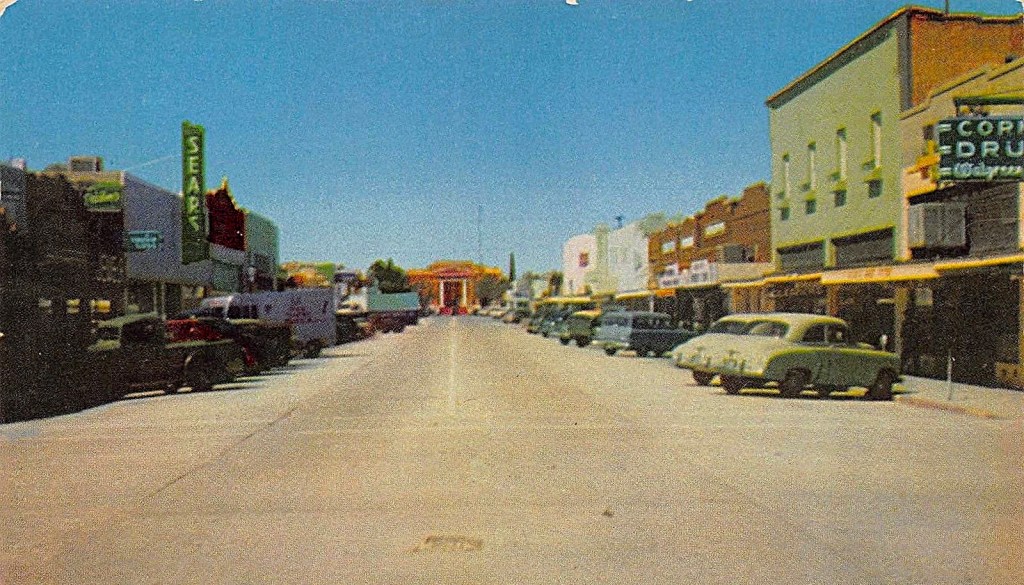
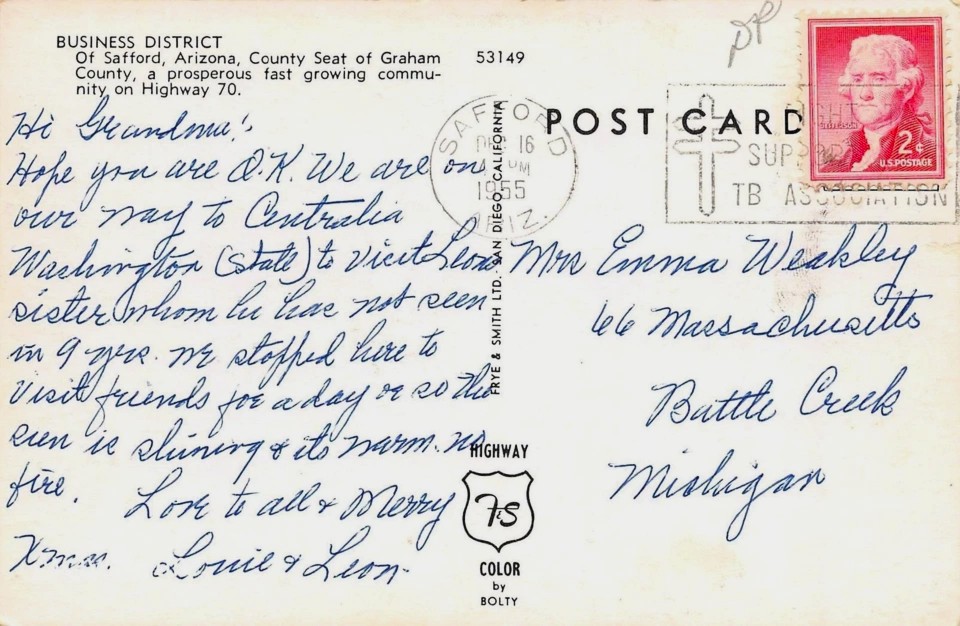
A postcard that Louie and Leon sent to Mrs. Emma Weakley in Battle Creek, Michigan, shows a photo of Main Street in Safford, Arizona. Old automobiles are seen parked along it. The color postcard is dated December 16, 1955, and was stamped in Safford. A short note on it without correction reads as follows,
“Dear Grandma,
Hope you are OK. We are on our way to Centralia Washington (State) to visit Leons sister whom we have not seen in 9 years. We stopped here to visit friends for a day or so. The sun is shining & its warm. No fire. Love to all & Merry Xmas. Louie & Leon”
Safford, Arizona, is located in Graham County in the southeastern part of the state. The city’s history dates back to the late 19th century, when the fertile Gila Valley attracted settlers seeking farmland and opportunity. The first permanent Anglo-American settlers arrived in the area around 1873, following earlier Native American habitation, primarily by the Apache people.
The town was officially founded in 1874 and named after Anson P.K. Safford, the third governor of the Arizona Territory. Safford served as a hub for agriculture, thanks to irrigation projects that supported cotton, alfalfa, and other crops. The arrival of the railroad in the 1890s further spurred economic growth and helped connect Safford to larger markets across Arizona and beyond.
Mining also played an important role in the region’s development, with nearby copper mines, especially in the Clifton-Morenci area, drawing workers and their families. Throughout the 20th century, Safford continued to serve as the commercial and governmental center of Graham County, and today it remains known for its agricultural production, small-town charm, and proximity to scenic attractions such as Mount Graham and the Gila River.
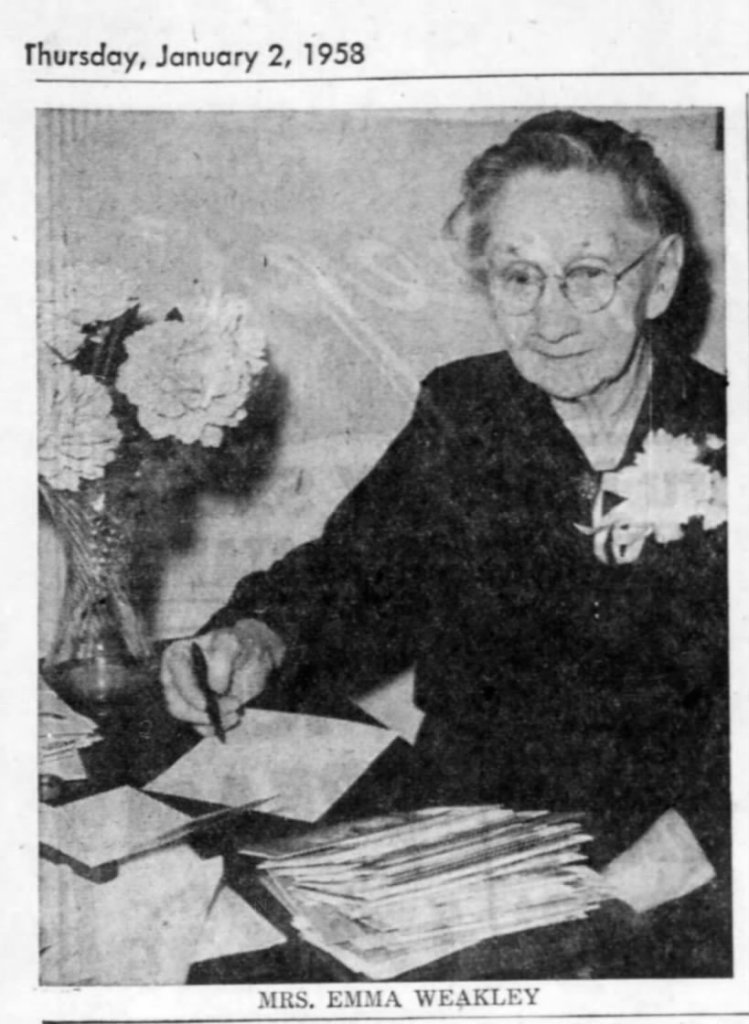
Emma I. Taylor was born January 4, 1868. She married James Weakley on January 12, 1886, at 18 years of age. Emma and James were married for 57 years before he died on March 18, 1943. James was 77.
Mrs. Emma Weakley was a very religious woman and played piano and organ in her church for almost 40 years. She died at the age of 98 on June 13, 1963. Emma Weakley was blessed by having so many family members. Mrs. Weakley’s well-written obituary sums her long life up best in so many words.
“Mrs. James A. (Emma) Weakley, 98, believed to be the oldest member of the Seventh-day Tabernacle here, died Sunday morning at a local hospital where she had been a patient for 3 years.
She had been a Battle Creek resident at 66 Massachusetts Ave., and an area resident since 1920, when she and her husband moved to a farm on Route 1, Fulton, from Lexington, Illinois.
Mrs. Weakley was born January 4, 1868, in Clarksville, Illinois, the daughter of William and Matilda (Youngs) Taylor. She and Mr. Weakley were married in Lexington on January 12, 1886. He died on March 18, 1943, and Mrs. Weakley came to Battle Creek to live with her son, Robert.
She is survived by two daughters, Mrs. Charles (Eva) Munster of 27 Cliff St., and Mrs. Charles (Creta) Herr of Berrien Springs; four sons, Ernest of Marshall, Russell of Athens, Robert of 66 Massachusetts Ave., and Michael of 124 Leonard Drive; 21 grandchildren, 53 great–grandchildren, and 23 great-great-grandchildren.”
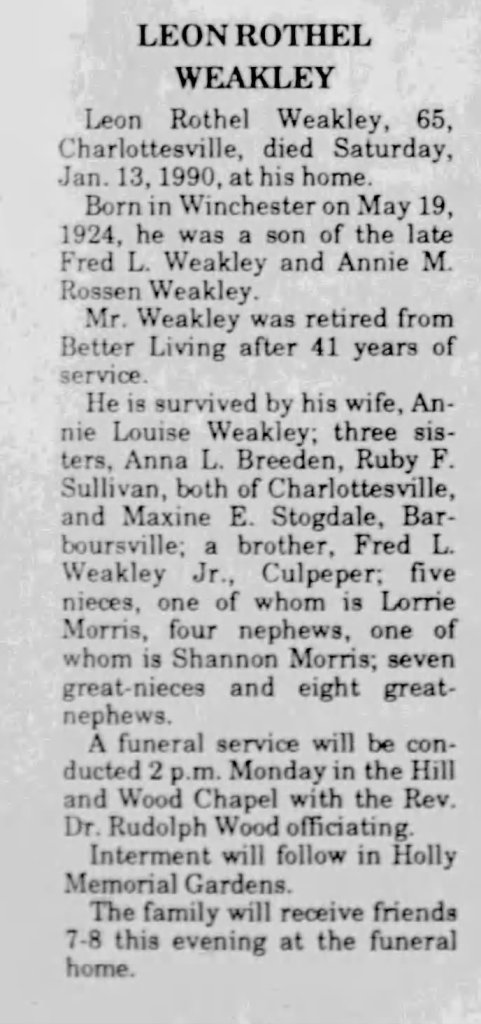
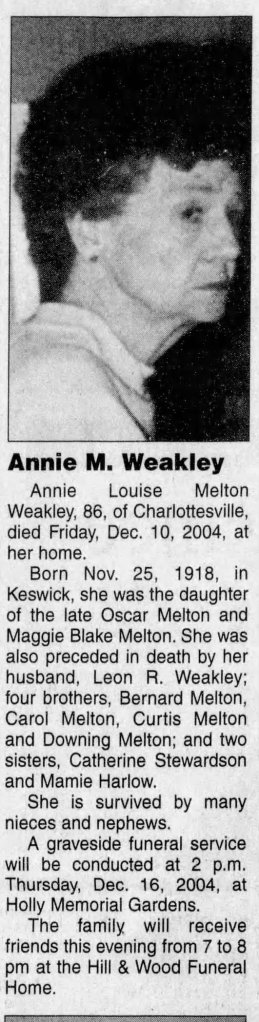
I didn’t find any flamboyant or earth-shaking information on Louie and Leon, other than Louie being a seldom-used first name for a gal. Louie is also a nickname for Louise, which stumped me for some time. Having no last name to go on, I spent hours trying to put this piece of the puzzle together. Things finally clicked.
Leon Rothwell Weakley was born in Virginia on May 19, 1924. He married Annie Louise “Louie” Melton on November 24, 1946. Leon passed away on January 13, 1990, while his wife, Louie, died on December 10, 2004. Leon was a blood relative of Margaret Emma Weakley, being one of her 21 grandchildren.
I’m sure if Emma Weakley had anything to say about the postcard held in her wrinkled hands, the 90-year-old woman would’ve questioned why Louie took Christ out of Christmas by writing Merry Xmas. That was highly frowned upon by Christians back then—and still is today.
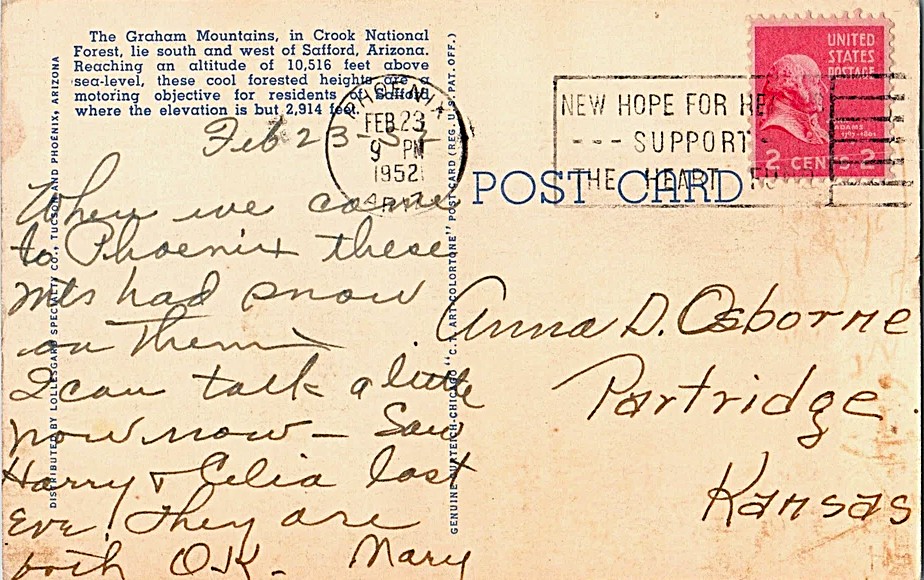
“A vintage picture postcard sent from someone named Mary to Miss Anna D. Osborne in Partridge, Kansas, shows Mt. Graham in all of its 10,720-foot glory.”
Mt. Graham
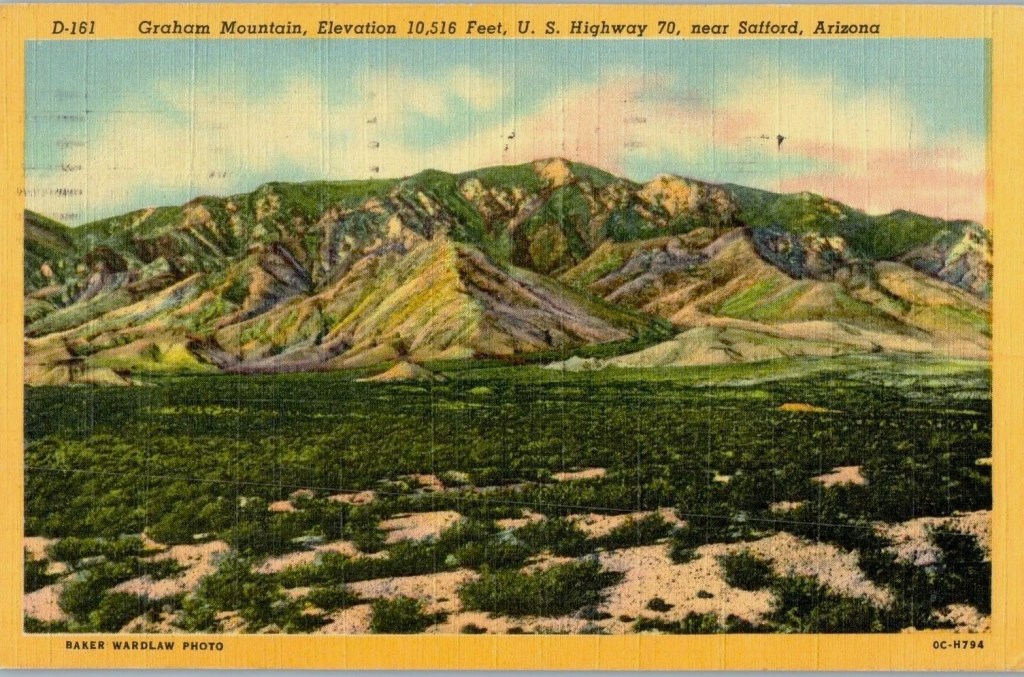
Easily visible from Safford, Arizona, Graham Mountain is the highest peak in the Pinaleño Mountains, located in southeastern Arizona. Rising to approximately 10,720 feet (3,267 meters), it stands as the summit of Graham County and is a prominent feature of the Coronado National Forest.
This majestic mountain is renowned for its rich biodiversity, featuring unique flora and fauna that thrive in its diverse ecosystems, ranging from desert foothills to alpine forests.
The mountain was named after Lieutenant Colonel James Duncan Graham, a U.S. Army officer who surveyed the region in the mid-19th century. The area around Graham Mountain has a deep history of Native American habitation, particularly by the Apache people, who considered the Pinaleño Mountains sacred.
During the late 1800s, settlers arrived, and the region became known for mining, ranching, and timber activities. Today, Graham Mountain is valued for its recreational opportunities, including hiking, camping, and wildlife observation, and is a focus for conservation efforts due to its ecological significance.
A vintage picture postcard sent from someone named Mary to Miss Anna D. Osborne in Partridge, Kansas, shows Mt. Graham in all of its 10,720-foot glory. The description on the backside of this postcard says that the mountain presents a motoring objective to those living in or traveling through Safford, with the town’s elevation only 2,914 feet above sea level.
Written in ink by Mary is a brief message,
“Feb 23 – 52
When we came to Phoenix these Mts had snow on them. I can talk a little more now – saw Harry & Celia last eve – they are both OK – Mary”
I have to assume that Mary was ill at one time, and perhaps had lost her voice while now slowly regaining it, with Laryngitis coming to mind. My research indicates that Mary was the daughter of Miss Anna D. Osborne and Dr. Worthington Hooker Osborne, with Harry being a son, and Celia, Harry’s wife, residing in Globe, Arizona, not far from Safford. Anna and Worthington Osborne had a total of seven children.
Anna’s husband was a physician who last practiced his trade in Nickerson, Kansas, as well as in Elsinore, Castleton, and Center Township. Not one to stay idle, after retiring from the medical profession, he became a farmer. Worthington Osborne died on March 16, 1932, at the age of 83.
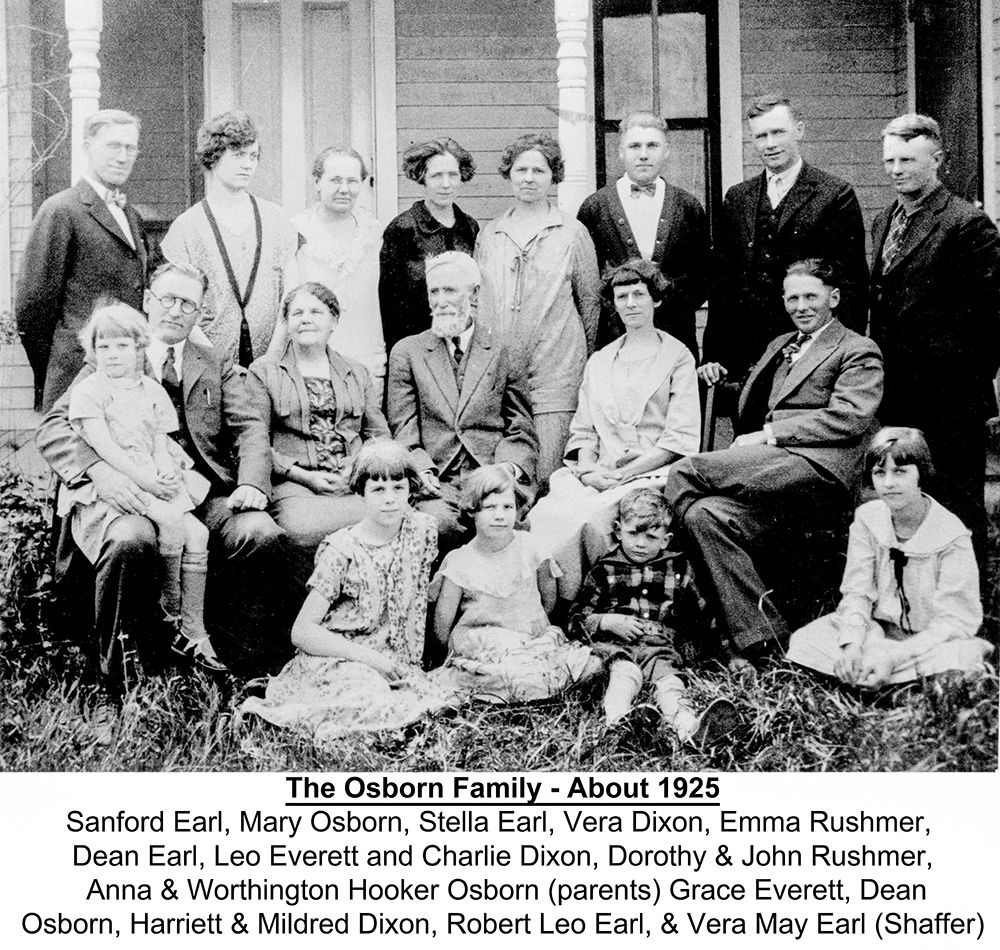
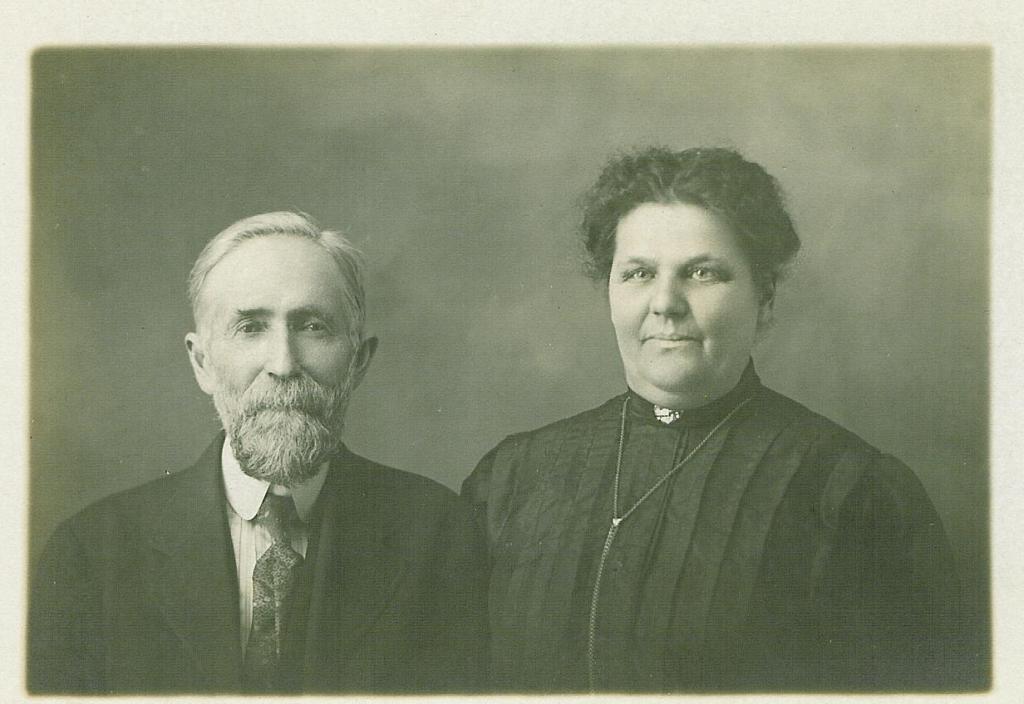
One surviving family photo shows the couple and their many children. A portrait of Anna and Worthington also came to light. Anna Dean-Worthington died at Mt. Pleasant, Iowa, in December 1953, at the age of 92. She’s buried beside her husband in Partridge Cemetery.
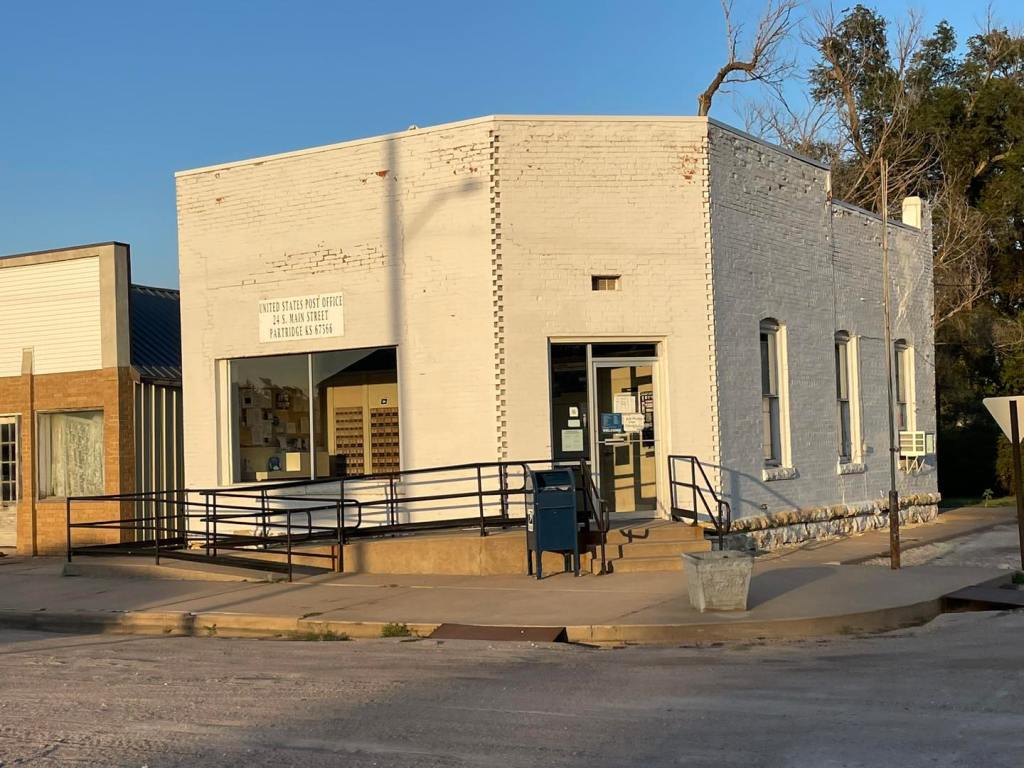
For mere trivia’s sake and nothing else, the town of Partridge, Kansas, during the last census, stood at 209. The Partridge Quails won the Kansas State High School boys Class B basketball championship in 1954. They haven’t regained the title since, now going on 72 years. Perhaps this is the year that the Quail don’t fail.
Worthington Hooker and Anna D. OsbornePartridge, Kansas, post office
“Imagine that you are Miss Ruby Ellens, having just received this card, or better yet, Ruby’s father.”
Main Street – Yuma, Arizona
Yuma Army Air Field, located near Yuma, Arizona, played a significant role during World War II as a key training base for military aviators. Established in 1942, the airfield was part of the United States Army Air Forces’ rapid expansion to meet wartime demands for skilled pilots and aircrew.
Throughout the war, Yuma Army Air Field hosted advanced flight training for thousands of cadets, specializing in single-engine aircraft. Its vast desert terrain provided ideal conditions for year-round flying and rigorous training exercises. The base operated various aircraft types, including the AT-6 Texan and P-40 Warhawk, and contributed to the preparation of pilots for combat missions across multiple theaters.
In addition to flight training, the airfield supported gunnery and bombing practice, further enhancing the capabilities of U.S. air forces. After the war ended in 1945, the base was deactivated but later reopened and evolved into today’s Marine Corps Air Station Yuma, continuing its legacy as a vital military aviation facility.
Private C.W. Hilleboe was assigned to the Yuma airfield at the start of WWII. I know this much because I have a picture postcard the private sent Miss Ruby Ellens in Sioux Falls, North Dakota, from Yuma, 71 years ago, on October 1, 1944. The card has a color shot of Yuma’s Main Street on the front, also showing older automobiles of the period.
Before I go any further, let me say that I’ve come across numerous vintage newspaper articles along with postcards having racist undertones. For the most part, I don’t include them in my stories, but in this case, the message that Pvt. Charles William “Bill” Hilleboe sent Ruby Ellens may have been the very reason this couple didn’t stay together.
I decided to print his short note, as written, to prove my point. Imagine that you are Miss Ruby Ellens, having just received this card, or better yet, Ruby’s father. Perhaps Bill didn’t mean what he said, but unfortunately, things came out wrong, especially where drinking alcohol is concerned.
“10-1-44
It isn’t that clean, believe me.
Here’s the card I promised to send you. I would have sent it sooner but last night was my first night in town, also my last. The town is no good. All you see are Mexicans and halfbreeds. One thing though they have plenty of liquor. Believe it or not, I didn’t touch it last night. I am waiting until I get home. Will write you a letter soon. Love, Bill.”
Ruby Jean Ellens was born on February 16. 1922, in Minnehaha, South Dakota. She came from a very religious family, and she was highly active in church as a young person.
Charles William “Bill” Hilleboe was born on March 5, 1924, in Minneapolis, Minnesota. Enlisting in the US Army on June 27, 1942, at the age of 18, he was only 20 when he wrote Ruby Ellens.
Pvt. Hilleboe served as a radio operator on B-17 and B-24 bombers during WWII. He married Barbara Ellen Doherty on June 29, 1946, but that marriage didn’t last. They divorced on May 19, 1950.
Bill then wed Iva Maurine McKinney on October 9, 1950. After leaving the service, he worked as a depot agent for Union Pacific Railroad for 37 years before retiring. Mr. Hilleboe was also mayor and city councilman of his hometown in Idaho, and an active Lions Club officer and participant. The couple had three children.
Bill and Maurine stayed together for 53 years before she died in 2004. Bill died one year later, on May 10, 2005, at the age of 81.
For those wondering what happened to Miss Ruby Jean Ellens, stay tuned for my next story, “Yuma Blues – Part Two.”
“The word Blythe alone doesn’t conjure up an oasis or vacation destination for me.”
Lonely and desolate
During WWII, there were several airfields in and around our neck of the woods. My mother always used that term when describing her hometown in Alabama. Works for me here in Arizona, although there are no woods within sight; only rocks and sagebrush out my back door, along with the lake.
Lake Havasu City had yet to become a dream in developer Robert McCulloch Sr’s eyes when a military airfield was built on what’s now called “The Island.” That facility was simply named Site 6 and was used as a recreational site more than anything. On occasion, a civilian airplane experiencing engine trouble landed there for repairs.
Yucca had a military base, as did Kingman and Yuma. What some people don’t realize is that an Army Air Base at Blythe, California, played a significant role during World War II as a training and operational facility for the US Army Air Corp.
Established in 1942, the base was strategically located in the desert of Riverside County, which provided an ideal environment for flight training due to its generally clear weather and vast open spaces.
Blythe Army Air Base primarily served as a training ground for bomber crews, including those assigned to fly B-17 Flying Fortresses and B-24 Liberators. The facility was part of the larger West Coast airfield network, supporting the war effort by preparing air crews for combat missions overseas. Personnel stationed at Blythe underwent rigorous training in navigation, bombing techniques, and aerial gunnery.
In addition to its training functions, Blythe Army Air Base supported various operational units and hosted several temporary deployments. Its airstrips and facilities were also used for aircraft maintenance and logistics operations. The base contributed to the overall readiness of the Army Air Forces, helping to ensure the effective deployment of trained airmen to the European and Pacific theaters.
After the end of World War II, Blythe Army Air Base was deactivated and eventually repurposed for civilian use, becoming Blythe Airport. Today, its legacy endures as a reminder of the region’s contribution to the nation’s wartime aviation history.
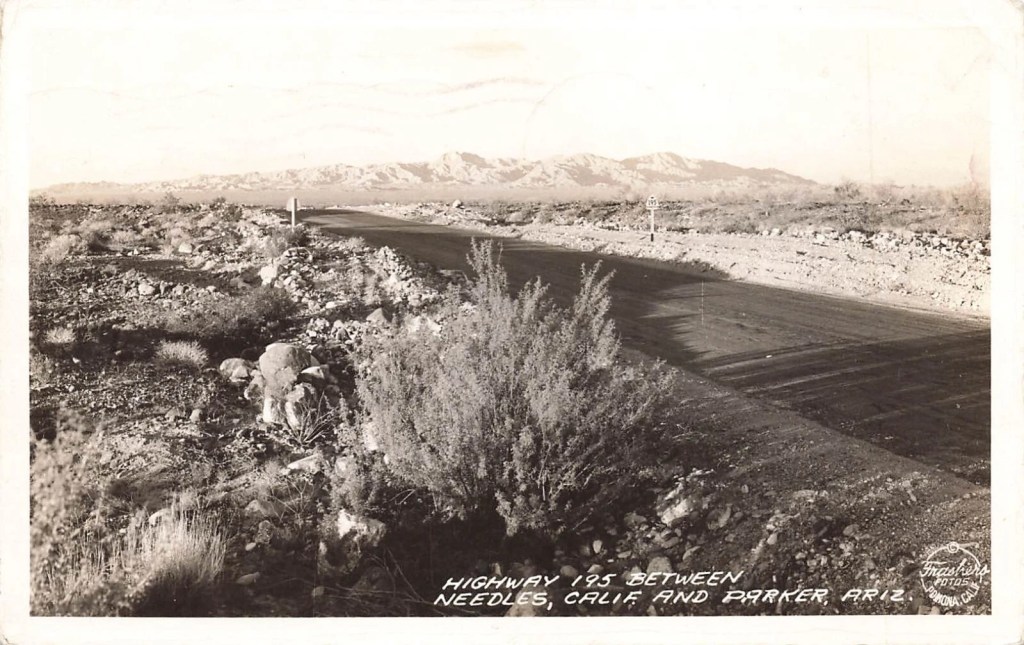
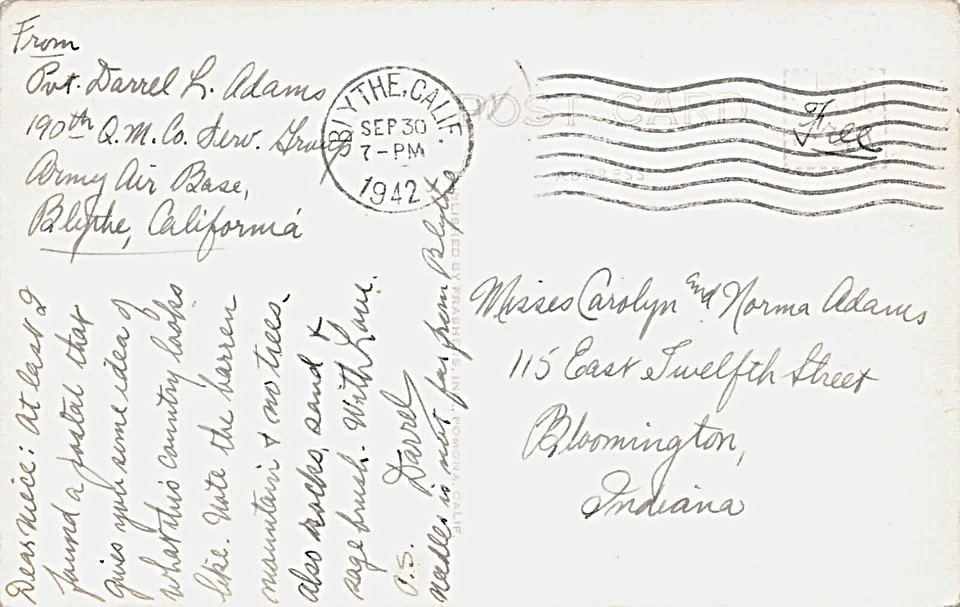
A postcard I acquired was sent by Pvt. Darrel L. Adams to his two nieces in Bloomington, Indiana, Carolyn and Norma Adams, while the private was stationed at Blythe Army Air Base in California. The message on this card briefly describes his surroundings:
“Dear Niece: At last I found a postal that gives you some idea what this country looks like. Note the barren mountain & no trees, also rocks, sand, & sage brush. With love, Darrel. P.S. Needles is not far from Blythe.”
Darrel’s black & white postcard shows a picture of a bleak section of Highway 195 from Needles to Parker. The word Blythe alone doesn’t conjure up an oasis or vacation destination for me. This vintage postcard was postmarked in Blythe on September 30, 1942, with the return address being,
Pvt. Darrel L. Adams
190th. Qm. Co. Serv. Group
Army Air Base
Blythe, California
I wasn’t sure what I’d find regarding the card sender and recipients, greatly hoping that Pvt. Adams made it through the war alive. Thankfully, things turned out well for all three people.
Private Darrel Adams was honorably discharged from the US Army in 1945 after WWII ended. Adams went on to become a custodian for an office building. Previous to enlisting in the service, he declared his occupation on a 1940 census report as a professional projectionist. Born in 1921, Darrel Lewis Adams died in 1988 at the age of 77.
Carolyn June Adams was born August 24, 1925, and would’ve been 17 when Uncle Darrel sent that postcard to the girls. Carolyn’s sister, Norma, was only 14, having been born on March 7, 1928.
Carolyn married Roy Henry Torbit on May 5, 1944, while her sister Norma wed a guy named Ted Lee Fox in 1948. A previous marriage for Norma had failed. Carolyn died in 2000 at the age of 75, with younger sister Norma outliving her, passing away in 2012 at the age of 84.
I found nothing outrageous or controversial about Darrel, Carolyn, or Norma Adams. Their lives were what I call routine where ‘postcard people’ are concerned—much unlike “The Adams Family” of television fame.
Postcard people is a new terminology I’ve given to the sender and recipients of vintage postcards. If things catch on, there’s a very slight chance it’ll go viral!