LONGTON RUMOR

“Her husband left town with a floozy from North Memphis.”

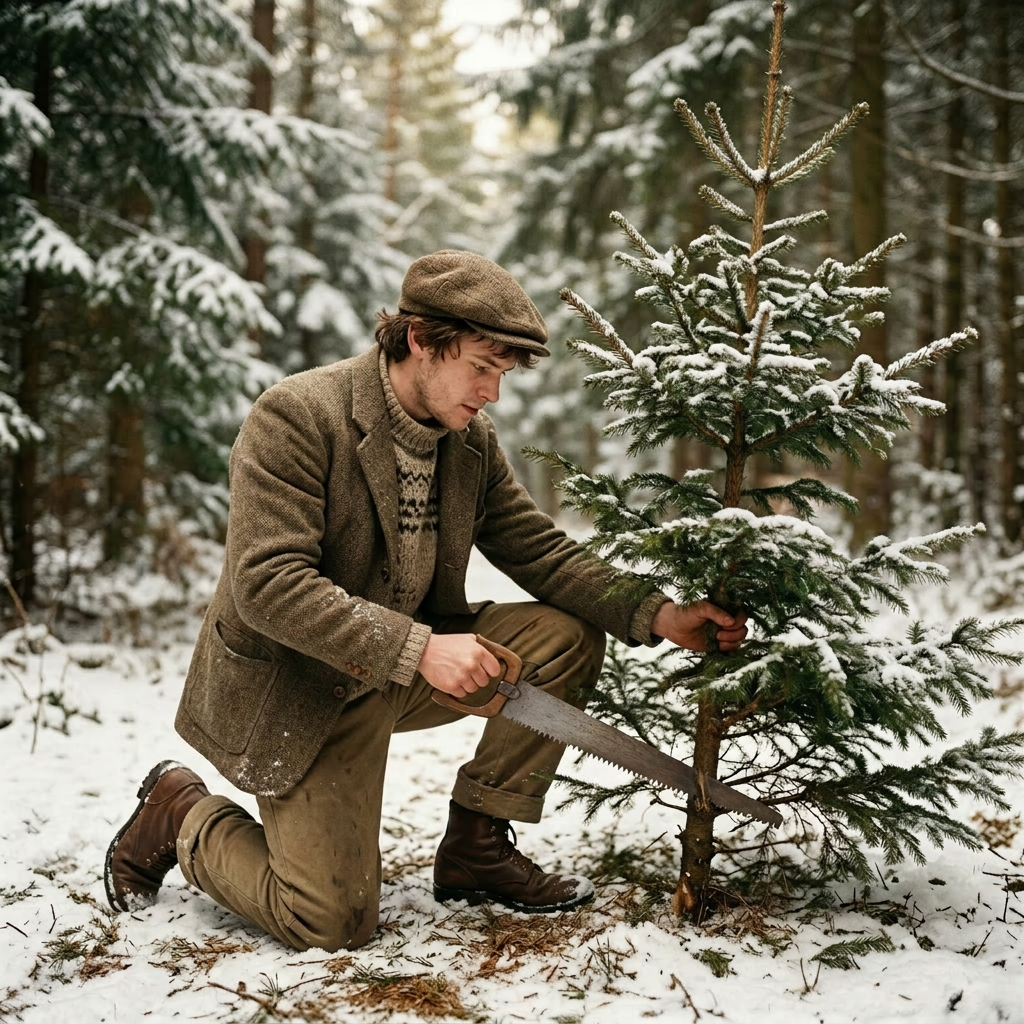
Man kneeling in snow using hand saw to cut small fir tree
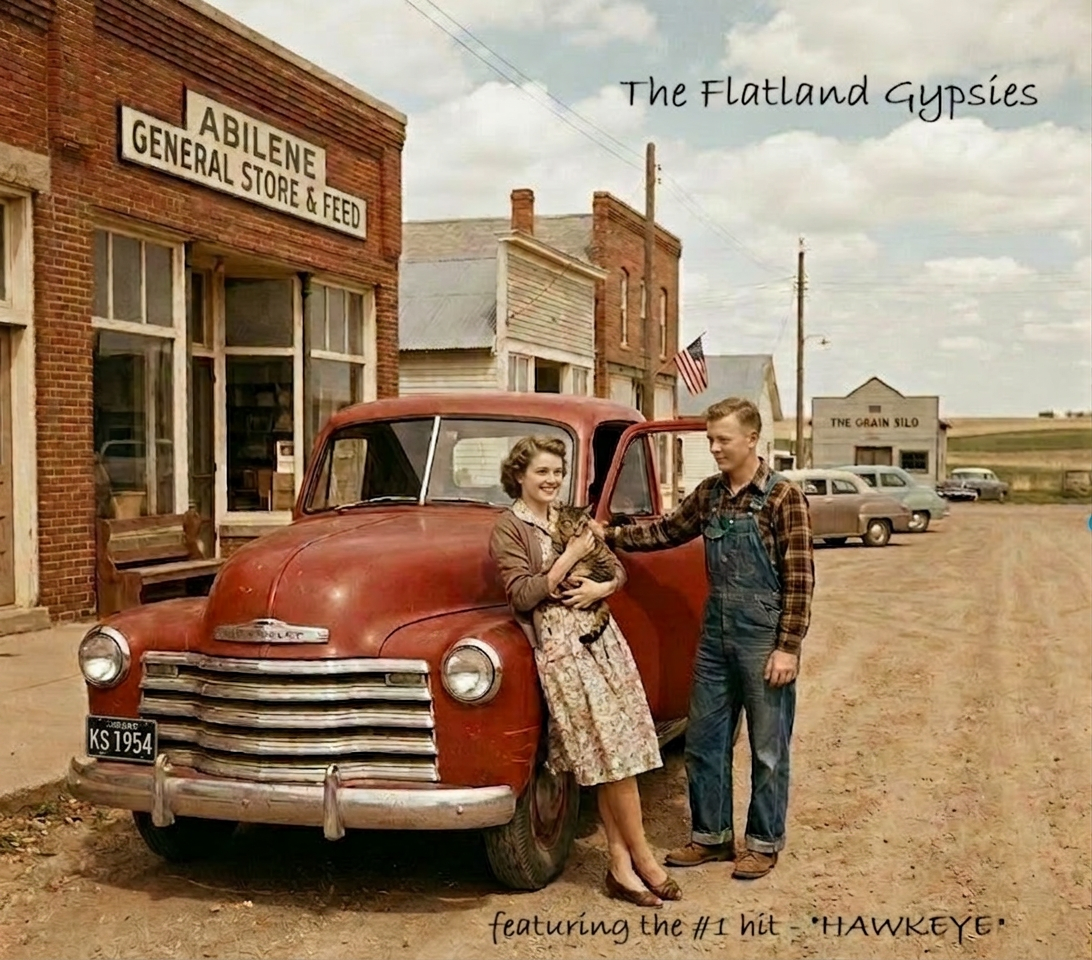
  • These are lyrics to a song I’m working on. Had to be so careful not to use names of real people buried in Kansas. There is no Richard Caulkins buried in Kansas, nor Henry Joe Dixon. Linda Sue Dixon is the name from a 1968 song by the Detroit Wheels, appropriately titled “Linda Sue Dixon.” It was banned from being played on radio stations because of the initials (LSD). I didn’t know that at the time and really liked the tune. Click the link at the bottom of page.

Some residents claim a ghost,

Still walks the streets of Longton.

I’m not one to dispute,

Whether those folks are right or wrong.

*****

The story goes that a young bride,

Was sobbing one snowy Christmas,

When her husband left town,

With a floozy from North Memphis.

Ummm

*****

Local residents tried their best

But failed to console Lynda Sue Dixon.

The poor gal spent rest of her life,

Popping pills she called a prescription.

*****

Friends could only take so much.

Relationships can’t survive without love and trust.

Lynda couldn’t make it through a day,

Without her wine and pill buffet.

Ummm

*****

They say a broken heart’s hard to heal.

No matter how others may feel.

Like Humpty Dumpty, shattered beyond repair.

Distrust can turn into total despair.

*****

Miss Lynda Sue passed away

On a dark, cold January day.

In the year 1908,

When the train was runnin’ late.

*****

She was soon laid to rest

Next to an unknown grave.

That old hole filled with bones,

Scattered in total disarray.

*****

They say late last evening,

Longton’s ghost was seen crying.

Limping through streets of mud,

Past businesses no longer thriving.

*****

Trying to find a bit of solace,

from a tall tale created by gossip.

The truth of it being,

That ghost is Richard Caulkins.

Ummm

*****

What dem gadflies didn’t know,

about young Henry Joe Dixon.

Was that the man never left town,

in the arms of a copulating vixen.

*****

Henry unexpectedly died,

Harvesting Christmas trees for his wife.

Fatally shot and then buried,

by Old Man Caulkins and his boy, Jerry.

*****

Henry Dixon’s bleached white bones,

Were found just outside of Longton.

By dogs huntin’ for cagey raccoons,

Near a smelly and dank lagoon.

*****

Although Sue didn’t know at this time,

She found out in the afterlife.

The moral of this song.

Spreading rumors is more than wrong!

Amen

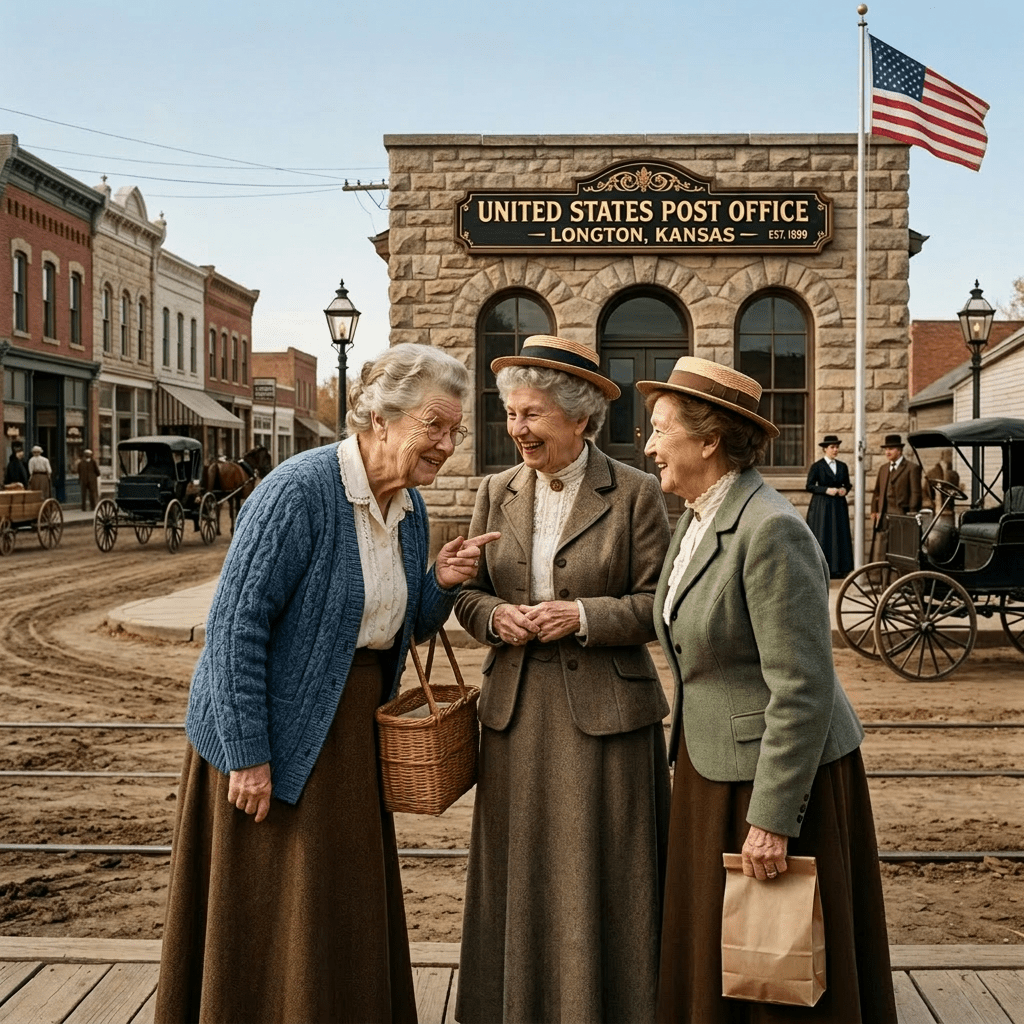
Three elderly women laughing and talking in front of Cedar Bluffs post office, Kansas

MUSIC MAN

“I’ve always liked writing lyrics and believe I’ll shift more in that direction.”

I’ve written some songs over the years, yet I couldn’t find anyone to sing them. Not blessed with the ability to play piano or guitar myself, I was left with unfulfilled compositions.

In one case, I sent the lyrics to a local Lake Havasu City band, yet never heard back. I was told that, like movie scripts, unsolicited song lyrics are scorned by lawyers representing musicians for fear that, if they do become a hit, the songwriter could file a lawsuit seeking additional proceeds.

Attorneys advise musicians to write their own lyrics or go through various music guilds for protection. Again, this is a ploy to control the music, as some big-name publishers try to do with books.

I recently wrote a song for my wife and was advised by a friend to have it released through AI. Not knowing what he meant, I researched the subject and found that many companies can do this. After looking at several, I finally went with a company called SUNO. I believe they did an awesome job.

AI music is made when computer programs learn from many examples of songs and sounds. These programs study patterns in music, such as melody, rhythm, harmony, instruments, and song structure. After learning these patterns, the AI can create new music based on a person’s instructions.

For example, someone might ask the AI to make a calm piano song, an upbeat pop track, or a dramatic movie-style soundtrack. The AI then uses what it has learned to generate notes, sounds, lyrics, or even a full song.

After the music is created, a person can listen to it, edit it, change the instruments, adjust the tempo, or improve the mix. In this way, AI music is made through a combination of machine learning and human creativity.

Personal lyrics can be added, with the music designer selecting instruments and singers to complete the composition. What this amounts to is that music writers no longer have to solicit bands and orchestras, nor do the writers have to belong to music guilds, which are nothing more than unions with their greedy hands out.

I was able to fine-tune my selection by choosing which instruments I wanted, the song’s genre (mostly country/pop), and singers of both sexes. It has a country-western twang that fits the lyrics about a girl named Joleen and a rural Kansas town named Hawkeye.

The name of this song is “Hawkeye” and can be heard on my YouTube site. I recorded it from the initial cut with my camera, so the acoustics aren’t quite right, unlike on the original. I’m still learning audio as I go along.

What does this all mean? The average Joe or Mary can now write music and have it professionally represented without having to kiss some music guild’s patooney.

As a writer, I tried working with publishing companies that wouldn’t give me the time of day. They were the final hurdle in getting things published until self-publishing came along. Now, I get voice messages all the time from representatives at publishing houses asking me to work with them on future projects. I never call them back.

I’ve always liked writing lyrics and believe I’ll shift more in that direction. The time is already here when AI songs have hit the top, especially in the UK. The US is fighting the influx of AI-generated music not just on traditional radio but across streaming platforms.

This push is led by major labor unions and the U.S. Copyright Office, culminating in federal legislation, state laws, and massive industry lawsuits. I laugh each time I hear one of these groups has lost.

The music industry is trying to keep them out of this country for monetary reasons, but they won’t be successful for long. A good song is a good song, no matter who creates it.

“The Archies” proved 57 years ago that a successful virtual band, made up of unknown musicians specifically for a cartoon series, was possible. If Archie, Betty, Veronica, Reggie, and Jughead can make good tunes, almost anyone can!

Four band members performing on stage with guitars, keyboard, and tambourine in front of an audience, banner reads The Archies
The Archies perform live on stage with energetic crowd support.

STILL KICKIN’ – 72

“If you see a similarity, it’s probably you…”

After hundreds of crazy and oftentimes inflammatory Facebook posts, perhaps a couple of thousand over 20 years, I wanted the last post to be totally special. To me, this is like retirement all over again.

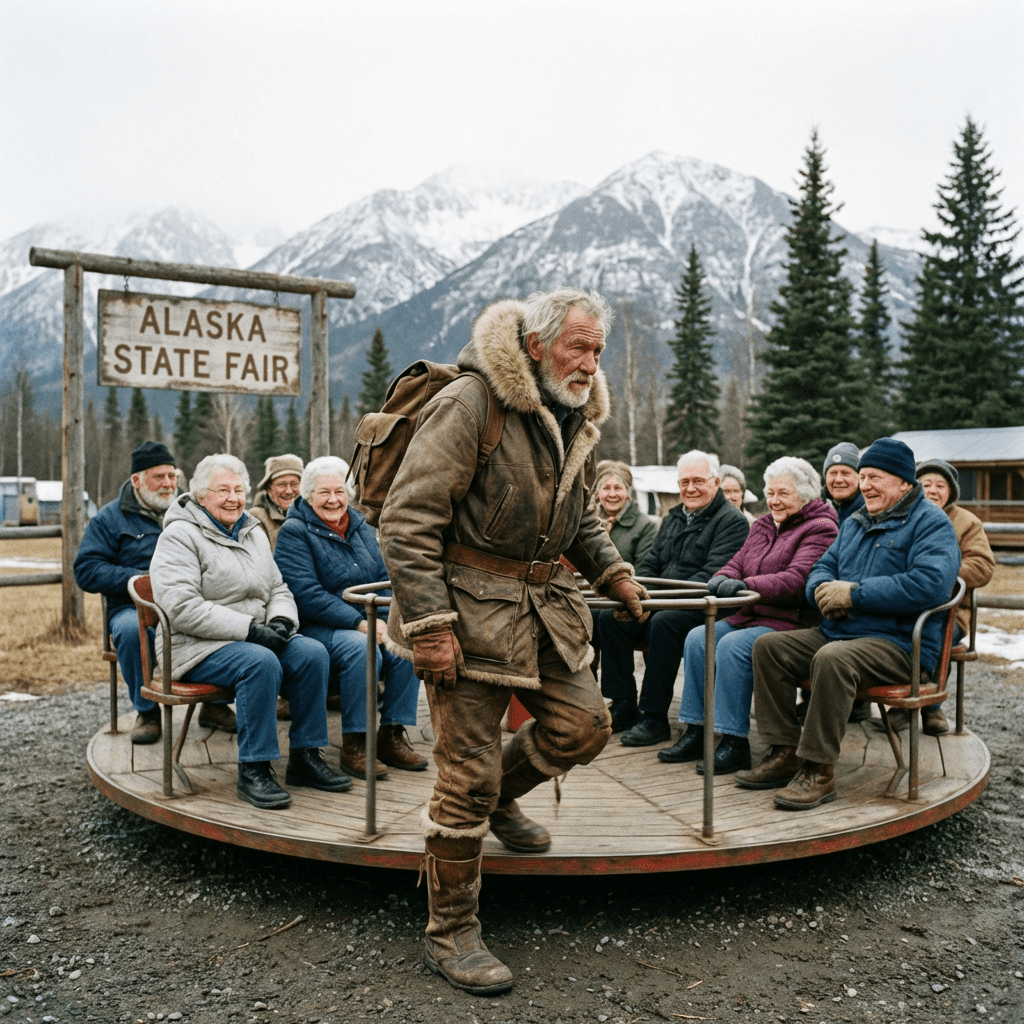
For this final project, my new and improved AI (artificial intelligence) photo generator asked for early ‘facial only’ images of 12 friends, with the 12th being me. Twelve bodies were all that would fit on the merry-go-round.

This was a tough assignment, yet I succeeded by snipping and copying school yearbooks and classroom photographs. No names or personal information was supplied.

AI somehow aged these people to make them appear in their late 70s, as if that was hard to do. We all look pretty much the same at that stage. If you see a similarity, it’s probably you, but my lips are sealed on exactly whose mugs were submitted.

I’m extremely happy with the outcome, especially with my early-Alaska-pioneer resemblance. That leather jacket is striking. I was so impressed that I ordered an 8×10 print for the office. That’s a first for me in framing something created entirely by a computer program.

From this day forward, many of my biking, hiking, Jeep adventures, and car show experiences will be permanently housed on the following website: www.michael-hankins.com.

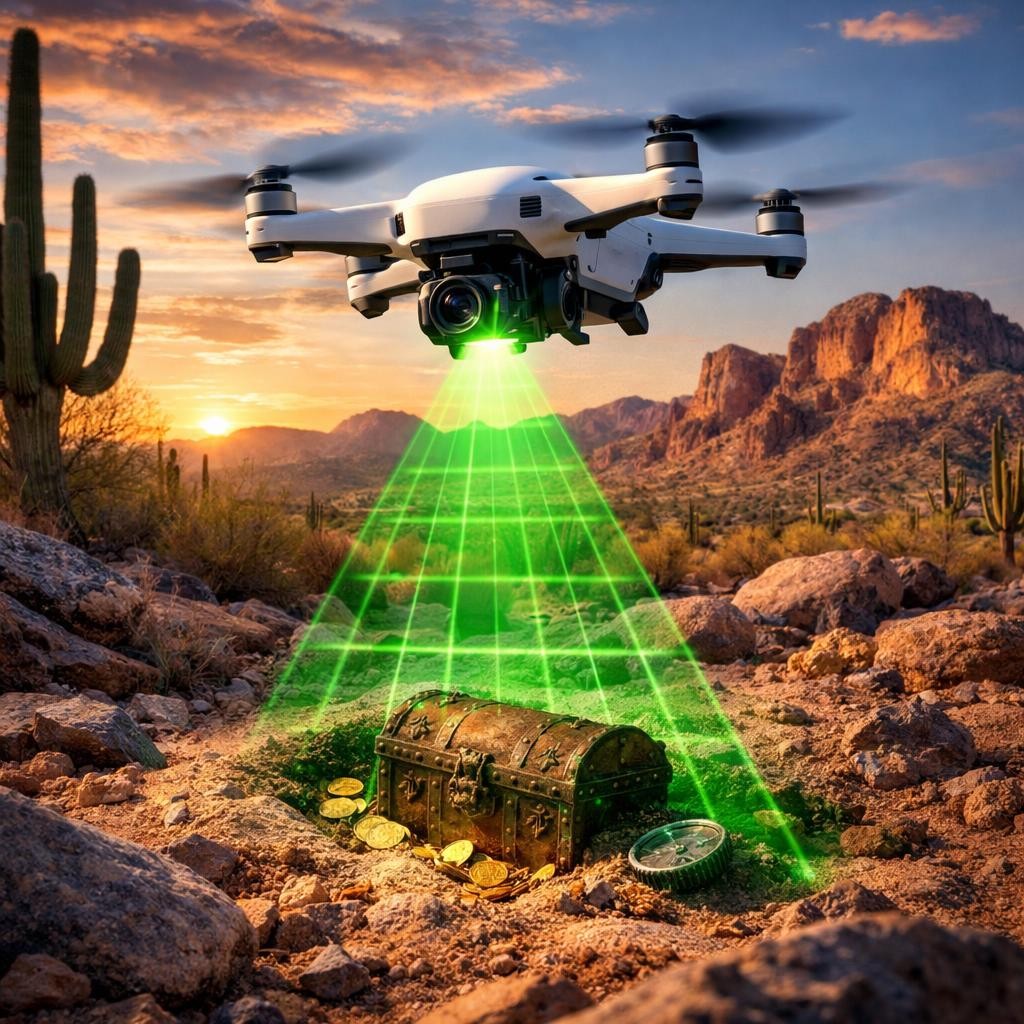
That site and the associated email section are monitored daily, unlike fb. The latest goal is to start producing drone videos of mysterious areas that are unreachable by foot, car, or plane, and to preview them on YouTube. Arizona is full of such inaccessible places.

I’m still kickin’, but I’d much rather use my rapidly diminishing time to create entertaining videos watched by many, rather than continue posting redundant info, stories, humorous memes, and photos seen by a few on fb. Nevertheless, I’ll still write for my blog and various periodicals, especially “The Today’s News-Herald.” A short update post will appear on April 9 each year.

YouTube seems to be growing, while Facebook continues to suffer from declining group participation. Always one to take an unknown path, new adventures and discoveries hopefully await me around the bend. The ability of drones to scour the desert for treasure has great potential. “I’m very excited” is more than an understatement here. 😊

DUST IN THE WIND

“Dust in Lake Havasu City can be bad at times, with dusting becoming a weekly ritual if not daily.”

HAZEL

It’s dusting time in our house again, and Hazel’s nowhere to be found. Sometimes I believe she went “union” on us. We rely on Hazel exclusively to keep dust off furniture and often have her clean vehicles when they need a little TLC (tender loving care). They generally get dusty, not dirty, like in Alaska.

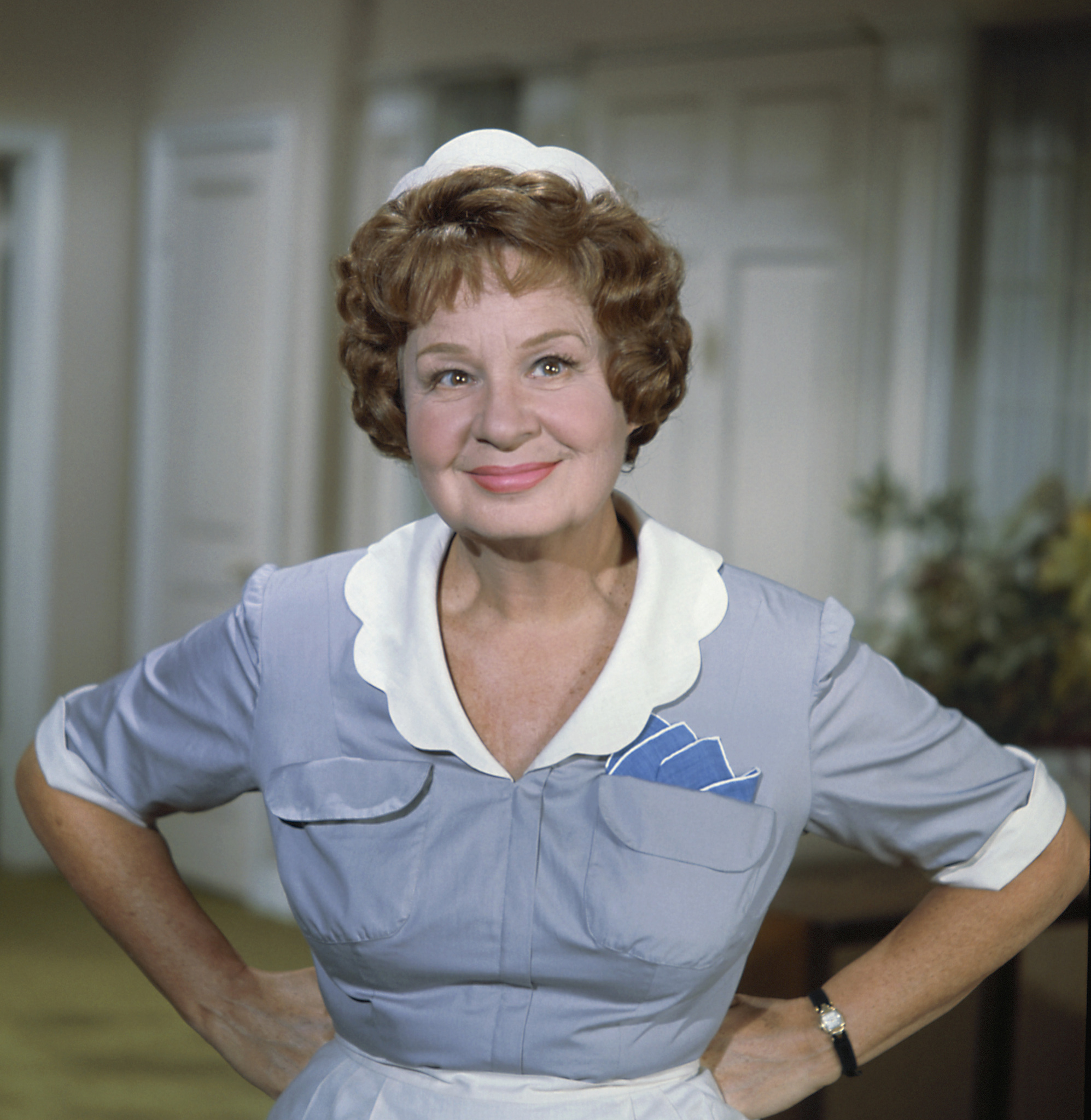
Hazel is not a real person, unlike the housekeeper of the same name featured in an early 1960s television sitcom starring Shirley Booth. Our Hazel is an authentic ostrich-feather duster like the one I used as a stocker at a grocery store. The fluffy feathers on a stick were always kept in a back pocket back then.

Dust in Lake Havasu City can be bad at times, with dusting becoming a weekly ritual if not daily. Having bad allergies to Arizona dust and pollen, Joleen is generally the one putting Hazel through the wringer, while my main household task is Vacuum Master. On occasion, you’ll find me dusting while holding my breath.

Dust in this city isn’t as bad as it was when we lived in Lubbock, Texas. My brother and I were assigned the dreadful chore during summer months to daily dust and vacuum our trailer home. Dust in Lubbock is red, and when a wind storm passed through, everything was covered, despite doors and windows being shut.

How it got in is still a mystery to me, and even now that we live in a house, it makes no difference. I’ve opened cardboard boxes sealed shut for years and found trace amounts of dust inside, and picture frames, too.

In 1977, the rock group Kansas released a tune called “Dust in the Wind.” Each time I hear it on the radio, I get a reminder to check our coffee table for the stuff, as this heavy piece of furniture seems to be the central dust magnet in our home.

How this song came to be is an interesting story.  “Dust in the Wind” was written by Kerry Livgren, one of the founding members of Kansas. The inspiration for the song came when Livgren was experimenting with a fingerpicking exercise on his guitar, which his wife encouraged him to turn into a full composition.

The lyrics reflect a philosophical perspective on life’s fleeting nature, influenced by Livgren’s readings in existentialism and the phrase “all we are is dust in the wind.” Bible verses 3:20 and 12:7 in Ecclesiastes helped to kindle his thoughts. The song ultimately became one of Kansas’s most iconic hits, resonating with listeners for its contemplative message about mortality and impermanence.

Two years after writing this tune, Kerry Livgren became a born-again Christian, and his music drifted more towards spiritual themes. I can see now why, because the hit song he wrote about dust conjures up depression to me, unless I knew I was going to a better place after death, of which I do. Perhaps Kerry felt the same until finally seeing the light?

As long as there’s wind, we’ll be dusting until the day we die, and I have an inside joke about dust that relates to the famous Kansas song, as well as those two Bible verses.

Viewing the dust covering our coffee table as a bunch of lazy people, I think to myself, “You folks need to move on down the road because there’s no loitering in this house. Don’t let the door hit you in the…!” I believe you know the ending here without me spelling things out.

At this point, Hazel is looked upon to do her thing, that is, when we find her!

PET PEEVE II

“The other night at home, Joleen and I were watching a movie when I heard the unmistakable sound of nails being clipped.”

A pet peeve is a particular behavior, habit, or occurrence that someone finds especially annoying or irritating, even if it might not bother others. These are often minor frustrations that can trigger disproportionate reactions in certain individuals.

Some common pet peeves are loud chewing or slurping, people who interrupt others mid-conversation, leaving dirty dishes in the sink, talking during movies, slow walkers blocking the sidewalk, not using turn signals while driving, using a phone during meals, leaving lights on in empty rooms, not replacing the toilet paper roll, and people who show up late.

While these are some of the most common pet peeves, everyone has their own unique list of things that bother them. Before I go into mine, I decided to research uncommon pet peeves, figuring there had to be some real doozies out there. This is what I found:

People who use excessive punctuation in texts, when someone moves your belongings slightly out of place, finding a tiny sticker left on fruit after peeling or slicing, when socks are mismatched or twisted inside shoes, group text messages where the conversation spirals off-topic, plastic packaging that’s difficult to open, unnecessary background noise in videos or audio recordings, people who walk slowly in the fast lane of a grocery store, when someone leaves a tiny bit of food or drink in a container and puts it back in the fridge, receiving flyers or advertisements tucked under windshield wipers.

I’m happy to report that none of these uncommon pet peeves are mine, because I’m guilty of creating a good number of them. Does anyone really care if socks are mismatched? The Stevie Wonder and Paul McCartney song, “Ebony and Ivory,” comes to mind here. Some of you will get it.

On the common list, drivers not using turn signals is a pet peeve, along with dirty dishes in the sink. That’s about it for me. I can think of a couple of others that weren’t mentioned on either list.

Going to car shows and hearing someone tear down another person’s ride is a pet peeve. I always think back to my days in school, when some kid was critical of another, only because they had low self-esteem and were trying to build it up at the expense of another. It’s a psychology thing.

My top pet peeve, and one that hasn’t happened for some time, is hearing someone cut their nails during church service. I’m talking fingernails here. In Anchorage, we always sat in the front row on the balcony. Perched up there, I could perfectly hear the music and preaching, yet also catch any oddities that happened along.

Watching someone being fast asleep in the pew while others stood to sing was quite common. It was generally the children and the older people who failed to rise. That’s understandable.

It’s amazing from up high, the bald spots folks had that weren’t visible at ground level. That’s one reason alone I didn’t sit down below. Getting back to the nail cutting. “Snip, snip, snip” for whatever reason bothered me more than anything. Once this noise began, my radar instantly began to pinpoint the location.

One might think it’s easy to find the culprit, but it wasn’t. Most were sly, quickly clipping a nail and then hiding the clippers. Several seconds later, and they’d snip another. Silver clippers were much easier to spot than black ones, which were next to impossible.

Not once did I find a man cutting his nails with it always being females; age not part of the equation. Once spotted, there was nothing I could do other than burn a hole through their head with my laser eyes. That still didn’t keep them from clipping.

Our pastor was good at finding congregation abnormalities while preaching, such as stopping his sermon in mid-sentence to ask someone to cease talking, or to get off their electronic device, but not once did he catch a nail cutting in progress.

Oh, I could’ve told him after church who was doing the snipping, but what good would it do me at that point? I’d merely be labeled a snitch by the person I snitched on. These days I don’t sit on the balcony, so it’s no problem.

The other night at home, Joleen and I were watching a movie when I heard the unmistakable sound of nails being clipped. Looking over at my wife—I saw that one of her hands grasped a cup of coffee—so I knew it couldn’t be her.

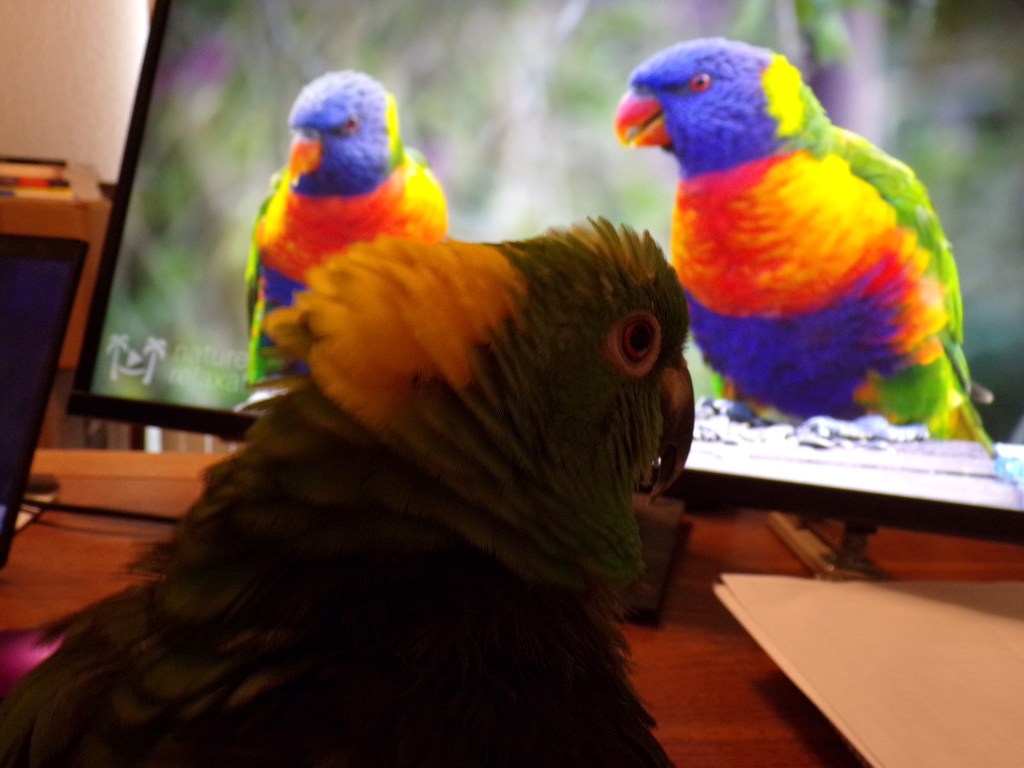
We have two parrots, Jess and Aldo, who’ve been with us going on 40 years now. Jess is very good at mimicking sounds, and he coughs exactly as we do when we’re sick. Our Yellow-naped Amazon thinks it’s funny.

Evidently, he’s now able to mimic the sound of fingernails being trimmed, which annoys me more than anything. Joleen believes that he’s merely rubbing his beak sections together, and it isn’t intentional. I don’t know this for sure, with Jess not saying.

The only thing I can do to drown out the noise is turn up the television volume. Last Saturday during Supercross, the volume number was 35, and that still wasn’t high enough. “Click, click, click,” came through loud and clear.

At volume 40, the television speaker sounded as if it were about to blow—with our neighbors undoubtedly hearing the motorcycle race announced word for word. Finally giving up, I had Joleen turn things back down.

At this point, I did as I’d seen so many old men do in church over the years, I fell asleep. When I awoke, the race was over, with Joleen telling me that Eli Tomac had won. That’s all I needed to know.

As my wife covered our birds up, Jess had one last thing to say, “Ready to go nighty night?” How could anyone stay upset with a pet peeve like that?

Jess and his online girlfriends

POSTCARD PEOPLE

“I just don’t like the idea of someone going through our mail and then writing a story about what they found.”

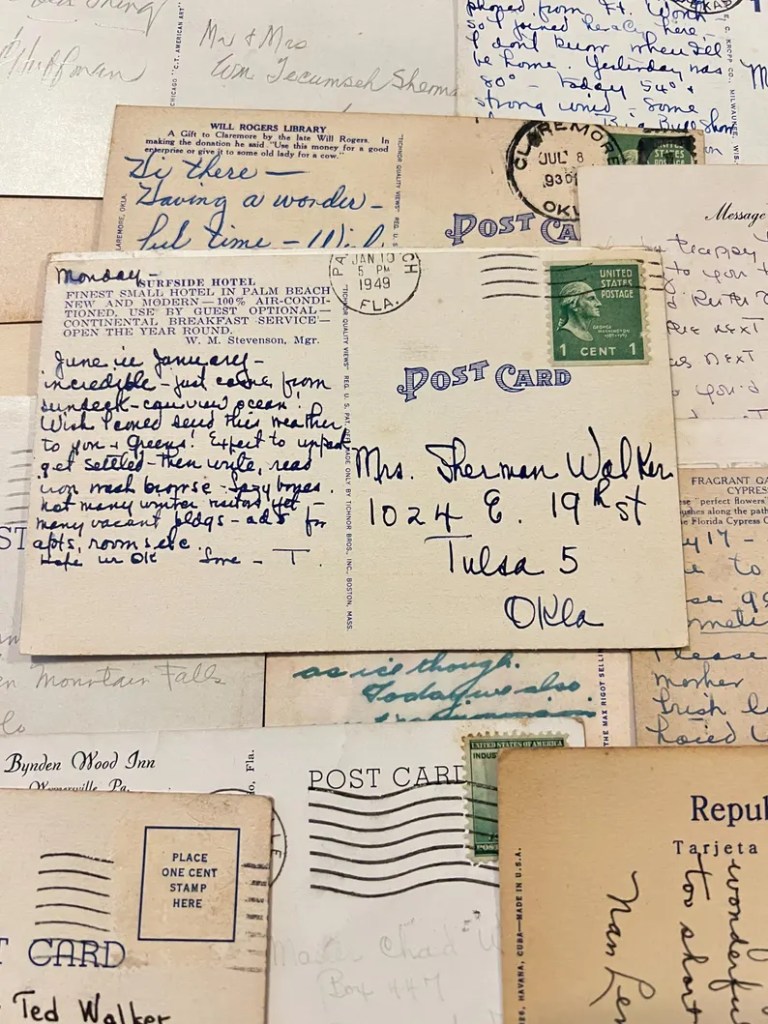
A while back, I started compiling vintage postcards and then researching the people who had sent them, including those on the receiving end. My goal was to dissect 50 postcards and then stop, which I did. Since stopping—I’ve been asked to continue my work with a book offer on the table.

There are postcard books out there, yet none that I’ve found where the book author went so far as to do background searches on people mentioned in the cards. “Postcard People,” as I call them. I’m sure someone will come along and do exactly that, but it won’t be me.

I get more satisfaction out of people reading my discoveries for free rather than trying to make an extra dollar hawking this material. Folks read my blog by the thousands, with payment being a like, thumbs up, or nice comment. Those gestures alone keep me writing.

The pressure of compiling another book turns me off more than anything, especially with book marketing almost non-existent for the little guy or gal. “Who you know” plays a big part in the literary field just as it does in music.

Some celebrities, sports stars, and politicians hawk their latest books on late-night television, although the finished product might stink. That global marketing reaches millions of people and sells tons of books.

A best seller doesn’t always mean it’s a good read—only that it was well promoted. I’ve purchased a couple of expensive best-sellers and stopped reading them less than halfway through. With that said, it’s time to get back to talking postcards, or is that postcards talking?

The act of sending postcards has long been a cherished tradition around the world. From the late 19th century to the present day, postcards have captured moments, shared stories, and connected people across distances. I’ll lightly touch upon how postcards evolved from simple pieces of mail into treasured keepsakes that reflect social, cultural, and technological changes throughout the years.

The concept of the postcard emerged in the mid-1800s as postal services expanded and literacy rates increased. The first known postcard was sent in 1840 by writer Theodore Hook in London, but it was not until 1869 that the Austrian postal service officially introduced the “Correspondenz-Karte.” This innovation offered a cheap, convenient way for people to send short messages without the need for an envelope, revolutionizing personal communication.

The idea quickly spread across Europe and beyond. By the 1870s and 1880s, countries such as Germany, France, and the United States had adopted postcards as part of their postal systems. Early postcards were typically plain, but soon, decorative illustrations and photographs appeared, turning them into miniature works of art. The Golden Age of Postcards, spanning from the 1890s to the 1910s, saw millions of postcards exchanged annually, capturing travel scenes, local landmarks, holidays, and personal messages.

Postcards played an important role in social life, offering a quick and accessible method for people to stay in touch. Travelers sent postcards to family and friends as souvenirs or updates from their journeys. Soldiers used them to communicate with loved ones during wartime, providing comfort and maintaining connections across great distances. Postcards also became tools for advertising, political campaigns, and public service announcements.

The rise of telephones and, later, digital communication methods such as email and messaging apps led to a decline in postcard usage. However, postcards remain popular among collectors and enthusiasts, and many people still send them as a personal touch from travels or on special occasions. The advent of customizable and digital postcards has allowed the tradition to persist in new forms, blending nostalgia with modern convenience.

Sending postcards has become more than just a way to convey information; it represents a unique intersection of art, culture, and personal expression. Collectors prize vintage postcards for their historical value and design, while contemporary aficionados appreciate the tangible connection they provide in an increasingly digital world. Count me in with that group.

Postcards continue to serve as artifacts of social history, capturing snapshots of everyday life and commemorating important events.

The history of sending postcards reveals a fascinating journey from simple cards to beloved keepsakes. While the way people communicate has changed dramatically, the postcard endures as a symbol of connection, creativity, and shared experience—reminding us of the enduring value of a personal message sent across the miles.

Mom and her two sisters loved to send postcards when they went on trips. My brother did as well. Joleen and I sent postcards, but over the past 20 years, we’ve mailed very few.

Some of the cards that Mother sent, I still possess, including several from other folks. I’ll hang onto them and make sure they don’t go public or are sold on eBay. Not that there’s anything shady lurking in my family’s past, that I know of, but I just don’t like the idea of some writer going through our mail and then composing stories about what they uncovered. There should be a law against it, or perhaps there already is 😊

SNAIL MAIL

“Lost mail always seems to end up in Limbo.”

I’ve used the United States Postal Service enough times over the past 50 years to observe this agency slowly go downhill. Stamps went from 8 cents in 1972 to 78 cents last July. Why don’t they just round things off to an even dollar—because that’s what they’re evidently aiming for.

Here’s another shocker. Priority Mail is no longer guaranteed to get there in 3 days or your money back. Why would I now want to spend the extra money for them to stick this red, white, and blue priority label on my package? It basically means nothing.

For over a century, a letter or parcel dropped off at your local post office had to be out of the building the same day. That rule doesn’t apply anymore. Sacks of mail can loiter around for as long as it takes for a truck driver to pick them up. Can you imagine a pizza place operating this way?

The humorous term “snail mail” has been used for decades. In some cases, that’s a disservice to the speed of snails. Before I harp on further, let me say that the postal clerks in Lake Havasu City do an exceptional job. My letter carrier is tops.

Part of the problem seems to lie with the USPS muckety-mucks in Washington, DC. There’s a popular statement regarding upper management that deals with too many chiefs, and not enough… I’ll stop at that point. Not all blame is administrative, though.

My brother-in-law has been a letter carrier for close to 40 years. He says that they can’t find good employees anymore, or people accustomed to actually working. Calvin recently told a story about a new hire coming on the job, and then a few days later, quitting, all because the work was too hard.

He said that some newbies never actually quit; they just don’t show up one day without explanation. I believe this isn’t just a postal employee problem, as business owners around town echo the same theme.

Returning to mail and delivery issues. I mentioned a while back that I was going to mail a box of candy to my grandchildren for Easter. It was sent First Class with tracking and was supposed to take 5 – 7 days to get from Havasu to Eden Prairie, Minnesota.

Three weeks later, it finally showed up, with the package full of ants. Somewhere along the line, they crawled in. I’m guessing Limbo, Mississippi. Lost mail always seems to end up in Limbo.

Christmas cards have become somewhat of a problem, with us now mailing them two weeks in advance just to make sure. Despite this extra time, there have been a few that haven’t shown up until the following year, generally the first week of January.

This year, our cards will go in the mailbox the day after Thanksgiving. They might get there a little early, but there’s no chiseled-in-stone rule on when to send them. Oddly enough, residents of West Jefferson, North Carolina, celebrate Christmas each year in July.

West Jefferson is the top Christmas tree producer in the US, so that might have something to do with it. Cards sent to that town would have to go out no later than the middle of June. No, you’d better change that to the end of May.

What should be done to improve the USPS? A couple of things come to mind. First of all, this agency should stop using the eagle as their symbol of expediency. Eagles, much like hawks, are fast and generally don’t mess around when they’re on a specific mission.

A bird more reminiscent of this new and improved USPS is the common feral pigeon. These comical birds like to wander in circles, stop, do some type of Tennessee strut, before flying off to their destinations.

The second and most important thing is to add an additional method of delivery besides Media Mail, First Class, and Priority. When I told my wife of my idea, she said that they already have such, although postal clerks don’t advertise it.

 Joleen said this undisclosed service is called “Whenever.”

MRS. STEINHARDT

“When Mrs. Steinhardt sent that card in 1949 to someone she either personally knew or met, the woman and her husband were finishing up a three-week cruise to Alaska.”

If I had a dollar for every time someone called me Michael Hawkins, I’d be a rich man. I stopped correcting folks on the pronunciation during my earliest days. While in school, if a teacher from another class said, “The Hawkins boy did it! — I knew immediately they were talking about me.

I believe the Hawkins name has a good ring to it, although I didn’t learn until much later that John Hawkins, the pirate, was also a slave trader.

Throughout the year, someone will write my wife and accidentally spell her first name, Jolene, when in fact the correct spelling is Joleen. It sometimes perturbs her, but I always say, at least they’re thinking of you. The analytic way to look at this is that they had a 50-50 chance at spelling things correctly, yet still got it wrong.

Alaska and Arizona names are perhaps the trickiest to spell or pronounce, with me often having to look online or in my old, 1964, “Dictionary of Alaska Placenames.” Yes, I have an original such book, and it’s one of my prized possessions. Speaking of dictionaries, what are those companies that print dictionaries doing now?

There’s a big push to change easy-to-pronounce town and geographical names of Native origin. The Inupiaq name for Barrow is Uqtiagvik. I doubt the younger Inupiaq population can even pronounce it, let alone me.

Kasilof is an Alaskan name of Russian origin. It’s supposed to be pronounced “kuh-SEE-lof,” but I’ve heard pioneer Alaskans say, “ka-SEAL-off.” It makes no difference to me because I know what they’re talking about.

Chemehuevi is an Arizona Indian tribe, and I often get tongue-tied trying to say it, with a street here in town named that. The correct way to pronounce it is “cheh-mih-WAY-vee.

The Hualapai Mountains are near Kingman, Arizona, and instead of me trying to remember this, let alone butcher the spelling or pronunciation, I often say to people, “Those mountains near Kingman.” Folks know what I’m talking about.

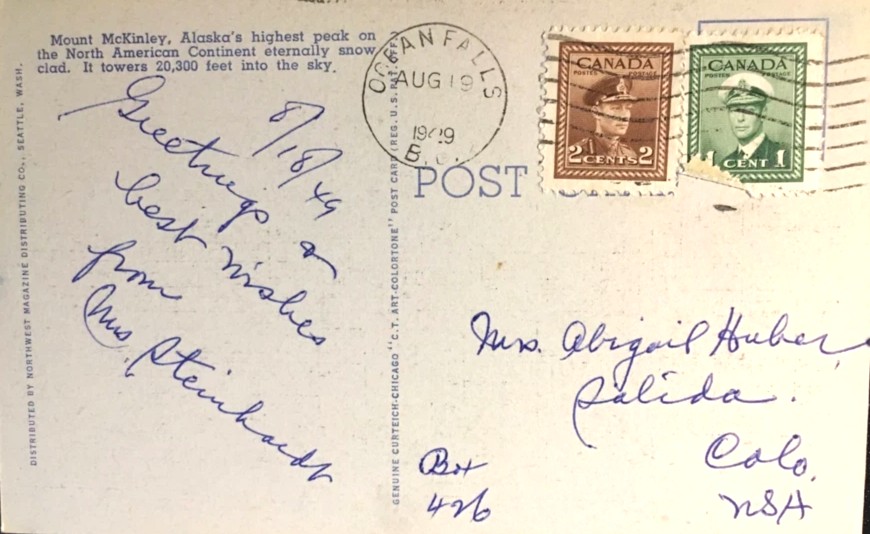
Mt. McKinley has been called Mt. McKinley going back to 1896. That’s the name I was taught throughout school. History shows it was called Buishale or Bulshaira before then, with it being named that by Russian explorers. Some will tell you that it was called Denali going way back.

Neither the Inuapiq nor the Koyukun Athabascan Indians nor any other Alaska and Canadian tribes had a written language. They did have a word for it in their language, meaning tall mountain. Somewhere along the way, in the latter stages of history, the sound uttered by Indigenous people was interpreted by European translators to be Denali.

I’ve found the Buishale or Bulsharia names in old newspaper articles going way back and documented them. The often-used newspaper term, “It’s here in black and white,” is hard to dispute.

President Obama officially changed McKinley to Denali in 2015. Trump officially changed it back to McKinley in 2025. It makes no difference to me what it’s called, Buishale, McKinley, or Denali. I’ll know what you’re talking about.

A vintage postcard from the 1940s has a picture labeled Mt. McKinley on the front. These days, that same postcard would undoubtedly be printed with Denali.

The short note inside with both sender and recipient names caught my attention. I wasn’t expecting to find anything unusual about either person. Initially, I misinterpreted one name to be Steinholdt when in fact it was Steinhardt. That made a big difference.

Mrs. Steinhardt sent the card from Ocean Falls, British Columbia, on August 19, 1949, to Mrs. Abigail Huber in Salida, Colorado. The one-cent and two-cent stamps are Canadian in origin. A short message written in perfect cursive says,

“8/18/49

Greetings & best wishes from Mrs. Steinhardt.”

Mrs. Abigail Leffingwell Huber lived a normal life, it seems, passing away in 1967 at the age of 87 in California. I make this assumption, finding nothing controversial or outrageous written about the woman in newspaper articles.

Abigail was born in Vermont in 1880, marrying Jacob Manley Huber in 1901. They lived in Minneapolis, Minnesota. Due to Jacob’s ill health, the family moved to Colorado in hopes that it would help. That’s where Jacob died in 1914.

J.M. was a partner in Huber Brother Manufacturing Company. The family was quite wealthy. They made washing machines and powered wagons, along with farm implements. Abigail continued to reside in Minneapolis before relocating to Colorado, and then on to California in 1954 to live with a daughter. After Mrs. Huber passed away, her remains were shipped back to Minneapolis to be interred next to her husband.

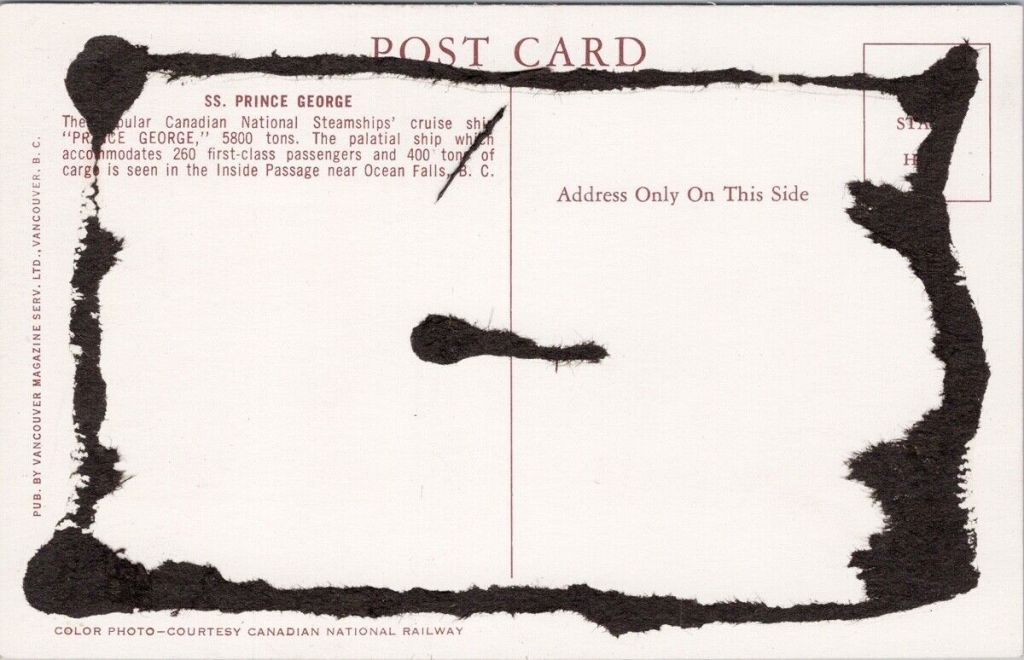
When Mrs. Steinhardt sent that card in 1949 to Mrs. Huber, Dulcie Steinhardt and her husband and daughter were finishing up a three-week cruise to Alaska. Their ship, the Canadian National Steamship SS Prince George, was only commissioned for service in 1947. It regularly stopped in Ocean Falls, British Columbia, Canada, where the postcard was mailed. It seems reasonable that she sent out quite a few cards from there.

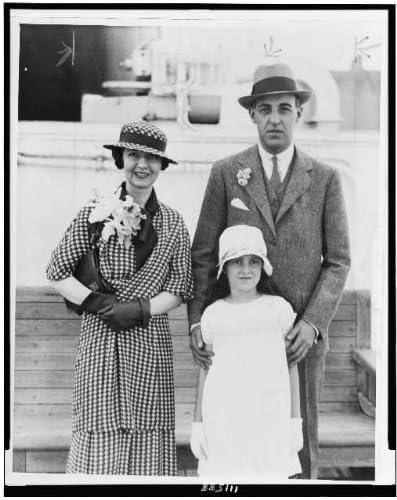
Laurence Adolph Steinhardt was the United States Ambassador to Canada at that time, and his wife, Dulcie Cecile Steinhardt, along with the couple’s 24-year-old daughter, Dulcie Ann, made that trip. A newspaper article from July 19, 1949, substantiates the Alaska vacation. Mr. Steinhardt had previously been ambassador to Peru, Turkey, Russia, and Czechslovokia. The family was well accustomed to traveling.

On March 28, 1950, only 7 months after their Alaska adventure, sadly, Ambassador Laurence Adolph Steinhardt perished in an airplane crash in Ramsay, Ontario, Canada.

This was big news, making all the newspapers, as Mr. Steinhardt was a prestigious man, well-liked in political and military circles, and a Nobel Peace Prize recipient. Steinhardt is buried in Arlington Cemetery. Six months later, his daughter married Allan Arthur Sherlock, a distinguished pilot during WWII.

Mrs. Steinhardt (Dulcie Cecile Hofmann Steinhardt) eventually remarried, but when she died in 1974, she too was laid to rest in Arlington beside her first husband.

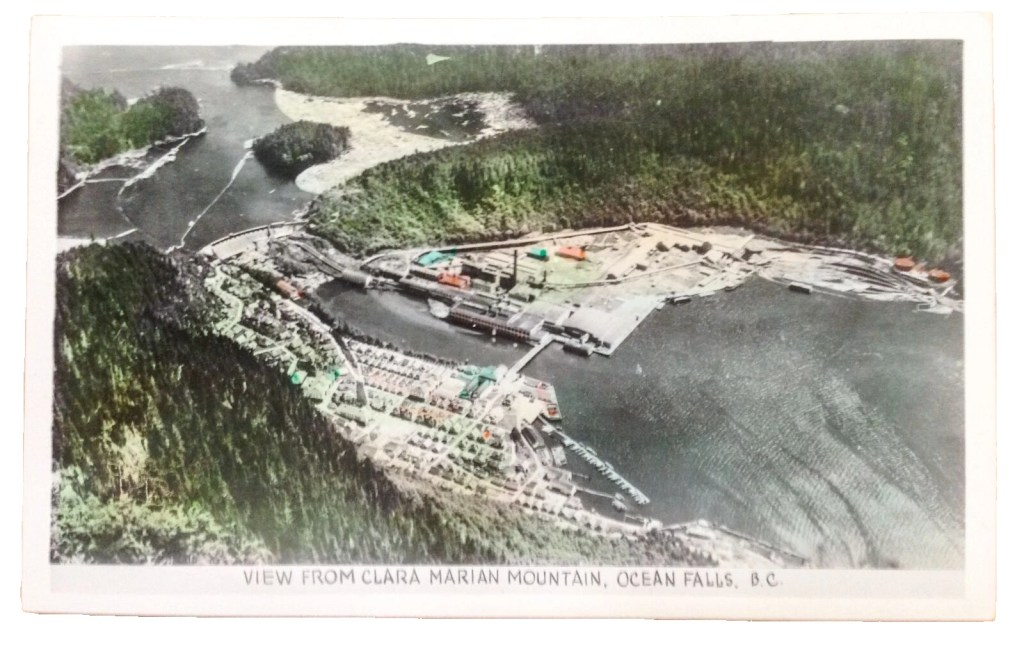
Ocean Falls is a water or seaplane accessible town in British Columbia built by the Crown Zellerbach Paper Company in 1906. The company provided residences for its employees and even had a company store, barber shop, hospital, school, and post office. At one time, 3,900 people lived there.

When it became too costly to keep the pulp mill running, Crown Zellerbach shut things down in 1973. Buildings were left as is, and over time, succumbed to the constant rain.

Many of the structures were removed, with others now rotting away. It’s estimated that a few dozen people currently live there year-round, with the post office remarkably still open. It’s now as close to being a ghost town as a town can get!

Ocean Falls (circa 1950)
Laurence, Dulcie Cecille, And Dulcie Ann Steinhardt
SS Prince George outside Ocean Falls, B.C. – 1949
SS Prince George final demise in 1995.
The vessel sank as it was being towed to Hong Kong for scrap.
Huber Manufacturing (Huber Brothers) – 1942

A CHRISTMAS POSTCARD

“I’ve been tempted to send Christmas cards in July, but thus far have resisted.”

Each Christmas, my wife takes the Christmas Cards we receive, opens and reads them, and then tapes them to a pantry door. My mother did the same, although she used a wall because we didn’t have a pantry.

After New Year’s is over, Joleen removes the cards and puts them back in their envelopes, so that she has a current address to mail ours the following year. People still change locations, so that’s an easy way to keep updated on their whereabouts.

There was a time we received close to 100 cars from friends, family, and businesses, but that number has slowly dwindled. I believe last year, in 2024, we got a total of 19. Some of the senders passed away, while others just don’t mail them anymore.

I recall my mom scratching her head, attempting to recall if so-and-so sent a card the previous year. With my wife keeping ours in a box, that’s no problem. Forty years ago, I came up with an idea so that people wouldn’t have that problem.

I took over the letter-writing department during Christmas, always making sure that our ‘form letter’ was bizarre and unforgettable. While Aunt Betty’s card and letter might not be remembered 30 days after getting them, I didn’t want that to happen with ours. I’ve had friends and family say that they think I’ve lost it, but at least they remember the card or letter. That’s what counts most!

We’ve sent out cards with our two parrots supposedly writing things, along with an attorney, a garbage collector, neighbors, a complete stranger, and firms that we supposedly paid to write because we were too busy. I even had a holiday form letter printed out with fill-in-the-blanks.

The phony lawyer’s office letter was 20 years ago, and I still recall the firm’s name: Bend, Ovar, and Takum. Another year, I had a rubber stamp made with our signatures in cursive, going on to let it be known the following year, in a Christmas form letter, that some folks were upset because we didn’t take time to sign them ourselves. It’s reminiscent of the Joe Biden autopen controversy.

The best cards we mailed were a select few that I took a propane torch to, scorching them just enough to make them look like they’d been in a fire. That card envelope was stamped, with me having to carefully draw black spiral lines across the stamps to make them appear as cancelled. I only addressed a certain number to family members.

A blackened card and envelope were then placed inside another plain brown envelope marked USPS, with an official-looking note inside, supposedly from the US Postal Service. The note said that the mail was damaged from being in a warehouse fire. We waited two months after Christmas to finally send them.

Family still talks about that, with a good majority believing that the warehouse fire actually took place. I suppose there is a question as to whether this act was legal, but the statute of limitations has long run out.

Back in the early 1900s, Christmas ‘postcards’ were quite common. I made my own one year, taking small 4×5 index cards and gluing a photo of Santa on the front, with him saying Merry Christmas.

There was little room to write a note on the back, with us just proclaiming, Happy New Year. I believe that’s the one we mailed right after Halloween. I’ve been tempted to send Christmas cards in July, but thus far have resisted.

Finding an early Christmas postcard from 1907 on eBay, the person receiving it was Mrs. Mildred Taylor, who lived in New Philadelphia, Ohio. Someone with the initials B.L. from Kokomo, Indiana, sent it with the following cryptic letter. I’ve left words as written.

“This is the 17th. I missed the mailman yesterday. I don’t know if this will be today or not. Accident if it happen.

Freeport, O.

December 16, 1907

Dear friend Mildred,

I thought I would drop you a few lines to let you know I am all O.K. and am having a pretty good time but it’s not Philla. How are you I can almost see you as I sit here writing was just looking at your picture and I bet you could not guess what mother said, I suppose not anything good, ha. She suffering lot. Hear from you soon. B.L.”

Mildred A. “Mary” Peacock Taylor spent her entire life in New Philadelphia, Ohio, along with her husband, Earl. Hopefully, Mildred interpreted what her friend was telling her because anyone else reading this note wouldn’t totally understand. I suppose that’s intentional on the writer’s part.

Nowhere is there mention of ‘Merry Christmas’ or ‘Happy New Year’, although the front of the Victorian-style Christmas postcard does say, ‘A Peaceful Christmas’. The photo of a frazzled Santa with a large bag of toys makes it appear he isn’t having one!

NUMBER PLEASE

“What seems so unreal is that I still remember part numbers from my days working at an automotive parts store.”

Desert Bar

I’ve always had a good memory, remembering small things from long ago. I chalk it up to never being dependent on recreational drugs or alcohol. Lately, what I seem to forget more than anything else is connecting names with faces.

I’ll watch an old movie and when some well-known actor comes on scene, oftentimes his or her name is on the tip of my tongue yet I can’t spit it out. This can be irritating, with it having me wonder if I’m becoming senile.

 Whenever this happens, I quietly ask myself, “What is the firing order of a Chevrolet V-8 engine. Thus far, I’ve been able to rattle off 1-8-4-3-6-5-7-2 without hesitation. Car guys and gals know what I’m talking about here. As long as I get those numbers right, I have to assume all is good upstairs.

Last winter, I was with some friends at the Desert Bar near Parker.  The name of this place can be misleading for those who’ve never been there. The rustic establishment is built around a former gold and silver mine, and it’s totally off-grid. I view it as more of a ghost town with a live band. It’s definitely family-friendly.

There are antique cars and old rusty mining stuff to be seen, including an awesome replica western day church, complete with a steeple. Yes, weddings can be arranged. The food is good, and I always make sure to bring cash because they don’t take checks or credit cards. Beer is served, but for guys like me, they have soft drinks as well.

On this last trip, a fellow and his wife walked up and recognized me. They knew my name and started up a conversation. All during that time, my brain was going, “I know these folks, but for the life of me, I don’t recall their names.” Seeing that I was confused, they helped give my memory a jumpstart.

Walking back to our table and repeating their names over and over, wanting them to permanently sink in, I informed my wife about my memory lapse. I told her that I’d make sure to remember their names next time. I have been doing so for several months now, even writing them down on a piece of paper. That paper is now hiding somewhere, and I don’t recall where I put it. 1-8-4-3-6-5-7-2.

They’re a nice couple, much younger than us, snowbirds, they come from Minnesota each winter, owning a home here. I can remember almost the whole conversation we had over coffee at Bashas. We planned on getting together when they came back and going metal detecting.

What seems so unreal is that I still easily recall part numbers from my days working in an automotive parts store. That was 40 years ago. The Spicer number for a 1975 Chevrolet Blazer constant velocity centering joint is 210782X. The Standard ignition number for Chevy points is DR2270P. Ford points are FD8183V. I could go on and on.

Why is it that I can still relate numbers to parts, yet faces to names is now escaping me? How do older ministers handle this problem? I suppose calling everyone brother or sister works, at least for a while.

Taking the herb Ginkgo biloba is supposed to help in the memory department, or at least a friend told me that eons ago. I believe at this point it’d do little good, and besides, one of my doctors said it’s not good to take this if you’re on blood thinners. Mark that off my list.

They say AI technology can recognize facial features. The police and other protective agencies have been using such for years. I believe the answer for older folks like me is for everyone to have a barcode stamped on their forehead. Keeping a scanner in my back pocket, I could then scan and say without embarrassment, “Hello, Joe, how are you doing today?”

I’m only joking here, but in reality, the world could be coming to that!