“I’m not so much into this living the dream theme like I was when younger.”
TACO CITY
I visited a local taco shop the other day looking to score a couple of shredded chicken burritos. Love those things especially with bell peppers and grilled onions crammed inside. Waiting for my food, I asked one of the young workers taking orders how it was going.
“Livin’ the dream!” was his reply and I immediately chuckled.
I’d heard that statement plenty of times over the years—even using it myself. It’s generally said in sarcasm, even so, I’m sure there are some folks out there who actually mean what they say.
This fellow should’ve been happy just to be working, although that seems to have gone by the wayside considerably since my generation… Okay, stop right there. Young readers don’t want to hear about our generation no more than they want us to talk about theirs. It’s been that way going back to the beginning of time.
I suppose to some millennials, living the dream would be akin to a Paris Hilton floating around the world on a trillion-dollar yacht, with servants at every corner waiting to refill their glass of Perrier-Jouet champagne. I can only assume that’s what these people drink based on stereotypes alone. Hey, Paris Hilton might even crave Hires Root Beer like me, in a crystal glass of course instead of an aluminum can.
For us older folks, living the dream takes on a different meaning after passing sixty, at least for this old man it does. Living the dream means crawling out of bed without my back kinked up to the point where I can’t ______ (you fill in the blank) because it’s different for all of us.
Living the dream is being able to park my car, and as I limp to the store, turn around to see that I actually got it between the lines, for once.
I’m not so much into this living the dream theme as I was when younger, these days, just give me the living part. I always dreamed I’d own a Lear jet, but that never happened. At this point I could care less, preferring to drive everywhere I go instead of flying.
You can see a Hecht of a lot more country this way. A former coworker of mine, John Hecht, always used his last name out of context like that for a chuckle. He won’t mind if I do the same.
Never being one of those rich folks that Forbes Magazine likes to tout, even going so far as to rate them from one to a thousand, life’s been rich enough in other nonmonetary areas and there are no complaints.
As I recall, Pastor Chad Garrison, at Calvary Baptist Church, once said that the poorest people in the United States have things better than something like 98% of those in third-world countries. I might have the number off a tad but you get the point. If that’s the case, I’d probably be looked at as a zillionaire by those destitute people, sadly so.
Living the dream to someone in Ethiopia I’m sure is much different than what young and old folks in America equate things to. Having clean water is undoubtedly at the top of their list. Most likely, the same applies to residents of Mozambique and Somalia, while having something to eat each and every day is only a dream for some of these folks—nothing else.
Next time I hear someone tell me that they’re living the dream, whether in jest or being serious, I’ll smile and have something fruitful to say in return.
“I’ll never disclose who is who, but if you think a portion relates to you, then it’s probably true.”
Movin’ on…
I’m pretty much done with all that I can do with my new book, The Last Christmas Card, now having moved on to another. The publisher in conjunction with a publicist totally takes over at this point in trying to sell it with me having fulfilled my obligation.
In another blog article, I mentioned some of the events within this book as “somewhat” actual occurrences although not on the same exact level as written. What wasn’t mentioned is that bits & pieces of my friends, going way back, are also included in an extremely subtle manner.
When my brother first proofread things he made mention of that although I hadn’t said a word to him. There’s a disclaimer at the front of the book that has to be there to protect the publisher and myself from any liability. Most fiction works have them. Some friends that read The Last Christmas Card will probably take notice of something and say,
“I believe that could be me doing that!”
I’ll never disclose who is who, but if you think a portion relates to you, then it’s probably true.
I started this project in 2009 and stopped before it was complete finding the ending much too hard to compose. My wife came across the unfinished manuscript a little over a year ago, and after reading a few paragraphs, asked that I please finish it.
This book was designed to be read in two hours; highly condensed writing much like a poem. It could’ve been ten times as long but the overall story would still remain the same.
Once finished, I took time to set back and enjoy it – glad that Joleen pushed me to complete the mission. The ending that I was looking for came to me one night along with the town where I wanted things to occur, Council Grove, Kansas. That’s how it often seems to go, thus, I sleep with a notebook close by so when that happens, I can groggily get up and jot things down. So many times I didn’t and the thought was lost.
This is my first fiction Novella as it’s called. Hopefully you enjoy it as much as I did putting the story together!
“What Gabriel discovered sixty-feet underground could destroy the peaceful religious community forever, including surrounding areas.”
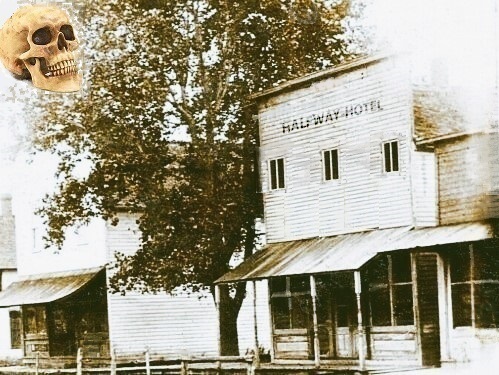
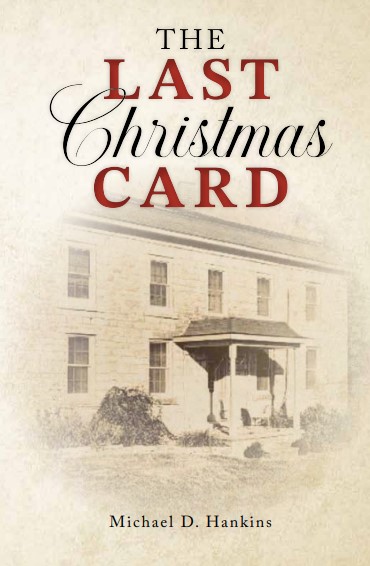
Front cover photo.
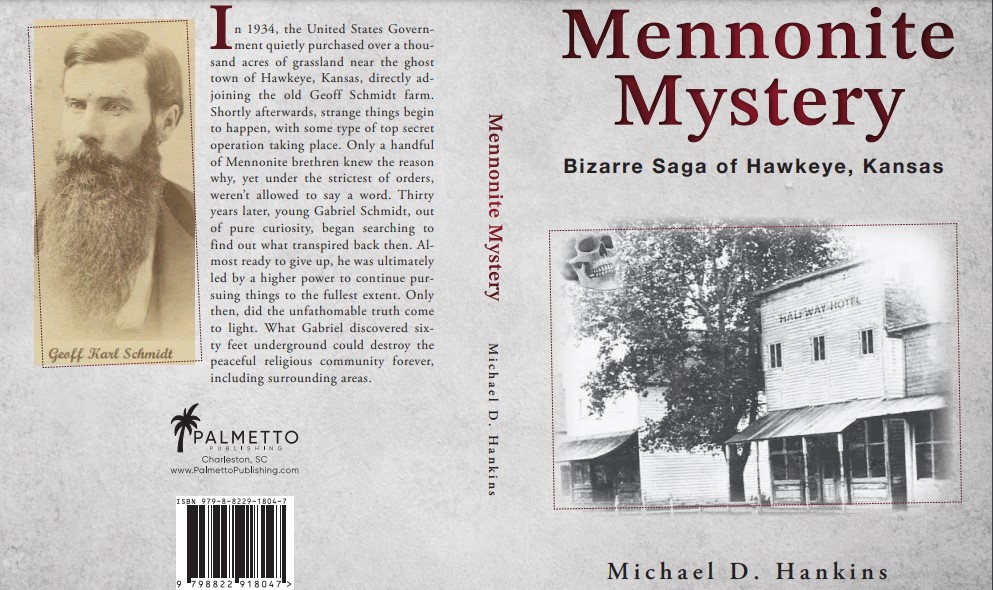
My latest book, “MENNONITE MYSTERY – Bizarre Saga of Hawkeye, Kansas” will be out early spring, 2024. The manuscript is complete and in the edit stages. Final book covers (front and rear) are being put together at this time.
The following is a short synopsis on what this fiction story’s about:
“In 1934, the United States Government quietly purchased over a thousand acres of grassland near the ghost town of Hawkeye, Kansas, adjoining the old Geoff Schmidt farm. Shortly afterwards, strange things begin to happen, with some type of top secret operation taking place. Only a handful of Mennonite brethren knew the reason why, yet under the strictest of orders, weren’t allowed to say a word. Thirty years later, area resident, Gabriel Schmidt, out of pure curiosity, began searching to find out what transpired back then. Almost ready to give up, he was ultimately led by a higher power to continue pursuing things to the fullest extent. Only then, did the unfathomable truth come to light. What Gabriel discovered sixty feet underground could destroy the peaceful religious community forever, including surrounding areas.”
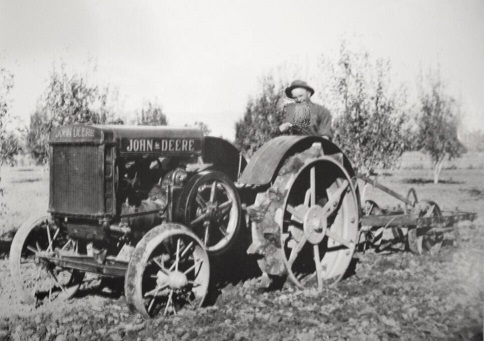
Klaus Schmidt – 1923 John DeereRelease date – Spring 2024
“Some of the stuff found in antique stores and on eBay have no more right being there than a life insurance agent does at a funeral.”
ANTIQUE CITY
I’ve heard a certain statement over the years repeated by many people that goes something like this,
“It really isn’t worth anything other than sentimental value!”
I first recall hearing that line as a child most likely coming from my mother, although all four grandparents might’ve used it as well. As a kid, I wasn’t tuned in to what sentimental value was, yet by my teen years, I began to somewhat grasp the meaning.
Mother had a tiny porcelain figurine of a lamb that her mom once owned. Now worth perhaps a couple of bucks at a garage sale if even that, she hung on the knicknack like it was a crown jewel. Story goes that Mom was fascinated by the figurine as a young girl, yet was forbidden to play with it. Undoubtedly, all five of her sisters were told the same and that’s why it survived.
Going through her things, I could’ve just added it to other stuff being donated to local charity such as the Hospice Retail Store here in Havasu, but that didn’t seem right with this little lamb. Even though the sentimental value of this object didn’t exactly apply to me, its family history does. A handed-down-story was attached to that lamb, and that story with figurine should be passed along to my children and grandchildren. I’ve since learned that what I think here and they think isn’t always the same.
Dad evidently had no use for items of sentimental value, because when he died there were relatively few things left from his childhood. I suppose to folks like him, simple objects from their past were nothing more than useless junk and ended up being tossed or sold. I’ve run into several folks, family and friends, that believe this same way. There’s no right or wrong here so who am I to condemn them.
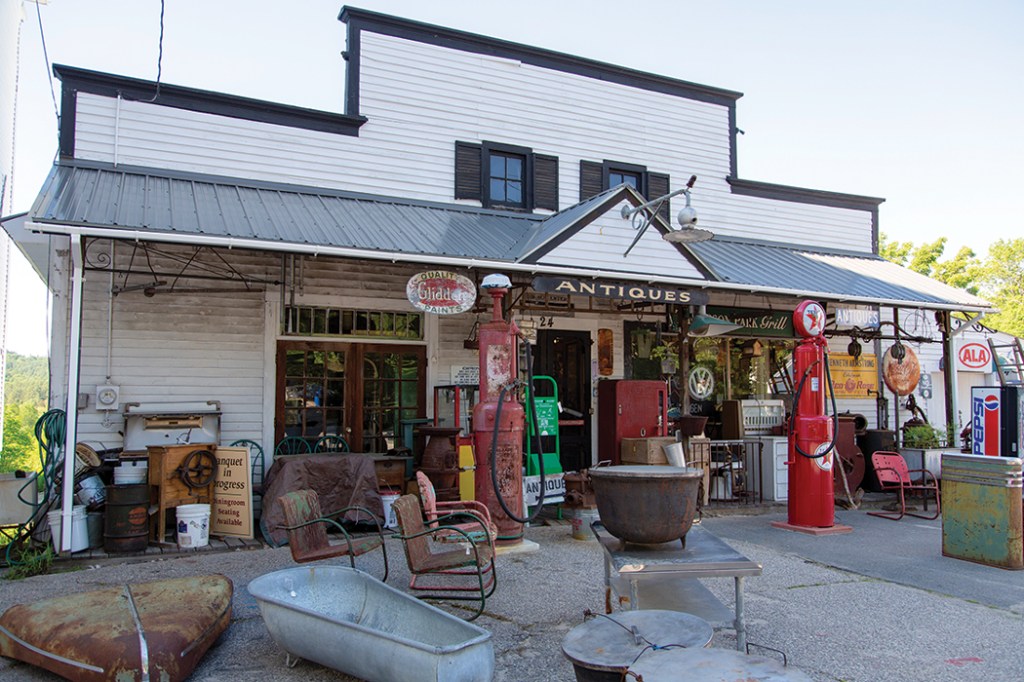
A friend once told me that antique stores are basically graveyards for people’s stuff. I know what he meant having been to numerous such stores throughout my life. I take things a bit further than Jeff, saying that an antique store is not only a cemetery for items, but a place where sentimental is no longer attached to value.
Some of the stuff found in antique stores and on eBay have no more right being there than a life insurance agent does at a funeral. Family members are well known for “claiming” something of dad, mom, or the grandparents under the guise of sentimental value, only to sell it down the road for financial gain. In some cases that was their intention to begin with.
Thankfully, stuff that my grandparents left behind including my parents has no real financial value. They do possess sentimental value with significant family history still attached. That little porcelain lamb is a prime example. I like to simply hold it, knowing that Mama Haynes once did the same, including Mom and her sisters, although for them it was quickly taken away.
I’ll keep it around, along with an old sewing machine that Grandma Hankins once sat in front of and pedaled, her wrinkled hands teaching me at an early age how to use. You see, in my mind, sentimental and historical value far outweighs the few dollars that can be had for these items. If my kids or grandkids decide to part with either after I’m gone, they’ll hear a couple of great-grandmas yelling at the top of their lungs from way up high!
“When Banquet frozen dinners start melting along with Minute Maid frozen orange juice you’ve got a real crisis on your hands.”
Frozen food section
I was in a southside grocery store the other morning when a bell started ringing much like those heard on a large ship. An automated message immediately came over the intercom asking for a perishable manager to come to the dairy section. I happened to be in that department getting a gallon of milk at the time. Having worked as a stocker and cashier at Proctor’s Grocery in Eagle River, Alaska, years ago for a short while, I don’t recall anyone having the title of perishable manager.
Perhaps they should have because I remember a freezer going down overnight when no one was around, and the next morning a bunch of us quickly shuttling goods to an outside frozen food locker. It was a little too late because most of this stuff was already partly thawed.
Not wanting to be one of those vultures following ambulances or firetrucks to accident scenes, nonetheless, I hung around the dairy section of this store waiting to see what transpired. Most likely, those clanging bells I heard were meant as a warning to hustle, much the same as when Code 99 comes across a hospital loud speaker signifying cardiac arrest. I was in a hospital once when that happened, with nurses and doctors seemingly coming out of the woodwork all on a dead run to a certain patient’s room.
Several minutes passed in this supermarket as I stood around like a vagrant watching for things to happen. Not seeing anyone rushing to the scene I decided to leave. At this point, a plainly dressed employee with no badge calmy walked up with a laser thermometer and pointed it inside the dairy case. Maybe it was just me, but it appeared this worker didn’t see things here as a real emergency. I don’t know what the temperature reading was in that case because I wasn’t tall enough to see over his shoulder, although I tried. It must’ve been okay because the young man walked away laid back and unconcerned like when he first arrived.
I suppose had that bell sounded and the robocaller asked for a perishable manager to come to frozen foods it might’ve been a different story. When Banquet frozen dinners start melting along with Minute Maid frozen orange juice you’ve got a real crisis on your hands. During midsummer, when it gets really hot outside and I’m having to shop, sometimes I venture to this section and leisurely stroll through. I’ll even open a door or two just because I like the feel of twenty degree air hitting my face and body. I’ve seen other seniors do this as well, although none have admitted like me that the reason is to cool off. That short burst of cold air sometimes allows my underarms to chill which is a really good feeling.
Should one of these frozen food freezers ever go down when a slew of us seniors are gathered around it, hopefully, the perishable manager sees fit to call a repairman right away. It might be nice if this employee also knows CPR. Jus’ sayin’. And one more thing. Why not change the title of the position to “cold enforcement” with perhaps a badge to wear dictating such. People like me would then know to give these folks the same respect due cops and firemen.
“Exactly what life accomplishments to place on a two-foot by two-foot chunk of granite took some serious pondering, being that I have so many.”
Life accomplishments
A letter specifically addressed to me arrived in the mail the other day, and I had to chuckle after reading the following message inside:
“A grave marker is how people will remember you long after everyone you know has passed, so you’d better make it good. When done well, it can provide a sense of one’s style in life. The epitaph should be pithy, the shape and style memorable. You could go for the classic granite slab, or opt for something a little more memorable.”
Of course, this advertisement was from a statewide monument manufacturer trying to coax me into preordering one before my time. No one else would claim that a grave marker is a person’s living legacy. It had me thinking of what would be the ultimate gravestone for a jokester. Of course, I’d definitely want one “a little more memorable” as the letter mentioned.
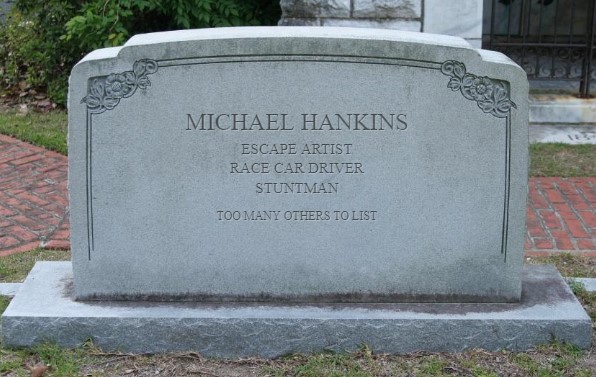
The ultimate tombstone would be one with a list of my life accomplishments chiseled into stone, so that those folks walking through the cemetery, after stopping and reading, would think more highly of Michael Hankins. Exactly what life accomplishments to have engraved on a two-foot by three-foot chunk of granite took some serious pondering, being that I have so many.
Early on, at five years of age, I escaped Sunday school one morning by faking a trip to the restroom, and then walked a couple of miles only to be caught. I’ve never bumped into anyone else having made it that far. At least I survived my escape unlike those three men trying to leave Alcatraz Island in 1962. This story alone would take up the whole stone so I’d just have to say: Escape artist.
At one o’clock in the morning, as Dad drove our family from Texas to Alabama, I accidentally shot my camera flash into his rearview mirror causing the old man to drive off the road without crashing. To simplify things on my memorial it would simply read: Photographer.
While on vacation in Lake Havasu City, and riding a rental personal watercraft on the lake, I popped things into reverse doing forty just to see what would happen. Catipulted a good twenty feet as my son watched, I survived other than having the wind knocked out of me. I’m definitely not the only person having done that but most likely one of the first. A simplistic description here for my marker: Stuntman.
Accruing nine speeding tickets before turning eighteen, and not losing my license or insurance thanks to there being no computers back then to log data equates to: Racecar driver.
Having my first checking account and not taking into consideration the balance didn’t reflect some checks not clearing made me a: Bouncer.
Playing catcher on a church softball team and having the crotch totally rip out on my weathered jeans, yet continuing to play while folks I didn’t know silently laughed: Exhibitionist.
Getting lost in a Phoenix parking lot after walking out of a large mall, and not being able to find my rental car for over an hour: Discoverer.
There’s many more accomplishments, yet I believe the stone’s now full. In fact, there’s not enough room left for month, day, and year. Perhaps, preordering a tombstone with that in mind isn’t such a bad idea after all?
“I elected to name it “Gibson” after retired United States Marine and Alaska State Trooper, the late Sergeant Dale Gibson.”
Thanks for the memories!
In 1970, Crosby, Stills, Nash, and Young came out with a song titled, “Almost Cut My Hair.” It was a favorite tune of mine for several reasons and still is. Some lyrics fit perfectly back then, especially one in particular, and even today this line still rings true although not as much as back then.
“It increases my paranoia,like looking at my mirror and seeing a police car.”
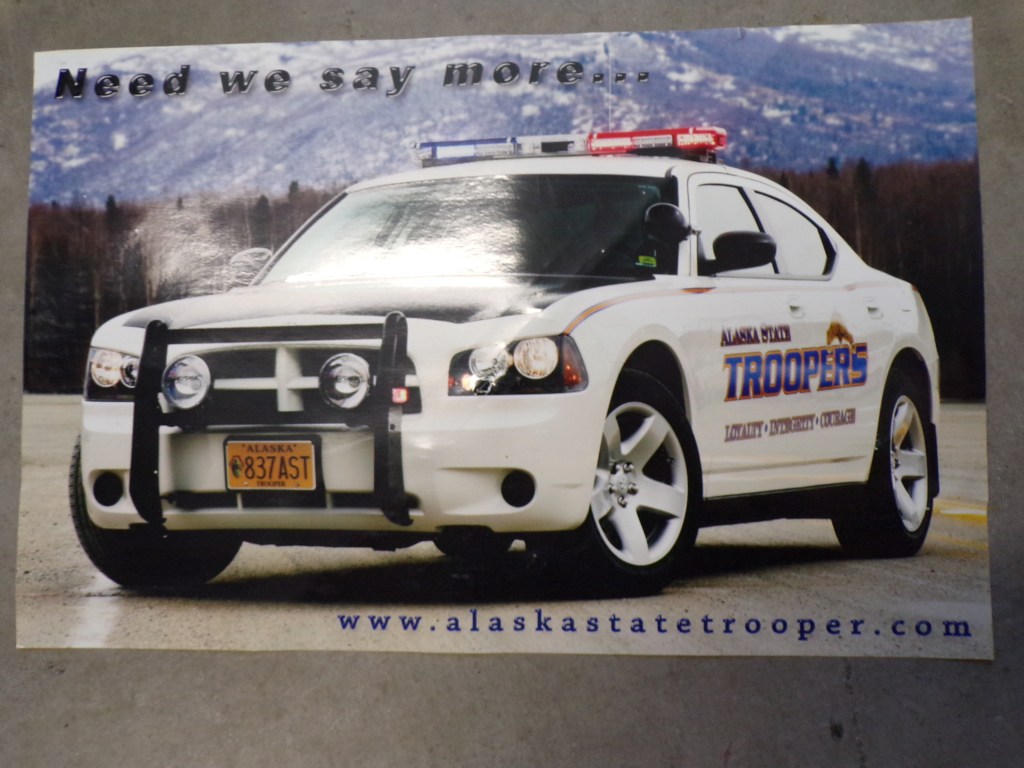
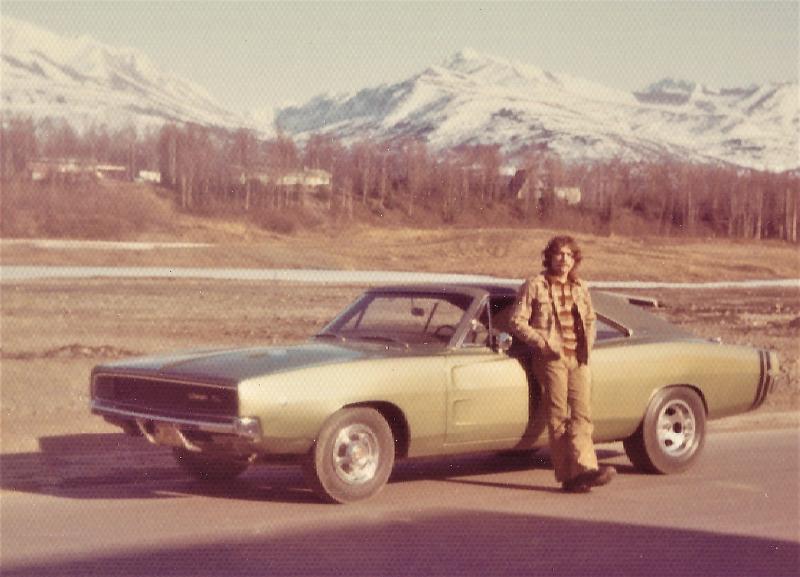
Being a car guy starting in the late 1960s, and into fast ones, it wasn’t uncommon to be driving my 1968 Dodge Charger and find that to be the case. Black and white Alaska State Trooper pursuit vehicles seemed to always be in the rearview mirror, oftentimes with red and blue lights flashing. With a slew of speeding violations tacked on my driving record, the F8 green Charger I drove with black tail stripes was well known throughout the Anchorage, Alaska, vicinity. During the heyday I even had my own nickname amongst fellow car enthusiasts, “Mopar Mike.”
I was pulled over on several occasions for nothing more than having long hair, at least that was my belief back then and still is. Of course, long hair in the ’70s was synonymous with pot use, while drugs and alcohol were things that I never took part in. I began to cop an attitude towards the law because of this, failing to see that my less than stellar driving record had a lot more to do with being pulled over than anything else.
I couldn’t park my car without police being attracted to it like bees on honey. There was one occasion when I met up with a friend, leaving my Dodge in a church parking lot while we took his Chevrolet. Stopping back by a couple of hours later to retrieve it, an Anchorage city policeman was walking around shining his flashlight inside, most likely looking for drug paraphernalia that was nonexistent. We circled the block waiting for the guy to leave.
On two occasions I was driving home and got pulled over for nothing. One trooper turned around and lit me up, saying that he clocked my car doing eighty in a fifty-five-mph zone. That one I beat in court when the trooper didn’t show up. I doubt I was going that fast because it was on a sweeping curve, and early Dodge Chargers were heavy cars and horrible in the handling department.
The other time I’d been out rock climbing with friends at McHugh Creek, not returning home until early the next morning. A trooper going the other direction on the Seward Highway turned around and pulled me over. Seeing my bloodshot eyes he evidently though I was high, making me walk the line as I like to call it. Passing the test with flying colors, he asked what I was doing out at four o’clock in the morning. This was in Alaska during July and the sun was already brightly shining.
“Climbing rocks!,” I told him. “And as soon as you’re finished hassling me I’m going home and climb into bed!”
He gave me a ticket for going six miles over the speed limit which was probably spot on. I might’ve gotten away with no ticket had I been a little more respectful. My smarting off didn’t help matters.
Flash ahead fifteen years: Now working for the State of Alaska as a mechanic, of all things, State Trooper cars were some of the vehicles I wrenched on. During that time I had amble opportunity to meet these law enforcement officials, greatly changing my tune on how I once viewed them.
When I mentioned to long time trooper, Sergeant Bob Vickers, about my old green Charger, he said that he remembered the Dodge quite well, having stopped it and arrested a couple of young guys for marijuana possession. Asking what year, Vickers told me around 1976. At that point in time I didn’t own the car, having sold the vehicle to a long haired kid in Eagle River. Evidently this fellow didn’t let the police down where stereotypes are concerned.
Alaska State Troopers Michael Opalka and Dale Gibson were a couple of troopers I came to respect while working at DOT. Hearing stories of what they went through on a daily basis in dealing with the public, gave me much empathy towards those working in this profession. As Trooper Gibson once told me, “We don’t make the laws, we only enforce them!” I’ve remembered that statement ever since when dealing with police.
One item on my bucket list was to own another Dodge Charger. Chrysler Corporation was manufacturing a four-door version and I wasn’t sure that was the way to go, although the Alaska State Troopers were using them with great success. In 2021, Dodge announced that they were going to build a special Hellcat Redeye Charger with 797 horsepower. My wife along with friend and Dodge connoisseur, Bob Frederick, convinced me to purchase one.
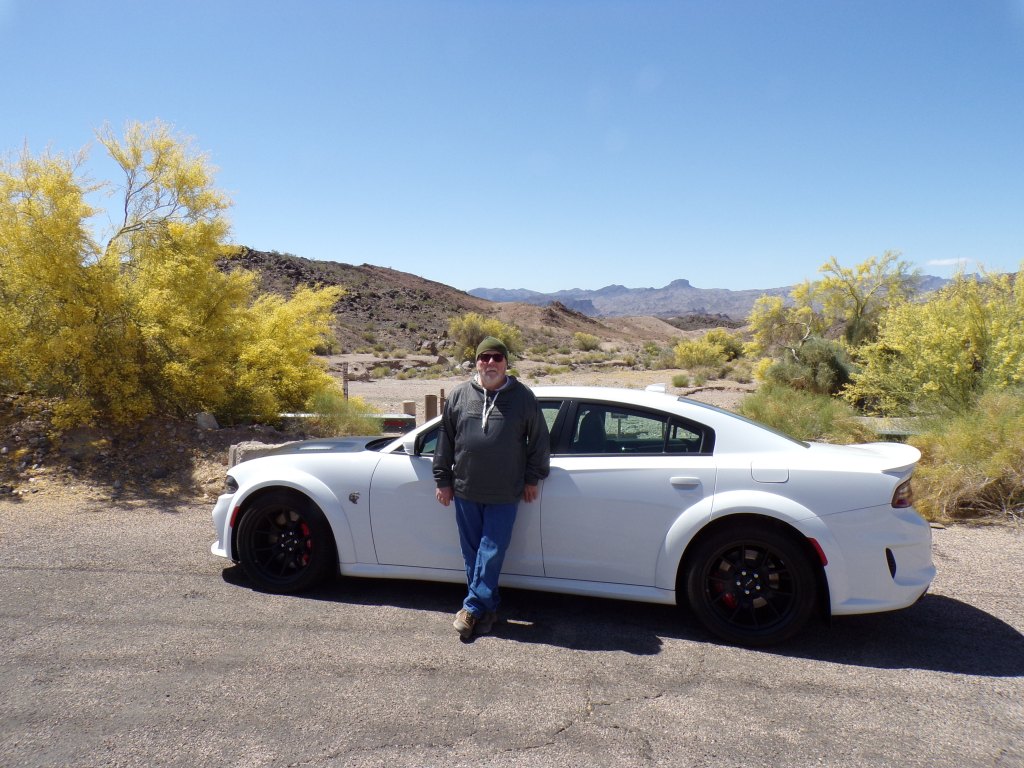
I was all set to place an order for another F8 green which was still available. At the last moment I changed that to an all white Charger with black hood, identical to the ones that Alaska State Troopers still use. On New Year’s eve in 2021, the car showed up at our Arizona home after being trucked from Pennsylvania. I officially signed the shipping papers on January 1, 2022.
Reasons for the the color change partly has to do with that Crosby, Stills, Nash, and Young song, along with my checkered past where driving was concerned. Rather than looking in the mirror and seeing a black and white, I wanted to be behind the wheel of one.
This car is reportedly good for 202 mph but will never see that speed with me in the drivers’ seat. With only ten 2021 Hellcat Redeye Chargers manufactured with the Alaska State Trooper color combination, I elected to name it “Gibson” after retired United States Marine and Alaska State Trooper, Sergeant Dale Gibson. As fearsome a driver as he was, I doubt there’s enough horsepower under the hood to have suited his taste. One thing I never got to tell the guy was,
“Thank you for your service!”
My primary reason for writing this story was to send it to Dale Gibson in Pahrump, Nevada, and complete the mission. Unfortunately, I didn’t learn he passed away until the day I finished writing. That’s how it seems to go with us older folks.
In literary terms, black and white also has specific meaning: If something is black and white, it’s defined as clear and distinct via Webster’s Dictionary. That especially holds true for seniors.
Here today, gone tomorrow seemingly creates more paranoia for the majority of us older folks over that of seeing a police car in our rearview mirrors!
“Mopar Mike” with “Gibson”1968 Dodge 4-speed 440 Charger R/T – “Mopar Mike” – Photo taken 1972 in front of Cheney Lake (Anchorage)
“I’m also one of those people you see in the checkout line grabbing additional items such as nail clippers and candy bars before leaving.”
I’ve been asked by several people, okay, make that one friend and my brother, if I have any tips on writing a book. That question was best left to a professional writer, yet I tried answering things in layman’s terms, which is the politically correct definition for someone who doesn’t know what they’re talking about.
I just finished my fifth book, with this friend telling me that if I keep writing them, maybe I’ll eventually get one right. He said that in jest although there’s much truth to it.
Everyone’s writing style is unique and mine’s no different. I equate it to a car having bald tires trying to get across a muddy field. This vehicle spins and twists its way through the mud, eventually, after much effort, arriving at the other side. The key here is never get stuck which is akin to giving up. I believe this holds true for all writers, professionals and amateurs alike.
Where writing a book is concerned, a person first has to ask themself, “Why do I want to write it?”
I suppose there are many answers to this, with a couple of them being: I’d like to sell a lot of books and make gobs of money, or, I have something of relevance to share with others regardless of the monetary payback. My reasoning fits within the latter explanation.
Time is the biggest factor in putting a book together and people have to be willing to give up a big portion of it. I find there are more fun things to do besides sitting behind a computer, but also realize that whatever I’m needing to compose will never get accomplished down at the lake, which is where I’m headed right now.
Having someone look over your composition is a must. I’ve went through several of these people, now former friends, throughout the past few years. I learned a bit too late that you can’t expect them to do something for nothing. If it’s a book you’re having folks look at, make sure to at least give your volunteer a free copy, plus lunch or dinner.
On magazine, newspaper, and smaller articles, a simple lunch is most appropriate for having them review the work, although fast food might not cut it for some. I still owe one proofreader several tokens of appreciation at the golden arches, namely my wife.
Don’t fret over typos, misspelled words, sentence structure errors, misuse of abbreviation, or anything of the like at the start of your book. That stuff can all be corrected once the manuscript is complete. If I tried writing “letter perfect” from beginning to end I’d never finish. This initial composition is called the rough draft by some while I refer to it as an outline.
Where lengthy manuscripts are concerned, never edit your own work. I learned that early on as well. Countless hours were spent doing so, only to send it to a professional editor and have them find mistake after mistake, ones that I’d repeatedly overlooked.
For a first book, I suggest using a vanity publishing outfit over that of total self-publication. These firms have inhouse editing employees along with graphic arts professionals for designing the cover. There are many writers that will disagree with me here, but we’ll just have to agree to disagree, or something to that effect.
There are a good number of reputable publishing houses to choose from, but check their reviews first before submitting your manuscript. I’ve used three so far and all were excellent. My reasoning for using Palmetto Publishing this last go-round is only because their company logo is a palm tree which gives it a Havasu feel. Shooting from the hip like that is how I make important decisions. For whatever it’s worth, I’m also one of those people you see in the checkout line grabbing additional items such as nail clippers and candy bars before leaving.
My last two pieces of advice are highly important. Number one: If I can write a book, anyone can. Being a mechanic by trade, and not a very good one at that should tell you something. Just take the time and do it as Nike would say.
Number two: Once your book is finished some people will request a signed copy. Before doing so, practice writing your name on a sheet of paper, cursive style, several times before signing the author page. Trying to use arthritic fingers, my handwriting now resembles a caveman’s or doctor’s. Currently having no books to sign, I’ll work on number two a bit longer myself, that is, once I return from the lake.
“Writing non-fiction is definitely harder, because making stuff up and trying to pass it off as truth is something only career politicians are good at.”
I first started writing The Last Christmas Card in the winter of 2009 – just now wrapping things up where publishing is concerned. Fourteen years passed with the manuscript securely digitized on an antique floppy disc, including being stored upstairs in my noggin during that time. Not sure if I wanted to complete things, my wife, Joleen, persuaded me to one year ago after she read several of the book’s beginning chapters.
Always knowing where I wanted to start and end this tale, yet not having a specific town where things were supposed to take place was a major problem. Lake Havasu City wouldn’t work because it was much too young. The location I chose needed to have a limestone house, as stucco and a tile roof just wouldn’t cut it.
This is my first foray into writing fiction and I like it. A fair amount of research still needed to be done, yet when a roadblock suddenly came up all I had to do is make junk up to get around it. Writing non-fiction is definitely harder, because making stuff up and trying to pass it off as truth is something only career politicians are good at.
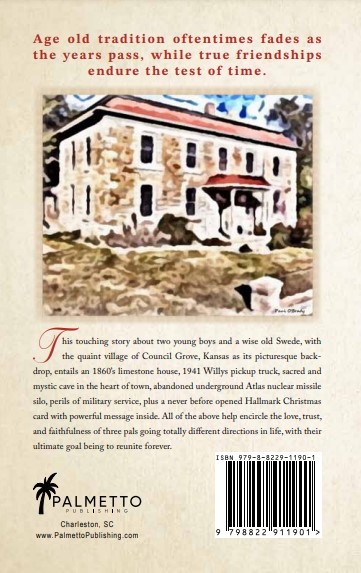
Visiting Council Grove, Kansas, I found that location to be picture perfect. For those having never been there, Council Grove is akin to an oasis in the prairie, first discovered by American Indians going far back in America’s history. An abundance of water was a magnet to wildlife of all type, with the indigenous natives following them. Starting in the mid 1800s, Council Grove became a major stopping point on the Santa Fe Trail. Now a major tourist attraction, “Hay’s Last Stop Store” built in 1850 still stands.
Many of the events in my book are ones that I played a role in, with other family members and friends doing the same. The Atlas missile silo mentioned in the story is approximately one mile from my wife’s Uncle Lee and Aunt Joan Mills’ farm. Joleen’s cousins, Randy and Larry Mills, took me there in 1975.
A humorous horseback ride talked about chronicles one that my family, including Uncle Noel and Aunt Gay, with cousins, Randall and Cheryl McDaniel, went on in 1964, at Buffalo Lake in Lubbock, Texas.
An 1860s limestone house mentioned is exactly like one in Manhattan, Kansas, that my wife and I were prepared to purchase, at least I was, but didn’t for unusual reasons, one of them being the home sat on County Road 911. A 1941 Willys pickup truck which is a key part of the story is a takeoff from a 1938 Willys that Joleen’s brother owns.
The “Freedmen” Cemetery is in the same town, Dunlap, Kansas, where my wife’s late father, Herman Freeman, was an elementary school principal for several years. This cemetery holds emancipated slaves going back to the American Civil War. Dunlap was a designation for African-Americans wanting to escape the pain and horrible memories of enforced bondage. I could go on and on but won’t. Palmetto Publishing is wrapping things up, with the official release date – May 23, 2023.
Another fiction book is rolling around in my head and this time Lake Havasu City will be featured, with The London Bridge as the main subject. I can’t wait another fourteen years to finish this one because at that point, I’m not sure I’ll be able to see the keyboard!
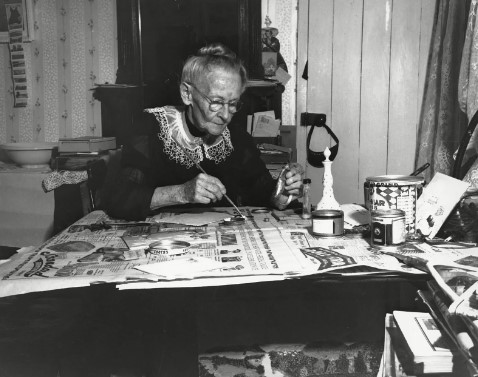
“It would be akin to dropping off Grandma Moses, who’s living in your home, at a convenience store for several days so that you can go on vacation.”
I remember questioning my mother about some of the quirky things she did in life and her response back to me was straightforward and simplistic,
“Young people will never fully understand us older people until they walk in our shoes!”
I got her drift, yet basically thought it was just another cliché that senior citizens use. I heard them all the time from aged family and friends. Nowadays, after finally walking in an older person’s shoes, I totally understand what she and others meant.
My wife and I have basically put our lives on hold for our aging Pekingese dog, Simon. We’ve been questioned about such, but those younger people doing the questioning seem to have a different grasp of the word, commitment.
Just like children, pets are dependent on their owners in more ways than just sliding a bowl of water and food under their noses. One of those areas is being sensitive to their needs when they too get older. A true pet lover will understand what I’m saying here, while those folks just owning pets won’t. There’s a big difference between the two personas.
On the flip side, those not having cats and dogs, and never wanting an animal, will think it’s just foolish talk. I’ve run into more than one of those people over the years, and sadly, they don’t know what they’re missing out on in life.
At this point in Simon’s life, he doesn’t want to travel all over creation seeing the country and leaving his mark like younger dogs. Our fur baby is more at peace being at home in surroundings that he’s accustomed to. To now abandon the poor guy with strangers would shorten his already fragile life considerably. It would be akin to dropping off Grandma Moses, who’s now living in your home, at a convenience store for several days so that you can go on vacation. There are some self-centered people in this world that would do exactly that.
Being true pet lovers, our commitment to Simon is to do all we can to make his last days on earth as comfortable as possible. It’s no more different than what a person should expect for their ailing parents or grandparents.
What many younger people don’t understand, is that pets help fill a big void after children have left the nest. Animals will never totally replace them where flesh & blood is concerned, but they do become family and are important. Most of us seniors see our pets on a daily basis, whereas, it might be weeks, months, or even years before the kids stop by.
I recall when my mother reached that same stage as Simon. She didn’t want to venture far from her church, doctors, grocery store, and little apartment. The thought of being twenty-miles away from any one of them created stress and anxiety, things that someone with a heart condition should avoid. When my brother asked her to travel around the state of Alaska with him, Mom basically told Jim to have at it, she’d hold down the fort.
Dad had a different way of looking at adult decisions than Mom. While some didn’t always agree with the quirky decisions he made, my father’s philosophy was quite simple like Mom’s. I believe this is how he would explain things if he were still alive:
“I’ve been calling the shots where decisions are concerned for most of my life, some of them right and some of them wrong. In spite of the errors, I’ll continue making my own decisions until the day I die!”
I’ve picked up a bit of both parent’s reasoning here. Like Mom, I’m a homebody and can find great joy going absolutely nowhere. Being a military kid, I had my fill of traveling, living in Florida and California, plus a couple of states in between. I’ve always been able to entertain myself doing crafty things around the house and still do. Dad and I are birds of a feather in certain areas, but I would add three significant words to his statement where making adult life decisions is concerned.
“I’ve been calling the shots where decisions are concerned for most of my life, some of them right and some of them wrong. In spite of the errors, with God’s guidance, I’ll continue making my own decisions until the day I die!”
One of those quirky decisions I’ve made is spending as much time with our little doggie as possible. If that means curtailing all vacations until he’s gone then so be it. Grandma Moses and my mother would definitely understand!








 I like to write junk...