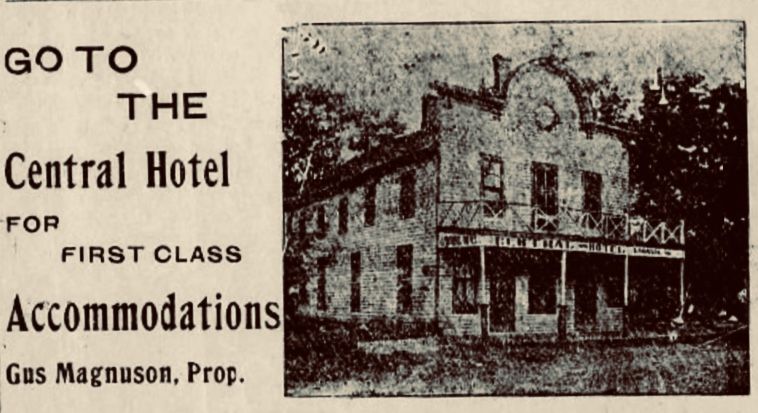
“Gustaf and Mary Mae Magnuson ran the Central Hotel in town…”
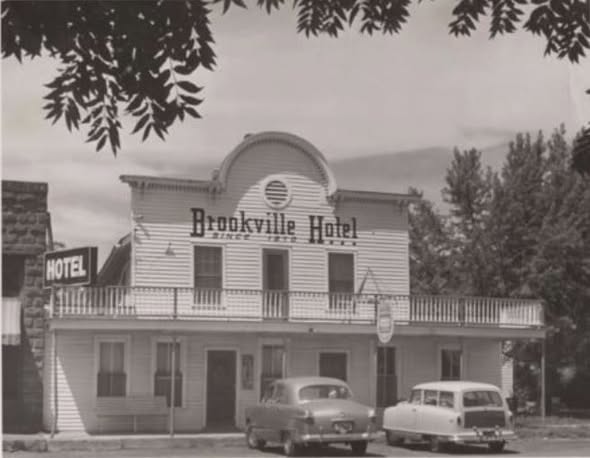
The Brookville Hotel in Brookville, Kansas, began its storied journey as the Central Hotel. Originally serving travelers and townspeople alike, the hotel quickly gained a reputation for its welcoming atmosphere and hearty home-cooked meals.
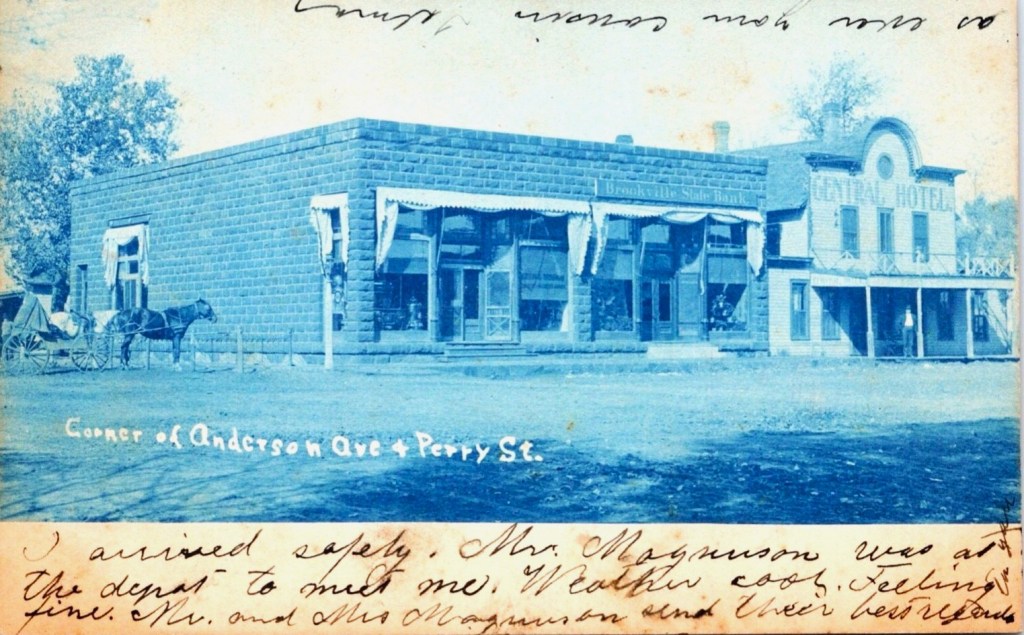
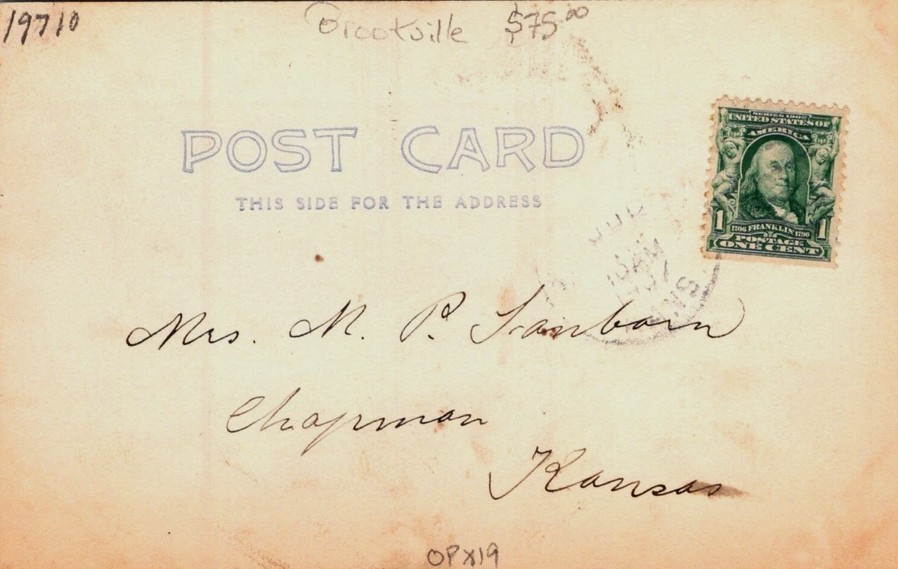
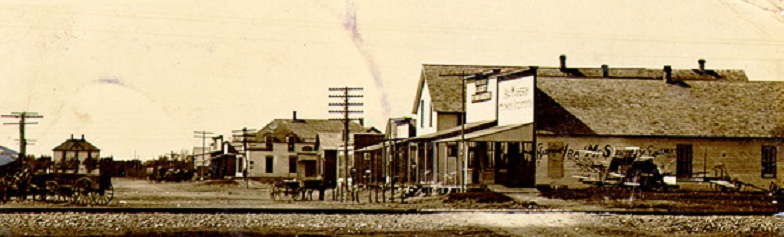
A picture postcard sent to Mr. M.P. Sanborn from Brookville, Kansas, in 1907, shows a photograph of the corner of Anderson Avenue and Perry Street in Brookville, with the Central Hotel visible. A message written across the front says,
I arrived safely. Mr. Magnuson was the depot to meet me. Weather cool. Feeling fine. Mr. and Mrs. Magnuson send their best regards in you. As ever, your cousin, Tilman”
Malte Peterson Sanborn was one of Chapman’s most well-known and respected residents. Born on March 26, 1857, in Sweden, he married Mary E. Phipps on March 25, 1886. She died in 1893. The couple had one child.
Mr. Sanborn remarried Anna Mary Phelps in 1896. They had three children. Malte and his wife owned a successful lumber business in Chapman. M.P. Sanborn was also involved in town politics, serving as a councilman.
Malte died on April 24, 1918. Anna Mary Phelps-Sanborn passed away on August 11, 1934. Both are buried at Indian Hill Cemetery in Chapman. I could not locate M.P. Sanborn’s cousin, Tillman.
Gustaf and Mary Mae Magnuson ran the Central Hotel in town, which later became known as the Brookville Hotel. In later years, it was considered to have one of the best restaurants in the entire state of Kansas. Many celebrities ate there, including “Buffalo Bill” Cody and John Wayne.
I was fortunate to also dine at this historic business with my wife’s family, before it moved to Abilene, Kansas, and then closed. Joleen was able to get the recipes for some of their exquisite dishes, especially fried chicken and creamed corn. She still serves them during holidays and special occasions.
Gustaf Magnuson was born in Sweden on December 3, 1864, in the same town as Malte Peterson Sanborn. The two men and their wives were friends. Gustaf passed away on September 15, 1933. He was 68.
Gustaf’s wife, Mary Mae, was born on November 27, 1873, in Pennsylvania. She died at the age of 60 on September 10, 1934. The couple had four children, Harry, Helen, Walter, and Leone. Gustaf and Mary are both buried in Brookville.
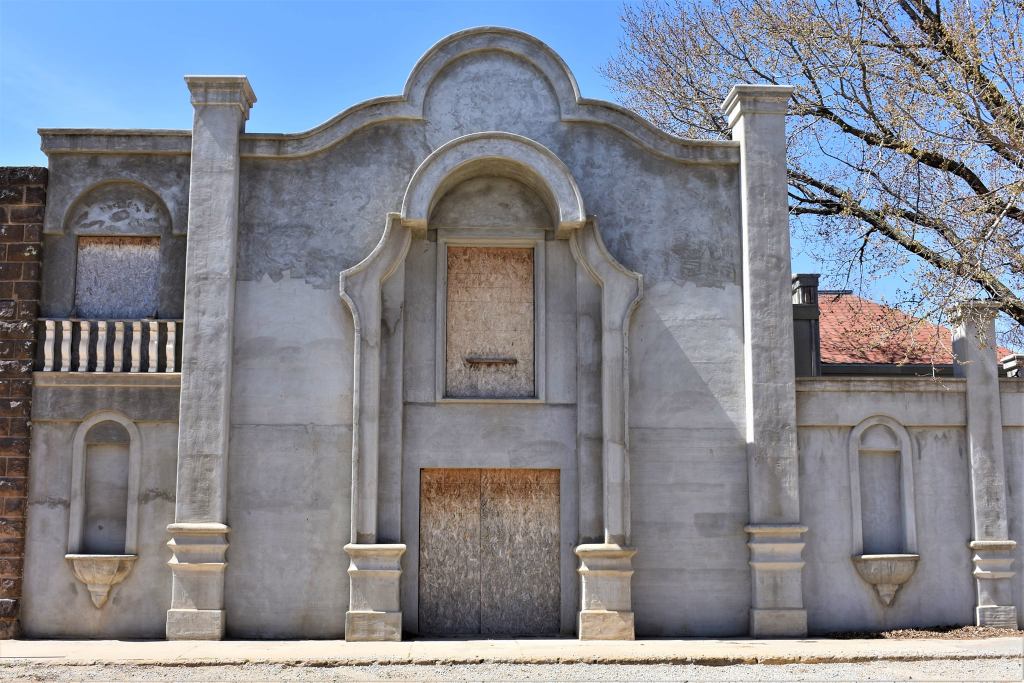
The Brookville Hotel building still stands, although it’s no longer used. Stingy Brookville town residents are responsible for the restaurant moving to Abilene, by voting not to help build a much-needed sewer line.
A few thousand dollars of tax revenue used towards such would’ve undoubtedly kept the business afloat. Over the years, thousands of dollars were lost, as tourists, hungry for a chicken dinner, no longer stopped in Brookville.
Such poor decisions come from those folks having no future vision for their town or city. They could’ve learned a lot from Council Grove town officials.
“Today, Bavaria still remains an unincorporated area, a ghost town.”
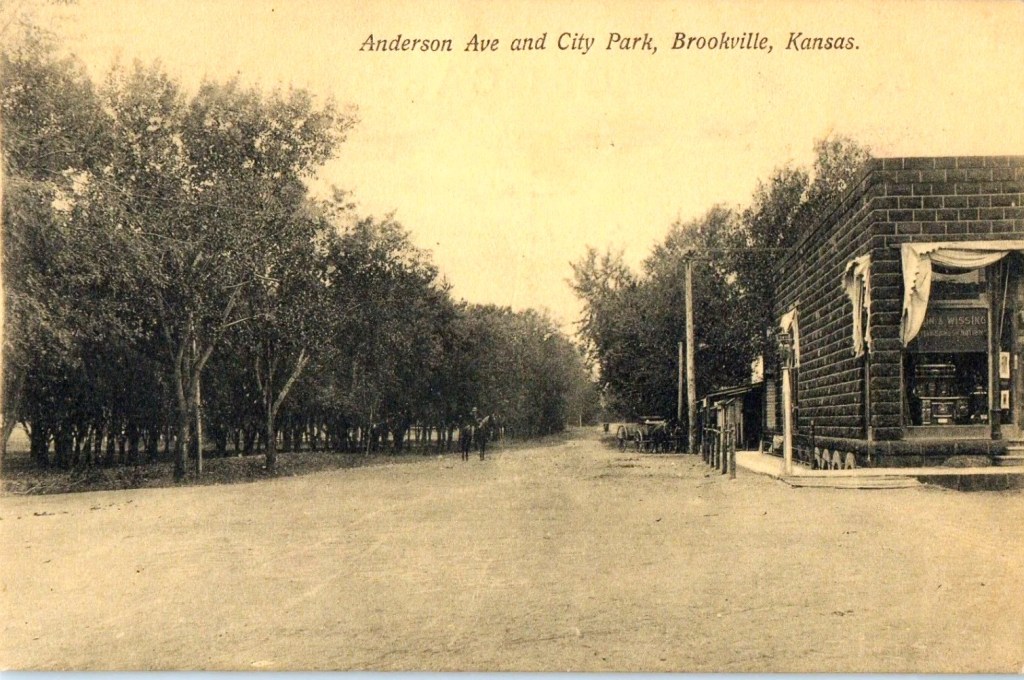
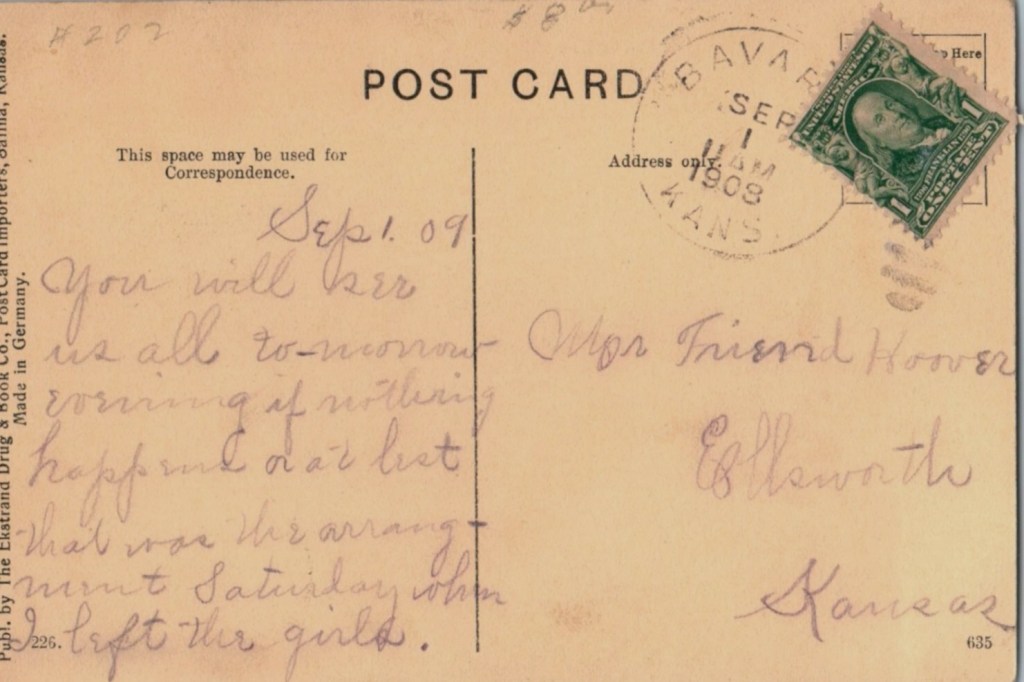
A 1908 picture postcard mailed from Bavaria, Kansas, to Ellsworth, Kansas, has a photograph of Anderson Avenue and City Park on the front, which is actually located in Brookville, Kansas. Brookville is in Saline County, like Bavaria and Ellsworth.
Bavaria, Kansas, is now a small unincorporated community located in central Kansas. Despite its regress, Bavaria has a rich and interesting history that reflects the development of rural communities throughout the American Midwest.
Bavaria was established in the 1860s during a time of rapid settlement and expansion in Kansas. Many of the first settlers in the area were of German descent, which is reflected in the community’s name—Bavaria, after the region in Germany. The town was strategically located near the Smoky Hill River, which provided vital water resources for agriculture and livestock.
In the late 19th century, Bavaria grew to include a post office, general store, and several other businesses serving local farmers and residents. The arrival of the railroad in Saline County helped foster growth and made it easier for residents to transport goods and travel to larger cities, such as nearby Salina.
The post office in Bavaria was established in 1867 and operated until 1960, serving as a hub for communication and commerce in the area. The community developed a reputation for being close-knit, with local churches and schools playing a central role in daily life.
As the 20th century progressed, Bavaria—like many small rural communities—faced challenges due to changes in agriculture, transportation, and population trends. The consolidation of farms, improvements in highways, and increased mobility led many residents to move to larger towns and cities. By the mid-20th century, Bavaria’s population had declined, and many of its businesses closed.
Today, Bavaria still remains an unincorporated area, a ghost town, with its historical significance preserved in local records and memories. Though small, it continues to be a symbol of the pioneering spirit and community values that shaped rural Kansas.
While Bavaria may no longer be a bustling place, its legacy lives on through its contributions to the region’s agricultural development and the stories of the families who once called it home. The old schoolhouse, now torn down, and other historical landmarks still standing, serve as reminders of the community’s vibrant past.
Mrs. Friend Hoover in Ellsworth was the recipient of her husband’s postcard. He was either in Bavaria or Brookville on business, having picked up the Brookville card at their local railroad depot.
“Sept 1, 1909
You will see us all tomorrow morning if nothing happens at lest that was the arrangement Saturday when I left the girls.”
Friend Herman Hoover was born in Greenleaf, Kansas, on February 22, 1887. Friend’s mother and father were Herman and Mary Elizabeth. Married on March 21, 1912, they had three children, Leroy, Herman, and Joyce.
During his work cycle, Friend worked as a farmer, at the Ellsworth Salt Works as foreman and fireman, culminating his career at retirement age as a tire repairman in an Ellsworth service station. He died in Ellsworth on September 18, 1960, at the age of 73.
Emma Mary Barkow-Hoover was born on October 21, 1884, in Ellsworth. She passed away on December 25, 1961. Emma was 76. Both Friend and Emma are buried in the Ellsworth Cemetery.
The Bavaria school, before it was torn down.Railroad depot
“Enlisting at age 17, Tam Brooks was a Confederate soldier during the American Civil War.”
Hillsboro, Texas, founded in 1853, serves as the county seat of Hill County. The city grew steadily with the arrival of the railroad in the late 1800s, becoming a hub for commerce and agriculture in Central Texas.
Known for its historic courthouse and downtown district, Hillsboro has long been recognized for its rich architectural heritage and vibrant community spirit.
Over the years, the city has balanced preservation of its historic character with modern development, maintaining its role as a cultural and economic center for the surrounding region.
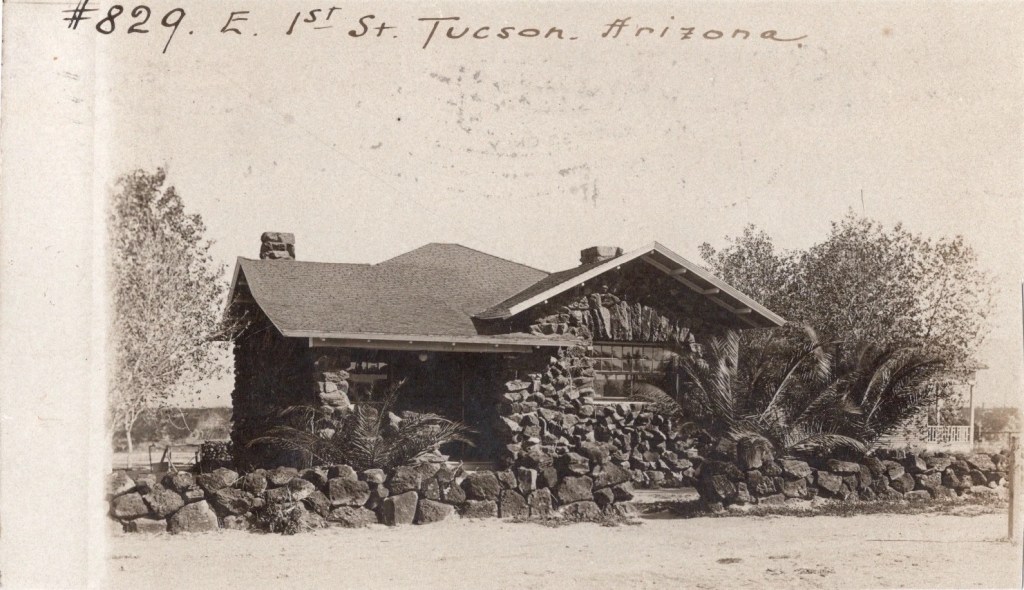
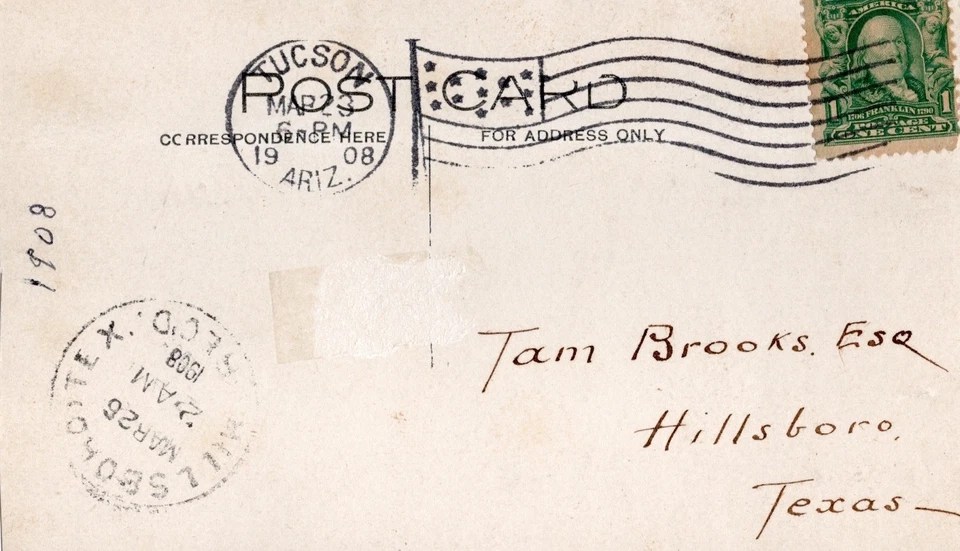
A picture postcard sent to Tam Brooks in Hillsboro features a stone house on the front in Tucson, Arizona. An address for this home is 829 E. 1st Street. The card was postmarked March 23, 1908. Oddly, there was no message.
Tamerlane Xenophon “Tam” Brooks lived quite a life before moving to Texas. Born in Walker County, Georgia, on November 9, 1844, to parents Jacob and Sarah, his father, Sgt. Jacob Reed Brooks served in the War of 1812. Tam had six sisters and brothers.
Enlisting at age 17, Tam Brooks was a Confederate soldier during the American Civil War. Captured during the battle of Chickamauga, he escaped and made his way back south to serve in a Georgia scouting unit.
After the war, Tamerlane Brooks moved to Hill County, Texas, where he became a successful land speculator, while also loaning money for the same. At this time, Tam married Mary Medora “Dora” Smith. The couple had six children. Tamerlane Xenophon Brooks died December 12, 1926, at the age of 82.
An obituary in the Fort Worth, Texas, newspaper details a small portion of Tam’s wife, Dora.
“Mrs. Dora Brooks, 94, widow of Tam Brooks, pioneer Hill County businessman, died Friday afternoon at her home here, in which she had lived for 68 years. She was a native of Mississippi and came to Texas in 1864. She was married here in 1872.
Funeral services for Mrs. Brooks, who had been a member of the Presbyterian Church for 82 years, will be held at Marshall & Marshall Funeral Chapel at 2 Sunday, Robert E. Robinson and Eugene E. Woods officiating.
She is survived by two sons, Byrd Hillsboro and Guy Brooks of San Angelo; two daughters, Mrs. Nina Groves of Houston and Mrs. Jewel Hudson of Hillsboro; seven grandchildren, 10 great-grandchildren, and four great-great-grandchildren.”
“By the late 1970s, the café closed its doors, leaving behind memories and a shell of its former glory.”
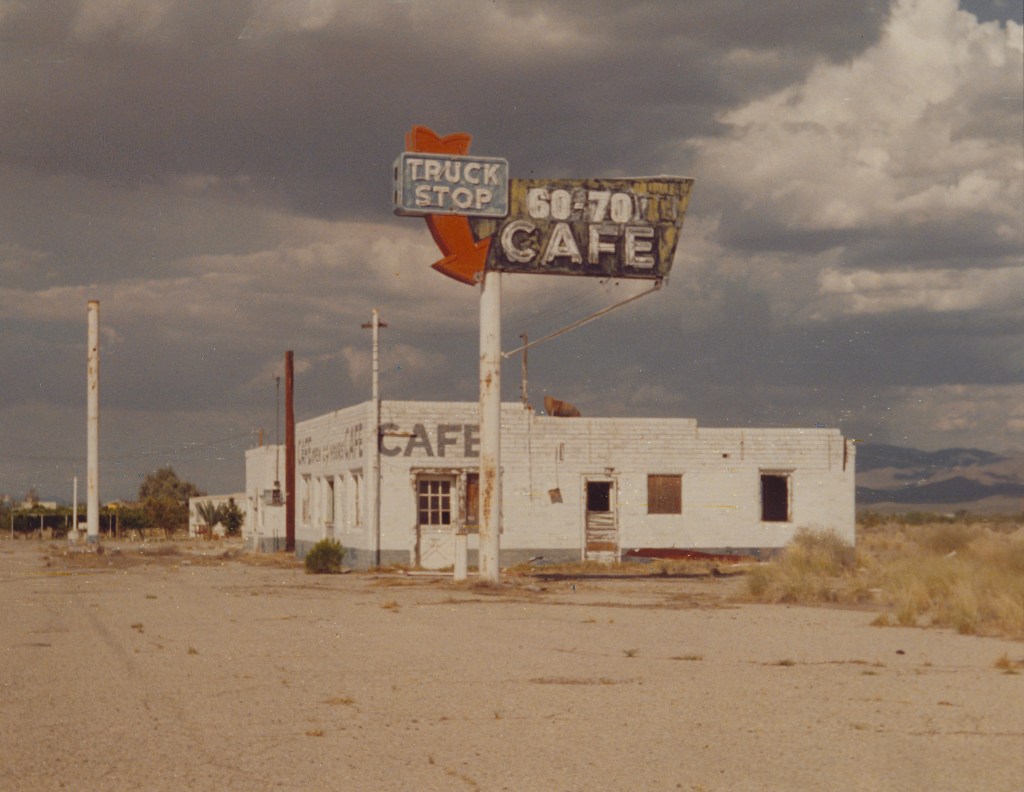
Forty years ago, I took this photo of the US 60-70 Café near Salome and Wenden, Arizona. The café was approximately 98 miles from Lake Havasu City, where we were heading.
Two years later, when we drove by, the building was gone. I was fortunate to be able to go inside back then and see that the booths and counters were still in place. The building hadn’t been vandalized or sprayed with graffiti, as is so common these days.
Nestled along the historic highways US 60 and US 70, just east of Salome, Arizona, the US 60 70 Café stood as an iconic pit stop for travelers journeying through the Arizona desert. Though the café is no longer in operation today, its history is emblematic of the golden era of cross-country road trips and the spirit of American roadside culture.
The US 60 70 Café was established in the late 1940s, during a period of significant growth in automobile travel across the United States. Positioned strategically near the intersection of U.S. Highway 60 and U.S. Highway 70, the café capitalized on the steady flow of motorists, truckers, and tourists heading to and from the West Coast.
The business also offered gas and diesel, making it popular with truckers. The simple yet welcoming architecture, featuring a neon sign visible from a distance, became a familiar sight for those crossing the arid landscapes of western Arizona.
During the 1950s and 1960s, the US 60 70 Café thrived as roadside diners became an essential part of American travel. The café was renowned for its hearty breakfasts, homemade pies, and bottomless cups of coffee, offering weary travelers a respite from the heat and monotony of the desert drive.
The interior décor reflected the era, with chrome stools, Formica countertops, and a jukebox filled with the latest hits. The café not only served locals and travelers but also became a gathering place for the small community around Salome, hosting social events and meetings.
The construction of the Interstate Highway System in the late 1960s and early 1970s dramatically altered traffic patterns across the United States. As more vehicles shifted to the faster and more direct Interstate 10, the once-bustling US 60 and US 70 saw a decline in cross-country traffic.
Like many other roadside businesses, the US 60 70 Café faced dwindling customers and increasing operational challenges. By the late 1970s, the café closed its doors, leaving behind memories and a shell of its former glory. I’m so thankful I was able to snap one picture before its total demise.
Though the US 60 70 Café no longer serves travelers, its legacy endures in the stories of those who visited and the nostalgia for a bygone era. The building’s remains, no longer there, still evoke a sense of wonder about the countless journeys that passed through its doors.
Local historians and longtime residents of Salome often recall the café as a symbol of the community’s connection to America’s great highway tradition. I came across several advertisements in the Phoenix newspaper saying that it was for sale. Evidently, there were no takers.
The US 60 70 Café near Wenden, Arizona, remains an evocative landmark in the history of American road travel. Its rise and fall mirror the broader trends of mid-century travel and the impact of changing transportation infrastructure.
Today, it serves as a reminder of the importance of small businesses in shaping the character and memory of America’s highways. For me, it was fodder for one more story.
“From the condition of the animal, I didn’t know if it’d last through the night.”
I like good news as much as anyone. Early on, this good news consisted of being told by Dad and Mom that we were going to visit my four grandparents in Vernon, Alabama. For my brother and me, that meant plenty of neat places to explore, including some areas we shouldn’t have been.
Papa Haynes’ bee hives were one of them. Jim found out the hard way by being stung just below the eye. The swelling didn’t go down until a few days later. We were instructed numerous times afterward not to shoot our BB guns at the hives again. I don’t believe we needed a warning by then, especially Jim.
Getting an A on a school test was good news. Some kids got them all the time, and I suppose they eventually came to take things for granted. Not me. There were instances where I wondered if I had actually gotten the grade or if the teacher made a mistake in grading.
Mom was the happiest when I brought home an A, which was a rare event, on the same level as spotting a white raven. Because of a genetic mutation, only one raven out of 30,000 will turn out white. Seeing one in the wild is something very few bird watchers ever achieve.
Good news thirty years ago was hearing that someone was getting married or having a baby. A pay raise or a promotion was considered good news. Discovering that we were having my favorite food for dinner was good news, especially when it was macaroni and cheese.
As I’ve grown older, bad news often tries to cut in line—stepping in front of the good news. I’ve heard a few senior citizens say, “Bad news comes with the turf!” In so few words, they’re claiming that age dictates bad things are bound to happen in our circle of friends, more so than with the younger generation. There’s validity to that.
Nowadays, when someone asks, “Do you want to hear the good news first—or the bad?” I tell them, “Neither!”
With so much bad news coming from my friends and family, about either their health or someone else’s, I’ve become somewhat distant while listening. I can only take so much bad before going on a ‘downer’ as the 1960s and 1970s crowd labeled depression.
Prayer eventually helps me get through this, but it’s not always instantaneous. A bit of good news also helps lift me out of the mire.
I was in one of these ‘Debbie Downer’ moods right after New Year’s. With a nasty cold, I was doing my best to remain upbeat, deciding that a trip to Culver’s for frozen custard would help ease the pain.
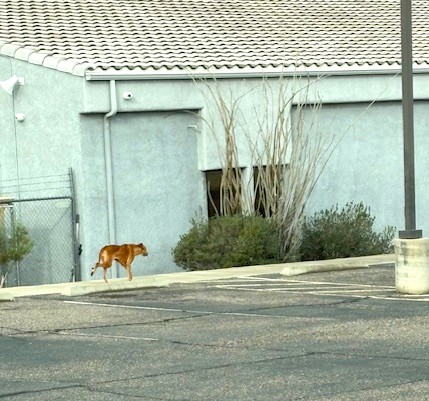
Jumping in the Jeep and backing out of the garage, my wife spotted a lethargic-looking dog with its ribs showing, standing in front of our house. We keep a water bowl out front for the wild birds and other animals to use. Quite thirsty, the collarless canine was taking advantage of it.
This dog quickly headed to the Western Arizona Humane Society building, a block away, perhaps having been there before and knowing it was a safe haven. Unfortunately, my attempt to call the animal resulted in it running away, but not before Joleen snapped a photo.
Curtailing my trip for frozen custard, we went back home and posted a photo of the loose dog on social media. Within minutes, folks came online saying that they’d try to find the pooch. One person recognized the golden-haired dog as “Whiskey.”
We searched some more that evening ourselves, but it was too dark outside to see anything. Before going to bed, I said a simple prayer, asking God to lead someone to Whiskey before it was too late.
From the condition of the animal, I didn’t know if it’d last through the night. Afterwards, thinking back to my request, I had to silently chuckle. A few folks will catch the humor once they reread things, although my wife didn’t.
Sunday, after watching the 11:00 a.m. Calvary Baptist Church service on Facebook, a message appeared at the top of my computer screen saying that Whiskey had been found. That was good news for a bunch of people—especially me.
I’ve never doubted that prayer is the first place to go when all seems hopeless, but this answer to prayer reaffirmed it in me—one more time!
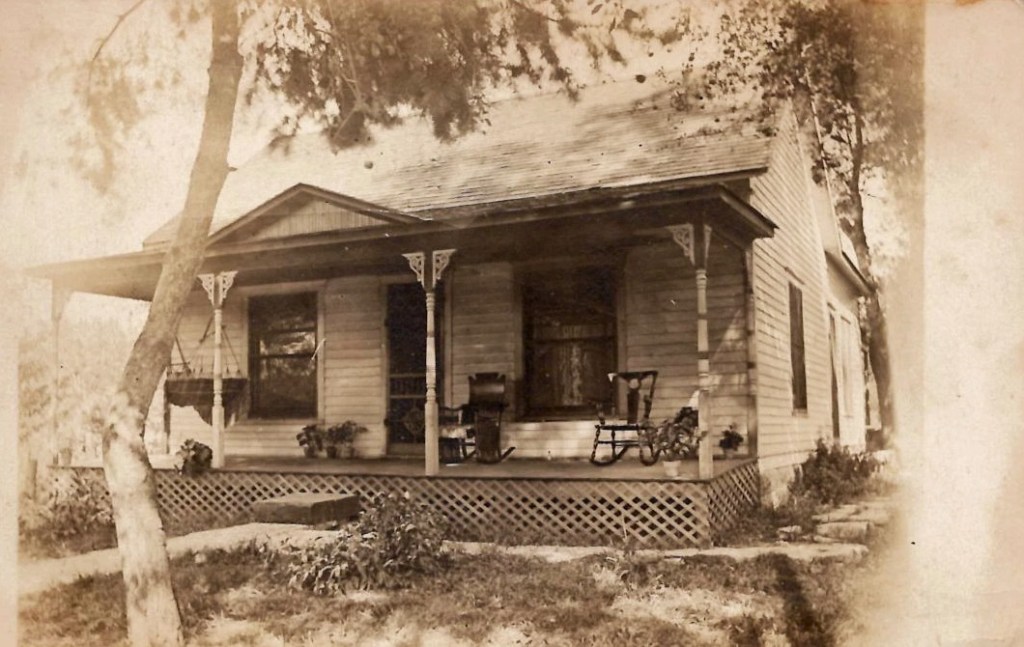
“A picture postcard mailed from Dunlap, on January 3, 1910, has a photograph of the residence of W.H. Robinson.”
William H. Robinson’s home in Dunlap, Kansas
Dunlap, Kansas, is a small, unincorporated community with a rich history marked by its role in post-Civil War migration and its unique place in the story of African American settlement in the Midwest. Located in Morris County, Dunlap’s legacy is intertwined with the Exoduster movement and the settlement of freed individuals seeking new opportunities after emancipation.
Dunlap was founded in the late 19th century, named after Joseph G. Dunlap, an early settler and entrepreneur who played a significant role in the community’s establishment. The area was originally part of the Great Plains, inhabited by various Native American tribes, including the Kansa and Osage, before white settlement began in the region.
The arrival of the Atchison, Topeka, and Santa Fe Railway in the 1870s spurred more rapid development. The railway provided crucial access to markets and transportation, encouraging settlement and economic growth in the area.
One of the most significant chapters in Dunlap’s history began in the late 1870s and early 1880s with the influx of African American settlers known as “Exodusters.” Fleeing racial violence and economic hardship in the post-Reconstruction South, many Black families migrated to Kansas, inspired by its reputation as a free state and the legacy of abolitionist John Brown.
Benjamin “Pap” Singleton, a prominent African American leader and former slave, played a pivotal role in encouraging this migration. He and others led groups of Exodusters to settle in Dunlap and surrounding Morris County, establishing one of the most significant Black farming communities in Kansas. These settlers built homes, churches, schools, and businesses, creating a thriving and resilient community despite facing significant social and economic challenges.
By the 1880s, Dunlap had become a vibrant town with a diverse population. The African American settlers established their own churches, including the St. Paul African Methodist Episcopal Church, and built schools such as the Dunlap Colored School, which provided education for Black children in the community.
The town supported several businesses, farms, and social organizations. Despite segregation and discrimination, the Exoduster community in Dunlap achieved a degree of self-sufficiency and prosperity, contributing to the broader story of Black migration and settlement in the American Midwest.
Dunlap’s fortunes began to decline in the early 20th century. Economic hardships, including the Great Depression and the Dust Bowl, led many residents to leave in search of better opportunities elsewhere. The consolidation of rural schools and the decline of the railroad also contributed to the town’s dwindling population.
By the mid-20th century, Dunlap had largely ceased to function as a distinct town, and many of its historic buildings were lost or fell into disrepair. However, the legacy of the Exodusters and their descendants remains an important part of the region’s history. Efforts to preserve and commemorate Dunlap’s past continue through historical societies, reunions, and educational initiatives.
Today, Dunlap is an unincorporated community, a ghost town, with only a few remaining residents and structures. The nearby cemeteries, such as the Dunlap Cemetery and the St. Paul AME Cemetery, serve as reminders of the town’s unique heritage and the enduring legacy of the African American pioneers who once called it home.
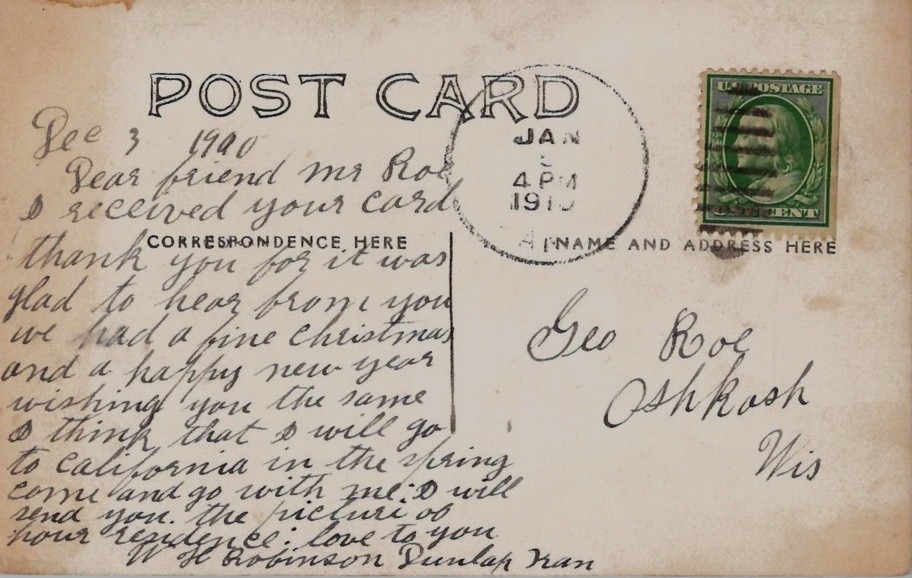
A picture postcard mailed from Dunlap, on January 3, 1910, has a photograph of the residence of W.H. Robinson. This card was sent to his friend, George Roe, in Oshkosh, Wisconsin. A nicely written message, transcribed as written, says:
“Dec 3 1900
Dear friend Mr. Roe
I received your card. thank you for it was glad to hear from you. we had a fine Christmas and a happy new year. wishing you the same. I think that I will go to California in the spring. come and go with me: I will send you the picture of our residence: love to you
W.H. Robinson Dunlap Kan“
Mr. Robinson was somewhat confused, as the card was mailed in January, although it was supposedly written in December. He also corrected the date from 1900 to 1910.
William H. Robinson was born in Ohio in 1844. He married around 1885 to a woman from Illinois named Mary. The couple had two children, Arthur and Sarah. William was a farmer and horticulturist.
William and Mary moved to Long Beach, California, in 1919. William H. Robinson passed away in 1924, while his wife died in 1936.
George Roe, the postcard recipient, was born in England on November 22, 1882. He was a woodworker by trade, owning a small shop in Oshkosh. George married wife, Lydia, around 1917. They had three children, Evelyn, Rexford, and Lydia. George died in 1959, with Lydia passing away in 1983 at the age of 97.
Unlike the Robinsons, who moved to California from Kansas, the Roes stayed put in Wisconsin. Both are buried in the small city of Omro.
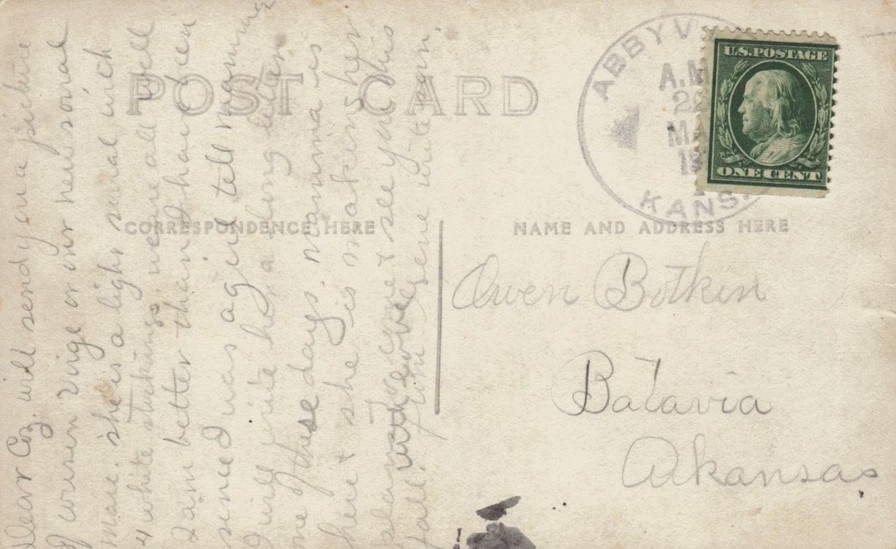
Will send you a picture of Cousin Virge on our soral mare. She is a light soral with 4 white stockings. We are all well. I am better than I have been since I was a girl. Tell mamma I will write her a long letter one of these days. Momma is here and she is making her plans to come and see you this fall.
With Love from Gene. Write soon.”
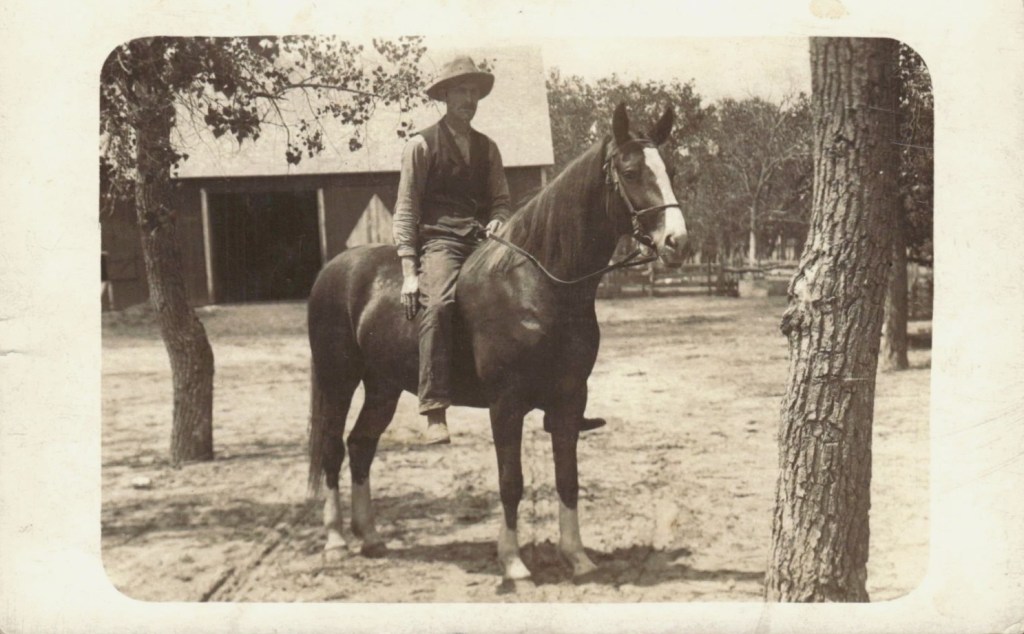
The above message was on an early 1920s picture postcard sent from Abbyville, Kansas, to Mrs. Owen Botkin in Batavia, Arkansas. A photograph on the front is evidently Cousin Virge on Gene’s soral mare.
That’s what a cowboy looked like back then, although Virge doesn’t have a six-gun hanging from his waist. Abbyville was a very mellow place at this point, with no real need for one other than shooting coyotes, snakes, and skunks (four-legged and two-legged).
Abbyville, Kansas, is a small town located in Reno County in the south-central part of the state. Founded in the early 1880s, the town was named after the wife of a railroad official, reflecting the importance of railroads to its development.
Abbyville quickly became a local hub for farming and ranching families, serving as a center of community life with its school, post office, and churches. Though its population has remained modest over the years, Abbyville’s history captures the spirit of rural Kansas and the close-knit communities that defined the American Midwest in the late 19th and early 20th centuries. Currently, 83 people live in the town.
Finding out who Mrs. Owen Botkin was required extensive research. Born in 1845, Owen Botkin was a successful sheep rancher in Kansas, along with raising horses and pigs. His family was a large one spread out from Kansas, Oklahoma, and Arkansas.
Owen Botkin died in 1900, leaving behind his widow, Julia Lieb-Botkin. She lived in Arkansas for a short time before moving to Osage County, Oklahoma, where Julia passed away on December 11, 1922, from serious burns and shock after her housecoat caught on fire. Born on August 31, 1846, she was 77 at the time of her death.
Frances Eugene “Gene” Botkin was Hazel M. McCully-Botkin’s husband. When Hazel sent the postcard, it was signed “Gene” for her husband. That threw me off and took plenty of digging to finally figure things out. Sherlock Holmes would be proud.
Gene Botkin was born April 16, 1897, and died December 15, 1972, at age 75. Hazel, Gene’s spouse, was born November 19, 1905, passing away October 9, 1974. She was only 68. The couple had one son, Dale.
“This card was one of the most difficult for me to decipher due to the poor handwriting.”
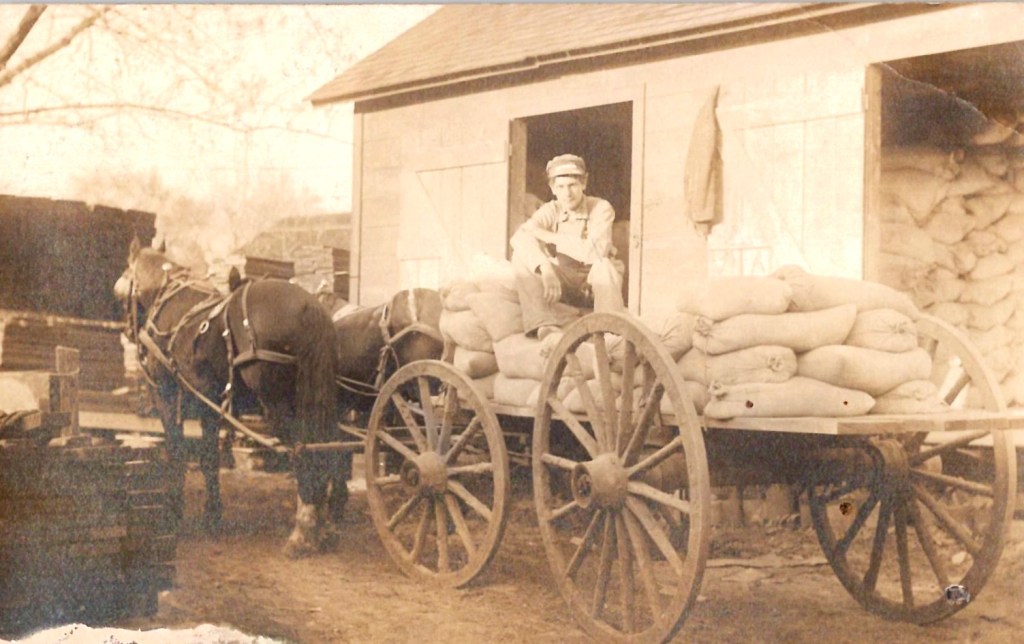
Sacks of grain – Girard, Kansas
Pittsburg, Kansas, located in the southeastern corner of the state, was founded in 1876 as a direct result of the booming coal mining industry in the region.
The city was named after Pittsburgh, Pennsylvania, reflecting its founders’ hopes that it would become a similarly prosperous industrial center. The arrival of the railroad in the late nineteenth century accelerated growth by making it easier to transport coal and attract settlers.
Coal mining quickly became the economic backbone of Pittsburg. The area’s rich coal seams drew waves of immigrants from Europe, particularly from Italy, the Balkans, and Eastern Europe, seeking work in the mines. These diverse populations contributed to the city’s unique cultural heritage, and mining continued to drive the local economy well into the twentieth century.
In 1903, Pittsburg State University was established as the Kansas State Manual Training Normal School, which played a significant role in the city’s development. The university is now a major educational institution in the region, offering a broad range of programs and contributing to the city’s growth and vitality.
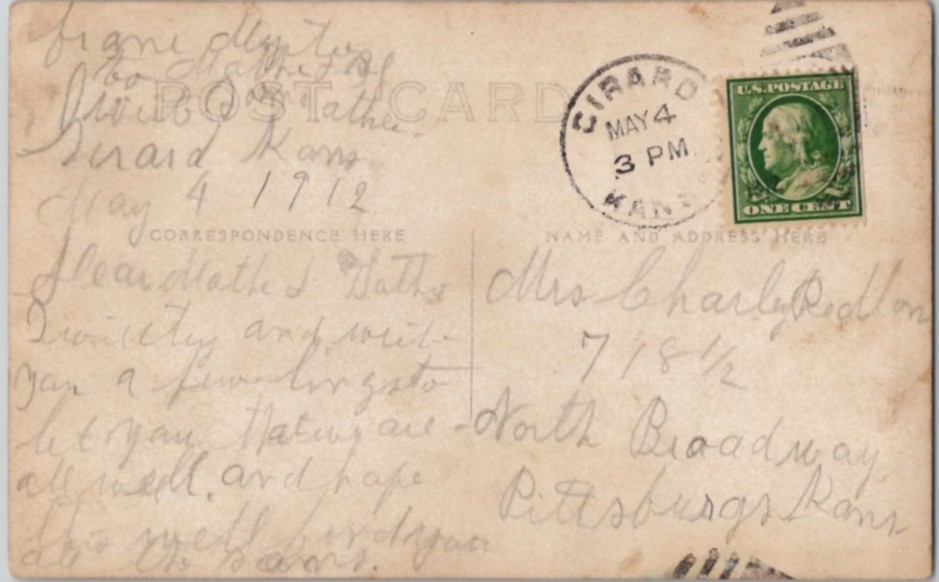
A picture postcard sent to Pittsburg, Kansas, in 1910, to Mrs. Charley Redlon contained nothing more than an “all is well” message. This card was one of the most difficult for me to decipher due to the poor handwriting.
“Dear mothe & datty I gather I will try and writ you a few lines to let you that we are all well and hope this will find you all the same.”
The signature was unreadable, yet I was finally able to figure things out based upon the fact that only one of the Redlon’s older children lived in Girard, this being the post office where the card was mailed.
Myrtle Belle Redlon-Williams was the sender. She was born April 25, 1871, one of six children to Charles and Emma Redlon. Myrtle married Wesley Hagen Williams sometime around 1888. Wesley died in 1912, and four years later she wed John Henry Crawford. Myrtle died on October 7, 1953, at the age of 82.
The card recipient, Myrtle’s mother, Mrs. Charley Redlon, was Emma O. Sprees-Redlon. Emma was born in 1850 and passed away on November 14, 1925. Emma’s husband, and Myrtle’s father, was Charles Benjamin Redlon. “Charlie” was born in 1854 and died on January 19, 1921.
Charlie Redlon was a constable in Pittsburg, and his name is mentioned quite frequently in early newspaper records. Constable Redlon was always arresting people, which suggests that Pittsburgh was a high-crime town back then. Young coal miners on payday evidently drank their share of liquor. Chicopee, Kansas, located only seven miles away, had an even worse reputation.
The area, part of a region known as the “Little Balkans” due to its immigrant population, was notorious for its rough, lawless atmosphere and significant number of unsolved murders. In 2025, crime is still high based on population, but is slowly getting better.
“Gateway Motel went through a smorgasbord of owners during its 30 years of business.”
This is the 100th anniversary of Route 66. Plenty of celebrations are planned with my wife and me, hoping to attend several events. Car shows galore are scheduled.
As a small boy, I rode with my parents and brother to California from Alabama, taking Route 66 for a good many miles. Several years ago, I wrote a short story that described a small portion of that trip, which almost killed my brother and me.
“The year was 1956. Dad was in the Air Force and had been notified that his next assignment was George A.F.B. in California. Loading up a black 1949 Mercury along with a small trailer home, our family departed Vernon, Alabama, headed west to Victorville, CA.
My brother Jim and I rode in the back seat. I would’ve been two at the time, so my recollection of events is extremely limited. Dad, Mom, and Jim provided me with the following details:
Entering Arizona via Route 66, a blazing July sun made things unbearably hot inside our car. The vehicle had no air conditioner. Being painted a dark color clearly amplified the intense, sweltering heat.
Jim and I quickly became drowsy and unresponsive. Pulling into a gas station on the outskirts of Holbrook, an employee told Mom she’d best cool her kids down, or they wouldn’t survive the trip.
The man sold my folks a block of ice, including a tin pan to hold things. Placing this crude cooling device on the floorboard, Jim and I made the remainder of our journey hovered over it.
That pump attendant probably saved our lives by advising us. For many years now, I’ve often wondered if this gas station still exists.”
Another place that I still wonder about is the motel we stayed at in Williams, Arizona. There were several to choose from back then, and without Dad or Mom here to try and remember, I don’t know.
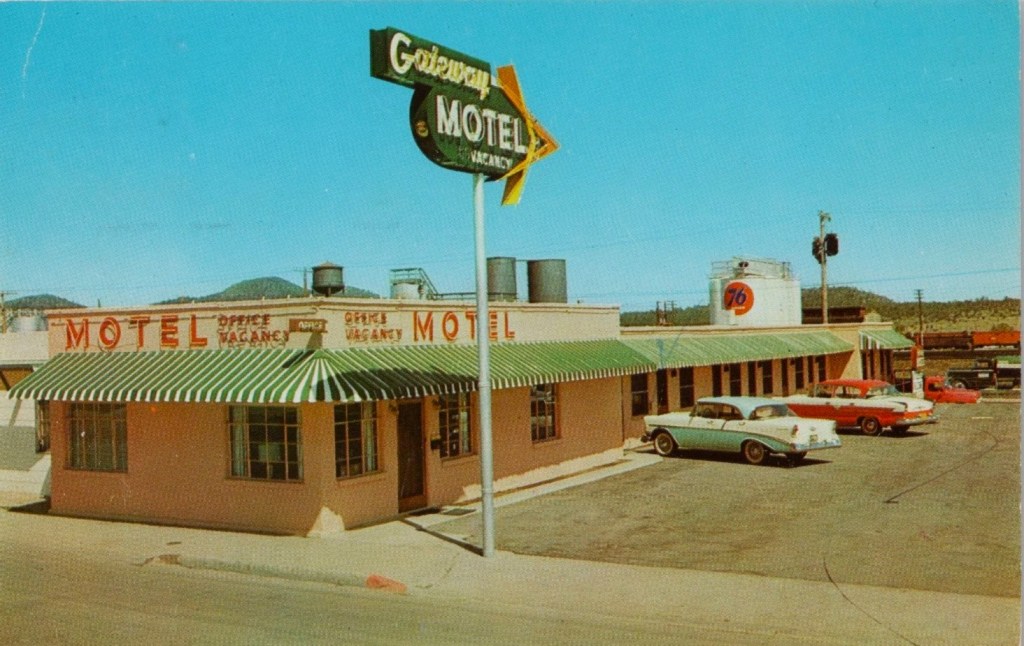
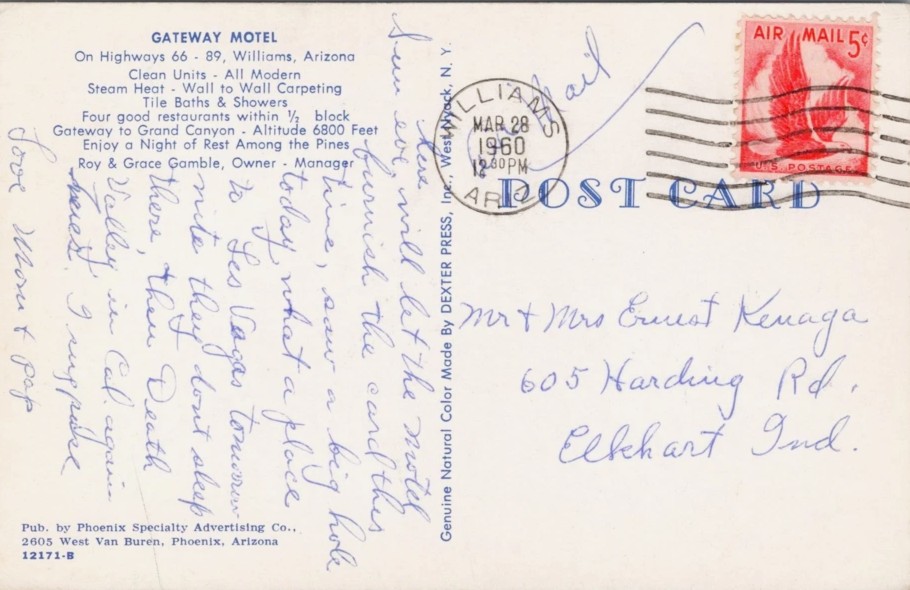
A March 28, 1960, picture postcard I came across shows the Gateway Motel on the front. It only had eight rooms, and this would’ve been the type of place my folks sought out because of price. Motel 6 didn’t exist back then.
The card was sent from “Mom & Pop” to Mr. & Mrs. Ernest Kenaga in Elkhart, Indiana. I decided to research this card in its entirety.
Although I’ll never know if this is the same motel, Gateway was there in 1956, having been built by Ralph A. Southworth in 1950. Being located directly on Route 66, we would’ve driven right by the place.
The message on the postcard, transcribed as written, reads as follows:
“Sun eve here,
Will let the motel furnish the card this time, saw big hole today, what a place to Las Vegas tomorrow they don’t sleep there then Death Valley in Cal again Tues. I suppose.
Love Mom and pop”
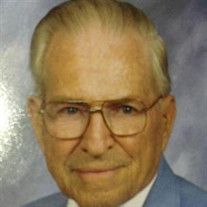
The best way for me to tell about Ernest and Margaret Kenaga is to print their obituaries. I know that Ernest’s mother wrote the postcard and not Margaret’s, because her mom had passed away in 1952. That big hole mentioned is undoubtedly Meteor Crater National Park.
“Ernest Leroy Kenaga, 95, Elkhart, died 8 p.m. Tuesday, Jan. 31, 2017, at Hubbard Hill Estates. He was born Dec. 23, 1921, in Crandon, Wisconsin, to Noble & Hazel (Loney) Kenaga. He married Margaret (Hunsberger) Kenaga on Aug. 28, 1943.
Surviving are his wife, Margaret, Elkhart, son, Mike (Helen) Kenaga, Elkhart, daughter, Candy (John) Sewell, Winter Park, Florida, granddaughters, Stacy Kenaga, Houston, Texas, and Molly (Adam) Sewell Schott, Winter Park, Florida, and a brother, Robert (Lucy) Kenaga, Elkhart. He was preceded in death by his parents, Noble and Hazel.
Ernest was a veteran of the U.S. Army, serving in WWII and discharged in 1946. He played the trumpet with the 12th Armor Division for General Patton’s funeral service. Ernest was a Manager of the Customer Service Department at Selmer, retiring after 40 years. He was a member of the First Brethren Church of Elkhart. Ernest was a 1939 graduate of Concord High School. Mr. Kenaga was a member of the American Legion and was an avid Notre Dame and Yankees fan.”
“Margaret Kenaga, 101, Wakarusa, formerly of Elkhart, died 10:35 a.m. Tuesday, April 26, 2022, at Miller’s Merry Manor. She was born May 3, 1920, in Wakarusa, to Clem & Maude (Schalliol) Hunsberger. On August 28, 1943, in Hopkinsville, Kentucky, she married Ernest Leroy Kenaga, who died on January 31, 2017.
Surviving are a son, Mike (Helen) Kenaga, Elkhart, a daughter, Candy (John) Sewell, Winter Park, Florida, two granddaughters, Stacy Kenaga, Houston, Texas, Molly Sewell, Wellington, Florida, and a sister, Starley Morrison, Waldorf, Maryland.
Preceding her in death are her parents, husband, Ernest, siblings, Winfred Hunsberger, Robert Hunsberger, Nancy Ummel, and Lois Turnock.
Margaret worked and retired from Miles Lab and Bayer. She was a member of the First Brethren Church of Elkhart. Margaret, who was very energetic, enjoyed keeping a clean house, yard work, being outside, and hummingbirds.
The family would like to thank a very special neighbor and friend, Tom Johnson, for all the help he gave Margaret over the years.”
Gateway Motel went through a smorgasbord of owners during its 30 years of business. Ralph Southworth built the place before selling it to Roy and Grace Gamble. One year later, the Gambles sold it to Harry Smith. Mr. Smith sold it just a few years later to Mr. and Mrs. A.C. Hollan.
In 1967, the Hollans unloaded it on Mr. and Mrs. George Motson. The Motsons peddled it to Mrs. Gamester, who, after a couple of years, successfully offloaded it to Dave Moslers. It appears that this man is the person turning it into retail shops, changing the name to Gateway Plaza. They even modified the old sign.
For whatever reason, business after business has come and gone at this address, with the latest being JD’s Espresso. It appears 66 Nails is still there. Kudos to them.
Part of my Route 66 celebration will be to take a drive to Williams and visit 219 E. Williams, this being the official address of the now-defunct Gateway Motel. There are plenty of things to see in this town to keep busy.
We’ll spend the night somewhere besides Motel 6, so that Joleen can get her nails done, and I can drink a toast to the memory of Gateway Motel with hopefully a steaming hot mocha in my hand, courtesy of Anna’s Grand Canyon Coffee and Café. Route 66 travelers claim that Anna’s breakfast burritos and mochas are to die for!
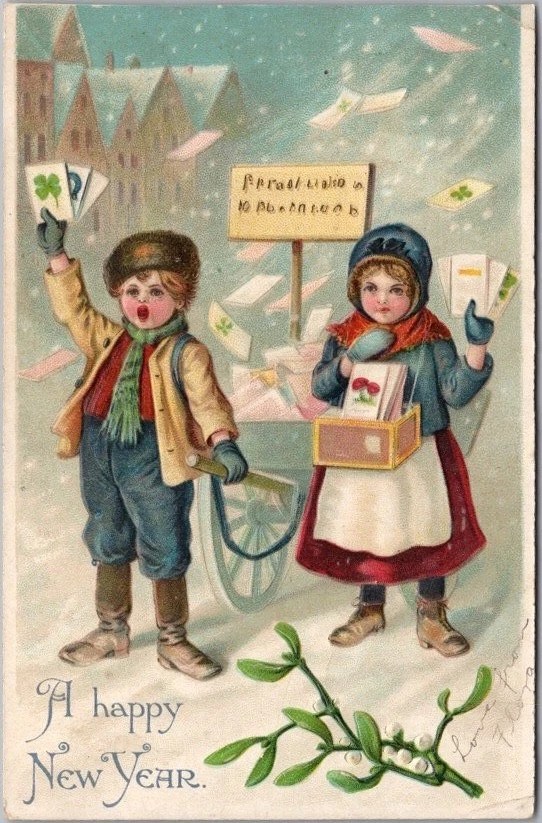
A simple New Year’s postcard sent from someone named Flora to Miss Rose Duff was postmarked on December 30, 1907, and mailed from Cochrane, Wisconsin, to Fountain City, Wisconsin. That is exactly 118 years ago. On the front of the card are two German children selling cards on a cold winter day. Written in pencil is, “Love from Flora.”
Cochrane is a small village in Buffalo County, with approximately 452 people living there. Photos show it to be a clean and well-laid-out community. The town was started in 1895 when the railroad was built nearby.
Fountain City is the largest town in Buffalo County, with approximately 806 residents. It started as a landing point on the Mississippi River for steamboats to pick up firewood for their boilers, including fresh water. Cochrane and Fountain City are only nine miles apart.
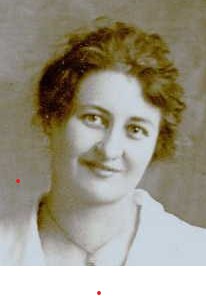
Rose Margaret Duff was the postcard recipient. She was born on July 5, 1885, to parents Jacob and Katharina. They were both from Ireland, while Rose Margaret was born in Buffalo City. Jacob Duff was a lawyer.
On May 20, 1919, Rose married Clarence Fred Kohlhepp. In the 1940 census, Clarence lists his occupation as a car salesman. The couple had two children, with one dying at birth. Rose passed away on January 31, 1974, in Winona, Minnesota. She was 88. A picture shows the Irish in her face.
Flora Rasale Bohrer was the friend sending Rose that card. Flora’s parents, Joseph and Louisa, came from Germany. That’s where the Victorian-style postcard was printed. Flora was born in Cochrane on January 15, 1890.
Miss Bohrer married Emil Josias “Joe” Florin on July 16, 1913. A man of different trades, the 1940 census lists him as being a hardware store salesman as well as an undertaker. They had one son and a daughter. Flora Rasale Florin died on May 8, 1965, after a long illness.
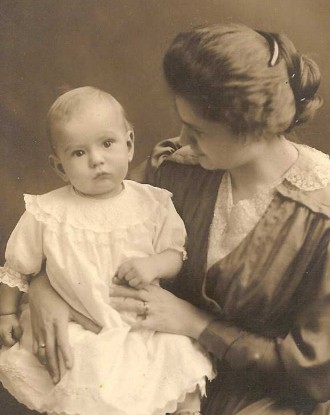
A picture I found shows Flora in the lap of her mother. I’m sure she turned out just as beautiful. Once again, the keeper of this postcard must’ve considered it something worth holding onto all of these years.
Sadly, sending cards has all but stopped, like so many other old-time traditions. It’s good that some of the old postcards have survived, as this one tells an unknown story, until now, of two dear friends






 I like to write junk...