UNDER CONVICTION

“I don’t use the infamous salute these days, but on occasion, the temptation has surfaced”

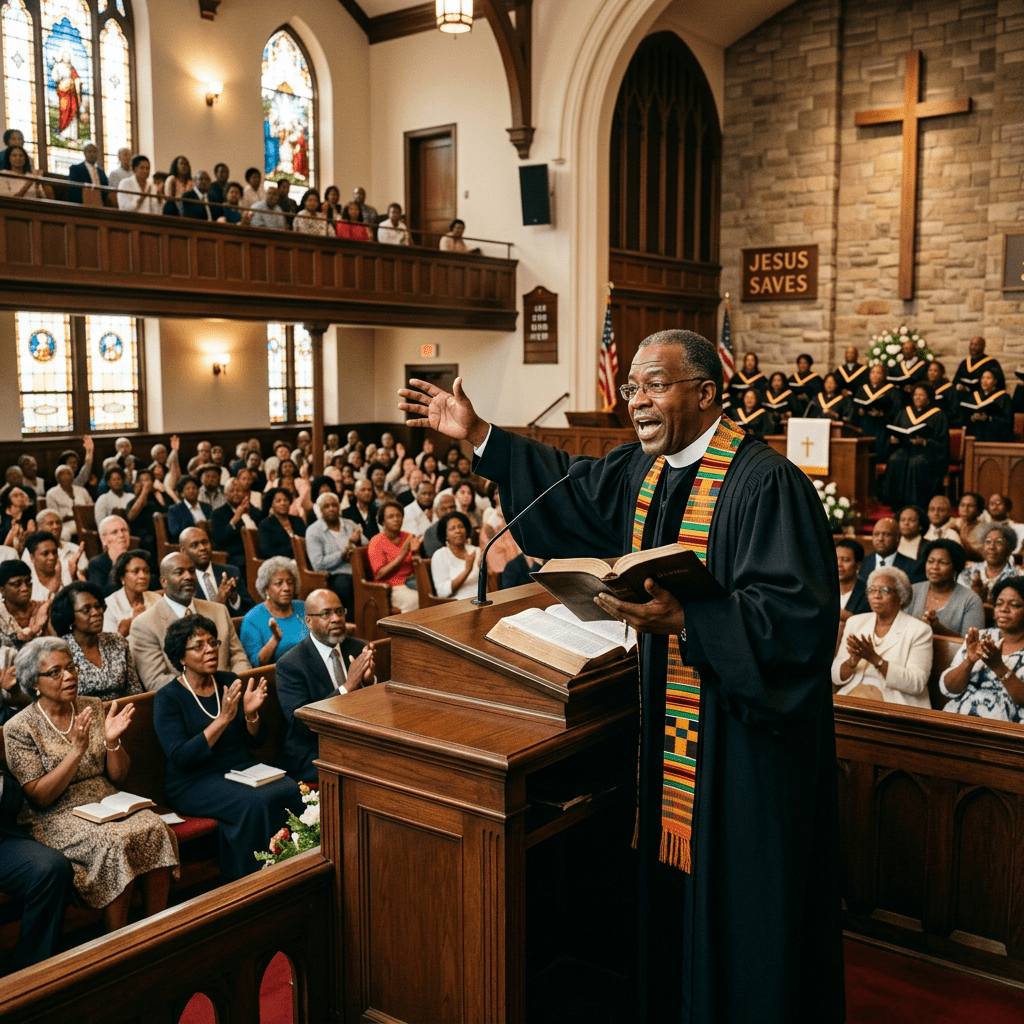
Pastor preaching from pulpit to attentive congregation in church

Years ago, when I was in my mid-30s, I attended a church service where the pastor was preaching about something he’d recently seen a member of his flock do. You’ll have to guess what this was for the time being, but it certainly wasn’t someone robbing a bank or convenience store.

After the message ended, I meekly asked an assistant pastor whether Pastor Prevo was using me as an example in his sermon. Glenn Clary gave me a serious stare and then said, “No, Mike, but you’re evidently under conviction.”

That was good to hear, because when I flipped some dude off for suddenly cutting in front of me, I was positive no one had seen me do it besides the other driver. Evidently, someone else in our congregation, in a fit of road rage, also gave the one-finger salute in retaliation, and the pastor observed him.

When I told my wife about it, she said it didn’t matter whether the preacher saw me or not, because God sees everything we do. I knew that, but sometimes, in the heat of battle on city roads while maneuvering through traffic, irritations can bring out the worst in a person.

My mother would’ve told me that my toes were stepped on that Sunday morning, and that my reaction was an old-fashioned way of knowing I was under conviction. When a preacher says he “stepped on someone’s toes” during a sermon, it typically means that his message touched on sensitive or personal topics that made individuals feel uncomfortable or convicted.

It’s often a way of indicating that the preaching brought to light issues or behaviors that need reflection or change. The phrase suggests that the sermon was impactful enough to resonate with someone in the congregation, leading them to reconsider their actions or beliefs.

I don’t use the infamous salute these days, but on occasion, the temptation has surfaced. “Go with the flow” is now my motto. What that means for me is to whisper something under my breath, generally calling them the two-word version of “donkey,” and to avoid any physical contact with the annoying driver by not looking at them.

The other afternoon in rush hour traffic, at the notorious Mulberry and Highway 95 red light, a fellow in front of me thought I was too close to his rear bumper. We were stopped, so what difference did it make?

When the light turned green, he just sat there, trying to make me sit through another red. The antagonist finally took off, and I made it through as well, just as the yellow turned red. Not wanting to deal with this guy any further, I held back. Unfortunately, the light at Swanson caught us, and he suddenly changed lanes, ending up directly beside our Jeep.

Yelling at us with his window rolled down, my wife opened hers to see what the man’s problem was. At this point, the guy started making pig-like grunts and telling us how ugly our vehicle was. I already knew that, so it was no insult. For whatever it’s worth, he appeared to be the same age as us.

Wanting to say something retaliatory in return, I bit my tongue. Watching him continually mouth off, I noticed that the man’s teeth were as yellow as a banana peel. For whatever reason, I shouted across Joleen’s lap, “Have you thought of brushing or flossing?”

That did the trick, because he shut up and took off like a jackrabbit when the light turned green. Joleen had me wheel off Highway 95 at the nearest cross street to avoid additional conflict.

Why he instantly clammed up is easy to answer. My abrupt comment that day undoubtedly placed him under what I’d call hygienic conviction. I’ve been there several times as well. My dental hygienist, Jenn, can always tell when I haven’t flossed and calls me out on it. Her vocal observation helps me to do a better job for the time being.

I suppose preachers and dental hygienists see the power of conviction as being a very useful tool. For most people, it helps them make wiser decisions!

Older man with yellowed teeth wearing a cap and plaid shirt sitting in vintage truck holding steering wheel

HEAVEN & HELL

“I have a good picture of Heaven, yet there are still some things that keep me thinking.”

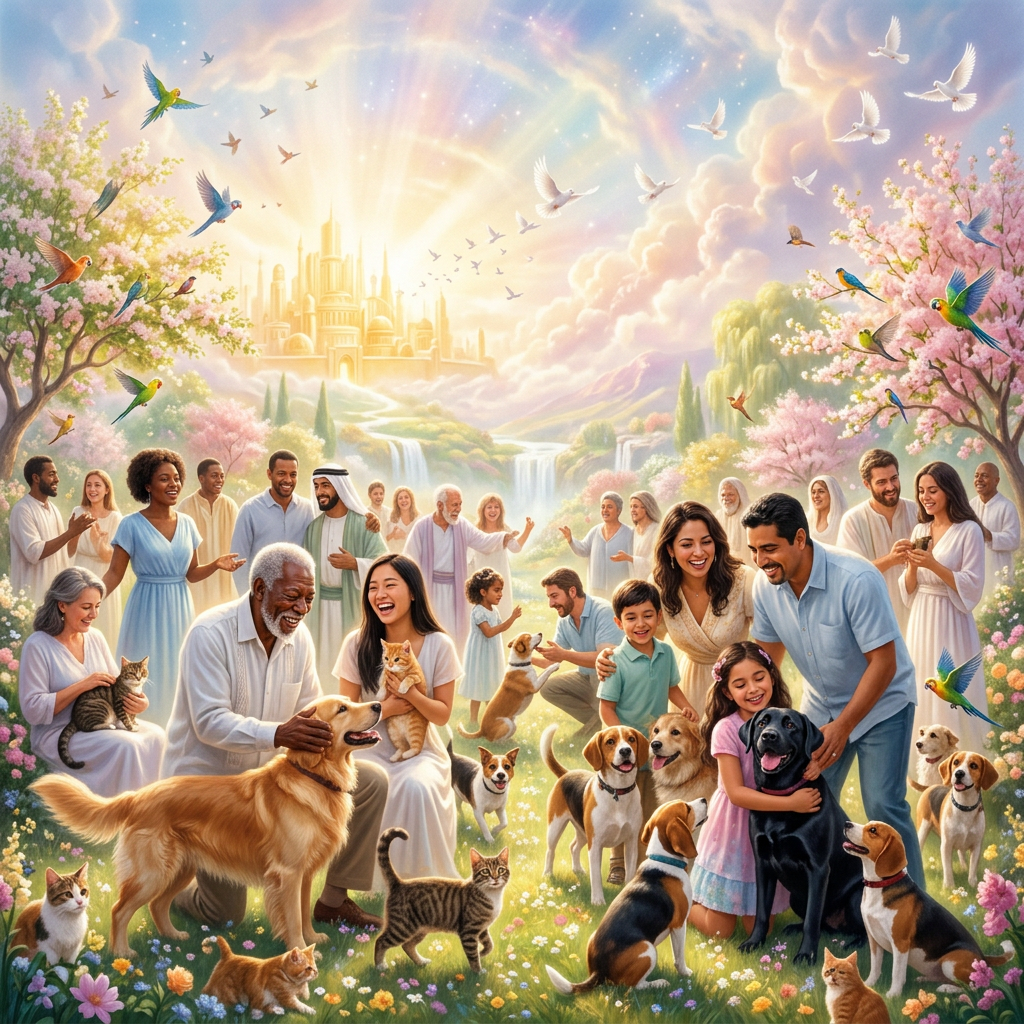
Diverse group of people smiling and interacting with cats and dogs in a bright, heavenly garden

I often lie awake at night wondering what Heaven will be like. I’ve had different pastors give me their take, and not one of them has painted the same picture. The best version, at least to me, was by a missionary who said that living in Heaven will be like living on Earth without the pollution and problems. I’d assume that means no tornadoes, hurricanes, or scorpions.

I’m not so concerned about the alternative to Heaven, because I know without a shadow of a doubt, I’ll not be headed there after death. For the sake of this article, and my curiosity, I decided to ask my AI (artificial intelligence) helpmate, Miss Purdy, to describe both Heaven and Hell.

“The concept of Heaven has been described in many ways across different cultures and religious traditions. Generally, Heaven is depicted as a place of eternal peace, joy, and fulfillment, where suffering and sorrow no longer exist.

Many believe it is a realm of perfect happiness, where people experience closeness to God or a higher power, and are reunited with loved ones who have passed away. The details may vary, but the common thread is that Heaven represents the ultimate reward and a state of complete contentment and love.

Looking at various cultures and religious beliefs, Hell is commonly portrayed as a place of punishment, separation, or suffering for those who have committed wrongdoings or have turned away from goodness.

Descriptions often include imagery of darkness, fire, or torment, and it is frequently seen as the opposite of Heaven—a state marked by spiritual anguish and the absence of peace. While interpretations differ, the central idea is that Hell represents the consequences of moral choices and the ultimate alienation from joy, love, or the divine presence.”

Miss Purdy completely missed the boat by not mentioning Jesus Christ as the sole means to reach Heaven. With her undoubtedly looking at this project from a secular viewpoint, I suppose she didn’t bring the Holy Bible into the picture, so I decided to seek answers from scripture.

The Bible describes Heaven as a place of eternal joy, peace, and communion with God. According to passages such as Revelation 21:4, there will be no more death, mourning, crying, or pain, for the former things have passed away.

It is depicted as a realm where believers in Jesus Christ are welcomed into God’s presence, experience perfect love and fulfillment, and are reunited with others who have been saved. The imagery often includes streets of gold, gates of pearl, and a radiant city, emphasizing the beauty and glory of Heaven. Ultimately, Heaven is portrayed as the ultimate reward for faithfulness and the restoration of all things.

The Bible describes Hell as a place of separation from God, marked by suffering and anguish. Passages such as Matthew 25:46 speak of ‘eternal punishment,’ while Mark 9:43-48 refers to it as a realm where ‘the fire is never quenched.’

Imagery includes darkness, weeping, and gnashing of teeth, emphasizing the seriousness of spiritual loss and the consequences of rejecting God’s salvation. Ultimately, Hell is portrayed as the ultimate consequence for those who turn away from the saving grace of Jesus Christ.

I have a clear picture of Heaven, yet there are still some things that keep me thinking. Will my new body look the same? Will I have a job? Will folks living there have different personalities than they do now? None of these questions have been adequately answered.

Much too complex a thought for my brain to handle, it seems I’ll just have to keep wondering until that day arrives. In the end, I’m sure Heaven will be a pleasant surprise!

Winding stone staircase with lanterns leading up through clouds to a radiant golden temple in the sky

MESSAGE OVER MONEY

“I’ve recently had requests from some small businesses to advertise on my site.”

I try to read as much as I can, even though my eyes aren’t what they used to be. I’d much rather read for myself what an article says rather than have someone tell me. Lately, on social media and online media sites, I’ll be reading when, out of the blue, a pop-up comes along, generally in the form of an advertisement.

After so many of them, I give up and stop. I know businesses and other entities are paying the host site for these ads. The longer a reader stays glued to an article, the more money is made by someone. Online newspapers use this as a revenue generator, and I have no opposition to that. They have to be financially savvy these days to pay employees and stay afloat.

I’ve been a blog writer for many years and watched readership numbers grow. On February 5 of this year, I set a record. A total of 547 people from 14 countries read my junk that day. This might not seem like much, but there were days not long ago when as few as three took a peek—some days not a one.

I’ve recently had requests from small businesses to advertise on my site. For each viewer seeing their ad, I’d get something, generally pennies. Over time, they can add up. YouTube works much like this, and some YouTubers have made boatloads of cash.

I turned down these requests because I want my message read, not just to make money. There’s no doubt that viewing numbers would start sinking if I gave in to allowing advertising on my blog, so it’s not going to happen.

Over the years, I’ve garnered income from articles and books, but that wasn’t the reason I wrote them. Getting my message across is foremost. Lately, that has been telling folks that Jesus is the only way to heaven, and that fiscal conservativeness is the key to a country staying solvent. To profit from spreading this truth runs counter to my principles.

I know some people who believe Buddha is the way to eternity, or through a Chinese monk, but they’re headed down the wrong path. The Bible warns against false religions; Buddhism, Hinduism, Scientology, Islam, and Humanism are prime examples.

Humanists are those who believe ‘education’ will lead them to the promised land. They also believe that all religions worship the same god. How wrong they are. There are many humanists in politics these days.

Matthew 24:24 says, “For false christs and false prophets will arise and perform great signs and wonders, so as to lead astray, if possible, even the elect.”

My interpretation of the word elect here is “educated folks” in our world. Many of them seem more in tune with wrongly worshipping stone idols than Jesus Christ. This is where their intelligence has failed them.

I’ll keep writing my blog, although at times I’ve thought of quitting. So much more could be done in and around our house, or in the garage, than sitting behind this laptop computer.

One plus of keeping at it is that I’m learning more about the Bible by researching verses for a story than at any other period of my life. That makes this task much more constructive than painting the living room walls or working on my old truck.

ETERNITY

“Eternity is a profound and complex idea that touches upon time, existence, and the infinite.”

Endless time

Thirty years ago, a friend and coworker told me that if his pals went to hell, he wanted to end up there, too. This guy was extremely upset that a buddy passed away so young. Evidently, he felt that hell was where his pal had gone.

At that time, being a weak Christian where testimony is concerned, I had no reply after hearing him say that, although I did meekly mention that life after death means spending eternity in either heaven or hell, and there’s no in between.

When I attempt to think of eternity, my brain basically shuts down, unable to fathom ‘life never ending.’ There’ve been many nights when I lay awake in bed contemplating this, with me always having to shut the thought process down without fear of blowing a tube. The best analogy I can come up with is an alarm clock having no hands.

Older brains like mine have tubes, like TVs and radios once did, while I believe it was in 1962 that transistors, diodes, chips, and microprocessors came along. I’m joking here, of course. I don’t have the slightest inkling of how our brains work, with electronics being the easiest comparison.

With the definition of eternity impossible for me to explain, once again I turned to Miss Purdy, my artificial intelligence helpmate. I’ve leaned a lot on her lately, only because she’s quick on the draw in coming up with answers. Purdy’s concise definition of eternity took some time for me to digest all of the philosophical facts she spewed forth.

“Eternity is the concept of infinite or unending time. It is often described as a state that exists beyond temporal limits—unaffected by beginnings, endings, or any measurable duration. Unlike ordinary time, marked by seconds, minutes, hours, and years, eternity transcends such divisions and is often considered timeless.

The word “eternity” comes from the Latin “aeternitas,” meaning everlasting or perpetual existence. Throughout history, philosophers, theologians, and poets have used the term to refer to the perpetual nature of existence, the infinite, and the immortal. In ancient philosophical traditions, eternity was often contrasted with the finite nature of human life.

In philosophy, eternity is sometimes discussed as an attribute of certain truths, beings, or values that are unchanging. For example, some thinkers believe that mathematical truths or abstract concepts are eternal.

In religious contexts, eternity commonly refers to the everlasting nature of the divine, the soul, or the afterlife. Many faiths depict eternity as the realm beyond death, where existence continues without end. John 3:16 tells us that in so many words.

In everyday language, people often use “eternity” to describe something that feels incredibly long or endless, such as waiting for a long period. Phrases like “it took an eternity” are hyperbolic ways of expressing impatience or the sense that time is passing slowly.

Eternity is a profound and complex idea that touches upon time, existence, and the infinite. Whether considered from a philosophical, religious, or everyday perspective, the concept invites reflection on the nature of reality, the limits of human experience, and the possibility of something beyond the finite world we know.”

Telling someone with deep Biblical knowledge, years later, about my friend saying that he wanted to go to hell, because he evidently felt people he was close to all went there, this person told me the words I should’ve used back then. It was blunt and to the point.

“Do you know without question that your pal went to hell, because he could’ve changed his mind and accepted Jesus Christ as savior mere seconds before his heart stopped? If you don’t know that for sure, then you may very well end up in a dark and hot place for the rest of your life with complete strangers. Eternity is a very long time, you know!”

It’s much too late for me to bring this up again, since the person who needed to hear it has since passed away. Still, I often wonder whether he might’ve changed his mind at some point, although he never told me. I hope he did.

A pastor once told our congregation that many ‘guys’ somehow believe that hell will be one big party, with kegs of beer and good old boys tossing footballs. I tend to think that my late friend was one of those believers.

I will say this for my own soul. If all of my family and friends chose hell, they’d best say their goodbyes to me before leaving, because this kid ain’t gonna be there.

It’s hot enough in Havasu four months out of the year, without electing to spend a lifetime in an even hotter place with no water or air conditioners!

BLESSED

“The question of why some people are blessed while others appear not to be has been asked for generations.”

Blessed

I’ve often wondered why some people seem to be blessed more than others. Ministers over the years have never fully explained this to me, as they most likely did not know the complete answer.

I decided to ask my AI helpmate, Miss Purdy, for a secular reply. Artificial intelligence is programmed, of course, and this programming can be subject to human bias, both political and religious. I’m not always sure which side of the fence Miss Purdy stands on, as she’s not telling.

“The question of why some people are blessed while others appear not to be has been asked for generations. It touches on ideas of luck, destiny, faith, social structures, and personal effort. While there is no single answer, several perspectives can help us examine this complex issue.

This is a profound question that has been contemplated by many throughout history. From a religious perspective, some believe that God’s blessings are part of a divine plan and may not always align with human understanding. They suggest that blessings might be given for reasons beyond our comprehension, or as a result of faith, prayer, or virtuous living.

Others interpret blessings as signs of God’s grace, rather than rewards for specific actions. Ultimately, the reasons why God blesses some and not others remain a mystery, often encouraging individuals to reflect on their own lives, practice gratitude, and seek meaning in both blessings and challenges.” — Miss Purdy

All in all, Miss Purdy didn’t specifically answer my question as I expected. She shucked and jived, not coming to a conclusive viewpoint. Seeing this much, I decided to turn to the Bible once again.

There are several verses regarding this, but I was still somewhat puzzled after reading and not finding the chiseled-in-concrete answer I wanted. It wasn’t until turning to an online Billy Graham site that I came away enlightened, although those other ministers over the years had echoed the same as him. Maybe it was Billy Graham’s literary voice that finally brought things into perspective for me.

According to Reverend Graham’s reply, people had evidently asked him the same question, perhaps thousands of times over the years.

“You aren’t the first person to ask this question, nor will you be the last—because sometimes it does look like God blesses people who don’t deserve it. Centuries ago, the prophet Habakkuk complained to God, “Why do you tolerate wrongdoing? … Why are you silent while the wicked swallow up those more righteous than themselves?” (Habakkuk 1:3, 13).

The Bible admittedly doesn’t answer all our questions about God’s ways; only in eternity will we fully understand them. But God’s Word does remind us of three important truths—truths we easily forget. First, it reminds us that wealth is not necessarily a sign of God’s blessing. In fact, some of the unhappiest people I’ve known over the years have been people with great wealth—and yet their lives were empty.

Second, the Bible reminds us that life’s greatest blessings come from knowing Christ and walking with Him every day. A person may be poor as far as this world’s goods are concerned—but rich beyond measure if they know Christ. Jesus said, “Blessed are those who hunger and thirst for righteousness, for they will be filled” (Matthew 5:6).

Finally, the Bible reminds us that someday we will all stand before God. On that day, we won’t be asked for the size of our bank account or the importance of our jobs. We’ll only be asked one question: Have you put your faith and trust in Christ alone for your salvation? Don’t be envious of what others have, but make certain of your commitment to Christ.” — Billy Graham

Blessed