WALKAHOLIC

“When I’m hiking the trails around town and someone my same age goes whizzing by, I’m not impressed.”

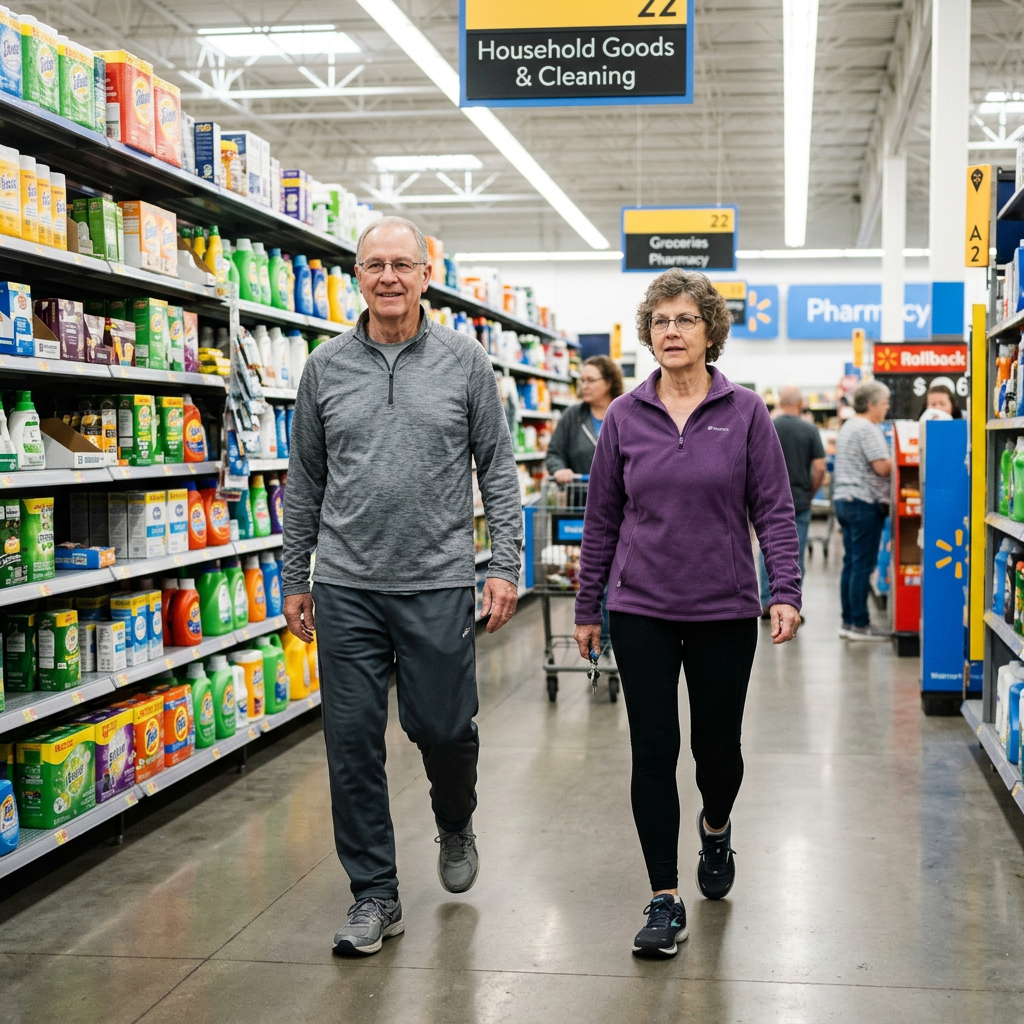
Senior couple walking down a grocery store aisle for household goods and cleaning

The average person walks between 3,000 and 4,000 steps per day, which is roughly 1.5 to 2 miles daily. Over the course of a year, this adds up to approximately 550 to 730 miles walked by an individual. Actual mileage may vary based on lifestyle, occupation, and physical activity habits.

My total mileage walked in 72 years, based on this formula, would be 52,560 miles, but I believe I’m way above average, so the number should be more than double that. Subtracting the first five years of my life, I’d say I’ve easily walked over 100,000 miles in total, which may seem high, yet Toyota cars and trucks, when properly maintained, can reach well over 300,000 miles.

I’ve taken care of things by not running, which impacts knees, hips, thighs, ankles, and feet. Studies have shown that runners are much more likely to require hip and knee replacements in later life due to the repetitive stress these activities place on the joints.

Over time, the increased wear and tear can lead to joint degeneration, making surgical intervention more common among frequent runners. Several of my friends who were former runners have undergone this.

While running is often celebrated for its cardiovascular benefits, walking offers many of the same health advantages with less impact on the joints. Regular walking can improve heart health, help maintain a healthy weight, boost mood, and reduce the risk of chronic diseases such as diabetes and hypertension.

For individuals looking to stay active without the increased risk of joint injury, walking provides an effective and sustainable alternative to running. It’s not as impressive to tell someone you walk for exercise as it is to run, yet when you reach 70, it doesn’t really matter what people think.

We keep an exercise bike and a treadmill in the house, and I use both sparingly, although in Alaska during winter, they both received a good workout. My old Schwinn Airyne had over 10,000 miles when it was retired. This new one is still under 1,000.

Rotary Park provides the best place to walk in Lake Havasu City during the summer months, though only in the morning hours before it gets too hot. Walmart is our next go-to place because it’s huge and air-conditioned. Joleen and I jokingly call it Walkmart. We’ve seen others walking there for exercise.

Three or four complete circuits around the store is sufficient, making for a good country mile. That’s a statement you don’t hear much anymore. A “country mile” is an informal phrase used to describe a distance that feels much longer than a standard mile, especially when traveling through rural or undeveloped areas.

The term often refers to the perception that distances in the countryside, where landmarks and reference points are fewer, seem to stretch farther than the same measured distance in a city or town. So, when someone says something is a “country mile” away, they usually mean it’s a lot farther than you might expect.

As long as I’m able to simply walk at a normal pace, I’m happy. So many seniors lose that ability and suffer immensely, and in some cases, never leave the house. When I’m hiking the trails around town and someone my same age goes whizzing by, I’m not impressed.

Given time, they’ll eventually be on the sidelines from too much strenuous activity, and I’ll pass them. I say that from a mechanic’s perspective after seeing old vehicles pushed to the limit and then breaking down.

Call me a “walkaholic” if you like. The joy I get from still being able to walk far outweighs most physical attributes at this point in my life. I hope I can continue walking until the buzzards start circling and squawking!

Elderly woman crossing Walmart 5K finish line indoors with cheering crowd

THE WATCH TOWER

My mother made it a point to always mail family and friends, postcards, whenever she traveled. I kept a few of these cards to pass on to my grandchildren. This was quite common back in the day, but not as many people have followed through on the tradition these days. It’s much like Christmas cards.

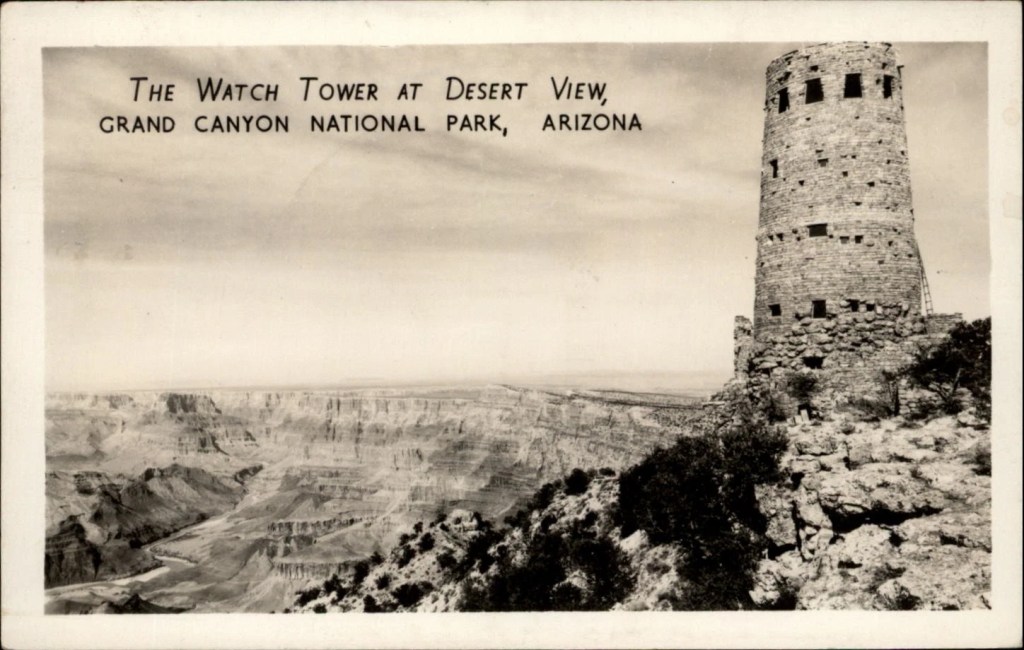
The featured postcard in this writing is one from the Grand Canyon National Park in Arizona. It shows a building called The Watch Tower. I remember this structure from visiting the place almost 38 years ago, and I was quite impressed with it. The tower was very busy, and we had to wait in line to go in. The rock and steel structure is also known as Desert View Watchtower and Indian Watchtower.

The late Jimi Hendrix had a hit song called “All Along The Watchtower.” Released in 1968, yet written in 1966 by Bob Dylan, this was some 48 years after the Grand Canyon tower was constructed.

I doubt this song was written about Dylan’s visit to the national monument, but he did spend considerable time in the state, living in Scottsdale with his wife. Some say that the tune has Biblical meaning, with Isaiah 21:5-9, mentioning such a dwelling. “Watchtower” is also the name of a magazine published by the Jehovah’s Witnesses religious organization.

The Grand Canyon tower was conceived by Mary Holter, an employee of the Fred Harvey Company. It was completed in 1932, becoming a major attraction to park visitors. It was designed by Mary Holter to resemble an ancient Puebloan watchtower, but the overall size is much smaller than the real thing.

Today, the lower floor is a gift shop, while the upper is designed for tourists to take in the spectacular view. Millions of visitors over the years have visited this structure and undoubtedly came away awestruck. The canyon itself had a lot to do with that.

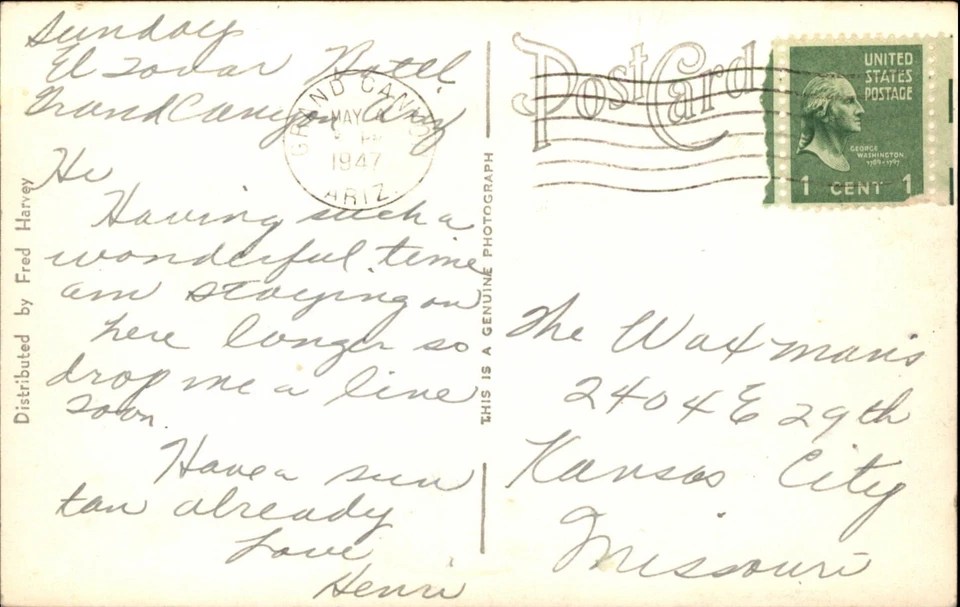
Someone named Henri visited the Grand Canyon in 1947. He mailed this postcard to The Waxman’s in Kansas City, Missouri. As I always try to do with addressed and cancelled postmark cards. I attempt to track down the sender and recipient, with it not always being easy.

In this case, the recipients were Meyer & Fannie Waxman. They lived at 2404 E. 29th Street in Kansas City. I can visualize Meyer retrieving the card from his mailbox, with Fannie reading it out loud to her husband.

“Sunday

El Tovar Hotel

Grand Canyon, Arizona

Hi

Am staying here longer so send me a line soon

Have a sun tan already

Having such a wonderful time

Love Henri”

Afterwards, the Waxmans talked about how they should visit Arizona before getting too old. Maybe they already had? It was only 9 years after getting the card that Meyer died in 1956. Fannie outlived him another 41 years, living to be 103.

Unfortunately, for now, Henri will have to remain a mystery in my postcard history.

BEYOND HOPE

“We’ve been searching for a place in Arizona that’s similar to Hope, Alaska.”

Hope, Alaska

While living full-time in Alaska, I spent a fair amount of time fishing, panning for gold, and hiking in the old mining town of Hope. My brother and I, along with friends, camped there for weeks on end. Having so much fun—we’d never want to return home to Anchorage.

Hope had a special appeal to me and still does. My wife and I contemplated retiring in the small community, but could never secure property on a bluff overlooking Cook Inlet. That was the only location I would’ve been satisfied with. Instead, Joleen and I chose Lake Havasu City, building our house with BLM land and Lake Havasu at the backside.

Regency Drive is the only area I would’ve been happy with here, and we were able to pull it off thanks to local realtor and former Alaskan, Richard Pagliero. With no property listed for sale on this street, Richard yanked some strings to make things happen. Having faith that he’d come through, our prayers were answered. A unique story in itself, I’ll save that tale for another day.

Hope, Alaska, is supposedly named after 17-year-old miner Percy Hope, although some historians question this. Percy Hope came to the area in 1895 as part of a contingent of gold seekers. With gold being discovered in Six Mile Creek, prospectors by the thousands flocked to the vicinity. Before long, saloons sprang up, with stores soon to follow.

Come 1898, when gold was discovered in the Yukon Territory, Canada, many miners left Hope to seek their fortunes in Dawson. Some of them remained, keeping the struggling locale from becoming a ghost town like Sunrise, located just a few miles away.

We were able to visit some of the old mining camps, with rusty relics still lying amongst the trees and brush. Large pipes that brought water for sluicing can still be seen in the old Palmer Creek mining camp. There is plenty of wildlife in this valley, with black and grizzly bears often spotted.

We’ve been searching for a place in Arizona that’s similar to Hope, Alaska. I wanted a spot to go for short stints and relax, with less noise than Havasu, although the sound of Harleys and Hotrods is music to my ears. It is a bit hard to concentrate at times while writing, with constant roaring in the background.

Listening to a friend one day talk about a small town where he loves to park his RV, I was more than shocked to hear the name, Hope. Joleen and I didn’t know it existed. Jim Brownfield and his wife have been going there for several years to unwind. They find it more peaceful and scenic than Bouse or Quartzite.

Hope, Arizona, is 89 miles south of Lake Havasu City via AZ-95 S and AZ-72 E. Ironically, the distance from Anchorage to Hope, Alaska, is 88 miles. Wanting to visit the town that Jim Brownfield refers to as a desert paradise, last month we traveled through there on the way to Prescott. I instantly fell in love with it, seeing the potential for great adventure.

Maps show the surrounding mountains chocked full of old gold mines to explore, while there’s a grocery store in town, along with a church, gas station, and antique store. Boondocking is in our immediate plans, meaning we’ll carry in our water, power, and septic system while carrying out all trash.

On the way out of this tiny town, my wife spotted a large billboard. Joleen read aloud, “You’re Now Beyond Hope.” Before I had time to chuckle she quickly became a poet, good-naturedly roasting me, “They made that sign with you in mind!”

Geographically speaking – she was correct!

Hope, Arizona