ANN SANDERS-MYSTERY MAIDEN OF OPHIR, ALASKA

“During my research, I found Patricia Perry to be a professional dancer, while at the same time she owned the Patricia Perry School of Dance.”

Hay bales in Ophir, Alaska

I decided to try my investigative skills on an Alaska ghost town postcard, this vintage piece of paper featuring Ophir, Alaska. Ophir is an old gold mining town that’s now deserted, other than during the summer months.

A few outfits still mine gold in the area, with Ophir offering up the best airstrip for miles around. A friend and I landed there in his Aeronaca back in 2000. I haven’t returned since.

The Iditarod Sled Dog Race goes through Ophir every other year, where the checkpoint is a private cabin formerly belonging to Dick and Audra Forsgren. Their grandson, Kyle, now owns the rustic dwelling. That cabin has changed little since it was first built over 100 years ago.

Ophir was a bustling center of mining activity starting around 1906, but by 1955, things had pretty much come to a grinding halt. The abundant gold found there slowed to a dribble during the last 10 years as miners left for other locales. Because of this, businesses folded from a lack of customers, with imaginary ghosts taking over the dwellings.

The Ophir postcard I’m researching was postmarked on Sunday, March 30, 1941. This post office was permanently closed 16 years later in 1955, with letters and postcards having an Ophir postmark quite desirable amongst collectors.

A picture on the front shows stacks of hay covered with snow, along with an unusual title: Belated Harvest. Hewitt’s Drug Store in Anchorage was the postcard seller. On the back is written:

“Miss Ann Sanders – Ophir, Alaska. Dearest Miss Perry, At last I’ve found time to write to you and give you my address so that you can send me my shoes. Do you remember Barbara Weatherall a former student of yours. I met her brother yesterday. I’ll close hoping this finds you well and happy. Sincerely Ann Sanders Ophir Alaska”

The recipient address is:

Miss Patricia Perry

Textile Tower

Seattle, Wash.

During my research, I found Patricia Perry to be a professional dancer and performer, while at the same time, she owned the Patricia Perry School of Dance. Undoubtedly, those shoes Ann Sanders asked for were fancy dancing shoes. Of all places, Ophir wasn’t a dancing city like Seattle. Ann must have known she wouldn’t remain there long.

Barbara Weatherall went on to wed her high school sweetheart, Ivan Raymond Stafford, in 1957, only to become a widow by 1963. She then married Rick Mason, two years later, in 1965, and they stayed together until she died in 2012. Barbara’s brother, whom Ann mentioned in the letter, was George Weatherall. He has the most significance in Alaska’s mining and transportation history, where this postcard is concerned.

George Weatherman owned a freighting company based in Talkeetna, where he used dog teams, barges, and trucks to transport people and goods to places such as Ophir, Flat, Iditarod, Fairbanks, and other locales. The entrepreneur also had mining claims that he worked on with his son. Ann Sanders must’ve encountered the hard-working man when he passed through Ophir.

Finding out just who Ann Sanders is has been a tough nut to crack and still remains unbroken. She evidently tutored under Patricia Perry, only to move to Ophir soon after. Was she the daughter of a miner, or someone going there to help cook in the mining camp? Unlike other people I’ve searched for, so far, all of my resources have failed me here.

Single women were scarce in Alaska during the early years, with men competing for their hearts. As sexist as this may seem, if Ann could cook and keep a tidy cabin, that was more than enough to woo a lonely miner’s fancy.

When WWII began in 1941, mines throughout the country were ordered to shut down by the US War Production Board, with those mines in Alaska no exception. Many of the men who came to Alaska to work in the field soon left the state, leaving no forwarding address. Ann Sanders seems to fit that mold as well.

I’ll continue searching, believing that other newspapers in Alaska will eventually come online. Right now, there are only a few that are archived for review. Some of those that aren’t, languish in places that need to be personally visited.

For now, Ann Sanders will have to remain the mystery maiden of Ophir, Alaska.

POETIC LICENSE

“Trying to lasso Columbus into these same devious actions wouldn’t hold up in a court of law, at least not one presided over by a nonactivist judge.”

Perry Mason

I’m sure most everyone has watched television shows or Hollywood movies where court scenes play out. As a witness rambles on and on about what they seemingly know about a specific case, an attorney suddenly blurts out for the judge to hear, “I object, your honor…. this is merely hearsay!”

If this fictitious TV judge rules that the lawyer is correct, “Objection sustained!” is immediately heard from the bench. One of my favorite such shows is “Perry Mason.” I still watch the reruns, especially loving the comedic interaction between Perry Mason and Los Angeles City Attorney, Hamilton Burger.

If hearsay was allowed in court, can you imagine the case outcome? All a witness would have to do is interject a bit of “poetic license” on their testimony to make things appear as if it happened instead of using proven facts. A case could suddenly turn into “Days of Our Lives” with both sides resorting to storytelling.

There seem to be two venues where this sometimes holds true — the 6:00 news and history books. I’ll stick to history books as my main point here because history is my favorite subject, and one where poetic license runs free like a raging river.

Before continuing on, for those not knowing what the term, poetic license, means, according to Miss Purdy, my artificial intelligence (AI) helpmate, it’s the freedom to depart from the facts of a matter or from the conventional rules of language when speaking or writing to create an effect.

In layman’s terms, where history is concerned, “Anything goes as long as it seems believable to the masses!”

Hollywood uses poetic license more than anyone. My wife and I watched “Field of Missing Shoes” the other evening. It’s a movie about a group of mostly teenage Virginia Military Academy students being used as soldiers during the American Civil War.

At the beginning of this historical film, the five words “Based Upon A True Story” slowly rolls across the screen. To some viewers, “based upon” automatically means everything in this movie is factual when, in fact, it’s not. Some things, such as romantic scenes, were undoubtedly added to give the film more viewing pleasure as I like to call it. Regardless, it was an excellent movie.

History books as a whole don’t have these five words anywhere in them. Readers are taught, especially elementary school students, that the contents inside are all real. I had no problem with that growing up, yet now I’m seeing this information attacked by activist groups using different truths or unadulterated hearsay to back up their changes.

It’s almost guaranteed that if I told someone a story about a 12-inch fish I caught in 1900, with that story being repeated over the years by 12 different people, now 125 years later, that fish story wouldn’t be close to the same.

Let’s take things back even further, with me telling it 600 years ago, with 125 different storytellers repeating it. That 12-inch fish would now grow even larger — perhaps being over 30 feet long.

Much of our history is based on passed-down stories, folklore, rumors, fables, and the like, with written documentation to back things up not always available. Christopher Columbus is a prime example. I was taught in grade school that he was a good man.

Some of his crew are known to have been filled with evil, based upon written records, yet trying to lasso Columbus into these same devious actions wouldn’t hold up in a court of law, at least not one presided over by a nonactivist judge. Much of this erroneous information against Christopher Columbus has been thoroughly debunked based upon Columbus’s own writings.

Saying that Christopher Columbus is guilty of atrocious acts because of what a few members of his crew possibly did is no different than holding President Joe Biden responsible for his son, Hunter Biden, and this younger man’s numerous illegal activities.

Mount McKinley, in Alaska, has been named that since 1895, as records prove. In 2015, President Barack Hussein Obama used hearsay in changing it to Denali, claiming that Denali is what the Alaskan Indians had originally called the mountain.

Obama’s statement is called spinning the truth, and even worse things, outside of Washington D.C. circles by those having done the research. Stories or folklore passed down via word of mouth have been proven countless times to be remarkably inaccurate.

Archived newspapers from the late 1800s, along with other documented records, show that Mt. McKinley was called “Bulshaia” by Alaska Natives and Russians way before 1895. It’s right there in black and white.

The Dena’ina Athabaskan Indians didn’t start phonetically recording their language until the 1970s. Denali would not have been one of their words five centuries ago, as their communication was strictly an oral language at that point, including simple drawings.

New Age historians are slyly trying to use the terms folklore or hearsay to substantiate their viewpoint here. That falls perfectly in line with my fish story example.

A good example of passed-down hearsay in Lake Havasu City is the rumor that an Olive Garden restaurant is coming to town. I’ve heard that story repeated over the years from many different people. Some of them still swear that their information came from reliable sources, with these people continuing to believe their own message.

It’s been some 30 years now, and no ground has been broken. In another 100 years, some citizens will erroneously report that Olive Garden was once located on Swanson Boulevard, yet has closed after being forced to by city leaders, with a good many future residents buying into this fable.

One of my favorite songs by the music group, Moody Blues, is “Knights in White Satin.” At the end of this popular 1970s song is a mind-provoking poem. In the poem, Late Lament, written by Graeme Edge, three ending lines sum up best how I now look at the truth, especially where certain manuscripts, books, movies, and television news channels are concerned.

“Red is grey and yellow white.

But we decide which is right.

And which is an illusion.”

That poem definitely applies to history books. The only book that I’ve found to tell the absolute truth, without reservation, is the Holy Bible.

If Christopher Columbus or any of my childhood heroes are guilty of atrocities against Indigenous people, as some now claim, all they need to have done afterward is ask Jesus for forgiveness, and those sins were washed away.

It’ll make no difference what history Professor Ima Knowitall or Dr. P.C. Leftist have to say about them in future history books, including me, or anyone else for that matter.

God is the ultimate and final judge here, with folklore, poetic license, and hearsay not admittable as evidence in His court of Absolute Truth!

John 17:17

1966

“JERRY”

“They were nice to me and on Christmas always left a sizable tip or present.”

Looking back at folks I’ve met along the way, several stand out tall amongst the rest. Two of these were special people that I didn’t entirely know the history of. It was only after they passed away and I began writing, did I unearth their backgrounds through old wedding announcements and obituaries.

Alan and Muriel Girardet I first met as customers on my newspaper route in Anchorage. They were nice to me and on Christmas always left a sizable tip or present. When I say sizable I’m talking at least $5. The couple lived in a small but well-kept trailer in an older section of Alaskan Village Trailer Park.

Muriel and Alan were especially kind to neighborhood children, and this was especially true on Halloween. They were known to hand out the largest amount of candy of anyone in the park. There was a reason for them being so gracious to us kids that I didn’t know back then.

Alan went by the nickname of Jerry and I still don’t know the reason for that and probably never will at this point. His middle name was Newton. Mr. Girardet and his wife owned Lock, Stock, and Barrel gun shop, with a few of us kids who owned rifles purchasing .22 ammo from him. We’d been taught gun safety at Clark Junior High so it was nothing out of the ordinary.

The school had a small “take down” shooting range for the Clark Shooting Club. It would be set up in the gym and then taken down when not in use. For competition purposes, we’d go to an indoor target range on a local military base.

At home, sitting behind the gun shop was a hill that we could safely shoot into. A wrecked car sitting in front of it was riddled with holes. It was quite common to find several locals back there on a Saturday morning firing away.

My father eventually purchased the building that housed Lock, Stock, and Barrel Gun Shop, and I came to know Jerry even better. The man had a German Shepherd dog named “Heidi” that he brought to work every day. At lunch, Jerry would toss a ball and Heidi would chase it. You could tell by the excitement in her retrieving it that it was the highlight of the day.

Jerry became friends with my father-in-law and I learned from Herman that Jerry had also been in the United States Navy. Both men saw duty in WWII so they had something in common to talk about. Jerry served on the aircraft carrier USS Maine before retiring in 1959. His wife, Muriel, was also in the Navy. Being a member of the WAVES (women accepted for voluntary emergency service), Muriel remained on active duty until the end of the war.

Sadly, Jerry’s brother, David Lloyd Girardet, was killed in the crash of a Grumman Hellcat airplane during WWII. Not once did Jerry ever mention this to me nor tell my wife’s father, Herman, about the tragedy. Ensign David Lloyd Girardet attended the Naval Academy with a presidential appointment courtesy of Franklin D. Roosevelt.

Hanging on a wall in the gun shop was a Brown Bess musket and powder horn dating back to the 1700s. I often visited Jerry just to check out this weapon. He eventually brought it down for me to inspect. I knew it was one of his prized possessions just by the way he handed it to me. The gun was long and heavy.

Because of my fascination for this Brown Bess, thirty years later I purchased one in Scottsdale, Arizona. I always wondered what happened to Jerry’s musket believing that it’d been sold after he passed away.

A couple of important things were learned about Jerry and Muriel along with that Brown Bess in writing this story—one of them quite sad. I never knew during the time I first met them in 1967, that they’d lost their only son in a motorcycle accident just three years prior.

David Lloyd Girardet was struck by a drunk driver in 1964 and killed. I can’t imagine the heartbreak of losing a child, and I suppose this was a reason for them seemingly “adopting” some of us neighborhood kids. David was without question named after Jerry’s late brother.

The other thing I came to know is not so tragic. The beloved “Brown Bess” was donated by Jerry and Muriel to the Lake Ronkonkoma Historical Society Museum in New York. A picture of it on their website shows the musket and powder horn in a place of reverence. A brass tag identifies it as being donated by the Girardets.

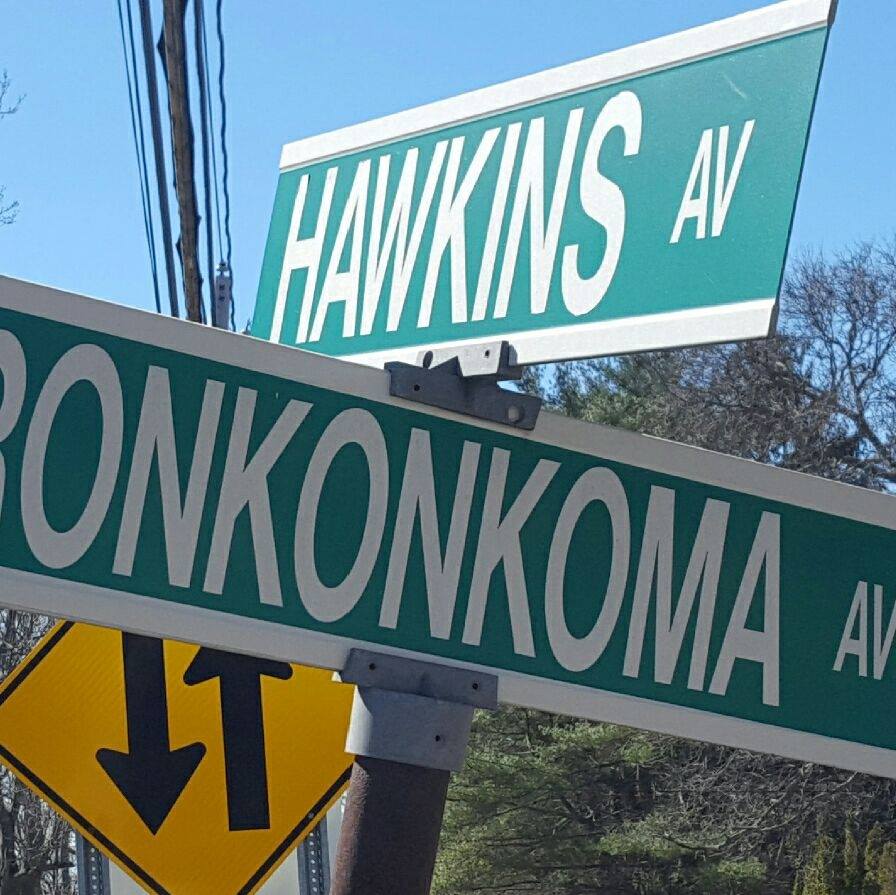
Interestingly enough, Jerry was born and raised in Lake Ronkonkoma, with the family living on Hawkins Lane. That street name was eventually changed to Hawkins Avenue, now considered the city business center. The Girardet patriarch came to America from France, where he also served in the Navy. Jerry, Muriel, and David are buried in the Lake Ronkonkoma Cemetery.

Some might ask what does this story have to do with Lake Havasu City? The answer is simple. There are thousands of seniors living here from all parts of the country. Undoubtedly, a good many have backgrounds much like the Giradets. In most cases, we’ll never know until they’re gone!

“HAPPY JACK”

“Thanks to Deana, Karon, Renee, and Starr for helping me with this project.”

On the way to Kingman from Lake Havasu City, a little-used byway crosses over Interstate 40, named Happy Jack Road. A sign identifying it is visible on this overpass. Access to the Happy Jack Road bridge or overpass is via the Santa Fe Ranch Road exit, and then one must head east for approximately one-half mile on a side road that follows alongside I-40. This side road is a remnant of old Route 66.

I’ve been on Happy Jack Road numerous times, following it until hitting Happy Jack Wash and Sacramento Wash. A BNSF railroad bridge back there has quite the history. A story could be written about it alone. Loose sand and a steep rocky incline make getting to this bridge a bit tough unless you have a four-wheel drive.

Approximately one mile west of this railroad bridge is an abandoned railroad stop named Haviland. Today, trains park there, but they only remain in place for a short time until the tracks are clear. The area is popular with meteorite hunters.

I’ve often wondered who Happy Jack was. The Jacks I know for the most part are all happy individuals—at least the ones still living. This fellow must’ve been someone special for a road and a wash to get named after him.

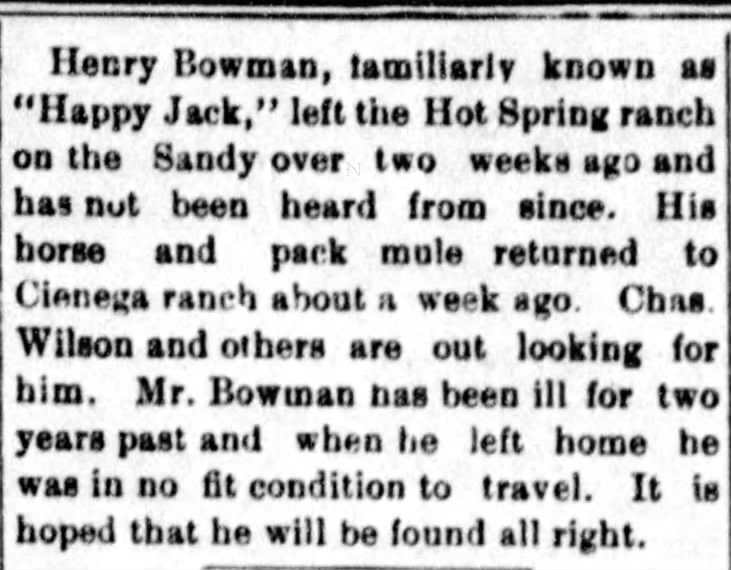
I presented that question to a Yucca forum site and ended up with several valid answers. One individual thought that Happy Jack was a train engineer, with two others saying that he was a former rancher in the area who owned a large section of land. A forum member said that she had an old newspaper article dictating such. It took some digging, but I eventually found several articles. Thanks to Deana, Karon, Renee, and Starr for helping me with this project.

Henry Jack Bowman is the real name of “Happy Jack.” Moving to Yucca from Tombstone in 1881, he came to the area at the same time the railroad was being constructed.

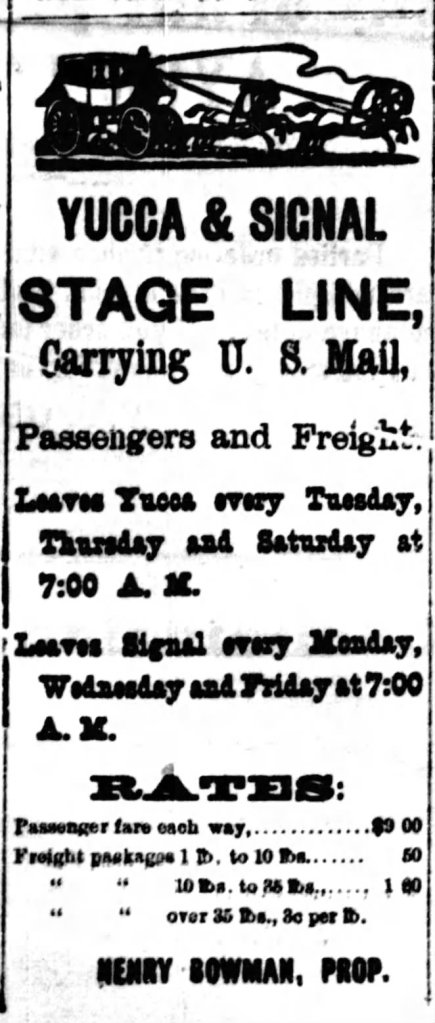
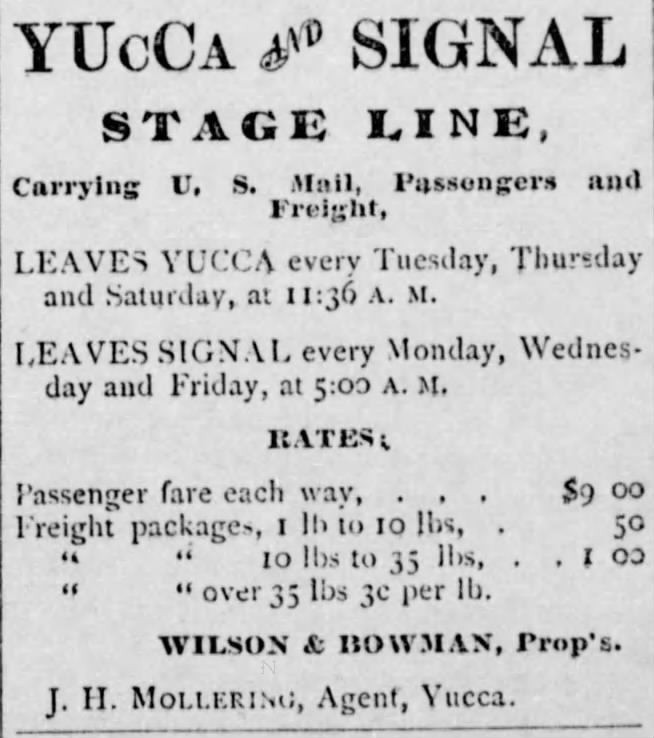
Henry owned The Yucca & Signal Stage Line in Yucca and provided service to and from the mining town of Signal. This business also hauled the mail. Henry was also a successful ranch owner and miner, along with keeping burros either to be sold or leased to other prospectors. Signal is now a ghost town.

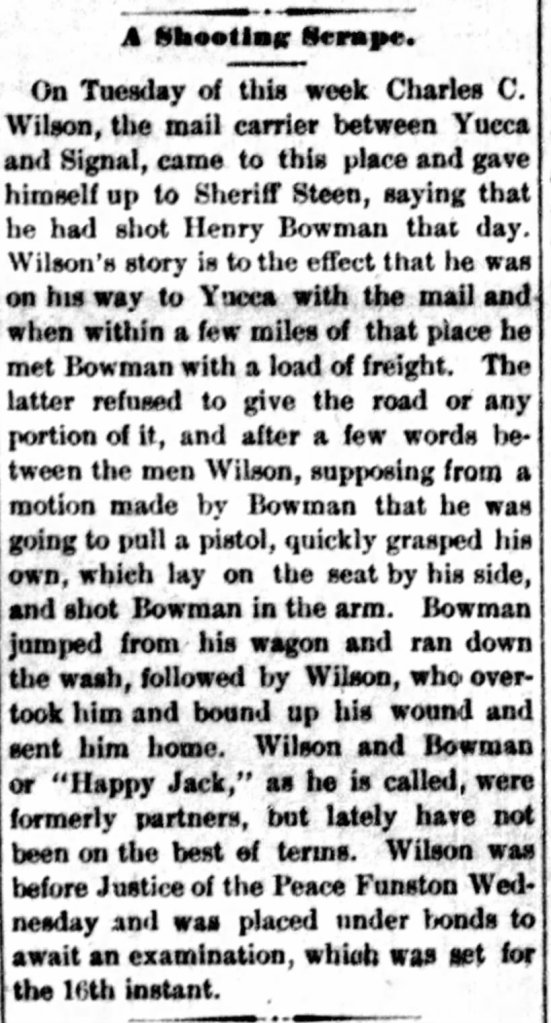
Newspapers paint a vivid photo of Henry Bowman. He had a partner in this stage and freight operation, Charles Wilson, but the two men eventually had a falling out and went in separate directions. Meeting on a trail one spring day near Yucca in their wagons—neither gave way to the other.

“Happy Jack” was shot in the arm by his former business associate and survived, with Charles Wilson eventually turning himself into Sheriff Robert Steen.

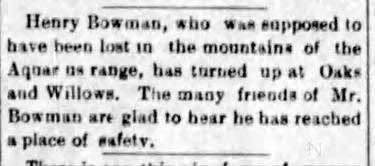
Seven years later, Bowman went on a mining expedition into the surrounding mountains, only for his burros to return to his Cienega Ranch without their owner. Charles Wilson was one of the first men to help look for him. Two weeks later “Happy Jack” turned up a bit weathered from the experience yet alive. He was definitely a tough old buzzard.

Having researched and written this short story, the next time I drive under Happy Jack Bridge on a sweltering 120-degree summer day in an air-conditioned vehicle, with a large Coke within easy reach, I’ll think of Henry “Happy Jack” Bowman sitting on top of his stagecoach with sweaty passengers inside.

How he and others survived back then is a testament to their strength, grit, and tenacity!

1885
1884
1895
1891
1888
1884
1883
1895
1895
Yucca (1943)

TIME MACHINE

“I no longer have to go to a library and search through microfiche cards or suffer eye strain watching flickering reels of fragile microfilm.”

I’ve read books or watched plenty of movies that involve time machines, yet always crave a new such adventure. The “Back to the Future” series with Michael J. Fox is perhaps my favorite. Following close behind is, “Bill and Ted’s Excellent Adventure. This 1991 comedy helped send actor Keanu Reeves to stardom.

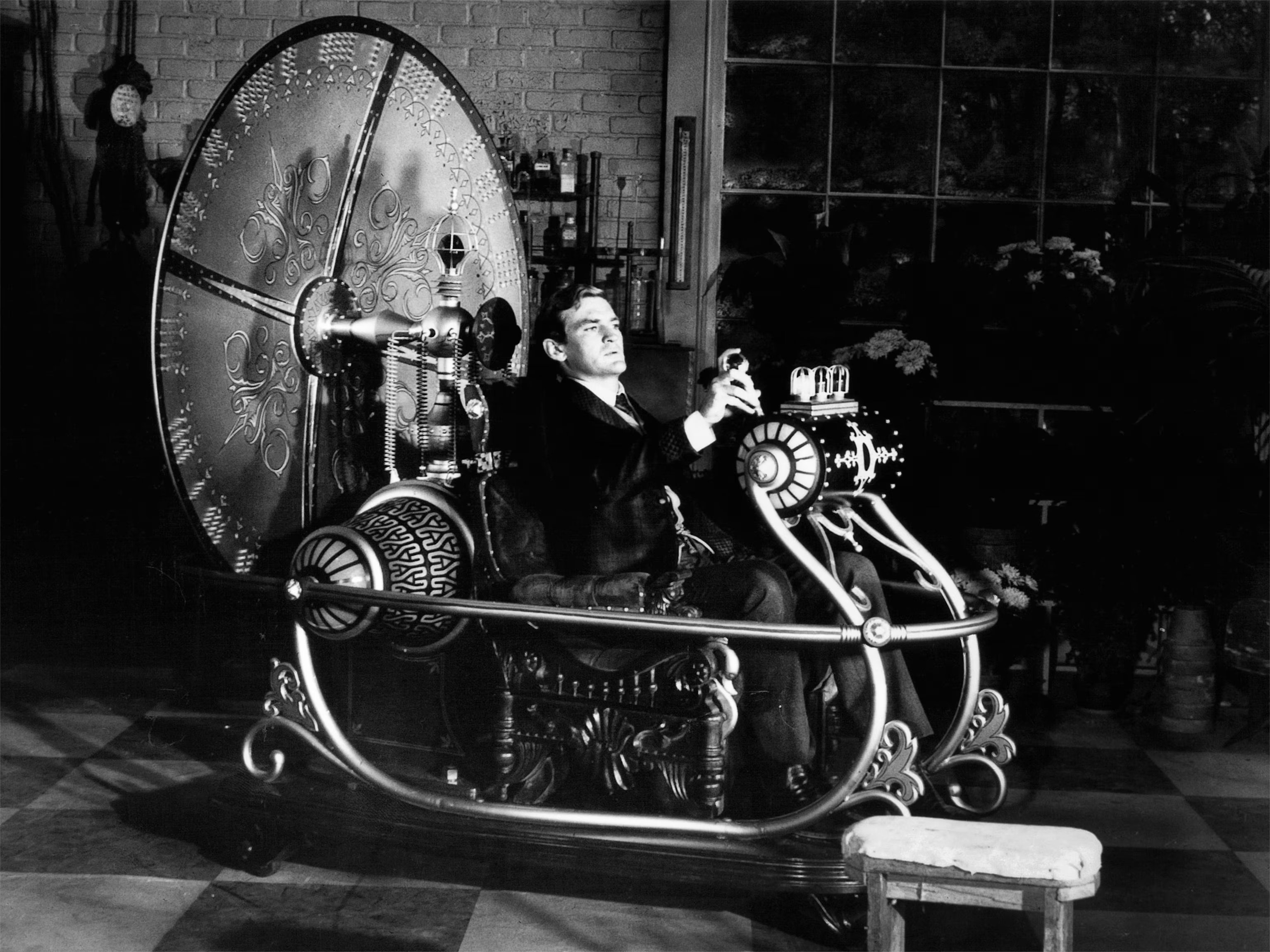
In 1895, H.G. Wells wrote the most famous time travel episode of all, “The Time Machine.” At only 133 pages long, it’s condensed and full of adventure, yet to fully comprehend things, a reader has to go slow.

Within my blog pieces and published newspaper articles, I mentioned several times, for almost 7 years now, that I’ve been using newspapers.com to travel back in history for research purposes. Lo and behold, in conjunction with this valuable asset, I have a time machine of my own and I’m sitting directly in front of it right now.

Called a computer, I no longer have to go to a library and search through microfiche cards or suffer eye strain watching flickering reels of fragile microfilm. For those folks having spent hours doing this without food or drink, they’ll know what I mean. Like many seniors, I’m slowly forgetting things from the past, yet old newspapers stop fading once they’re digitized.

Newspapers.com is a superb tool for writing articles about events from long ago, yet it’s also great for genealogical purposes. Having spent most of my life in Alaska, just recently, two Alaskan newspapers from that timeline were added to newspapers.com.

Already having access to archived papers from other places we lived, like Florida, California, Alabama, and Texas, I’m now able to reconnect with segments of my life from the forty-ninth state that were captured in print.

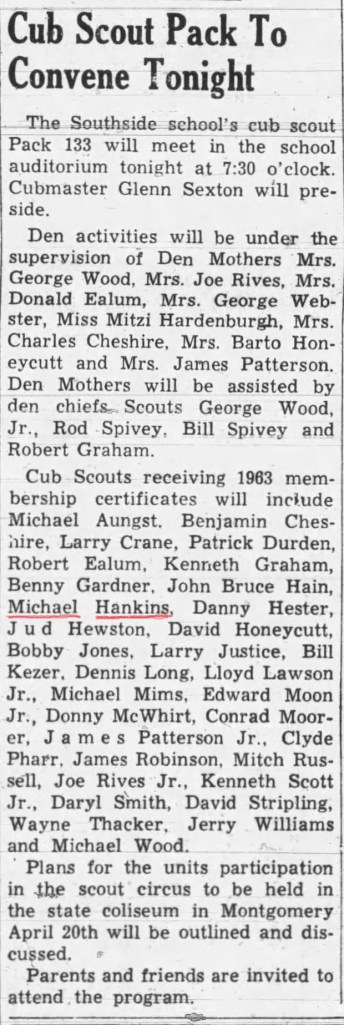
Traveling back to 1954, the year that I was born, a birth announcement from the “Pensacola News-Journal” in Pensacola Beach, Florida, was uncovered. From there, jump ahead 9 years to April 9, 1963, and my name is mentioned in the “Selma Times-Journal” as belonging to the recently started Cub Scout Pack 133 in Selma, Alabama.

April 9 is my birthday and I find it very interesting the article was published on that very Tuesday I was having cake and ice cream. Within that short composition, it’s mentioned that our group was going to the Cub and Boy Scout circus in Montgomery. I vaguely recall this, as only one month later, my family moved to Lubbock, Texas.

Very little is mentioned in Texas newspapers about me, other than belonging to the Boy Scouts there and winning an award and prize for reading the most books during the summer of 1964. My prize for this event was a non-fiction adventure manuscript called “Kon Tiki” by Thor Heyerdahl. Although the book is quite tattered after one of our dogs got hold of things, it now resides in a safe place.

Two Alaska newspapers, “The Anchorage Times” and “Anchorage Daily News” contain quite a bit of my history starting with high school graduation, wedding announcements, birth announcements of our children, their graduation and nuptial announcements, obituaries of family and friends, and a smorgasbord of “letters to the editor” written by me. Thankfully, a slew of speeding tickets during the earlier years were never published.

That’s not all of my Alaska history. In the classifieds sections, I came across an ad for a 1968 Dodge Charger that I purchased for $1200, including a 1968 Plymouth GTX for $600, and a 1971 Polaris TX795 Starfire snowmachine for $550. Entering our home phone numbers in a search for other such records, I was able to view items such as furniture that we sold through both newspapers. Old phonebooks provided me with the phone numbers.

During my research, I found archived articles on newspapers.com mentioning American Civil War veterans that were directly related to our family, including news regarding my long-departed great-grandparents, great-aunts, and great-uncles.

Specific events include a tragic fire in 1943 involving an uncle I never met, and horrible accidents that Mom and Dad were involved with. One of those was a car crash near Victorville, California, on July 9, 1957. On that day, my father was riding in a 1957 Corvette driven by a friend who swerved off a curve on Route 66 and flipped. Dad’s leg was severely damaged and he walked with a limp for the rest of his life.

I came across a bunch of wedding and birth announcements for family and friends. I’ve relived life through newspaper articles, regarding tornadoes, floods, and world atrocities such as the 1963 assassination of President John Fitzgerald Kennedy.

The cost for a subscription to newspapers.com is minimal, and best of all, it can be had for 6-month subscriptions. For writing purposes and for genealogical research, I couldn’t do without my time machine. Quite often, when bored, I fire things up and take a literary journey back to when life was simple.

Yes—living in the past can be a blast!

Tuesday – April 9, 1963

WOKE MENTALITY

“Records show that neither George Washington nor Martin Luther King Jr. were perfect, much the same as Christopher Columbus.”

Captain Christopher Columbus

Americans recently celebrated Columbus Day. Some “woke folks” have tried to change the name to Indigenous Peoples Day, but it’ll always be Columbus Day to me and others. For those illogically thinking members of society constantly wanting to change history—they should create another day to have American Natives honored besides the second Monday of October. There’s plenty of room for additional federal holidays on the calendar—354 open slots to be exact.

Columbus Day was created in 1892 by President Benjamin Harrison, as a way to memorialize the lives of 11 Italian Americans killed in New Orleans by a vigilante mob on March 14, 1891. Nine of the Italians were lynched with two of them shot. The massacre created quite a rift between Italy and United States relations, with President Harrison attempting to calm the tension with his declaration. This bit of history is never brought up by those trying to remove Columbus Day because undoubtedly, they know little of the history.

For political leaders to now try and erase Columbus Day is a blunt insult to Italians throughout the world, especially those immigrants and their ancestors having settled in America. It’s no different than 50 years down the road, a group of self-described “do-gooders” deciding to change the holiday names of Martin Luther King Jr. Day, or Washington’s Birthday, after delving into their lives and discovering morally questionable behavior.

Records show that neither George Washington nor Martin Luther King Jr. were perfect, much the same as Christopher Columbus. Why punish these guys eons after they were placed in the grave?

Getting back to the definition of “woke.” I hear this word all the time regarding a certain group of thinkers, and it makes me visualize a mass of half-asleep people trying to make decisions when they’re not fully awake. It’s evident that those trying to erase Columbus Day—still need to wake up and smell the coffee!