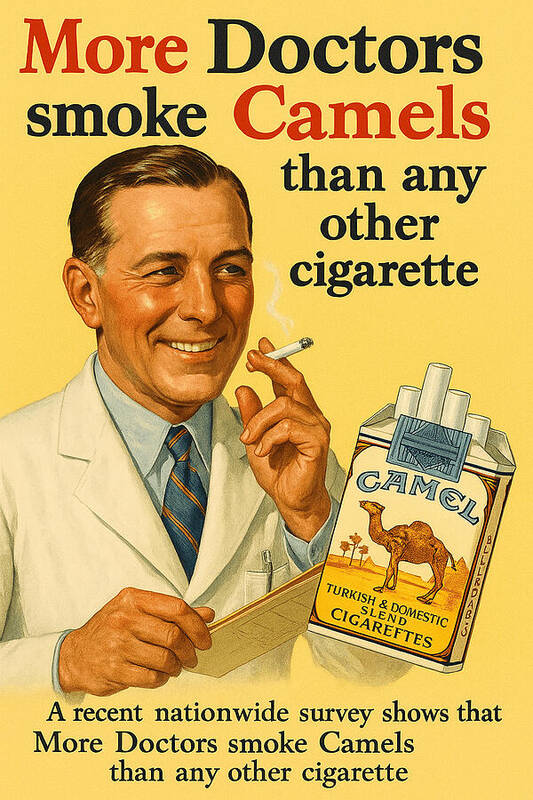
DOCTORS PREFER CAMEL

“Here in Havasu, I’ve watched Dr. Thomas Wrona retire, Dr. Pareed Aliyar, and, just recently, Dr. C. Reese Mead, my dentist.”

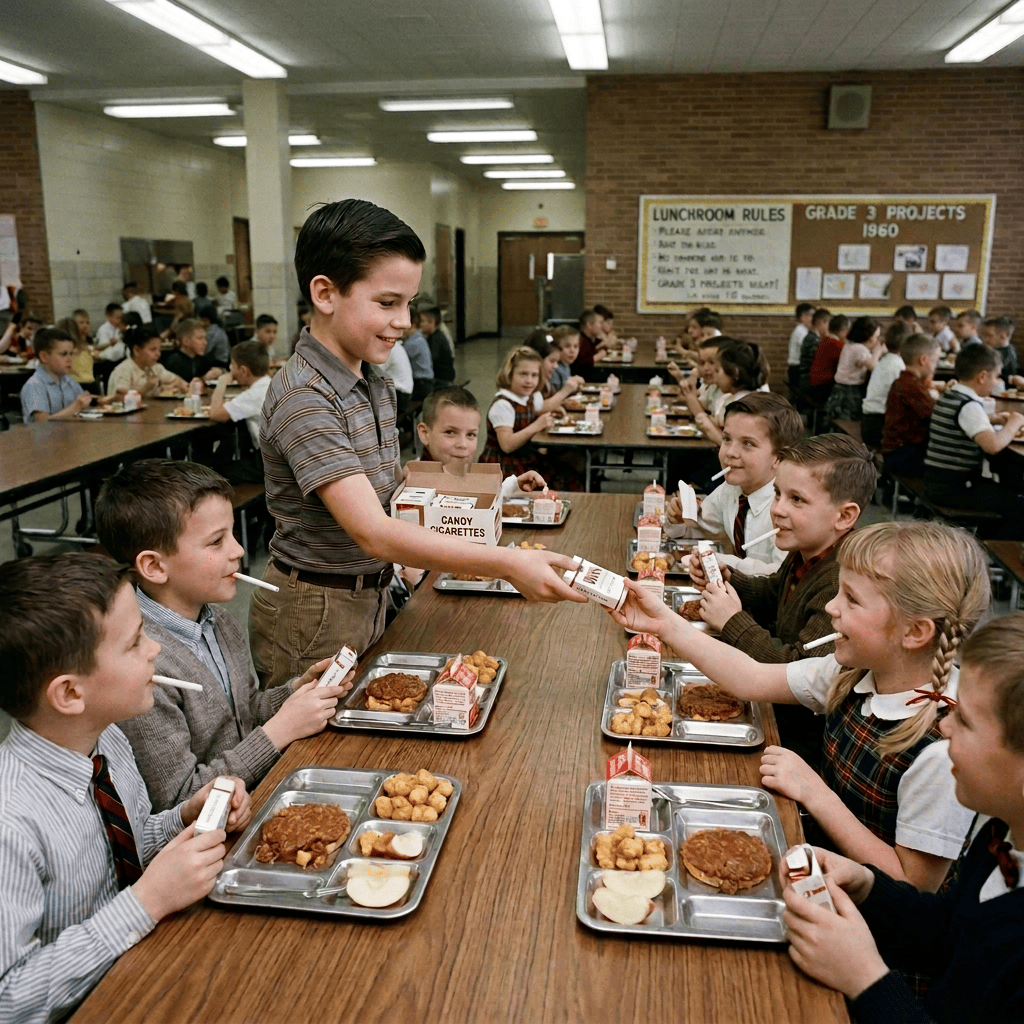
Children in a school cafeteria share candy cigarettes; bulletin board reads “LUNCHROOM RULES” and “GRADE 3 PROJECTS 1960.”

I’ve had several doctors retire over the years here in Lake Havasu City and in Anchorage, Alaska. Dr. John J. Smith retired after like 50 years of practice in Alaska, with Dr. Ernest Meinhardt taking over some of his family medical patients, with me being one of the lucky ones. Dr. Meinhardt had a dry sense of humor, yet I could make him crack a smile.

Meinhardt was the main flight physical examiner in Anchorage, and he owned an airplane. A picture of the Helio Courier was on his office wall, with the late Alaskan explorer Lowell Thomas Jr. owning one almost identical. Only doctors, lawyers, and successful businesspeople seemed to buy these Helio planes because they are expensive to maintain.

I once asked Dr. Meinhardt if he thought I could fly helicopters. Looking at me, with a hardened face, he said, “You’ve got high blood pressure, vertigo, inner ear problems, and I just prescribed Xanax for your anxiety attacks. What do you think?” After that, he let go with a rare smile.

Dr. Joshua Wright II was my Anchorage dentist, and I was his client long enough to see him retire and leave the practice. Dr. Wright was also a politician, and several of my letters to the editor went against the grain on how he viewed things. Wright was a staunch Democrat while I was Republican. Despite this, we still got along, and I trusted his medical advice on teeth and oral health.

Here in Havasu, I’ve watched Dr. Thomas Wrona retire, Dr. Pareed Aliyar, and, just recently, Dr. C. Reese Mead, my dentist. My wife and I attended Dr. Mead’s going-away function outside his office. A live DJ played music, with free non-alcoholic beverages and tasty hors d’oeuvres, as I’d call this finger-lickin’ good food.

Dr. Wrona and his wife were there, and she too was a retired dentist. Listening to the conversation going on around me, there was no lack of professional folks along with simply clients like Joleen and me, or is that Joleen and I?

Years ago, when Dr. John J. Smith retired in Anchorage, I wanted to wrap a carton of Camel cigarettes as a gift, because back in the 1940s and 1950s, the R.J. Reynolds Tobacco Company advertised that doctors recommended Camel over all other brands.

Dr. Smith didn’t smoke, and I thought this joke was perfect for his retirement. I didn’t go through with things after being told it was a waste of money. How I wish I hadn’t listened to that person. Dr. Smith lived to be 94, and I hope all of my doctors make it that far or further.

For Dr. Reese Mead’s retirement, a few pieces of Reese’s candy were tossed into his card basket. Someone told me that dentists can sometimes be the biggest candy aficionados. I’m not sure Dr. Mead is, but he can get rid of it quickly with Halloween coming up.

Speaking of Halloween, candy, and cigarettes. Just recently, I saw an advertisement for a box of different varieties of candy cigarettes, undoubtedly meant for the upcoming holiday.

When I was a kid in Selma, Alabama, some parents occasionally gave out these popular candy delights when we trick-or-treated. They all tasted the same to me, much like sweetened chalk.

For a brief two seconds, I thought of buying a carton and sending them to my youngest grandchildren. After thinking it over, kids these days would probably be expelled from school for having such in their lunchboxes. I can still picture one of them in their school lunchroom, pulling out a pack and passing it around to classmates like soldiers did in WWII Army movies.

This acting wasn’t punishable in 1960, but today, being a kid and trying to have harmless fun without causing a serious nuclear meltdown is a thin gray line. I would’ve never survived!
ALASKA KEMOSABE

“My ultimate goal was to create the best, funniest, and most creative book ever written on the 49th State, and I feel as if I’ve accomplished that.”

Over 30 years ago, a reporter from the Anchorage Daily News told me you sometimes have to toot your own horn to get noticed.

He mentioned this when I called his newspaper to see about getting a certain story published, with it ending up front and center, along with an awesome color photo.

That was the first and last time I’ve ever brought attention to myself where journalism credit is concerned. I prefer to remain in the shadows, not soliciting ribbons, awards, or trophies. The finished product is gratitude enough.

Two years ago, I set off on a writing project unlike anything I’ve ever attempted. It was a grueling undertaking, with me spending countless hours late at night and into the morning sunrise, tediously putting things together.

There were nights I wondered what was I doing as my wife and our parrots slept peacefully in the next room. During this time, I also kept busy composing articles for our local Lake Havasu City newspaper, Today’s News–Herald. I’d venture out in the garage between writing sessions to tinker on my old truck and garner needed sanctity — or pray.

A total of 50 entertaining and unique stories on Alaska, as well as creating 51 photos with help from AI, was, for me, a monumental task. As a car nut, I’d say it’s akin to sanding a vehicle down to bare metal, performing all the priming and sanding, and then spraying on a custom paint job. The book will be around 400 pages, making it the largest I’ve composed.

My ultimate goal was to create the best, funniest, and most creative book ever written on the 49th State, and I feel as if I’ve accomplished that.

Over 10 years, six books later, and a blog with almost 500 submissions, my work has been read in 104 countries and all 50 states, including Puerto Rico. I find that totally amazing. ALASKA KEMOSABE will be featured via several yet-to-be-scheduled podcasts. Thankfully, those can be done from home.

I’ve always been careful to not cross the line where language or humor is concerned in my writing. I know that what I compose is always being scrutinized by the Man upstairs, including those non-believers that I dare not lead astray.

ALASKA KEMOSABE is unlike anything ever placed on the market. Not holding back one iota in putting things together, creatively speaking, there will never be another book like it. I say this because I’d have to be the one composing a sequel. My publisher is pushing me here, although I’ve yet to agree.

Neither an inflated ego nor bravado has anything to do with the above comments; it’s based entirely upon my thought train instead.

Everyone on this planet thinks differently, and there’s no counterfeiting our uniqueness, especially where writing is concerned — unless, of course, plagiarism comes into play.

God is responsible for us being different, with him blessing me with an outrageous and creative mind. It’s gotten me in trouble more than once when I crossed the line, so to speak.

The Choctaw Indians of North America are known as perhaps the best storytellers of all the tribes. They were able to paint a vivid picture by using their hands and gestures, along with artwork, to convey messages.

Their stories often incorporated life lessons passed down from elders, along with moral and religious teachings. Having no written language, they sometimes relied upon animal characters to get their point across.

My Great-Great Grandmother Minnie Pearl Redus-Hankins was half Choctaw, and undoubtedly, a tiny portion of her blood is in my veins. I give God first credit, and then Minnie Pearl for providing me the ability to relay tales of my own, both verbally and in print.

A friend that I personally never met, other than on the phone and email, Jeff Maddox, coaxed me into writing books more than anyone. Jeff was on another writing project when he was suddenly taken to Heaven before finishing.

ALASKA KEMOSABE may never make The New York Times bestsellers list, yet that wasn’t the reason for writing it. If only one person finds the finished manuscript a hoot as I do, all of that time and work was well worth the effort.

I laugh each time I see the cover alone, and I’d love to share it, but the publisher wants things kept totally under wraps until release time.

*ALASKA KEMOSABE will be available by late July 1 through Amazon, Barnes and Noble, and via eBook.

“HAPPY JACK”

“Thanks to Deana, Karon, Renee, and Starr for helping me with this project.”

On the way to Kingman from Lake Havasu City, a little-used byway crosses over Interstate 40, named Happy Jack Road. A sign identifying it is visible on this overpass. Access to the Happy Jack Road bridge or overpass is via the Santa Fe Ranch Road exit, and then one must head east for approximately one-half mile on a side road that follows alongside I-40. This side road is a remnant of old Route 66.

I’ve been on Happy Jack Road numerous times, following it until hitting Happy Jack Wash and Sacramento Wash. A BNSF railroad bridge back there has quite the history. A story could be written about it alone. Loose sand and a steep rocky incline make getting to this bridge a bit tough unless you have a four-wheel drive.

Approximately one mile west of this railroad bridge is an abandoned railroad stop named Haviland. Today, trains park there, but they only remain in place for a short time until the tracks are clear. The area is popular with meteorite hunters.

I’ve often wondered who Happy Jack was. The Jacks I know for the most part are all happy individuals—at least the ones still living. This fellow must’ve been someone special for a road and a wash to get named after him.

I presented that question to a Yucca forum site and ended up with several valid answers. One individual thought that Happy Jack was a train engineer, with two others saying that he was a former rancher in the area who owned a large section of land. A forum member said that she had an old newspaper article dictating such. It took some digging, but I eventually found several articles. Thanks to Deana, Karon, Renee, and Starr for helping me with this project.

Henry Jack Bowman is the real name of “Happy Jack.” Moving to Yucca from Tombstone in 1881, he came to the area at the same time the railroad was being constructed.

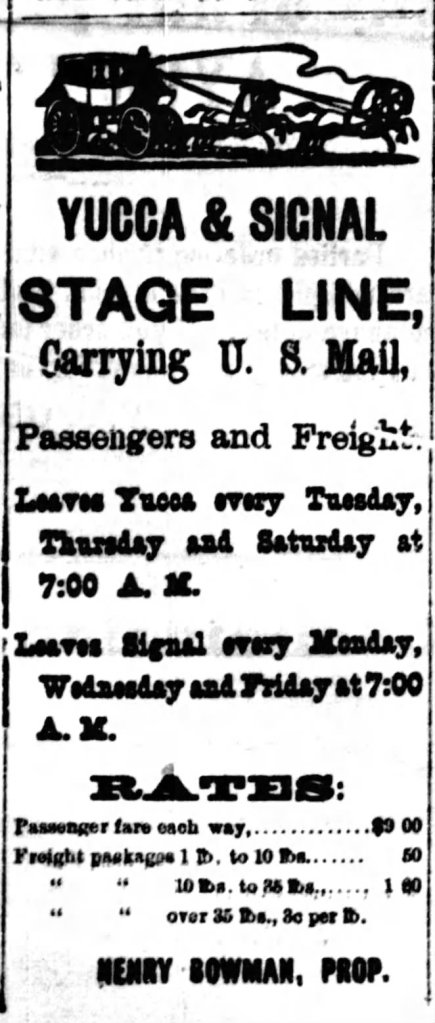
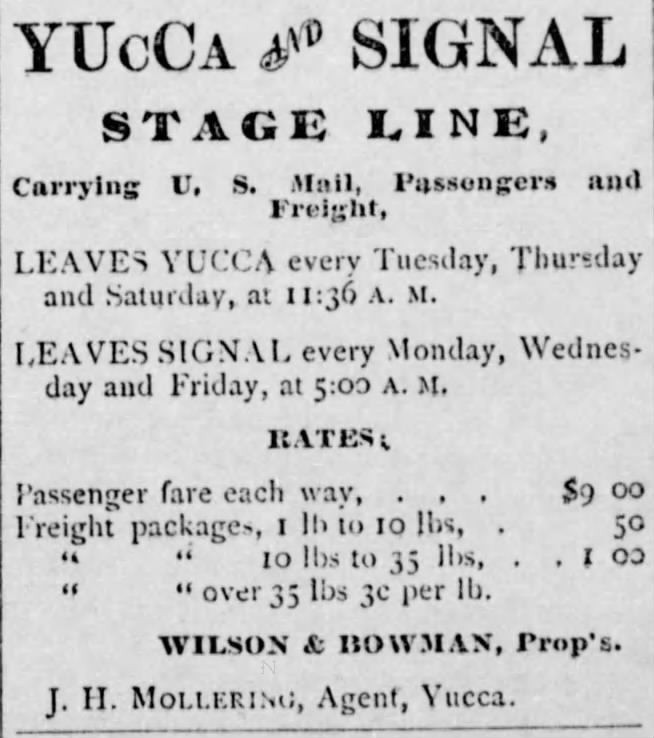
Henry owned The Yucca & Signal Stage Line in Yucca and provided service to and from the mining town of Signal. This business also hauled the mail. Henry was also a successful ranch owner and miner, along with keeping burros either to be sold or leased to other prospectors. Signal is now a ghost town.

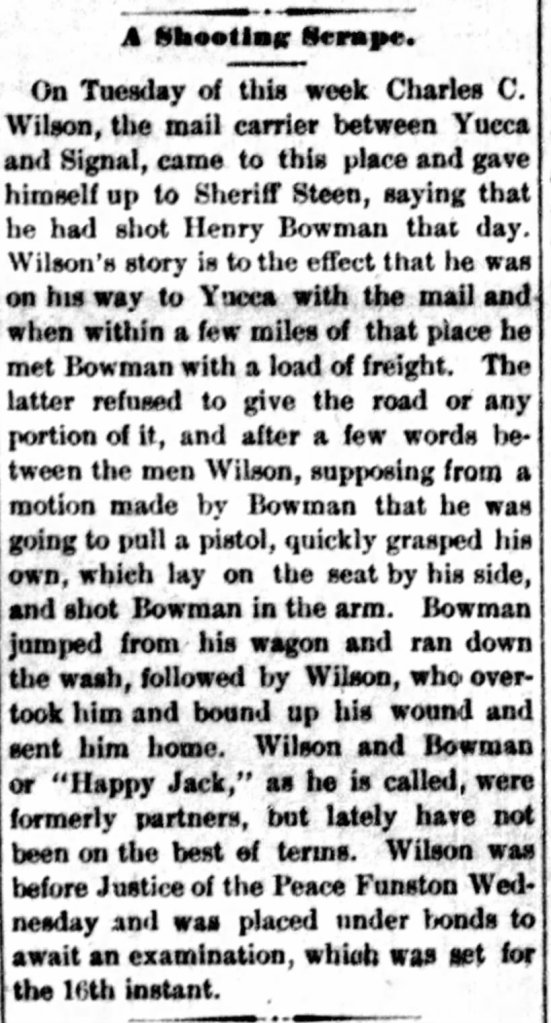
Newspapers paint a vivid photo of Henry Bowman. He had a partner in this stage and freight operation, Charles Wilson, but the two men eventually had a falling out and went in separate directions. Meeting on a trail one spring day near Yucca in their wagons—neither gave way to the other.

“Happy Jack” was shot in the arm by his former business associate and survived, with Charles Wilson eventually turning himself into Sheriff Robert Steen.

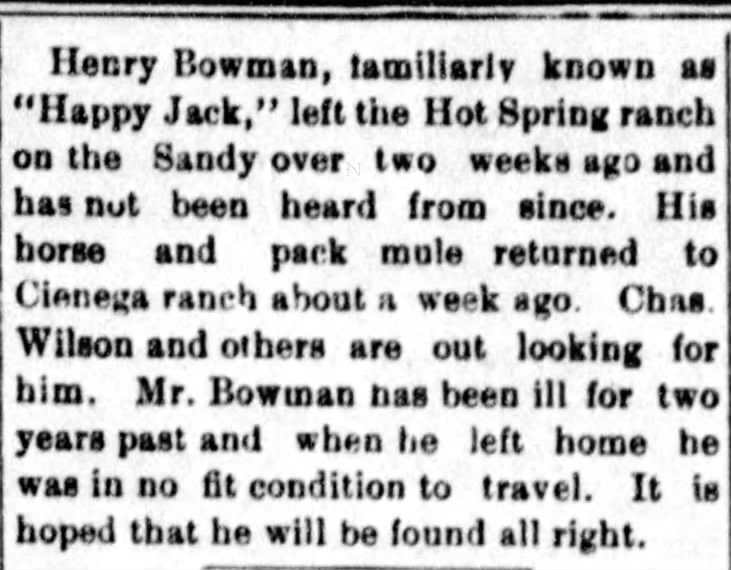
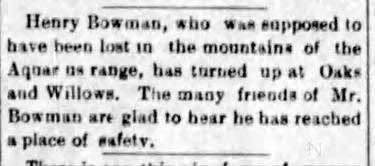
Seven years later, Bowman went on a mining expedition into the surrounding mountains, only for his burros to return to his Cienega Ranch without their owner. Charles Wilson was one of the first men to help look for him. Two weeks later “Happy Jack” turned up a bit weathered from the experience yet alive. He was definitely a tough old buzzard.

Having researched and written this short story, the next time I drive under Happy Jack Bridge on a sweltering 120-degree summer day in an air-conditioned vehicle, with a large Coke within easy reach, I’ll think of Henry “Happy Jack” Bowman sitting on top of his stagecoach with sweaty passengers inside.

How he and others survived back then is a testament to their strength, grit, and tenacity!

1885
1884
1895
1891
1888
1884
1883
1895
1895
Yucca (1943)