LIFE STORIES

“Bob said that he grabbed the other fellow and ripped his head clean off his shoulders before placing it on the counter.”

Reid Bowman

In my younger years, I worked with several great storytellers at different places of employment. They were generally much older men than me. Most of their tales revolved around workplace experiences, fishing, hunting, and youthful exploits, along with rehearsed or unintentional acts of mischief.

For the most part—I believed all their tales were true—except for one bizarre story told to a group of us during morning break.

Robert Nelson was a parts expeditor for the State of Alaska. I’m not sure what his former background was because he was a “man of mystery” with little known of his past by coworkers. Bob was in his 70s when I first met the guy. I was told he drank a lot over the weekends and that his accent drastically changed when he did so.

At break one Monday morning, in what appeared to be Irish undertones, the man bragged of being at a tavern years ago when a fight broke out between him and another bar patron. Bob said that he grabbed the other fellow and ripped his head clean off his shoulders before placing it on the counter.

We laughed hysterically believing it was a joke until Mr. Nelson became very angry. With his ears and forehead glowing cherry red, he yelled that his story was true and that we’d greatly offended him. The room turned totally quiet, with laughter returning once again, only after Bob Nelson stormed out the door.

Bob worked less than a year longer before he resigned. We were informed through the workplace grapevine, that he lost his driver’s license and had to leave because this job consisted of driving a state vehicle.  That strange story of Nelson’s is probably still circulating in certain Alaskan circles. Undoubtedly, Bob Nelson created his tall tale while tanked up on agave juice. Tequila was his brew of choice.

Three men stand tall where “factual storytelling” is concerned. All of them had a lifetime of exciting adventures to share. I wish I could remember more of what they relayed over the years.

Reid Bowman served in the United States Navy during WWII, being at Iwo Jima during the heat of conflict at age 17. He saw battle on ships that I no longer recall the names of. Some of his observations while fighting the Japanese were quite graphic. I can still see tears coming from his eyes during one recollection of fellow sailors being killed when enemy fire struck their ship.

Reid had some great fishing stories as well. With him owning a beautiful cabin directly on the Kenai River near Soldotna, Alaska, there was no doubt they were true. The Kenai River has some of the best salmon fishing on the Kenai Peninsula.

Martin Allen was a native Arizonian although he was born in Roswell, New Mexico, in 1920. He was a real cowboy during his younger years, riding horses and herding cattle like those cowboys seen in Western movies. He served in WWII as a Marine, and afterward, he worked in the mines of Bisbee for what I believe was close to 30 years.

This was at the same time that miners went on strike there, and a mining company Martin Allen worked for during those years, Phelps Dodge, was found to be irresponsible with pension money. Unbeknownst to the employees, the company had been dipping into these funds for operational purposes.

At the age of 68, Martin moved to Alaska and went to work as a mechanic for the State of Alaska. He spent several years in the villages of Bethel and Aniak, where he was dubbed “The Aniak Cowboy” by locals.

An avid fisherman, Martin was also good at flipping cars and trucks and made sizable money after retirement in doing so. Martin told great stories about his time cowboying, as well as working in the mines. With mining a dangerous occupation, he mentioned losing several friends from occupational accidents.

One story I remember most was actually a wisdom-filled fable if you can call it that. I can’t describe things using his exact words because they’re a bit salty for this family newspaper, but here goes:

Two bulls were standing on a hill watching a herd of cows grazing down below. One of the bulls, a youngster, said to the other, “Let’s run down there and make love to one of those heifers.”

The larger of the pair, much older and wiser than his immature partner, with a blade of grass stuck between both front teeth, slowly replied,

“Why don’t we walk down there and make love to all of them!”

Martin Allen

Ron Kolbeck came to Alaska from Wisconsin. His family was involved in farming and that’s where he picked up some of his ability to work on all types of heavy equipment, along with being in the Air Force as an aircraft mechanic during the Korean War.

Ron worked on the Alaska Pipeline from start to finish and was able to sock away a significant amount of money. He spent several years at Prudhoe Bay as a mechanic. Most younger guys doing the same weren’t as savvy and spent their windfall on frivolous things like fancy trucks, cars, and toys. Ron and his wife, Helen, wisely invested theirs.

Oil pipeline work was dangerous with Kolbeck mentioning several accidents that took the lives of fellow workers. He told stories of enduring harsh weather 12 hours a day – 7 days a week to get the job done. I especially remember him talking about a welder he worked with who used an acetylene torch to cut up galvanized metal.

Ron warned the man about the hazards of doing such without an outside air supply and the guy didn’t listen. Galvanized steel heated to its melting point, gives off a deadly green gas. Ron told us that this fellow died of a serious lung infection before the summer was over.

I miss listening to Ron, Reid, and Martin share the exciting adventures they were a part of. Each man lived a relatively long life despite their hazardous occupations. One of my regrets is never thanking them for their military service.

I still enjoy chatting about the past with family, friends, and acquaintances who are now in their senior years. Not once have any of them mentioned taking someone’s head off and placing it on a bar counter. Without question, Robert Nelson set the bar sky-high for anyone to top that amazing feat!

Ron Kolbeck

THE JEEP WAVE

“So far no one has waved at us but in due time I suppose that’ll change.”

Driving Mr. Trump through McDonalds.

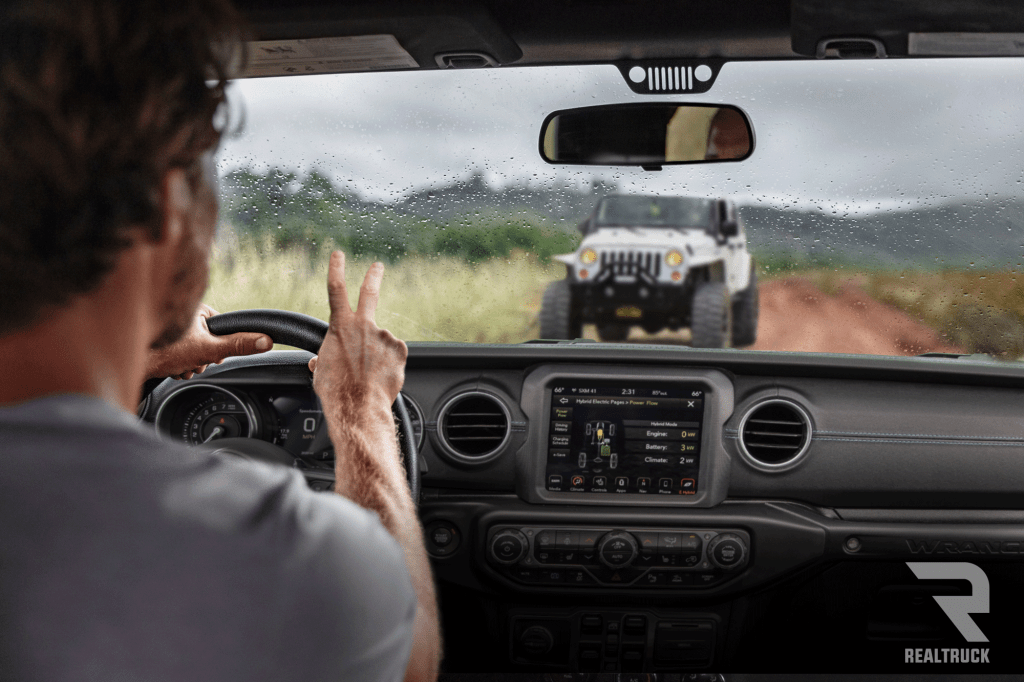
Over the years, I’ve had several friends along with in-laws who owned Jeeps. I believe Charlie Hart was the first followed by Gary Adair in the 1970s. Jeff Thimsen in Alaska eventually came to drive one and then Arizona friends, John Ballard, Tom Gildea, and Jim Brownfield.

Out of all of these names, Jim Brownfield is the only survivor where still owning and driving a Jeep is concerned. Riding with him one day I noticed a person in a decked-out Jeep Wrangler wave as he drove by. Asking if Jim knew the guy, my pal replied, “No, that was a Jeep Wave.” He went on to explain that Jeep owners much like motorcycle riders sometimes wave or acknowledge each other while on the road.

Not long after that, my wife and I purchased a Jeep Grand Cherokee. This model wasn’t four-wheel-drive with us figuring we wouldn’t need it. Our vehicle wasn’t a typical Jeep like the Wrangler or Gladiator either, and for 3 years, I can’t recall anyone waving at us. There were a few instances of receiving the middle finger after we placed a lifelike photo of Donald Trump on the rear window. A sufficient number of “thumbs up” also occurred.

With our little Jeep climbing up there in the mileage department, we decided that the time was ripe to trade it in. A fellow from Anderson Chrysler-Dodge-Jeep had been calling for several months asking if we might be interested in upgrading. They had some 2024 models with a nice rebate including an additional markdown.

On presidential election day, Joleen and I decided it might be a good time to roll the dice and take Brian Marazoni up on his offer. Finding what we wanted on their website first, I made an appointment with Brian to look things over. It only took us a few hours to be handed the keys. Our first stop was In-N-Out Burger on the way home for celebratory fries and a drink.

This Jeep is a bit taller than our old ride yet we knew that beforehand. Jim and Pat Brownfield’s Jeep Gladiator is much the same and we’d climbed in and out of it several times. Doing so is a great stretching exercise.

A couple of friends advised that we’d regret purchasing any type of vehicle sitting up high in our senior years, yet we ignored them. A set of mountable doorsteps was ordered and that took care of the problem like right now.

So far no one has given us the Jeep Wave but in due time I suppose that’ll change. If by chance we get ignored, I’ll order a Trump decal like the last one and place it on the passenger rear window. “The Donald” loved to ride in the back of our Grand Cherokee and I’m sure it’ll be the same with this new rig.

Just for grins, I might stick Kamala on the driver’s side rear window just to see if those two can now get along!

The Jeep Wave.

BEYOND HOPE

“We’ve been searching for a place in Arizona that’s similar to Hope, Alaska.”

Hope, Alaska

While living full-time in Alaska, I spent a fair amount of time fishing, panning for gold, and hiking in the old mining town of Hope. My brother and I, along with friends, camped there for weeks on end. Having so much fun—we’d never want to return home to Anchorage.

Hope had a special appeal to me and still does. My wife and I contemplated retiring in the small community, but could never secure property on a bluff overlooking Cook Inlet. That was the only location I would’ve been satisfied with. Instead, Joleen and I chose Lake Havasu City, building our house with BLM land and Lake Havasu at the backside.

Regency Drive is the only area I would’ve been happy with here, and we were able to pull it off thanks to local realtor and former Alaskan, Richard Pagliero. With no property listed for sale on this street, Richard yanked some strings to make things happen. Having faith that he’d come through, our prayers were answered. A unique story in itself, I’ll save that tale for another day.

Hope, Alaska, is supposedly named after 17-year-old miner Percy Hope, although some historians question this. Percy Hope came to the area in 1895 as part of a contingent of gold seekers. With gold being discovered in Six Mile Creek, prospectors by the thousands flocked to the vicinity. Before long, saloons sprang up, with stores soon to follow.

Come 1898, when gold was discovered in the Yukon Territory, Canada, many miners left Hope to seek their fortunes in Dawson. Some of them remained, keeping the struggling locale from becoming a ghost town like Sunrise, located just a few miles away.

We were able to visit some of the old mining camps, with rusty relics still lying amongst the trees and brush. Large pipes that brought water for sluicing can still be seen in the old Palmer Creek mining camp. There is plenty of wildlife in this valley, with black and grizzly bears often spotted.

We’ve been searching for a place in Arizona that’s similar to Hope, Alaska. I wanted a spot to go for short stints and relax, with less noise than Havasu, although the sound of Harleys and Hotrods is music to my ears. It is a bit hard to concentrate at times while writing, with constant roaring in the background.

Listening to a friend one day talk about a small town where he loves to park his RV, I was more than shocked to hear the name, Hope. Joleen and I didn’t know it existed. Jim Brownfield and his wife have been going there for several years to unwind. They find it more peaceful and scenic than Bouse or Quartzite.

Hope, Arizona, is 89 miles south of Lake Havasu City via AZ-95 S and AZ-72 E. Ironically, the distance from Anchorage to Hope, Alaska, is 88 miles. Wanting to visit the town that Jim Brownfield refers to as a desert paradise, last month we traveled through there on the way to Prescott. I instantly fell in love with it, seeing the potential for great adventure.

Maps show the surrounding mountains chocked full of old gold mines to explore, while there’s a grocery store in town, along with a church, gas station, and antique store. Boondocking is in our immediate plans, meaning we’ll carry in our water, power, and septic system while carrying out all trash.

On the way out of this tiny town, my wife spotted a large billboard. Joleen read aloud, “You’re Now Beyond Hope.” Before I had time to chuckle she quickly became a poet, good-naturedly roasting me, “They made that sign with you in mind!”

Geographically speaking – she was correct!

Hope, Arizona