
Las Vegas, a city celebrated for its neon-lit nights, high-stakes glamour, and ceaseless entertainment, owes much of its iconic identity to one particular establishment: the Flamingo Hotel. Steeped in both glitz and intrigue, the Flamingo was more than just a hotel—it was a turning point in the transformation of Las Vegas from a dusty railroad town into the entertainment capital of the world.
The story of the Flamingo Hotel begins in the mid-1940s. At that time, Las Vegas was a modest settlement with a handful of casinos clustered in its downtown area. The seeds of expansion, however, had been planted by several visionaries, among whom Billy Wilkerson stood out.
Wilkerson, publisher of The Hollywood Reporter, dreamed of building an opulent resort outside the city limits on a stretch of highway that would become the world-famous Las Vegas Strip. He envisioned a luxury hotel with fine dining, lavish entertainment, and a casino that catered to Hollywood’s elite.
Construction on Wilkerson’s dream began in 1945, but he soon ran into financial trouble. It was at this critical juncture that the infamous Benjamin “Bugsy” Siegel entered the picture. Siegel, a notorious figure in the world of organized crime, saw the potential in Wilkerson’s project. Backed by mob syndicate funding, Siegel took over the construction and poured money into the venture, determined to create the most dazzling resort Las Vegas had ever seen.
The Flamingo Hotel and Casino officially opened its doors on December 26, 1946. The opening was anything but smooth. Construction delays, budget overruns—reportedly ballooning to $6 million, a staggering sum at the time—and a rainstorm that dampened opening night festivities made for a rocky start. The unfinished hotel failed to impress its celebrity guests, and the casino lost money in its first few months.
Despite these setbacks, the Flamingo was a marvel of its time. It boasted luxurious accommodations, lush gardens, an Olympic-sized swimming pool, and a showroom that would host some of the biggest names in entertainment. The hotel’s pink neon sign and tropical motif set it apart from the Western saloons and low-slung casinos of downtown. Siegel was determined to make the Flamingo succeed and spent lavishly to cement its reputation as the finest resort in Las Vegas.
However, the financial troubles continued. By June 1947, the Flamingo still had not turned a profit. The mob investors grew impatient, and on June 20, 1947, Siegel was assassinated in Los Angeles. With Siegel’s death, Gus Greenbaum took over management, and the Flamingo finally began to thrive.
The Flamingo’s success reshaped the Las Vegas landscape. Its location—a couple of miles south of downtown along Highway 91—became the blueprint for future resort developments. Soon, other lavish hotels followed: the Desert Inn, the Sands, the Sahara. The Las Vegas Strip was born, and the Flamingo stood as its glamorous pioneer.
Throughout the 1950s and 1960s, the Flamingo played host to a who’s who of entertainers: Frank Sinatra, Dean Martin, Sammy Davis Jr., and Judy Garland graced its stage. The hotel became synonymous with high-class entertainment, drawing crowds from across the country. Its casino was the playground of gamblers and celebrities alike, and its poolside gardens became the ultimate symbol of postwar leisure.
Over the decades, the Flamingo underwent numerous expansions and renovations. The original low-rise wings were demolished in the 1960s to make way for larger towers, as the hotel adapted to the boom in Las Vegas tourism. The property changed hands several times—first to Kirk Kerkorian, who acquired it in the late 1960s, and then to Hilton Hotels Corporation in the 1970s. Each new owner invested in upgrades, ensuring the Flamingo remained competitive with newer resorts.
By the late 20th century, the Flamingo had become a sprawling complex, with over 3,600 rooms, sprawling gardens, and one of the largest casinos on the Strip. However, it always maintained its signature pink and tropical theme, a nod to Siegel’s original vision.
In the 1990s, the Flamingo became part of the Hilton chain, and later, following a series of mergers, was operated by Caesars Entertainment. The resort continued to reinvent itself to meet changing tastes, introducing new restaurants, nightclubs, and entertainment options.
One of the Flamingo’s most charming features is its famous wildlife habitat—a lush sanctuary filled with Chilean flamingos, swans, ducks, koi, and turtles. This tranquil oasis offers a refreshing contrast to the bustling casino floor and continues to delight visitors today.
The Flamingo’s entertainment legacy lives on, now featuring successful residencies and shows such as Donny and Marie Osmond, RuPaul’s Drag Race Live!, and other acclaimed productions. Its wedding chapel remains a popular choice for couples seeking a touch of Vegas glamour on their special day.
The Flamingo occupies a unique place in the cultural imagination. Its beginnings are entwined with the lore of the American mob, the glamour of Hollywood, and the rise of Las Vegas itself. While the building itself has been replaced and expanded many times over the decades, its name is a direct link to the city’s storied past.
In film and television, the Flamingo has appeared as a backdrop to countless stories—its neon sign a beacon in the desert night. Its association with Bugsy Siegel and the mob has been immortalized in movies such as “Bugsy” (1991) and in numerous books and documentaries about Las Vegas.
Today, the Flamingo stands as both a monument to the past and a vibrant part of Las Vegas’s present. While new mega-resorts have risen on the Strip, the Flamingo remains a favorite for those seeking the nostalgia and charm of classic Las Vegas. Its pink facade, iconic signage, and tropical grounds continue to invite guests into a world of fun, fantasy, and history.
More than seven decades after its opening, the Flamingo Hotel and Casino has seen triumph and tragedy, reinvention and renewal. Its history is the history of Las Vegas itself—a story of visionaries, risk-takers, and dreamers who turned a patch of desert into a playground for the world. As long as the neon lights shine on the Strip, the Flamingo’s legacy will endure, a symbol of glamour, resilience, and the ever-evolving magic of Las Vegas.
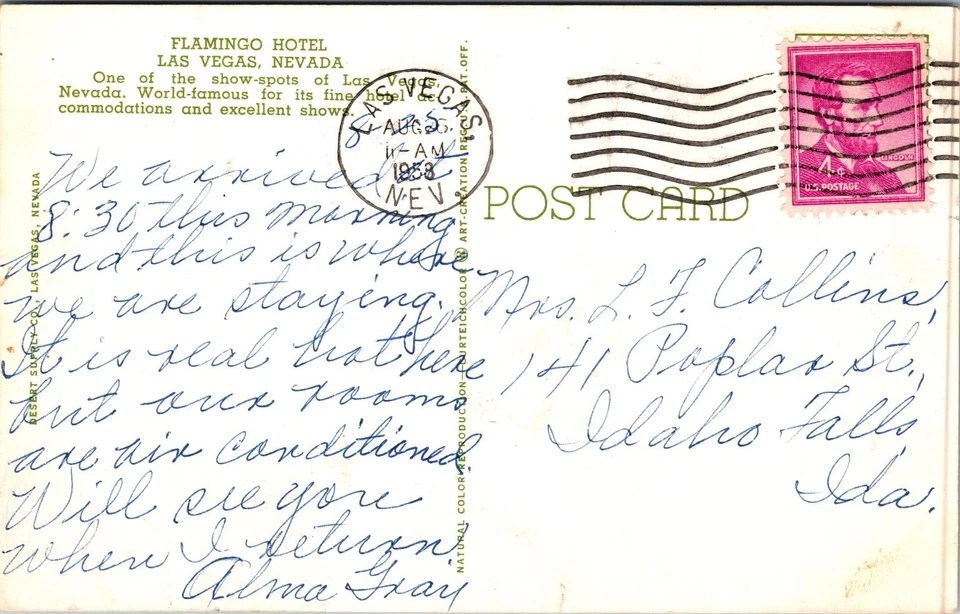
On August 26, 1958, Alma May Gray, of Idaho Falls, Idaho, visited Las Vegas for perhaps the first time. Only two years prior, on May 8, 1956, she’d lost her husband, Charles Thaddeus Gray. The couple had been married for 33 years.
I can only speculate here. Friends and family undoubtedly told Alma after Charles died that she needed to get out of the house more often, “Take a trip!” they said. Finding a good deal on a bus excursion from Idaho Falls to Las Vegas, she did just that. Alma’s postcard to Mrs. L.F. Collins described what she found once she got there.
“We arrived at 8:30 this morning, and this is where we are staying. It is real hot here but our rooms are air conditioned. Will see you when I return. Alma Gray.”
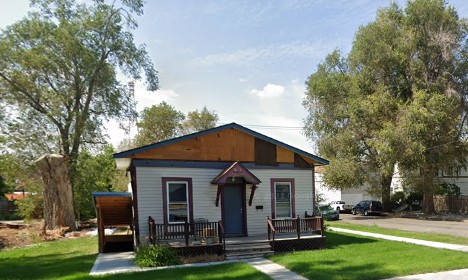
The person Alma wrote to, Mrs. L.F. Collins, was Virginia Grahame Parsons Collins. She went by her husband, Lucksley F. Collins, initials as many women did back in the day. With the name of Lucksley, Virginia’s husband should’ve also been on that Vegas trip.
Alma Mae Gray lived to be 91, passing away on June 26, 1989. Hopefully, she got to see more of the country before getting too old to travel. Her friend, Mrs. L.F. Collins, made it to 94, dying on July 30, 1980. It’s possible that Alma Gray and Virginia Collins eventually went on bus tours together, with Virginia’s husband, Lucksley, passing away in 1964.
On a bright note, the Flamingo Hotel still stands, a popular stopping off point for tour buses, automobiles, and air travelers from throughout the world.
 I like to write junk...