ILLUSIONAL?

“I’ve come across blurred photographs of paper plates hanging from strings, with folks jokingly calling them flying saucers.”

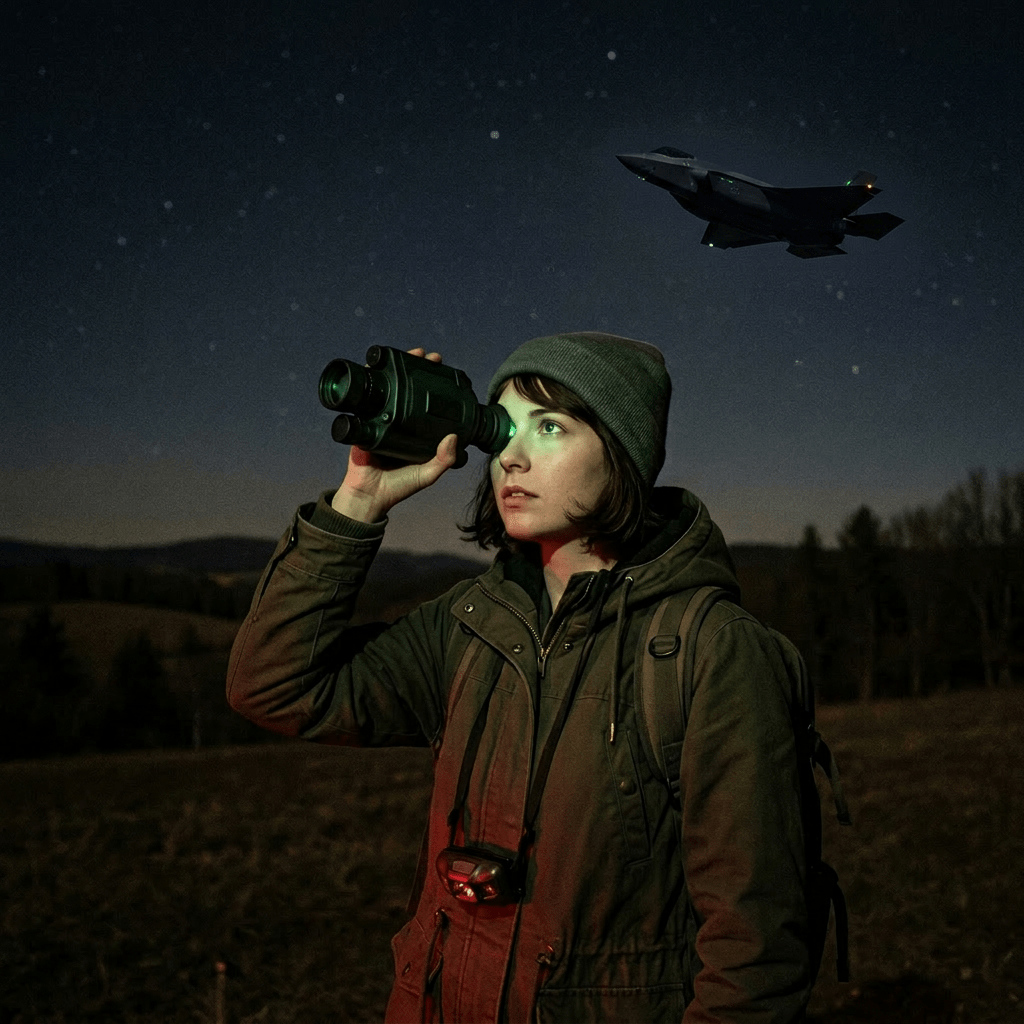
Woman looking through a night vision monocular under a starry night sky
A woman uses a night vision monocular to observe the night sky outdoors

UFOs (unidentified flying objects) and UAP (unidentified anomalous phenomena) seem to be on the news more often this past year for various reasons. Many of these sightings turned out to be drones, although the military didn’t exactly disclose who owned them. The words “extraterrestrial” or “alien” were associated with a number of these reports.

Rumors quickly spread that some were Chinese or Russian drones, with citizens threatening to take the law into their own hands and shoot them down with rifles. Only after our government promised to take action did cooler heads prevail.

The Department of War recently released, under President Trump’s authority, former confidential and top-secret reports, photos, and videos of UAPs. I saw nothing here that made me a believer; more on my reason why later.

Our backyard is a great place to watch satellites and airplanes at night. With the recent development of the prestigious Rivera housing development, light pollution has increased, but we’re still able to view the stars and galaxies better than in some parts of town.

On occasion, shooting stars and even the International Space Station (ISS) have been observed. I know it’s the ISS by checking a website that shows its exact location at a given time. This manmade object is also much brighter than the average satellite.

As of 2026, there are an estimated 6,000 active satellites orbiting our planet, supporting everything from communications and weather monitoring to scientific research and navigation, including military surveillance. I’ve counted as many as sixteen in one evening with the naked eye.

For years, I’ve kept hoping I’ll stumble across satellite fragments while hiking around in the desert, but so far, no luck. Experts tell us that most “space junk” disintegrates upon reentry, yet some make it through unscathed, as photos have shown.

The corridor along the Colorado River behind our house is busy with commercial and private airplanes, including military jets. Quite often, I can hear the fighters yet never spot them. I’m not sure if this is because they’re stealth or my eyes are failing.

Recently, my wife and I have been tuning in to YouTube channels where adventurous guys and gals camp out in the Nevada desert near Area 51, solely to spot unique aircraft prototypes. They use night-vision equipment to do this. This includes both digital and analog goggles/binoculars, with the prices ranging from $50 to over $13,000.

I ordered an economy-priced version with very good reviews from buyers. Hopefully, these glasses will help us see stealth fighters and bombers, along with providing better images of satellites. My main reason for getting them is to view SpaceX flights streaking across the sky after takeoff from Vandenberg Air Force Base in California.

In the reviews for our glasses, purchasers claimed they were great for viewing wildlife at night, with plenty of that in the desert behind our place. We have coyotes sneaking around, with an occasional UWO (unidentified walking object) at night. I suspect them to be bobcats and loose dogs.

With limited use of this new toy, they do brighten the night sky tremendously. Some stars seem almost blinding, much like those repulsive Xenon headlights on select newer cars and trucks. Cupcake Mountain and the surrounding peaks come in very clearly, even at the darkest hours.

Slow-moving satellites are much easier to pick out, and they don’t fade quite as fast using this night vision. I can only imagine how those high-dollar or military-grade versions perform.

Getting back to UFOs, especially those that some folks insist contain alien beings, I’m still a skeptic here. Until I see the real deal, I believe many of these stories are the product of someone’s wild imagination or them jumping to conclusions more than anything else.

Rumor has it that aliens crashed their spacecraft near Kingman in May of 1953 and survived. If true, I suppose they’d still be living in the vicinity. No exact location is mentioned, with the Walmart shopping area being my first guess.

I uncovered no photographs to prove this Kingman rumor, but there’s a restaurant in Yucca cleverly named “The Frying Saucer.” It’s next to that geodesic dome resembling a giant golf ball. My wife and I have yet to eat there, but it’s on our radar.

Reported sightings of flying saucers are akin to those reports of “Bigfoot” and “The Loch Ness Monster.” Why are their photographs always grainy and fuzzy, as if on purpose? I’ve come across blurred photographs of paper plates hanging from strings, with folks jokingly calling them flying saucers.

Artificial intelligence (AI) is already capable of producing realistic fake images, and before long, they’ll undoubtedly be introduced as the “real deal” in many scenarios. Perhaps they already are, and we just don’t know it. The seemingly large crowds at Gavin Newsom rallies come to mind here.

One of my favorite poems regarding life and reality is a short one by Graeme Edge, of the Moody Blues. This 1967 poem, titled “Late Lament,” is oftentimes read at the end of the song “Nights in White Satin.”

Graeme seemed to be a visionary, knowing that as time goes on, it’ll become harder for people to recognize the truth, even when they see it.  Perhaps he understood AI before any of us. The final five lines of this poem sum things up best for me.

“Cold-hearted orb that rules the night,

Removes the colors from our sight.

Red is gray and yellow white.

But we decide which is right.

And which is an illusion.”
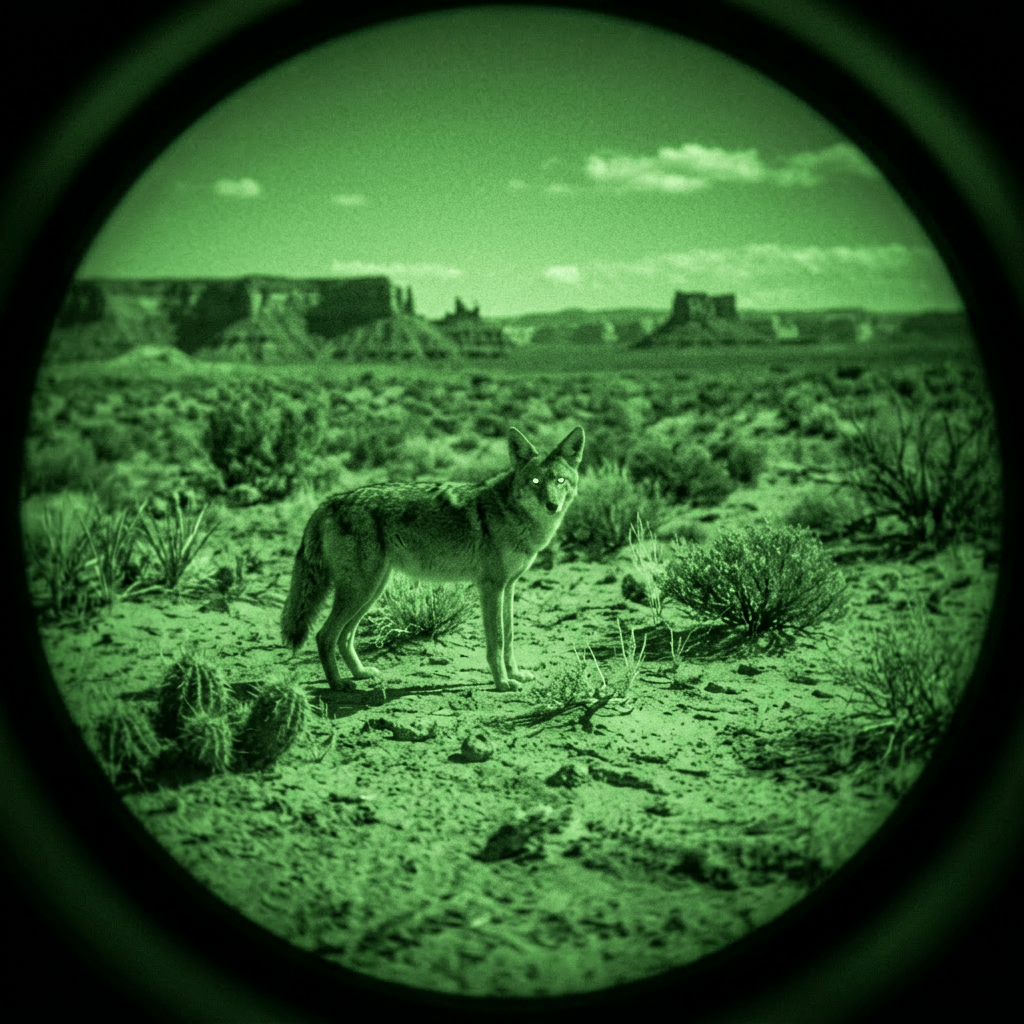
Coyote standing in desert vegetation viewed through a night vision scope

ROLL THE DICE

“With the name of Lucksley, Virginia’s husband should’ve also been on that Vegas trip.”

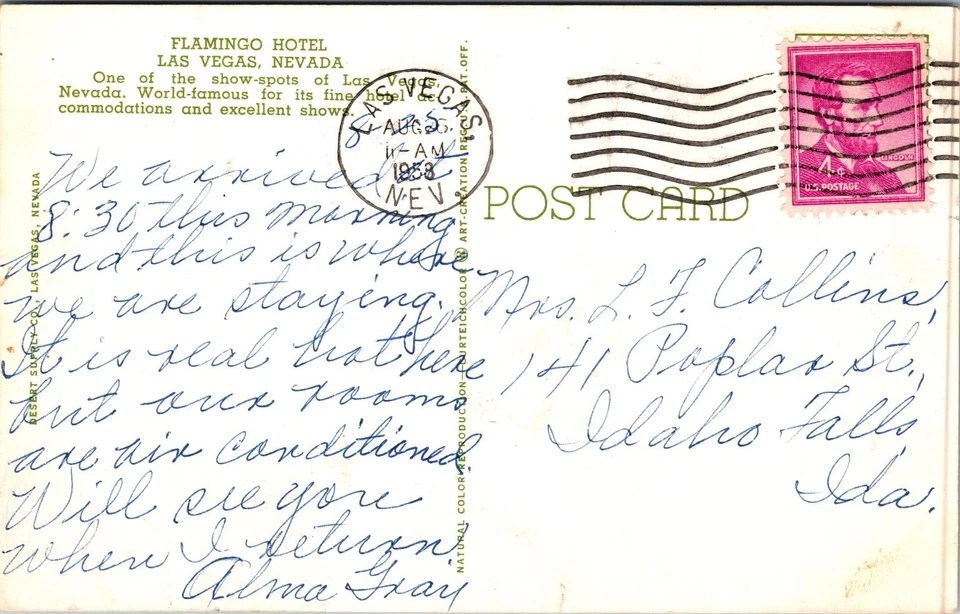
Flamingo Hotel – Las Vegas, Nevada

Las Vegas, a city celebrated for its neon-lit nights, high-stakes glamour, and ceaseless entertainment, owes much of its iconic identity to one particular establishment: the Flamingo Hotel. Steeped in both glitz and intrigue, the Flamingo was more than just a hotel—it was a turning point in the transformation of Las Vegas from a dusty railroad town into the entertainment capital of the world.

The story of the Flamingo Hotel begins in the mid-1940s. At that time, Las Vegas was a modest settlement with a handful of casinos clustered in its downtown area. The seeds of expansion, however, had been planted by several visionaries, among whom Billy Wilkerson stood out.

Wilkerson, publisher of The Hollywood Reporter, dreamed of building an opulent resort outside the city limits on a stretch of highway that would become the world-famous Las Vegas Strip. He envisioned a luxury hotel with fine dining, lavish entertainment, and a casino that catered to Hollywood’s elite.

Construction on Wilkerson’s dream began in 1945, but he soon ran into financial trouble. It was at this critical juncture that the infamous Benjamin “Bugsy” Siegel entered the picture. Siegel, a notorious figure in the world of organized crime, saw the potential in Wilkerson’s project. Backed by mob syndicate funding, Siegel took over the construction and poured money into the venture, determined to create the most dazzling resort Las Vegas had ever seen.

The Flamingo Hotel and Casino officially opened its doors on December 26, 1946. The opening was anything but smooth. Construction delays, budget overruns—reportedly ballooning to $6 million, a staggering sum at the time—and a rainstorm that dampened opening night festivities made for a rocky start. The unfinished hotel failed to impress its celebrity guests, and the casino lost money in its first few months.

Despite these setbacks, the Flamingo was a marvel of its time. It boasted luxurious accommodations, lush gardens, an Olympic-sized swimming pool, and a showroom that would host some of the biggest names in entertainment. The hotel’s pink neon sign and tropical motif set it apart from the Western saloons and low-slung casinos of downtown. Siegel was determined to make the Flamingo succeed and spent lavishly to cement its reputation as the finest resort in Las Vegas.

However, the financial troubles continued. By June 1947, the Flamingo still had not turned a profit. The mob investors grew impatient, and on June 20, 1947, Siegel was assassinated in Los Angeles. With Siegel’s death, Gus Greenbaum took over management, and the Flamingo finally began to thrive.

The Flamingo’s success reshaped the Las Vegas landscape. Its location—a couple of miles south of downtown along Highway 91—became the blueprint for future resort developments. Soon, other lavish hotels followed: the Desert Inn, the Sands, the Sahara. The Las Vegas Strip was born, and the Flamingo stood as its glamorous pioneer.

Throughout the 1950s and 1960s, the Flamingo played host to a who’s who of entertainers: Frank Sinatra, Dean Martin, Sammy Davis Jr., and Judy Garland graced its stage. The hotel became synonymous with high-class entertainment, drawing crowds from across the country. Its casino was the playground of gamblers and celebrities alike, and its poolside gardens became the ultimate symbol of postwar leisure.

Over the decades, the Flamingo underwent numerous expansions and renovations. The original low-rise wings were demolished in the 1960s to make way for larger towers, as the hotel adapted to the boom in Las Vegas tourism. The property changed hands several times—first to Kirk Kerkorian, who acquired it in the late 1960s, and then to Hilton Hotels Corporation in the 1970s. Each new owner invested in upgrades, ensuring the Flamingo remained competitive with newer resorts.

By the late 20th century, the Flamingo had become a sprawling complex, with over 3,600 rooms, sprawling gardens, and one of the largest casinos on the Strip. However, it always maintained its signature pink and tropical theme, a nod to Siegel’s original vision.

In the 1990s, the Flamingo became part of the Hilton chain, and later, following a series of mergers, was operated by Caesars Entertainment. The resort continued to reinvent itself to meet changing tastes, introducing new restaurants, nightclubs, and entertainment options.

One of the Flamingo’s most charming features is its famous wildlife habitat—a lush sanctuary filled with Chilean flamingos, swans, ducks, koi, and turtles. This tranquil oasis offers a refreshing contrast to the bustling casino floor and continues to delight visitors today.

The Flamingo’s entertainment legacy lives on, now featuring successful residencies and shows such as Donny and Marie Osmond, RuPaul’s Drag Race Live!, and other acclaimed productions. Its wedding chapel remains a popular choice for couples seeking a touch of Vegas glamour on their special day.

The Flamingo occupies a unique place in the cultural imagination. Its beginnings are entwined with the lore of the American mob, the glamour of Hollywood, and the rise of Las Vegas itself. While the building itself has been replaced and expanded many times over the decades, its name is a direct link to the city’s storied past.

In film and television, the Flamingo has appeared as a backdrop to countless stories—its neon sign a beacon in the desert night. Its association with Bugsy Siegel and the mob has been immortalized in movies such as “Bugsy” (1991) and in numerous books and documentaries about Las Vegas.

Today, the Flamingo stands as both a monument to the past and a vibrant part of Las Vegas’s present. While new mega-resorts have risen on the Strip, the Flamingo remains a favorite for those seeking the nostalgia and charm of classic Las Vegas. Its pink facade, iconic signage, and tropical grounds continue to invite guests into a world of fun, fantasy, and history.

More than seven decades after its opening, the Flamingo Hotel and Casino has seen triumph and tragedy, reinvention and renewal. Its history is the history of Las Vegas itself—a story of visionaries, risk-takers, and dreamers who turned a patch of desert into a playground for the world. As long as the neon lights shine on the Strip, the Flamingo’s legacy will endure, a symbol of glamour, resilience, and the ever-evolving magic of Las Vegas.

On August 26, 1958, Alma May Gray, of Idaho Falls, Idaho, visited Las Vegas for perhaps the first time. Only two years prior, on May 8, 1956, she’d lost her husband, Charles Thaddeus Gray. The couple had been married for 33 years.

I can only speculate here. Friends and family undoubtedly told Alma after Charles died that she needed to get out of the house more often, “Take a trip!” they said. Finding a good deal on a bus excursion from Idaho Falls to Las Vegas, she did just that. Alma’s postcard to Mrs. L.F. Collins described what she found once she got there.

“We arrived at 8:30 this morning, and this is where we are staying. It is real hot here but our rooms are air conditioned. Will see you when I return. Alma Gray.”

The person Alma wrote to, Mrs. L.F. Collins, was Virginia Grahame Parsons Collins. She went by her husband, Lucksley F. Collins, initials as many women did back in the day. With the name of Lucksley, Virginia’s husband should’ve also been on that Vegas trip.

Alma Mae Gray lived to be 91, passing away on June 26, 1989. Hopefully, she got to see more of the country before getting too old to travel. Her friend, Mrs. L.F. Collins, made it to 94, dying on July 30, 1980. It’s possible that Alma Gray and Virginia Collins eventually went on bus tours together, with Virginia’s husband, Lucksley, passing away in 1964.

On a bright note, the Flamingo Hotel still stands, a popular stopping off point for tour buses, automobiles, and air travelers from throughout the world.

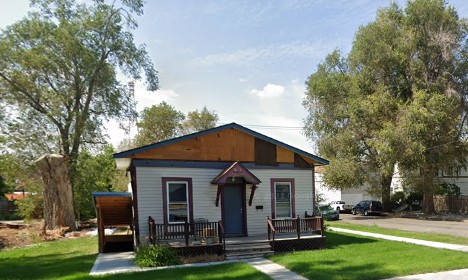
The former Collins house in Idaho Falls, Idaho, is now undergoing new siding replacement