STORMY WEATHER

“Easing into my chair, I found the noise had only gotten louder, with metal rattling from a house next door.”

Storm lifting a trailer above the Edmund Pettus Bridge in Selma, Alabama

Watching television reports of Hurricane Isaias inflicting heavy damage in the South and tropical storm Rachel bringing high winds and torrential rains to the West, including Lake Havasu City, I sat back in my easy chair and listened to the ruckus outside. Chairs and tables flew around, smacking against our house.

The American flag I meant to take down snapped and popped with each gust. At this point, I decided to go outside and survey the damage. It was raining cats and dogs, and I could hear a river rushing down the nearby wash.

A 20-year-old Pygmy Palm tree, like a drunken sailor, was lying on its side for the umpteenth time. The wire support that held it up had broken.  Securing the flag and deciding to let the palm tree sleep things off, I was glad to finally go back inside.

Easing into my chair, I found the noise had only gotten louder, with metal rattling from a house next door. Praying God would keep the damage to a minimum, I thought of my late Papa and Mama Haynes and their little farm in Vernon, Alabama. They had a storm shelter carved into a hill, with a wooden door.

I can remember spending one night in this cave when a hurricane hit off Alabama’s coast, sending tornadoes throughout the state. Mama Haynes had quilts inside along with candles, matches, and a kerosene lamp. I don’t recall a bed, since I don’t think the dwelling was big enough to hold one.

My brother and I explored this storm shelter many times, and it always smelled damp and earthy. Salamanders called it home, and I now wonder if snakes did, too. Mom told me that, as a little girl, her parents and four sisters used it many times. Mama Haynes was a praying dynamo, and I doubt she stopped praying until each storm ended.

That old storm shelter eventually collapsed. I’m sure everything is still inside, since my grandparents never excavated the fallen dirt. I wanted to, but by then the property was sold.

With no storm shelter here in Havasu, and only four walls and a roof to protect us, and no basement to hide in, Joleen and I can only ask God to fortify our structure whenever these rare storms come up.

Thankfully, I insisted on hurricane straps on the garage roof trusses, although the builder said they weren’t needed. Code required them, and our building supervisor, John Ballard, had to literally shove this paperwork in the guy’s face.

I feel much safer now in a storm than I did in a trailer. Only those who’ve lived in mobile homes during high winds will know what I mean. In Alabama and Texas, there were times when I thought ours would blow away like Dorothy and Toto’s house in Kansas.

Joleen and I might not have a storm cellar, but we have something better, and there are no salamanders. I’ll simply ask God to protect us, but if it’s my time to go during an Arizona storm, I’d sure like to bring that old easy chair along.

Bearded man floating in armchair above a desert town during a dust storm

GRANDMA’S HANDS

“I’ve been craving an authentic Alabama pecan pie for several years now.”

Holiday time is upon us. Not long ago, using “eternity” as a guideline, Mama Haynes prepared special food from generational handed-down recipes for Thanksgiving, Christmas, and New Year’s.

As kids, in the early 1960s, my brother Jim and I helped Mama Haynes “shell” peas or cut snap beans. Several types of peas were served at almost every holiday dinner, with blackeye peas always in a big bowl at the center of the table come New Year’s Day. Eating them was supposed to bring good luck, although none of my relatives ever won the lottery.

I can still recall the unique odor associated with shelling green peas, unlike anything I’ve smelled other than perhaps one counterculture product. The fragrance was very strong if a pod full of green peas was especially fresh. I’m not a hemp user, but I’ve driven by a few marijuana greenhouses in California, and the pungent sweet aroma coming from them is close to the same. I believe my grandparents’ name for marijuana was loco weed. My folks called it Wacky Tobackie.

Jim and I would sit on Mama Haynes’s back porch, simultaneously talking and shelling with her. By the end of the process, certain fingers would be green from pinching hundreds of pods until they were all shelled. Soap and water removed some of the green chlorophyll, although some staining remained. It was no worse than having dirt or grease embedded in my skin, a daily ritual. No biggie.

Both of my grandmas would mash their own potatoes using hand-crank mixers. I’d assist on rare occasions but it wasn’t one of my favorite tasks. The procedure was labor intensive. Mashed potatoes in a box took care of that problem, but they’re not near as good as the real thing, not even the Idahoan brand.

When making a cake or a pie, that was a different story where mixing ingredients was concerned. I’d gladfully help out and even “sift flour” as it was called. Mama Haynes made the best pecan pies, with the nuts gathered locally from Lamar County pecan trees or sent to her from my Aunt Katrulia.  Aunt K’s family owned a pecan orchard near Grand Bay, Alabama.

I helped open the unshelled pecans using a small hammer to crack the shell. The object was to remove the “meat” of a pecan in one piece. It took practice. When she wasn’t looking I often smashed a pecan to smithereens just to see how flat it would go.

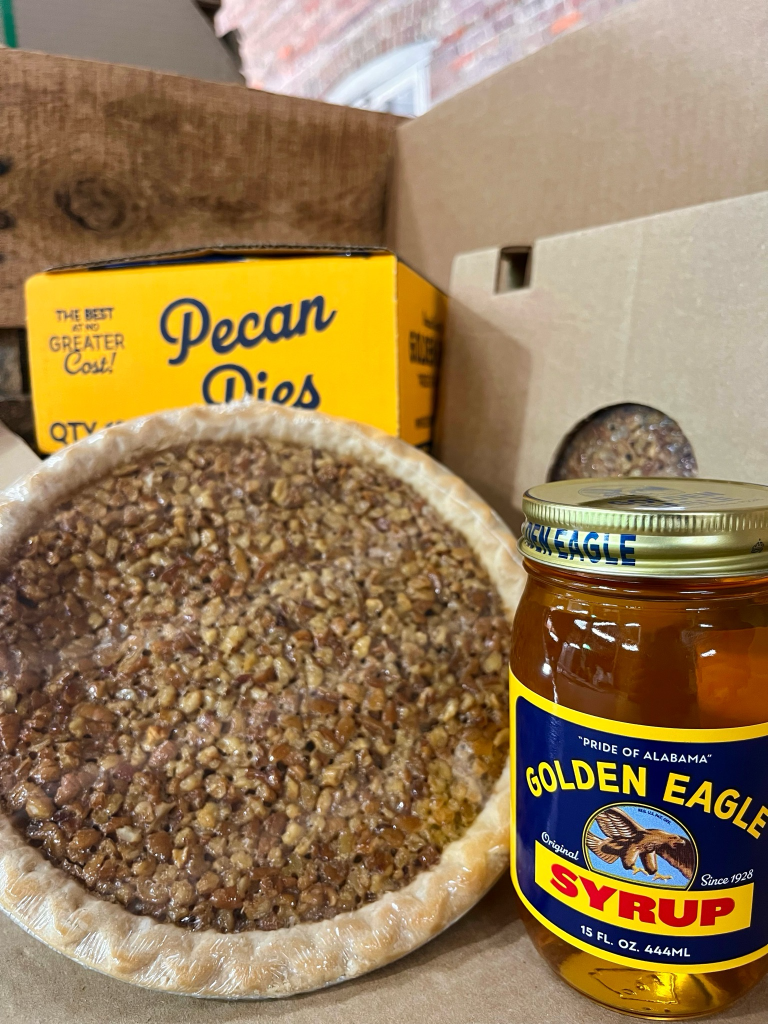
Mama Haynes’ pecan pies were made using a special syrup named Golden Eagle. This delicious ingredient is manufactured in a small town in Alabama called Fayette, with the company in operation for almost 100 years. Fayette was originally called LaFayette after the famous Revolutionary War hero, Marquis de LaFayette.

Incorporated in 1821, my brother was born there and I often joked as a boy that he looked Fayette, although I was the chubby one.

After my family moved to Alaska, shelling peas with Grandma Hankins and Mama Haynes became a thing of the past. On holidays, Mom would use her electric mixer to make fresh mashed potatoes, while she still made the scrumptious pecan pies using Mama Haynes’s recipe.

I’ve been craving an authentic Alabama pecan pie for several years now. Some time ago I ordered a jar of Golden Eagle and had it sent via UPS to Arizona. That delicious syrup ultimately came to be used on pancakes, waffles, and biscuits. Why it was never turned into a pie is forgotten history.

This fall, the Golden Eagle Syrup Company announced that they’d be making a select number of large pecan pies, and that immediately caught my attention. Ordering up one before they were all spoken for, it should be here in time for Thanksgiving. With two of my grandchildren traveling from Minnesota to see us, I wanted them to partake in a part of the holiday I’d been accustomed to while young.

The distance this pie has to travel via the United States Postal Service to Lake Havasu City is 1,717 miles. I’m not sure if it’s coming by truck or plane, but when it arrives it’ll be greeted with open arms. My wife wanted to know why I didn’t just order a jar of Golden Eagle, and have her bake a pecan pie. Joleen makes excellent pies but there’s more to having this specific pie than she understands.

My grandparents on both sides of the family lived in Vernon, Alabama, which is only 18 miles from Fayette. There’s something about folks living in that neck of the woods that makes this pecan pie significant to me. It’ll be as close to one of Mama Haynes’ pecan pies as I can get.

Grandma’s hands might not have made it, but the recipe used by Golden Eagle is one and the same as hers.