HOONAH TUNA?

“Was she going fishing for tuna in Hoonah”

On July 4, 1911, 114 years ago, someone named Lula wrote a simple yet somewhat complex message on a black and white picture postcard of the Wrangell Narrows. It was mailed from Hoonah, Alaska, four days later, on July 8. The brief note says,

“7/4/11

I wonder where you are to-day. Thinking of the good time we had last year makes me want to be there too. Geo. & the children are shooting crackers on the beach. This picture is a scene on the way up to Hoonah & Juneau. Lula”

I can only assume that Lula was referring to a Fourth of July celebration she had celebrated with Mrs. John F. Good, the previous year. What the lady meant by George and the kids shooting crackers is somewhat puzzling, although I believe I have finally figured things out.

No, the family wasn’t lining up Nabisco saltine crackers on the beach and plinking them with a .22 rifle, this before hungry seagulls swooped down and inhaled the remnants. Lula was merely talking about shooting off firecrackers. Unfortunately, they didn’t have bottle rockets as well.

Why she was going to Hoonah and Juneau after passing through the Wrangell Narrows is a mystery in itself. Was she going fishing for tuna in Hoonah and Juneau? The most plausible explanation is that the woman was on a steamer taking a cruise.

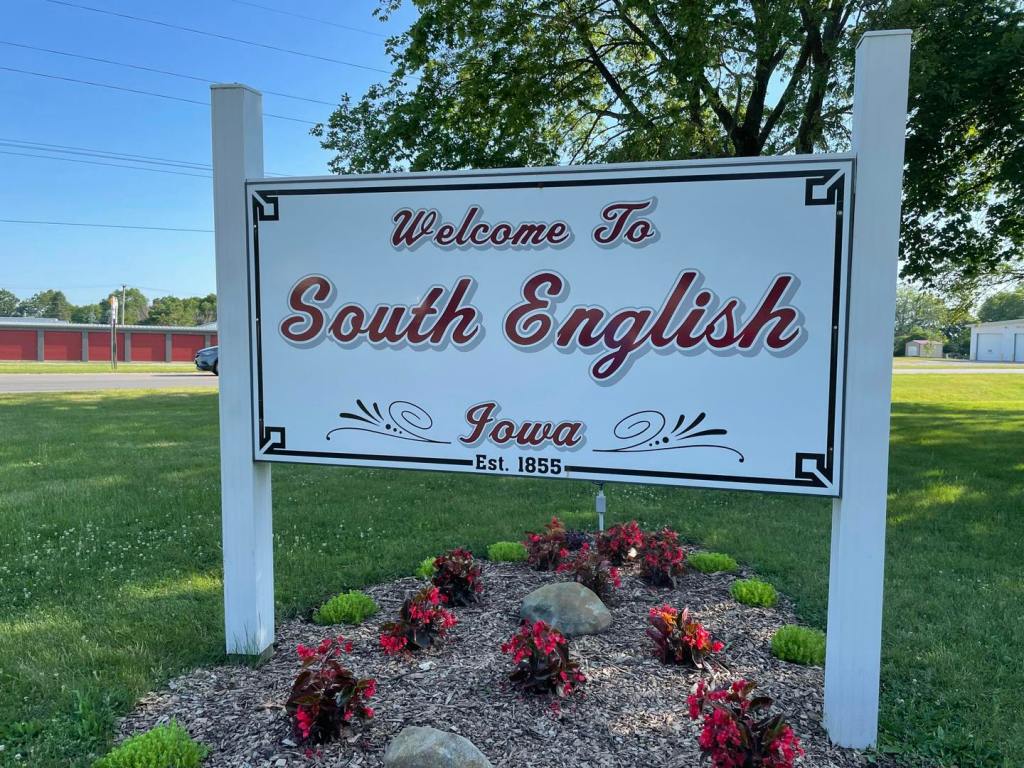
Lula was undoubtedly glad to get out of Dodge (South English, Iowa). That statement didn’t come along until Marshall Matt Dillon and Miss Kitty made it popular on “Gunsmoke,” but it works just fine here.

Before I tell you who Lula and Mrs. John F. Good were, South English, Iowa, Wrangell Narrows, and Hoonah, Alaska, have to be briefly explored first.

South English, Iowa, is a small farming community named after the nearby English River. In 1910, its population was just 338 residents, reflecting its rural character and close-knit atmosphere. Located in southeastern Iowa, the town is surrounded by fertile farmland and has traditionally relied on agriculture as its economic foundation. Life in South English was marked by a strong sense of community and the rhythms of the farming calendar, making it a quintessential example of early 20th-century rural Iowa.

Wrangell Narrows is a scenic and essential waterway located in Southeast Alaska, known for its narrow channel, strong currents, and importance to both local communities and marine traffic. This passage has served as a lifeline for the region’s transportation, commerce, and culture.

This body of water stretches approximately 22 miles (35 kilometers) between the towns of Petersburg and Wrangell, Alaska. It lies between Mitkof Island to the east and Kupreanof Island to the west, forming part of the Inside Passage—a network of protected waterways renowned for safe navigation and stunning scenery.

The narrows are well-known for their winding curves and variable widths, at some points narrowing to less than 300 feet across. Depths also fluctuate, requiring careful navigation, especially for larger vessels.

Wrangell Narrows is famous among mariners for its complex navigation. The channel is dotted with more than 60 navigational aids—buoys and markers—that help vessels avoid shallow areas, rocks, and other hazards. Currents can be strong and tidal shifts significant, making timing and skill essential for safe passage.

Large cruise ships typically avoid Wrangell Narrows due to its tight bends and shallow spots, but ferries, fishing boats, and freight vessels frequently traverse the waterway, connecting regional communities and supporting the local economy.

The towns of Petersburg and Wrangell depend on the Narrows for their connection to the rest of Southeast Alaska. The Alaska Marine Highway ferry system and other local vessels use the passage regularly, making it a crucial route for passengers, goods, and services.

The Narrows is surrounded by lush temperate rainforest, home to Sitka spruce, western hemlock, and abundant wildlife. Visitors may see bald eagles, harbor seals, sea lions, and even humpback whales in the surrounding waters. The shoreline is dotted with small islands, tidal flats, and forested hills, offering breathtaking views for travelers and photographers.

While Wrangell Narrows is not typically navigated by large cruise ships, its scenic beauty and accessibility make it a favorite for smaller expedition vessels, private yachts, and kayakers. Petersburg, often called “Little Norway” due to its Norwegian heritage, and Wrangell, one of Alaska’s oldest towns, are both popular stops for visitors exploring the Inside Passage.

Hoonah, Alaska, is a small city located on Chichagof Island in the Alexander Archipelago of Southeast Alaska. Its history is deeply rooted in the traditions of the Tlingit people, who have inhabited the area for thousands of years. Originally a seasonal camp for fishing and gathering, Hoonah became a permanent settlement as Tlingit families established more substantial homes and communities.

In the late 19th and early 20th centuries, Hoonah saw increased interaction with non-Native settlers, missionaries, and traders, which influenced its development. The town was officially incorporated in 1946, but its cultural heritage remains strong, with many residents tracing their ancestry directly to the region’s original Tlingit inhabitants.

Hoonah’s economy has traditionally relied on fishing, logging, and subsistence activities, though tourism has grown in recent years, particularly following the development of cruise ship facilities at Icy Strait Point. Today, Hoonah preserves its unique blend of traditional culture, natural beauty, and community resilience, making it an important hub in Southeast Alaska. For those still wondering, there are no tuna in Hoonah.

Mrs. John F. Good is actually Mrs. Ida Parnell-Good. She married John on July 24, 1895, becoming his second wife. John’s first spouse, Hannah, died in 1892 after 18 years of marriage. Ida Good was born in 1857 and passed away 80 years later in 1933. They were farmers.

It took some time-consuming sleuthing to uncover Lula’s history, as she also went by the name Lulu. Born on April 18, 1866, to Merritt and Margaret Brown, Lula married Jacob Doll on February 17, 1887. When Jacob died four years later in 1891, she wed George Franklin Marshall. This took place on October 2, 1892. Between both marriages, the couple had eight children.

Lula Belle Brown-Doll-Marshall passed away at the age of 59 on February 12, 1924. The Marshalls, like the Goods, listed farming as their sole occupation. Both families were quite well-to-do in their endeavors, with this allowing for George, Lula, and four of their children to make the Alaska trip.

John F. and Ida Parnell-Good are buried at English River Church of the Brethren Cemetery in South English, Iowa, while Lula Belle and George Marshall are interred at Keota Cemetery in Keokuk County.


FLAT, ALASKA

“Today, Flat stands as one of Alaska’s best-preserved ghost towns…”

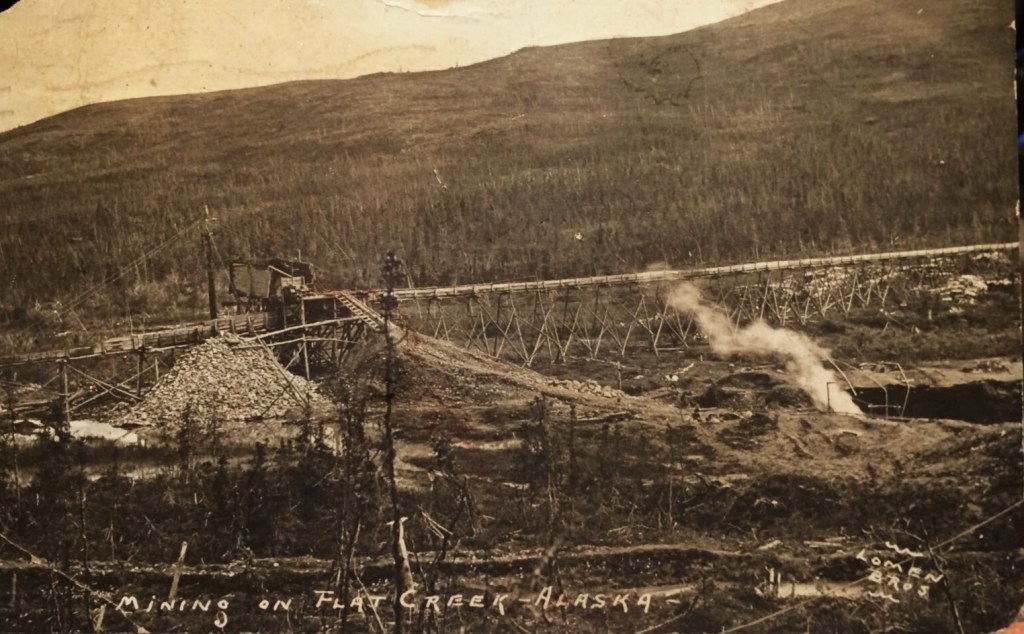
Gold mining just outside the town of Flat, Alaska

Flat, Alaska, is one of my favorite places to visit. There’s something about the name that intrigues me, almost as much as that affable character, Flat Stanley.

I’m not sure the thin-faced Glat Stanley has ever been to this ghost town, but perhaps he hitched a ride there on a plane, boat, dogsled team, or snowmachine at some time. There are no drivable roads to Flat, so he couldn’t have come via car or truck. For those not knowing who Flat Stanley is, let’s just say he’s a famous world traveler.

Once a bustling gold mining town, Flat sprang to life during the early 20th-century gold rush. Founded in 1908 after gold was discovered along Otter Creek, Flat quickly grew as prospectors and entrepreneurs flocked to the area in hopes of striking it rich.

At its peak, the town boasted several thousand residents, complete with schools, hotels, stores, and even its own newspaper. However, as the gold deposits dwindled and mining operations slowed, Flat’s population declined just as rapidly as it had risen.

Today, Flat stands as one of Alaska’s best-preserved ghost towns, offering a glimpse into the state’s gold rush era and the adventurous spirit of those who once called it home.

In 1920, H.J. Landwehr sent a picture postcard to Sidney Svensen in Fond du Lac, Wisconsin. This postcard shows mining on Flat Creek, which runs right beside the town. It appears they are thawing frozen tundra using wood fires to get at the rich paydirt.

The postcard was postmarked in Seattle on February 26, 1920. Mr. Landwehr possibly picked up the black and white card on a trip to Alaska. I hoped my research would show this as being true.

The short message reads”

“Feb 26/20

Dear friend, just a line to let you know I got your letter. Was shure glad to hear from you. I will write you a letter later.

H.J. Landwehr

2341 E Lake Seattle”

It took almost a day of careful searching to find out who Landwehr and Svensen were. Having last names like theirs, I figured they were of German and Norwegian descent. The problem I had was that there are different ways to spell each, and the handwriting was hard to read.

Heinrich Jacob “Henry” Landwehr was born in Iowa on July 28, 1876. His parents were from Germany, with H.A. and Louise Landwehr immigrating to America for a better life. Farming was their occupation.

Census records indicate that the youngest son, Henry, transitioned into a carpenter after working in a bar and being a policeman as well as a boomman. This final change in occupation might’ve had something to do with a December 25, 1920, newspaper article I found. Transcribed word-for-word, it reads like this.

“Raising a chair in the air, Tom Curtain, 39, recently released from the federal penitentiary at McNeil Island, smashed H.J. Landwehr, an employee of the Our House bar at 151 Washington St., into unconsciousness late Friday evening.

According to Landwehr’s statement to the police, the attack was brought on by Curtain’s belief that Landwehr had ‘squealed’ and sent him to the penitentiary.”

It’s possible, early on, that Henry had high aspirations to strike it rich in the gold fields of Alaska, perhaps even mining in Flat or Iditarod. After combing through archived newspapers, I found a record of the man being there.

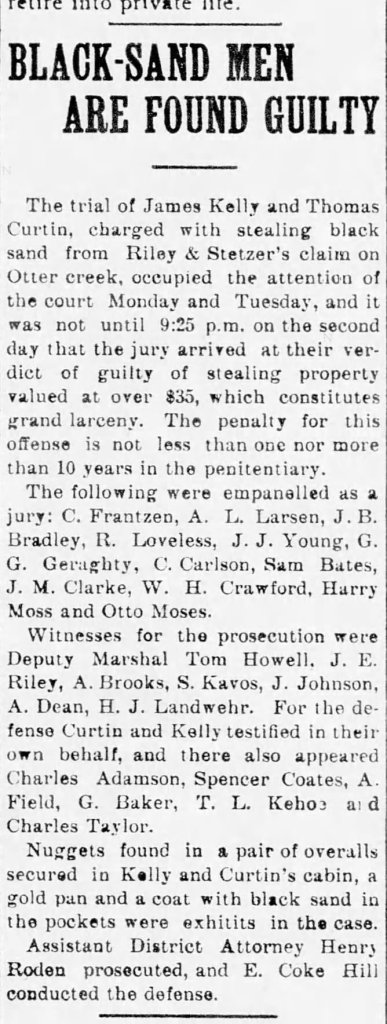
H.J. Landwehr is mentioned in the July 20, 1912, edition of the “Iditarod Pioneer” as a witness to individuals stealing gold-laden black sand from another prospector. After a proper trial, the men were found guilty by a jury, thanks in part to Henry Landwehr’s testimony.

Gold mining must not have been as prosperous as he thought it would be, with Henry returning home to Washington before 1920. Records show Henry Landwehr was a respected member of the Order of the Moose lodge in Seattle, with Mr. Landwehr passing away at the young age of 47 on March 21, 1924. It appears he was not married.

The postcard recipient, Sidney Svensen, is best described by his graphic obituary—as they don’t write them like this anymore. It goes into a little more detail than what I would see fit to print, especially the cause of death. I was correct once again in Svensen’s parents being of Norwegian descent.

“Longview Daily News, Monday, Sep 28, 1970:

Sidney Svensen, 81, of Puget Island, died Sept. 27 in a Longview hospital. He was born Aug. 16, 1889, on Puget Island.

Son of Sven and Servina Johnson Svensen, he married Esther Vog in 1914, was a commercial fisherman, lived at Rt 1 Box 55 Cathlamet, died in Cowlitz General Hospital of ventricular fibrillation with arrest, cancer of the duodenum with metastases, pulmonary emphysema due to asthma, per death certificate 20037, whose informant was his wife. Buried Sep 30, 1970.

He was a member of the First Lutheran Church on Puget Island, was a retired commercial fisherman, served three years as deputy sheriff, two years as town marshal of Cathlamet, and had been a fish buyer.

Surviving are his widow, Esther; two sons, Elroy of Puget Island and Eugene of Camano Island; two daughters, Mrs. Lorraine Bailey of Seattle, and Mrs. Selma Olsen of Longview; 14 grandchildren; six great-grandchildren; and a sister, Mrs. Garda Sherman of Portland.


Services will be at 2 pm on Wednesday at his church with Rev. Karl Berg officiating. Interment will be in Greenwood Cemetery.”

From the July 20, 1912, “Ididarod Pioneer”
“Flat Stanley” in Maui, Hawaii

BEEN THERE – DONE THAT

“I have no regrets about having grown up in Alaska.”

Each day when I walk outside my front or back door here in Arizona, the sky is generally royal blue, and no rain or snow is present. It’s become so ‘the norm’ that I sometimes take Arizona weather for granted.

During the summer months, heat is always present, but I’ve become accustomed to it. There’s nothing like wearing shorts and a T-shirt a full 12 months out of the year. Some residents opt for jackets and jeans during December and January, but being from Alaska must’ve toughened my skin, or warped my brain.

There were times in Anchorage when it rained the full summer, with occasional clear days. On those good days, someone would always say, “That’s why we live here!” I was never one of those folks. The nice days were sweet, but I always remembered that the following week or month could be gray and gloomy.

Snow was great to have when I owned a snowmachine or cross-country skied, yet I’d forego it in a Tennessee minute for warm weather and a swimming pool. Living in Alaska, a person had to enjoy whatever weather came along or they’d be miserable.

I did my fair share of camping and hiking in the rain, but I can say for sure that it put a damper on such activities. Staying inside a tent for two days while it rained cats and dogs did make for some quiet reading and thinking time.

I recall occasions when I dialed up my realtor friend, Randy Randall, in Lake Havasu City, during December or January. He’d tell me he just got back from exploring some mine in the desert, or shooting his gun. I’d be looking out our back window in Anchorage as he mentioned this, seeing that the outside temp was 10 below. “What am I doing here?” immediately popped into my head.

I have no regrets about having grown up in Alaska. I got to see and do things that others living in the ‘lower 48’ never experienced. When I say the lower 48, I mean those states excluding Hawaii and Alaska.

Each winter in our city by the lake, I see more and more Alaska license plates pop up. Making it a point to see who’s driving these vehicles, I find that not all are old retired people like me.

Some of them, like the family owning a second home right around the corner from us, are from Homer, Alaska. They have a seasonal business. Although I’ve never asked, they must view warm temperatures as more advantageous than cold and damp. Many of these Alaskans now stay year-round.

When someone asks if I’d move back to Alaska full-time, the answer is no. Been there—done that—applies to many things, with my nearly freezing to death being one of them. That one experience was when I fell through the ice in Chester Creek in January, when the temperature was 20 below.

My clothes froze solid like a fudgsicle. A friend, along with my brother, quickly got me into a hot shower, clothing, boots, and all. That saved my hide from frostbite.  Almost becoming another Frosty the Snowman will never happen again—at least not to me while living in the Grand Canyon State!

MRS. STEINHARDT

“When Mrs. Steinhardt sent that card in 1949 to someone she either personally knew or met, the woman and her husband were finishing up a three-week cruise to Alaska.”

If I had a dollar for every time someone called me Michael Hawkins, I’d be a rich man. I stopped correcting folks on the pronunciation during my earliest days. While in school, if a teacher from another class said, “The Hawkins boy did it! — I knew immediately they were talking about me.

I believe the Hawkins name has a good ring to it, although I didn’t learn until much later that John Hawkins, the pirate, was also a slave trader.

Throughout the year, someone will write my wife and accidentally spell her first name, Jolene, when in fact the correct spelling is Joleen. It sometimes perturbs her, but I always say, at least they’re thinking of you. The analytic way to look at this is that they had a 50-50 chance at spelling things correctly, yet still got it wrong.

Alaska and Arizona names are perhaps the trickiest to spell or pronounce, with me often having to look online or in my old, 1964, “Dictionary of Alaska Placenames.” Yes, I have an original such book, and it’s one of my prized possessions. Speaking of dictionaries, what are those companies that print dictionaries doing now?

There’s a big push to change easy-to-pronounce town and geographical names of Native origin. The Inupiaq name for Barrow is Uqtiagvik. I doubt the younger Inupiaq population can even pronounce it, let alone me.

Kasilof is an Alaskan name of Russian origin. It’s supposed to be pronounced “kuh-SEE-lof,” but I’ve heard pioneer Alaskans say, “ka-SEAL-off.” It makes no difference to me because I know what they’re talking about.

Chemehuevi is an Arizona Indian tribe, and I often get tongue-tied trying to say it, with a street here in town named that. The correct way to pronounce it is “cheh-mih-WAY-vee.

The Hualapai Mountains are near Kingman, Arizona, and instead of me trying to remember this, let alone butcher the spelling or pronunciation, I often say to people, “Those mountains near Kingman.” Folks know what I’m talking about.

Mt. McKinley has been called Mt. McKinley going back to 1896. That’s the name I was taught throughout school. History shows it was called Buishale or Bulshaira before then, with it being named that by Russian explorers. Some will tell you that it was called Denali going way back.

Neither the Inuapiq nor the Koyukun Athabascan Indians nor any other Alaska and Canadian tribes had a written language. They did have a word for it in their language, meaning tall mountain. Somewhere along the way, in the latter stages of history, the sound uttered by Indigenous people was interpreted by European translators to be Denali.

I’ve found the Buishale or Bulsharia names in old newspaper articles going way back and documented them. The often-used newspaper term, “It’s here in black and white,” is hard to dispute.

President Obama officially changed McKinley to Denali in 2015. Trump officially changed it back to McKinley in 2025. It makes no difference to me what it’s called, Buishale, McKinley, or Denali. I’ll know what you’re talking about.

A vintage postcard from the 1940s has a picture labeled Mt. McKinley on the front. These days, that same postcard would undoubtedly be printed with Denali.

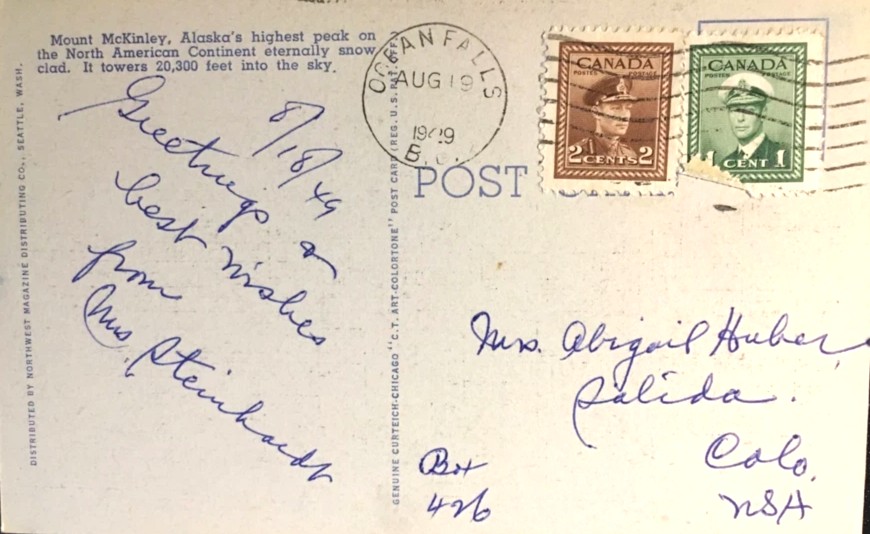
The short note inside with both sender and recipient names caught my attention. I wasn’t expecting to find anything unusual about either person. Initially, I misinterpreted one name to be Steinholdt when in fact it was Steinhardt. That made a big difference.

Mrs. Steinhardt sent the card from Ocean Falls, British Columbia, on August 19, 1949, to Mrs. Abigail Huber in Salida, Colorado. The one-cent and two-cent stamps are Canadian in origin. A short message written in perfect cursive says,

“8/18/49

Greetings & best wishes from Mrs. Steinhardt.”

Mrs. Abigail Leffingwell Huber lived a normal life, it seems, passing away in 1967 at the age of 87 in California. I make this assumption, finding nothing controversial or outrageous written about the woman in newspaper articles.

Abigail was born in Vermont in 1880, marrying Jacob Manley Huber in 1901. They lived in Minneapolis, Minnesota. Due to Jacob’s ill health, the family moved to Colorado in hopes that it would help. That’s where Jacob died in 1914.

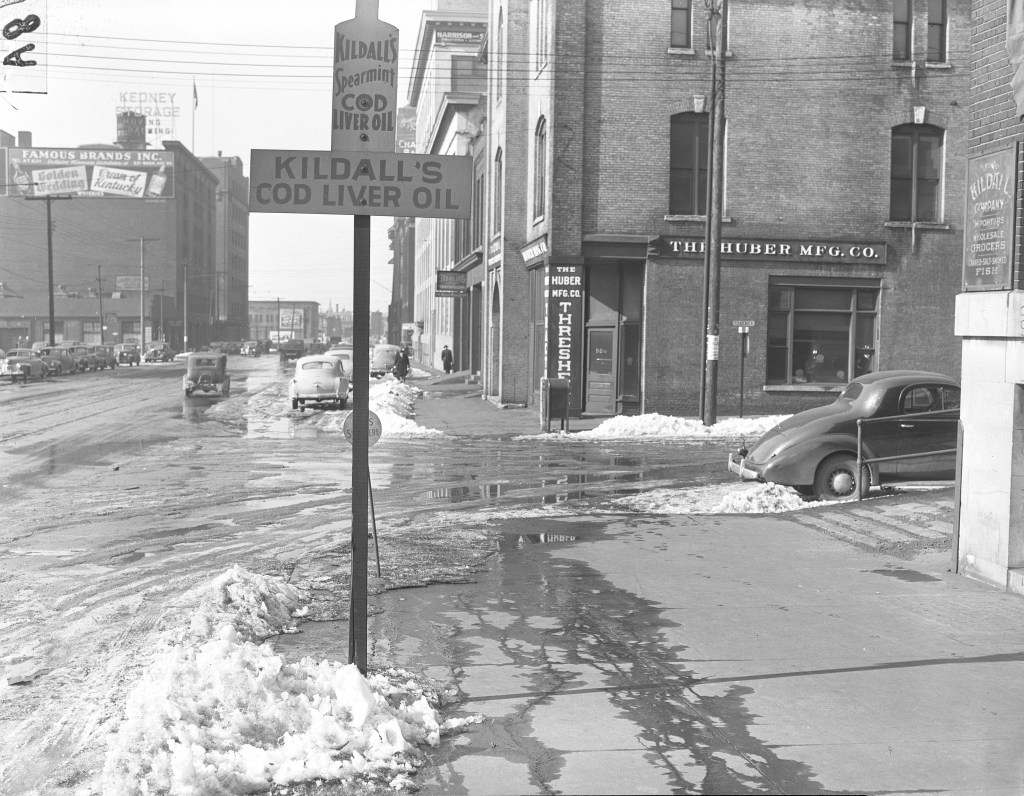
J.M. was a partner in Huber Brother Manufacturing Company. The family was quite wealthy. They made washing machines and powered wagons, along with farm implements. Abigail continued to reside in Minneapolis before relocating to Colorado, and then on to California in 1954 to live with a daughter. After Mrs. Huber passed away, her remains were shipped back to Minneapolis to be interred next to her husband.

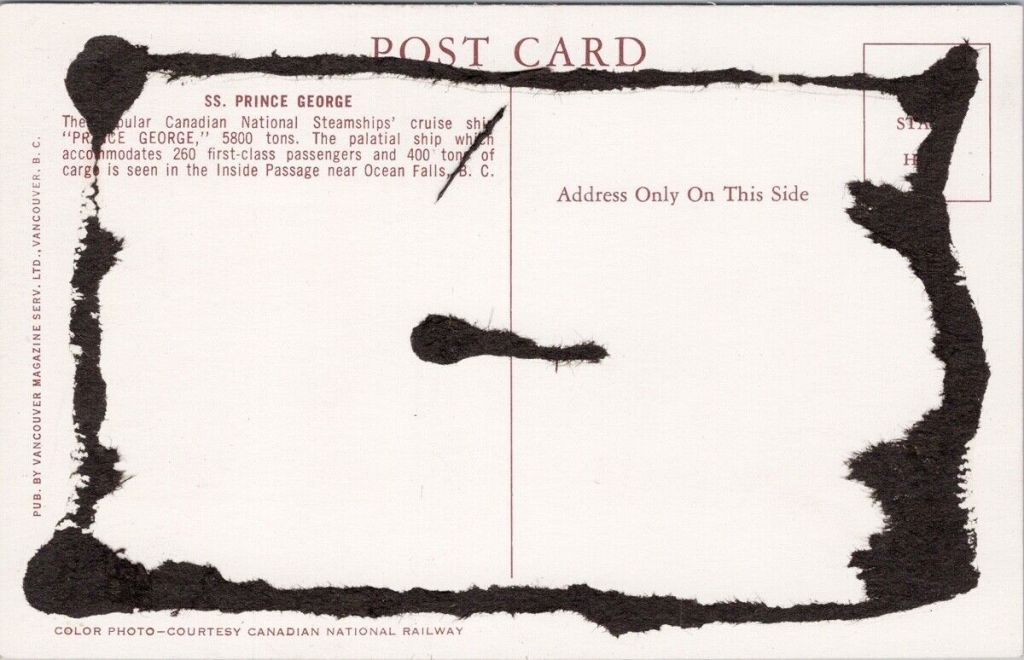
When Mrs. Steinhardt sent that card in 1949 to Mrs. Huber, Dulcie Steinhardt and her husband and daughter were finishing up a three-week cruise to Alaska. Their ship, the Canadian National Steamship SS Prince George, was only commissioned for service in 1947. It regularly stopped in Ocean Falls, British Columbia, Canada, where the postcard was mailed. It seems reasonable that she sent out quite a few cards from there.

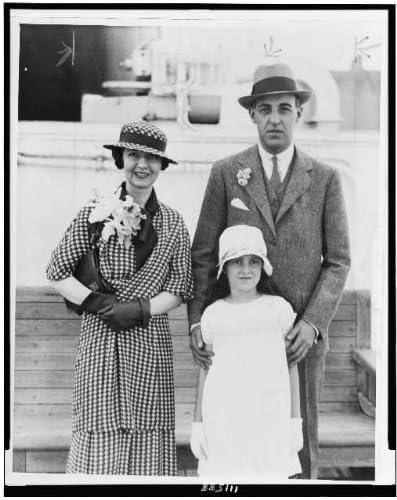
Laurence Adolph Steinhardt was the United States Ambassador to Canada at that time, and his wife, Dulcie Cecile Steinhardt, along with the couple’s 24-year-old daughter, Dulcie Ann, made that trip. A newspaper article from July 19, 1949, substantiates the Alaska vacation. Mr. Steinhardt had previously been ambassador to Peru, Turkey, Russia, and Czechslovokia. The family was well accustomed to traveling.

On March 28, 1950, only 7 months after their Alaska adventure, sadly, Ambassador Laurence Adolph Steinhardt perished in an airplane crash in Ramsay, Ontario, Canada.

This was big news, making all the newspapers, as Mr. Steinhardt was a prestigious man, well-liked in political and military circles, and a Nobel Peace Prize recipient. Steinhardt is buried in Arlington Cemetery. Six months later, his daughter married Allan Arthur Sherlock, a distinguished pilot during WWII.

Mrs. Steinhardt (Dulcie Cecile Hofmann Steinhardt) eventually remarried, but when she died in 1974, she too was laid to rest in Arlington beside her first husband.

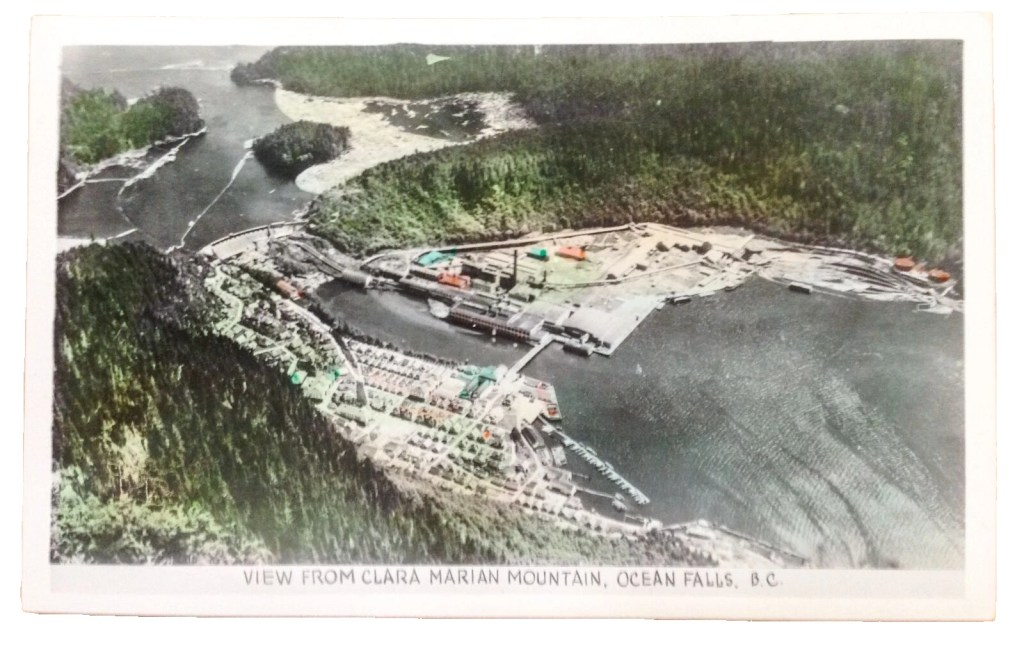
Ocean Falls is a water or seaplane accessible town in British Columbia built by the Crown Zellerbach Paper Company in 1906. The company provided residences for its employees and even had a company store, barber shop, hospital, school, and post office. At one time, 3,900 people lived there.

When it became too costly to keep the pulp mill running, Crown Zellerbach shut things down in 1973. Buildings were left as is, and over time, succumbed to the constant rain.

Many of the structures were removed, with others now rotting away. It’s estimated that a few dozen people currently live there year-round, with the post office remarkably still open. It’s now as close to being a ghost town as a town can get!

Ocean Falls (circa 1950)
Laurence, Dulcie Cecille, And Dulcie Ann Steinhardt
SS Prince George outside Ocean Falls, B.C. – 1949
SS Prince George final demise in 1995.
The vessel sank as it was being towed to Hong Kong for scrap.
Huber Manufacturing (Huber Brothers) – 1942

ANN SANDERS-MYSTERY MAIDEN OF OPHIR, ALASKA

“During my research, I found Patricia Perry to be a professional dancer, while at the same time she owned the Patricia Perry School of Dance.”

Hay bales in Ophir, Alaska

I decided to try my investigative skills on an Alaska ghost town postcard, this vintage piece of paper featuring Ophir, Alaska. Ophir is an old gold mining town that’s now deserted, other than during the summer months.

A few outfits still mine gold in the area, with Ophir offering up the best airstrip for miles around. A friend and I landed there in his Aeronaca back in 2000. I haven’t returned since.

The Iditarod Sled Dog Race goes through Ophir every other year, where the checkpoint is a private cabin formerly belonging to Dick and Audra Forsgren. Their grandson, Kyle, now owns the rustic dwelling. That cabin has changed little since it was first built over 100 years ago.

Ophir was a bustling center of mining activity starting around 1906, but by 1955, things had pretty much come to a grinding halt. The abundant gold found there slowed to a dribble during the last 10 years as miners left for other locales. Because of this, businesses folded from a lack of customers, with imaginary ghosts taking over the dwellings.

The Ophir postcard I’m researching was postmarked on Sunday, March 30, 1941. This post office was permanently closed 16 years later in 1955, with letters and postcards having an Ophir postmark quite desirable amongst collectors.

A picture on the front shows stacks of hay covered with snow, along with an unusual title: Belated Harvest. Hewitt’s Drug Store in Anchorage was the postcard seller. On the back is written:

“Miss Ann Sanders – Ophir, Alaska. Dearest Miss Perry, At last I’ve found time to write to you and give you my address so that you can send me my shoes. Do you remember Barbara Weatherall a former student of yours. I met her brother yesterday. I’ll close hoping this finds you well and happy. Sincerely Ann Sanders Ophir Alaska”

The recipient address is:

Miss Patricia Perry

Textile Tower

Seattle, Wash.

During my research, I found Patricia Perry to be a professional dancer and performer, while at the same time, she owned the Patricia Perry School of Dance. Undoubtedly, those shoes Ann Sanders asked for were fancy dancing shoes. Of all places, Ophir wasn’t a dancing city like Seattle. Ann must have known she wouldn’t remain there long.

Barbara Weatherall went on to wed her high school sweetheart, Ivan Raymond Stafford, in 1957, only to become a widow by 1963. She then married Rick Mason, two years later, in 1965, and they stayed together until she died in 2012. Barbara’s brother, whom Ann mentioned in the letter, was George Weatherall. He has the most significance in Alaska’s mining and transportation history, where this postcard is concerned.

George Weatherman owned a freighting company based in Talkeetna, where he used dog teams, barges, and trucks to transport people and goods to places such as Ophir, Flat, Iditarod, Fairbanks, and other locales. The entrepreneur also had mining claims that he worked on with his son. Ann Sanders must’ve encountered the hard-working man when he passed through Ophir.

Finding out just who Ann Sanders is has been a tough nut to crack and still remains unbroken. She evidently tutored under Patricia Perry, only to move to Ophir soon after. Was she the daughter of a miner, or someone going there to help cook in the mining camp? Unlike other people I’ve searched for, so far, all of my resources have failed me here.

Single women were scarce in Alaska during the early years, with men competing for their hearts. As sexist as this may seem, if Ann could cook and keep a tidy cabin, that was more than enough to woo a lonely miner’s fancy.

When WWII began in 1941, mines throughout the country were ordered to shut down by the US War Production Board, with those mines in Alaska no exception. Many of the men who came to Alaska to work in the field soon left the state, leaving no forwarding address. Ann Sanders seems to fit that mold as well.

I’ll continue searching, believing that other newspapers in Alaska will eventually come online. Right now, there are only a few that are archived for review. Some of those that aren’t, languish in places that need to be personally visited.

For now, Ann Sanders will have to remain the mystery maiden of Ophir, Alaska.

ALASKA KEMOSABE

“My ultimate goal was to create the best, funniest, and most creative book ever written on the 49th State, and I feel as if I’ve accomplished that.”

Over 30 years ago, a reporter from the Anchorage Daily News told me you sometimes have to toot your own horn to get noticed.

He mentioned this when I called his newspaper to see about getting a certain story published, with it ending up front and center, along with an awesome color photo.

That was the first and last time I’ve ever brought attention to myself where journalism credit is concerned. I prefer to remain in the shadows, not soliciting ribbons, awards, or trophies. The finished product is gratitude enough.

Two years ago, I set off on a writing project unlike anything I’ve ever attempted. It was a grueling undertaking, with me spending countless hours late at night and into the morning sunrise, tediously putting things together.

There were nights I wondered what was I doing as my wife and our parrots slept peacefully in the next room. During this time, I also kept busy composing articles for our local Lake Havasu City newspaper, Today’s NewsHerald. I’d venture out in the garage between writing sessions to tinker on my old truck and garner needed sanctity — or pray.

A total of 50 entertaining and unique stories on Alaska, as well as creating 51 photos with help from AI, was, for me, a monumental task. As a car nut, I’d say it’s akin to sanding a vehicle down to bare metal, performing all the priming and sanding, and then spraying on a custom paint job. The book will be around 400 pages, making it the largest I’ve composed.

My ultimate goal was to create the best, funniest, and most creative book ever written on the 49th State, and I feel as if I’ve accomplished that.

Over 10 years, six books later, and a blog with almost 500 submissions, my work has been read in 104 countries and all 50 states, including Puerto Rico. I find that totally amazing. ALASKA KEMOSABE will be featured via several yet-to-be-scheduled podcasts. Thankfully, those can be done from home.

I’ve always been careful to not cross the line where language or humor is concerned in my writing. I know that what I compose is always being scrutinized by the Man upstairs, including those non-believers that I dare not lead astray.

ALASKA KEMOSABE is unlike anything ever placed on the market. Not holding back one iota in putting things together, creatively speaking, there will never be another book like it. I say this because I’d have to be the one composing a sequel. My publisher is pushing me here, although I’ve yet to agree.

Neither an inflated ego nor bravado has anything to do with the above comments; it’s based entirely upon my thought train instead.

Everyone on this planet thinks differently, and there’s no counterfeiting our uniqueness, especially where writing is concerned — unless, of course, plagiarism comes into play.

God is responsible for us being different, with him blessing me with an outrageous and creative mind. It’s gotten me in trouble more than once when I crossed the line, so to speak.

The Choctaw Indians of North America are known as perhaps the best storytellers of all the tribes. They were able to paint a vivid picture by using their hands and gestures, along with artwork, to convey messages.

Their stories often incorporated life lessons passed down from elders, along with moral and religious teachings. Having no written language, they sometimes relied upon animal characters to get their point across.

My Great-Great Grandmother Minnie Pearl Redus-Hankins was half Choctaw, and undoubtedly, a tiny portion of her blood is in my veins. I give God first credit, and then Minnie Pearl for providing me the ability to relay tales of my own, both verbally and in print.

A friend that I personally never met, other than on the phone and email, Jeff Maddox, coaxed me into writing books more than anyone. Jeff was on another writing project when he was suddenly taken to Heaven before finishing.

ALASKA KEMOSABE may never make The New York Times bestsellers list, yet that wasn’t the reason for writing it. If only one person finds the finished manuscript a hoot as I do, all of that time and work was well worth the effort.

I laugh each time I see the cover alone, and I’d love to share it, but the publisher wants things kept totally under wraps until release time.

*ALASKA KEMOSABE will be available by late July 1 through Amazon, Barnes and Noble, and via eBook.

SUPERCROSS

“Jeff had turned around and stopped, wondering if he was going to have to kickstart my lungs.”

Julien Beaumer

My wife and I are big Supercross motorcycle fans. We subscribe to the liberal-based NBC Peacock cable channel just so that we can tune in each Saturday evening. I wouldn’t go this route for the NFL or any other sport.

Joleen and I have even more reason to watch because a Lake Havasu City resident is racing and doing very well in the 250SX class. Number #23, Julien Beaumer is in the thick of things and our prayers are for him to stay healthy and finish out the season on top. This sport’s attrition rate seems higher than most, with riders often racing right to the ragged edge — if they want to win.

An Alaskan competed in the 250SX and 450SX classes for several years, with Ben LaMay related to a friend and former co-worker, Bill Yadlosky, from Eagle River, Alaska. Bill’s family grew up on Old Harbor Road in Anchorage less than a mile from where we lived. I knew Ben’s late father, Gene, and his grandfather, Clarence — both of them accomplished drag racers.

Ben LaMay, also known as “The Alaskan Assassin,” semi-retired from motorcycle racing, but now trains up-and-coming students of the sport at Thunder Valley Raceway in Palmer, Alaska. The forty-ninth state has turned out some great professional hockey players, and there’s no reason another Supercross prospect can’t be found to replace Ben.

Practicing in Alaska, unlike Arizona, can be a little rough though — with only so many nice rain-free days in summer. Traveling to the lower states for riding time is a necessity. The cost of such is substantial according to those having done it.

I owned several dirt bikes while growing up and enjoyed riding them with friends. The only time I gave racing a whirl was on a track at Kinkaid Park in South Anchorage. I was more into keeping my bike looking good rather than thrashing it as racers often do. The day that I decided to go for it, I’d put Armorall on the seat and the machine was looking fine, with a glimmering shine.

Riding slowly around the track a couple of times with my friend, Jeff Thimsen, just to get a feel for things, I eventually grabbed a handful of throttle and instantly went flying off the back of my Yamaha. Armorall turned out to be slicker than ice!

Only doing 40 miles per hour or less, the impact still knocked the wind out of my pipes for several seconds. Jeff had turned around and stopped, wondering if he was going to have to kickstart my lungs.

I decided then and there that racing dirt bikes wasn’t for me, although illegally street racing motorcycles was another thing. I kept riding dirt bikes, while our two children were in elementary school, eventually hanging it up — mainly because Jeff had sold his by then.

There was no longer anyone else to ride with so why go it alone. I took up bicycling once again finding it much safer, that is until a Toyota pickup hit me at a busy intersection.

The fellow’s truck fared far worse than me, suffering a broken window and a dented door. The bad thing was that I had to pay for all vehicle damage, including being fined $50, as the accident was deemed my fault.

For those folks who haven’t watched Supercross, check it out. This week the races are in Phoenix. The action is nonstop and the crashes way too many. I don’t know how these guys can continually control a fast-moving bike going over whoop-de-dos and continually flying through the air, some as high as 35 feet. One thing that I do know is that they don’t use Armorall on their seats.

Wanting to keep another dirt bike, my wife has told me, “No!” more than once. She doesn’t believe many older guys ride them. That was proved wrong in Bouse after I met a guy named Dave from California.

I’d guess Dave was in his 60s, and he had the coolest dirt bike, a two-stroke I believe manufactured in Germany. I can’t remember the brand. He wore a tee shirt his granddaughter gave him, saying, “Some Grandpa’s Play Bingo — Real Grandpas Ride Dirt Bikes.”

Showing Joleen, Dave’s bike and his cool shirt, saying that I’d like one of each, her response was immediate and ego-deflating. “I don’t think you can even handle the shirt at this point!”

“JERRY”

“They were nice to me and on Christmas always left a sizable tip or present.”

Looking back at folks I’ve met along the way, several stand out tall amongst the rest. Two of these were special people that I didn’t entirely know the history of. It was only after they passed away and I began writing, did I unearth their backgrounds through old wedding announcements and obituaries.

Alan and Muriel Girardet I first met as customers on my newspaper route in Anchorage. They were nice to me and on Christmas always left a sizable tip or present. When I say sizable I’m talking at least $5. The couple lived in a small but well-kept trailer in an older section of Alaskan Village Trailer Park.

Muriel and Alan were especially kind to neighborhood children, and this was especially true on Halloween. They were known to hand out the largest amount of candy of anyone in the park. There was a reason for them being so gracious to us kids that I didn’t know back then.

Alan went by the nickname of Jerry and I still don’t know the reason for that and probably never will at this point. His middle name was Newton. Mr. Girardet and his wife owned Lock, Stock, and Barrel gun shop, with a few of us kids who owned rifles purchasing .22 ammo from him. We’d been taught gun safety at Clark Junior High so it was nothing out of the ordinary.

The school had a small “take down” shooting range for the Clark Shooting Club. It would be set up in the gym and then taken down when not in use. For competition purposes, we’d go to an indoor target range on a local military base.

At home, sitting behind the gun shop was a hill that we could safely shoot into. A wrecked car sitting in front of it was riddled with holes. It was quite common to find several locals back there on a Saturday morning firing away.

My father eventually purchased the building that housed Lock, Stock, and Barrel Gun Shop, and I came to know Jerry even better. The man had a German Shepherd dog named “Heidi” that he brought to work every day. At lunch, Jerry would toss a ball and Heidi would chase it. You could tell by the excitement in her retrieving it that it was the highlight of the day.

Jerry became friends with my father-in-law and I learned from Herman that Jerry had also been in the United States Navy. Both men saw duty in WWII so they had something in common to talk about. Jerry served on the aircraft carrier USS Maine before retiring in 1959. His wife, Muriel, was also in the Navy. Being a member of the WAVES (women accepted for voluntary emergency service), Muriel remained on active duty until the end of the war.

Sadly, Jerry’s brother, David Lloyd Girardet, was killed in the crash of a Grumman Hellcat airplane during WWII. Not once did Jerry ever mention this to me nor tell my wife’s father, Herman, about the tragedy. Ensign David Lloyd Girardet attended the Naval Academy with a presidential appointment courtesy of Franklin D. Roosevelt.

Hanging on a wall in the gun shop was a Brown Bess musket and powder horn dating back to the 1700s. I often visited Jerry just to check out this weapon. He eventually brought it down for me to inspect. I knew it was one of his prized possessions just by the way he handed it to me. The gun was long and heavy.

Because of my fascination for this Brown Bess, thirty years later I purchased one in Scottsdale, Arizona. I always wondered what happened to Jerry’s musket believing that it’d been sold after he passed away.

A couple of important things were learned about Jerry and Muriel along with that Brown Bess in writing this story—one of them quite sad. I never knew during the time I first met them in 1967, that they’d lost their only son in a motorcycle accident just three years prior.

David Lloyd Girardet was struck by a drunk driver in 1964 and killed. I can’t imagine the heartbreak of losing a child, and I suppose this was a reason for them seemingly “adopting” some of us neighborhood kids. David was without question named after Jerry’s late brother.

The other thing I came to know is not so tragic. The beloved “Brown Bess” was donated by Jerry and Muriel to the Lake Ronkonkoma Historical Society Museum in New York. A picture of it on their website shows the musket and powder horn in a place of reverence. A brass tag identifies it as being donated by the Girardets.

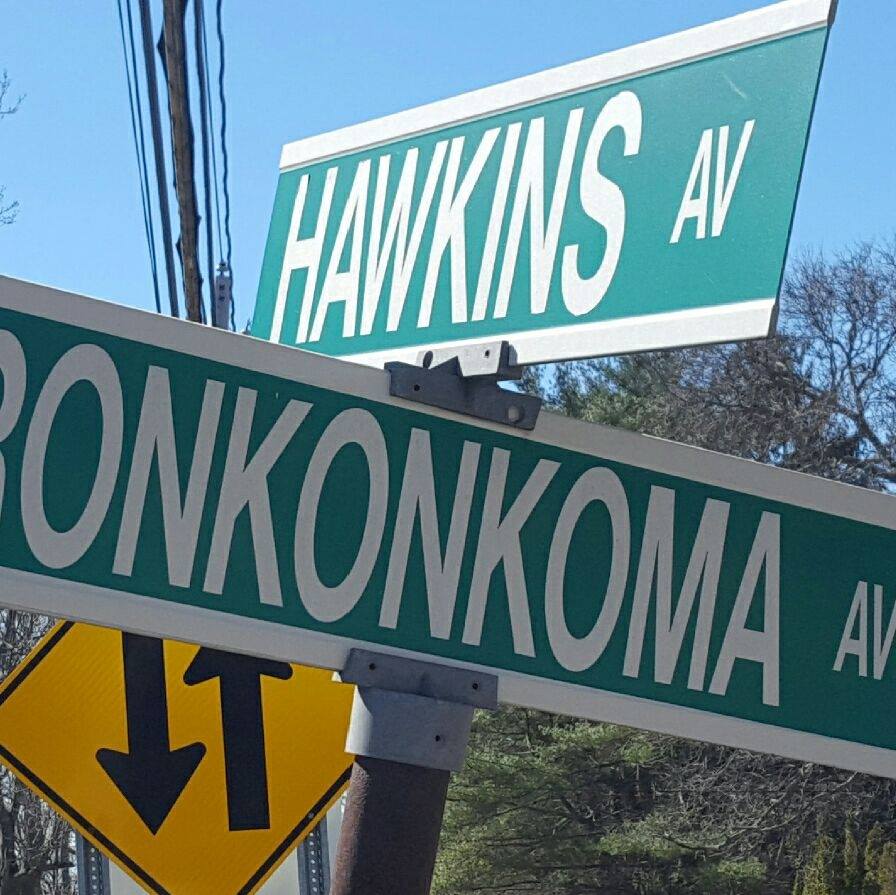
Interestingly enough, Jerry was born and raised in Lake Ronkonkoma, with the family living on Hawkins Lane. That street name was eventually changed to Hawkins Avenue, now considered the city business center. The Girardet patriarch came to America from France, where he also served in the Navy. Jerry, Muriel, and David are buried in the Lake Ronkonkoma Cemetery.

Some might ask what does this story have to do with Lake Havasu City? The answer is simple. There are thousands of seniors living here from all parts of the country. Undoubtedly, a good many have backgrounds much like the Giradets. In most cases, we’ll never know until they’re gone!

LIFE STORIES

“Bob said that he grabbed the other fellow and ripped his head clean off his shoulders before placing it on the counter.”

Reid Bowman

In my younger years, I worked with several great storytellers at different places of employment. They were generally much older men than me. Most of their tales revolved around workplace experiences, fishing, hunting, and youthful exploits, along with rehearsed or unintentional acts of mischief.

For the most part—I believed all their tales were true—except for one bizarre story told to a group of us during morning break.

Robert Nelson was a parts expeditor for the State of Alaska. I’m not sure what his former background was because he was a “man of mystery” with little known of his past by coworkers. Bob was in his 70s when I first met the guy. I was told he drank a lot over the weekends and that his accent drastically changed when he did so.

At break one Monday morning, in what appeared to be Irish undertones, the man bragged of being at a tavern years ago when a fight broke out between him and another bar patron. Bob said that he grabbed the other fellow and ripped his head clean off his shoulders before placing it on the counter.

We laughed hysterically believing it was a joke until Mr. Nelson became very angry. With his ears and forehead glowing cherry red, he yelled that his story was true and that we’d greatly offended him. The room turned totally quiet, with laughter returning once again, only after Bob Nelson stormed out the door.

Bob worked less than a year longer before he resigned. We were informed through the workplace grapevine, that he lost his driver’s license and had to leave because this job consisted of driving a state vehicle.  That strange story of Nelson’s is probably still circulating in certain Alaskan circles. Undoubtedly, Bob Nelson created his tall tale while tanked up on agave juice. Tequila was his brew of choice.

Three men stand tall where “factual storytelling” is concerned. All of them had a lifetime of exciting adventures to share. I wish I could remember more of what they relayed over the years.

Reid Bowman served in the United States Navy during WWII, being at Iwo Jima during the heat of conflict at age 17. He saw battle on ships that I no longer recall the names of. Some of his observations while fighting the Japanese were quite graphic. I can still see tears coming from his eyes during one recollection of fellow sailors being killed when enemy fire struck their ship.

Reid had some great fishing stories as well. With him owning a beautiful cabin directly on the Kenai River near Soldotna, Alaska, there was no doubt they were true. The Kenai River has some of the best salmon fishing on the Kenai Peninsula.

Martin Allen was a native Arizonian although he was born in Roswell, New Mexico, in 1920. He was a real cowboy during his younger years, riding horses and herding cattle like those cowboys seen in Western movies. He served in WWII as a Marine, and afterward, he worked in the mines of Bisbee for what I believe was close to 30 years.

This was at the same time that miners went on strike there, and a mining company Martin Allen worked for during those years, Phelps Dodge, was found to be irresponsible with pension money. Unbeknownst to the employees, the company had been dipping into these funds for operational purposes.

At the age of 68, Martin moved to Alaska and went to work as a mechanic for the State of Alaska. He spent several years in the villages of Bethel and Aniak, where he was dubbed “The Aniak Cowboy” by locals.

An avid fisherman, Martin was also good at flipping cars and trucks and made sizable money after retirement in doing so. Martin told great stories about his time cowboying, as well as working in the mines. With mining a dangerous occupation, he mentioned losing several friends from occupational accidents.

One story I remember most was actually a wisdom-filled fable if you can call it that. I can’t describe things using his exact words because they’re a bit salty for this family newspaper, but here goes:

Two bulls were standing on a hill watching a herd of cows grazing down below. One of the bulls, a youngster, said to the other, “Let’s run down there and make love to one of those heifers.”

The larger of the pair, much older and wiser than his immature partner, with a blade of grass stuck between both front teeth, slowly replied,

“Why don’t we walk down there and make love to all of them!”

Martin Allen

Ron Kolbeck came to Alaska from Wisconsin. His family was involved in farming and that’s where he picked up some of his ability to work on all types of heavy equipment, along with being in the Air Force as an aircraft mechanic during the Korean War.

Ron worked on the Alaska Pipeline from start to finish and was able to sock away a significant amount of money. He spent several years at Prudhoe Bay as a mechanic. Most younger guys doing the same weren’t as savvy and spent their windfall on frivolous things like fancy trucks, cars, and toys. Ron and his wife, Helen, wisely invested theirs.

Oil pipeline work was dangerous with Kolbeck mentioning several accidents that took the lives of fellow workers. He told stories of enduring harsh weather 12 hours a day – 7 days a week to get the job done. I especially remember him talking about a welder he worked with who used an acetylene torch to cut up galvanized metal.

Ron warned the man about the hazards of doing such without an outside air supply and the guy didn’t listen. Galvanized steel heated to its melting point, gives off a deadly green gas. Ron told us that this fellow died of a serious lung infection before the summer was over.

I miss listening to Ron, Reid, and Martin share the exciting adventures they were a part of. Each man lived a relatively long life despite their hazardous occupations. One of my regrets is never thanking them for their military service.

I still enjoy chatting about the past with family, friends, and acquaintances who are now in their senior years. Not once have any of them mentioned taking someone’s head off and placing it on a bar counter. Without question, Robert Nelson set the bar sky-high for anyone to top that amazing feat!

Ron Kolbeck

BLAZO

“Toss a can of Blazo on a fire and you have an instant inferno.”

Over the past 40 years, I’ve written many “letters to the editor” for various newspapers. It wasn’t worth my time to sit down and write one unless it was somewhat controversial and would elicit a response.

I learned a lot about how to write newspaper letters by emulating a fellow named, Edward Boyd. The late Ed Boyd was a successful Anchorage businessman and a prolific writer. I decided to take the time and copy a few of my favorites just for grins.

Looking them over, after all these years, I still think pretty much the same as I did back then. I named this blog “Blazo” for a specific reason. Toss a can of Blazo on a fire and you have an instant inferno. I’ve learned that words can do the same where emotions are concerned.

I added a few rebuttals to make things interesting. The last letter of mine concerns welfare. Two people reading it in Homer and Talkeetna, quickly responded back, with them seemingly lacking reading comprehension skills.

I’ll be adding more to this fun project as time permits.

“Anchorage Daily News” – Thursday – June 28, 2001
“Anchorage Daily News” – Tuesday – February 26, 1985
“Anchorage Times” – Sunday – December 15, 1991
“Anchorage Daily News” – Tuesday – May 27, 1997
“Anchorage Times” – Tuesday – December 29, 1998
“Anchorage Daily News” – Wednesday – May 26, 1999
“Anchorage Daily News” – Friday – August 18, 2000
“Anchorage Daily News” – Friday – September 29, 2000
“Anchorage Daily News” – Tuesday – November 13, 2001
“Anchorage Daily News” – Sunday – July 7, 2002
“Anchorage Daily News” – Wednesday – July 10, 2002
“Anchorage Daily News” – Monday – January 28, 2002
“Anchorage Daily News” – Friday – November 27, 1998 –
“Anchorage Daily News” – Saturday – February 1, 2003
“Anchorage Daily News” – Monday – May 10, 2004
“Anchorage Daily News” – Wednesday – March 7, 2001
“Anchorage Daily News” – Saturday – August 14, 2004
“Anchorage Daily News” – Wednesday – August 25, 2004
“Anchorage Daily News” – Monday – August 18, 2008
“Anchorage Daily News” – Saturday – January 15, 2005
“Anchorage Daily News” – Tuesday – November 13, 2007
“Anchorage Daily News” – Wednesday – July 26, 2006
“Anchorage Daily News” – Thursday – March 20, 2003
“Anchorage Daily News” – Tuesday – November 25, 1997
“Anchorage Daily News” – Monday – December 17, 2001
“Anchorage Daily News” – Friday – December 21, 2001
“Anchorage Daily News” – Sunday – November 12, 2000
“Anchorage Daily News” – Saturday – April 15, 2006
“Anchorage Daily News” – January 2, 2001
“Anchorage Daily News” – Saturday – January 06, 2001
“Anchorage Daily News” – Monday – January 8, 2001
“Anchorage Daily News” – Sunday – January 7, 2001