A CHRISTMAS POSTCARD

“I’ve been tempted to send Christmas cards in July, but thus far have resisted.”

Each Christmas, my wife takes the Christmas Cards we receive, opens and reads them, and then tapes them to a pantry door. My mother did the same, although she used a wall because we didn’t have a pantry.

After New Year’s is over, Joleen removes the cards and puts them back in their envelopes, so that she has a current address to mail ours the following year. People still change locations, so that’s an easy way to keep updated on their whereabouts.

There was a time we received close to 100 cars from friends, family, and businesses, but that number has slowly dwindled. I believe last year, in 2024, we got a total of 19. Some of the senders passed away, while others just don’t mail them anymore.

I recall my mom scratching her head, attempting to recall if so-and-so sent a card the previous year. With my wife keeping ours in a box, that’s no problem. Forty years ago, I came up with an idea so that people wouldn’t have that problem.

I took over the letter-writing department during Christmas, always making sure that our ‘form letter’ was bizarre and unforgettable. While Aunt Betty’s card and letter might not be remembered 30 days after getting them, I didn’t want that to happen with ours. I’ve had friends and family say that they think I’ve lost it, but at least they remember the card or letter. That’s what counts most!

We’ve sent out cards with our two parrots supposedly writing things, along with an attorney, a garbage collector, neighbors, a complete stranger, and firms that we supposedly paid to write because we were too busy. I even had a holiday form letter printed out with fill-in-the-blanks.

The phony lawyer’s office letter was 20 years ago, and I still recall the firm’s name: Bend, Ovar, and Takum. Another year, I had a rubber stamp made with our signatures in cursive, going on to let it be known the following year, in a Christmas form letter, that some folks were upset because we didn’t take time to sign them ourselves. It’s reminiscent of the Joe Biden autopen controversy.

The best cards we mailed were a select few that I took a propane torch to, scorching them just enough to make them look like they’d been in a fire. That card envelope was stamped, with me having to carefully draw black spiral lines across the stamps to make them appear as cancelled. I only addressed a certain number to family members.

A blackened card and envelope were then placed inside another plain brown envelope marked USPS, with an official-looking note inside, supposedly from the US Postal Service. The note said that the mail was damaged from being in a warehouse fire. We waited two months after Christmas to finally send them.

Family still talks about that, with a good majority believing that the warehouse fire actually took place. I suppose there is a question as to whether this act was legal, but the statute of limitations has long run out.

Back in the early 1900s, Christmas ‘postcards’ were quite common. I made my own one year, taking small 4×5 index cards and gluing a photo of Santa on the front, with him saying Merry Christmas.

There was little room to write a note on the back, with us just proclaiming, Happy New Year. I believe that’s the one we mailed right after Halloween. I’ve been tempted to send Christmas cards in July, but thus far have resisted.

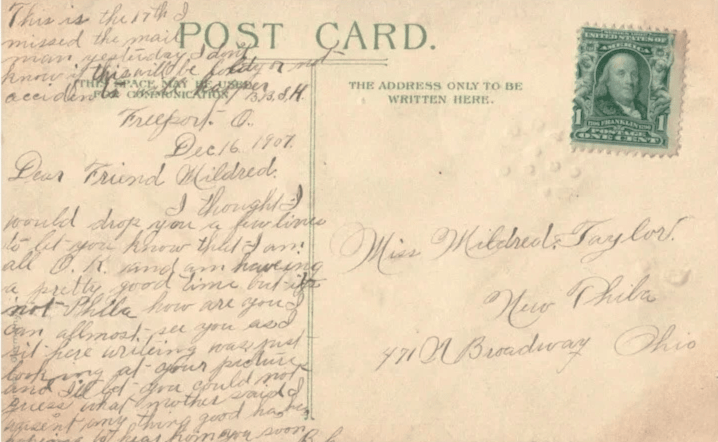
Finding an early Christmas postcard from 1907 on eBay, the person receiving it was Mrs. Mildred Taylor, who lived in New Philadelphia, Ohio. Someone with the initials B.L. from Kokomo, Indiana, sent it with the following cryptic letter. I’ve left words as written.

“This is the 17th. I missed the mailman yesterday. I don’t know if this will be today or not. Accident if it happen.

Freeport, O.

December 16, 1907

Dear friend Mildred,

I thought I would drop you a few lines to let you know I am all O.K. and am having a pretty good time but it’s not Philla. How are you I can almost see you as I sit here writing was just looking at your picture and I bet you could not guess what mother said, I suppose not anything good, ha. She suffering lot. Hear from you soon. B.L.”

Mildred A. “Mary” Peacock Taylor spent her entire life in New Philadelphia, Ohio, along with her husband, Earl. Hopefully, Mildred interpreted what her friend was telling her because anyone else reading this note wouldn’t totally understand. I suppose that’s intentional on the writer’s part.

Nowhere is there mention of ‘Merry Christmas’ or ‘Happy New Year’, although the front of the Victorian-style Christmas postcard does say, ‘A Peaceful Christmas’. The photo of a frazzled Santa with a large bag of toys makes it appear he isn’t having one!

THE PRODIGAL SON

“I’m sure Robert Lefever’s mom, Blanche, was tickled pink to get this message from her youngest boy.”

For the past couple of months, I’ve been on intense writing projects involving old postcards. I’ve learned some history lessons from the pictures on front, while encountering funny and sadness from those people writing them, including the recipients.

It’s like being able to legally read someone’s mail, or eavesdrop on a personal phone call. I did that a few times as a kid when we had a party line. That form of entertainment came to a grinding stop when Mom caught me. She grabbed the phone and apologized to the person on the other end. My bottom was toasted soon afterwards.

This project has also allowed me to use psychological insight into how and why some of these cards were written. Some folks might ask after that last comment, “Do you have a background in psychology, Mr. Hankins?” The answer is no. I’m just an old man with an opinion. There’s a mess of us out there.

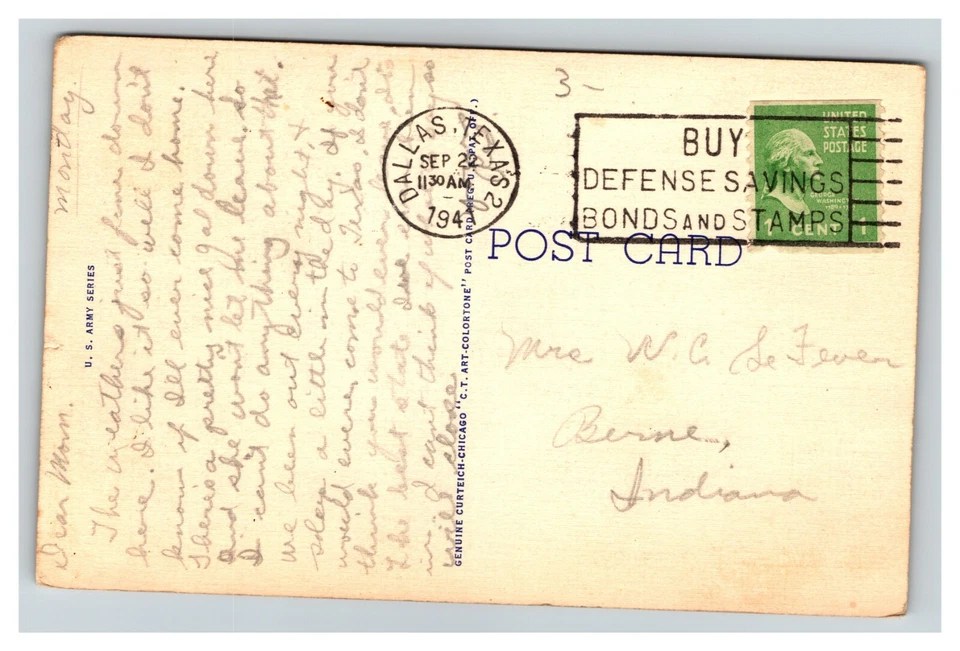
Before I go further, let me reveal things about my latest project. The card is postmarked from Dallas, Texas, September 22, 1941. Beside the circular stamp is another rectangular one marked, ‘Buy Defense Savings Bonds And Stamps.’ WWII hadn’t officially started, but tensions were high between the US and Japan.

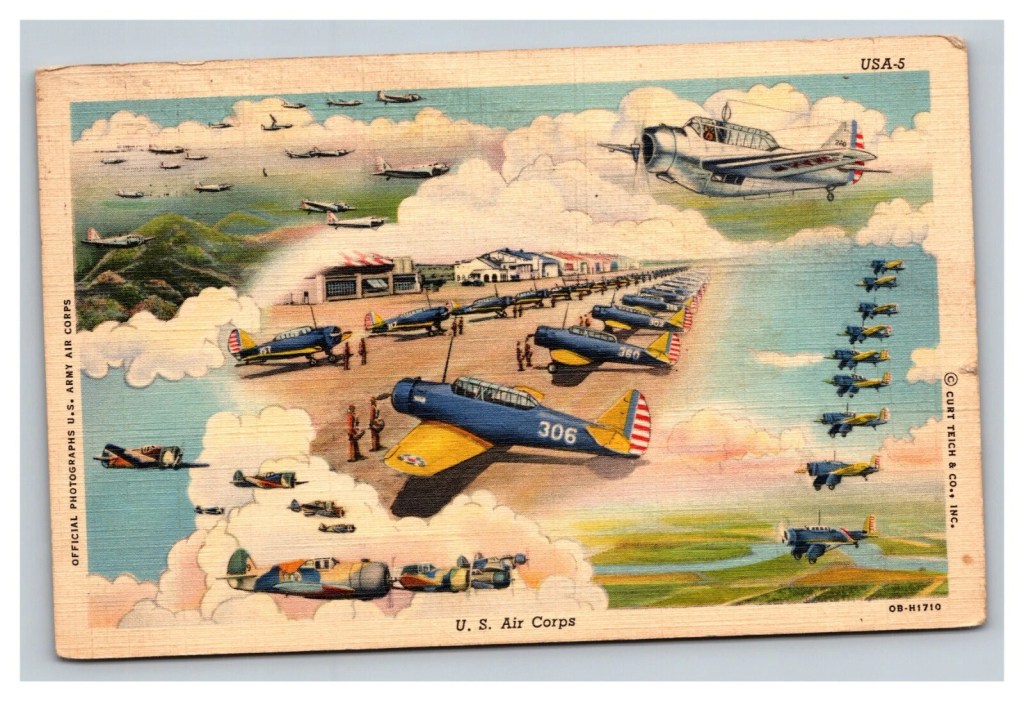
On the front of this lithographed postcard is a color picture showing training airplanes of the Army Air Corps. This branch of the military was called such before being renamed the United States Air Force in 1947. The recipient of the card is Mrs. W.C. Lefever in Berne, Indiana. The pencil-written message goes as follows, with typos and errors left unchanged:

“Dear Mom, Monday.

The weathers just fine down here. I like it so well that I don’t know if I’ll ever come home. Theres a pretty nice gal down here and she wont let me leave, so I can’t do anything about that. We been out every night + sleep a little during the day. If you would ever come to Texas, I don’t think you would ever leave. It’s the best state Ive ever been in. I cant think of what else to say so will close. Your son Robert”

I could just barely read the sign-off because the postmark covered it. There were enough readable letters to finally make things out. I’m sure Robert Arnold Lefever’s mom, Blanche, was tickled pink to get this message from her youngest boy.

William Clarence Lefever, Robert’s father, wasn’t mentioned in the correspondence, although both parents were still alive in 1941 and living together, as records indicate. The objective of the card and the way it was written is quite clear to me.

Robert was evidently having problems with his dad and saw this as a way to get back at the old man. What better way to say I love you than by letting both parents know that he was ‘sowing his wild oats’ and he’d never see them again.

Before the start of each Indianapolis 500 race, the late Jim Nabors sang, “Back Home Again in Indiana.” I believe the tradition is still being fulfilled by other singers. One or two word changes to the first four lines of this song can be made to reflect most anyone’s former home. For me, that would be switching Indiana for Alabama, Alaska, or Arizona.

“Back home in Indiana

And it seems that I can see

That gleaming candlelight is still shining bright

Through the sycamores for me.”

Research shows that Robert A. Lefever didn’t stay in Texas, eventually returning home to Indiana and marrying a local woman named Lillian in 1949. Robert’s buried in a Fort Wayne cemetery with his wife. Someone chose to spell their last name the old way on their gravestone, Lefevre.

Both parents, along with older brother Russell and his wife, Nora, are laid to rest 45 miles away in Berne. There’s no record of Robert serving his country during the war, yet there is a Russell Lever from Fort Wayne who was deployed and safely returned.

This research reminds me of Luke 15:11-32. This is the story of the prodigal son. A father has two sons. One is responsible, while the youngest is just the opposite. This immature boy asks his dad for his inheritance and then goes out and squanders it. After all of the money is gone from frivolous and foolish living, he comes crawling back home, expecting to live with the pigs.

Instead, his father puts on a big feast, which the older son finds to be a great disappointment. He can’t believe his father is doing this, for after all, he was the mature one. The older child is angered by this lavishness, yet goes along with things, while the father is delighted that his lost son is now returned.

Is that how Clarence Lefever saw things after Robert finished sowing his wild oats in Texas and came back home? I’d like to think so!

SELMA & LHC

“I’ve been asked numerous times over the years, “Do you remember seeing any discrimination?”

Selma, Alabama, and Lake Havasu City, Arizona, are comparable in two respects. Both populations are located near recognizable bodies of water, and each is home to a famous bridge. Havasu and Selma eventually became victims of a severe economic drought, although Selma’s has lasted much longer.

Craig Air Force Base was located in Selma, starting before World War II in 1941. When it closed in 1977, the area’s businesses suffered greatly. New home building all but came to a screeching halt. The Dallas County school system lost a significant number of students, and several teachers and administrators were eventually laid off.

Valiant efforts by politicians and businesspeople to address the issues helped some, yet the city never fully regained the financial stability it once had. From the outside looking in, it appears town leaders have yet to get a firm grasp on how to promote the historical and recreational potential of the area. It also seems, judging by crime statistics, that they’ve become somewhat lax on enforcing crime.

Lake Havasu City is known for the London Bridge and was home to the McCulloch Corporation, which employed hundreds of workers. It was the largest employer in town during that time. When the company moved its operation in 1988 to Tucson, those employees were left without jobs. Some of them relocated to the famous western town, with a significant number also staying in Havasu and toughing things out.

Our local economy was severely wounded for a few years, yet being a popular vacation destination helped overcome the downfall. Fishing and boating were major attractions. Sound conservative leadership from business and political leaders was a major factor in the success, and in the last 20 years, this city has prospered.

I lived in Selma, Alabama, from late 1958 to early 1963. This was right before the civil rights demonstrations and police brutality took place, which was witnessed by millions on mainstream news throughout the country. I’ve been asked numerous times over the years, “Do you remember seeing any discrimination?”

I was quite young, and the only thing I recall was a small ice cream and hot dog stand with a sign saying they did not serve negroes. I only use that word because it was on the sign. A small black boy walked up as we were parked there, and he, along with another child, was turned away.

Not knowing why, I asked my parents, yet I don’t recall their explanation. It wasn’t until later years that I discovered the serious discrimination that wasn’t observed by me as an adolescent.

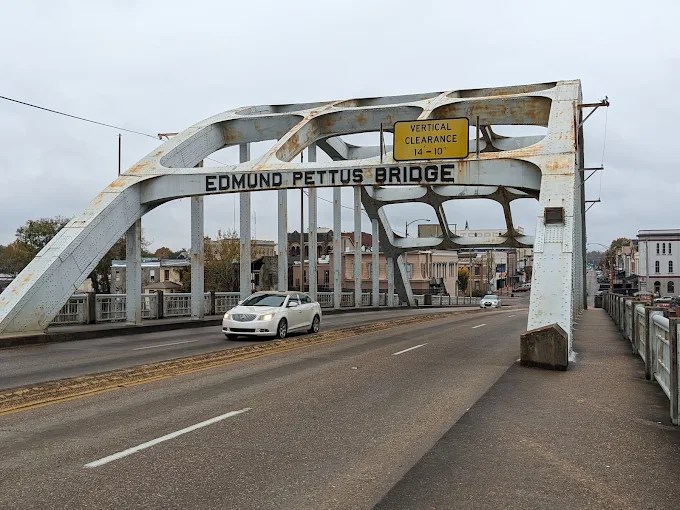
We left Selma for Lubbock, Texas, in 1963, right before the famous 1965 march, which crossed the Edmund Pettus Bridge and went a good 50 miles from Selma to Montgomery. Martin Luther King Jr. headed up that procession of approximately 25,000 protestors. On March 7, 1965, marchers were turned back from crossing the bridge, with that day now labeled “Bloody Sunday.”

The civil rights group walked along US Highway 80 directly in front of where we once lived. That road is now called the “Selma to Montgomery National Historic Trail.” It was on this stretch of asphalt that I remember “chain gangs” cleaning the right-of-way on each side. The workers consisted of both black and white prisoners.

I enjoyed living in Selma. We boated and fished in the Alabama River, with my family feeling safe and comfortable living there, just as I do now in Lake Havasu City. Having a local police force that takes a dim view of crime breakers is a major asset in helping keep things that way in Havasu.

Selma still has a solid place in my heart, and I’d love to see the rebirth of this once vibrant and prosperous city. If I were the mayor of Selma, the first thing I’d do is seek the advice of Lake Havasu City movers and shakers on how to fix things.

My father always told me, “If you want to be successful, emulate the traits of successful people.” I believe that advice directly relates to city leadership as well!

LEGACY

“The way we treat people comes under this heading.”

Hobo Mark “Shoestring” Nichols

As I’ve gotten older the word legacy has become more and more important to me. What will I leave behind in my life that will positively enhance others? I find different interpretations of legacy in dictionaries and the Holy Bible.

Judaism indicates that legacy can be good or bad, with spiritual or Godly legacy foremost over that of monetary or material assets, such as real estate, stocks, and bonds. A bad father or mother can leave a blemished legacy where children are concerned. Thankfully, my parents don’t fit the bad mold and hopefully, I don’t either.

Godly legacy enriches people’s lives long after a person is gone. The way we treat others comes under this heading. I find evangelist Billy Graham and Mother Theresa fitting this definition more than anyone.

As a Christian—faith, values, and traditions much like the Jewish also take precedence over that of leaving behind wealth. Both religions make it clear that there’s nothing wrong with making sure your family is financially secure once you’re gone. Not everyone can do that.

A spiritual legacy is defined as non-material, such as stories, beliefs, values, and wisdom. That seems to fit with me, although I do strive to leave something of all three. Spiritual legacy can be left behind through videos, tapes, books, and even letters.

Being a writer, and loving to research the lives of people who have long since departed, in certain cases all I’ve uncovered is a decaying gravestone more than anything else. I find that sad.

Some of these men and women were one-time owners of huge companies, with the businesses now long gone and their establishment names no longer remembered. Other than an aging obituary telling more about their business accomplishments than anything, it appears these folks dropped off the face of the earth without leaving any lasting legacy at all. They seemingly followed the dollar more than God. I don’t want that happening to me.

Perhaps the saddest thing I’ve observed over my lifetime is encountering family and friends who’ve said to me, “I plan on letting my children make up their own minds about what religion to choose.” The scriptures don’t recommend this, with that leading me to believe these folks weren’t Bible readers, although they claimed to be. Years have now passed and I see the aftermath of their flawed philosophy. It wasn’t good in some cases although a few of these offspring finally came to their senses and saw the light.

I watch YouTube videos quite often, especially following the life of hobo “Shoestring” Mark Nichols. Mark was a military veteran and has been a hobo traveling the rails throughout the US for some time.

“Shoestring” documented his adventures via a blog he started around 1989, and then began videoing them. He had over 2,000 followers on YouTube. The man was paid well for his episodes and loved by many. In his videos, he comes across as a very caring person. In several episodes he calls out to God for help or thanks him for help received.

Mark Nichols unlike Billy Graham, Mother Theresa, or other noteworthy people still left behind a positive legacy despite his hobo lifestyle. I believe that everyone can do the same as it’s strictly a matter of choice.

Sadly, “Shoestring” suffered through cancer, diabetes, a bad back, and macular degeneration of the eyes, with liver failure believed to have led to his unexpected death. His stories live on through numerous writings and films.

I can only hope Mark Nichols knew Jesus Christ as Savior, and I believe he did, or his legacy becomes significantly dimmer. The Bible says this about legacy where our faith is concerned in Deuteronomy 6: 6 & 7 (KJV). Moses is speaking here about the Ten Commandments:

6. “These commandments that I give you today are to be on your hearts.”

7. “Impress them on your children. Talk about them when you sit at home and when you walk along the road, when you lie down, and when you get up.”

If parents heed these two verses alone and pass them on as instructed, I believe the legacy left to children and grandchildren far surpasses that of wealth and prosperity.

If I’ve achieved only that much—I deem my life to be successful.

“JERRY”

“They were nice to me and on Christmas always left a sizable tip or present.”

Looking back at folks I’ve met along the way, several stand out tall amongst the rest. Two of these were special people that I didn’t entirely know the history of. It was only after they passed away and I began writing, did I unearth their backgrounds through old wedding announcements and obituaries.

Alan and Muriel Girardet I first met as customers on my newspaper route in Anchorage. They were nice to me and on Christmas always left a sizable tip or present. When I say sizable I’m talking at least $5. The couple lived in a small but well-kept trailer in an older section of Alaskan Village Trailer Park.

Muriel and Alan were especially kind to neighborhood children, and this was especially true on Halloween. They were known to hand out the largest amount of candy of anyone in the park. There was a reason for them being so gracious to us kids that I didn’t know back then.

Alan went by the nickname of Jerry and I still don’t know the reason for that and probably never will at this point. His middle name was Newton. Mr. Girardet and his wife owned Lock, Stock, and Barrel gun shop, with a few of us kids who owned rifles purchasing .22 ammo from him. We’d been taught gun safety at Clark Junior High so it was nothing out of the ordinary.

The school had a small “take down” shooting range for the Clark Shooting Club. It would be set up in the gym and then taken down when not in use. For competition purposes, we’d go to an indoor target range on a local military base.

At home, sitting behind the gun shop was a hill that we could safely shoot into. A wrecked car sitting in front of it was riddled with holes. It was quite common to find several locals back there on a Saturday morning firing away.

My father eventually purchased the building that housed Lock, Stock, and Barrel Gun Shop, and I came to know Jerry even better. The man had a German Shepherd dog named “Heidi” that he brought to work every day. At lunch, Jerry would toss a ball and Heidi would chase it. You could tell by the excitement in her retrieving it that it was the highlight of the day.

Jerry became friends with my father-in-law and I learned from Herman that Jerry had also been in the United States Navy. Both men saw duty in WWII so they had something in common to talk about. Jerry served on the aircraft carrier USS Maine before retiring in 1959. His wife, Muriel, was also in the Navy. Being a member of the WAVES (women accepted for voluntary emergency service), Muriel remained on active duty until the end of the war.

Sadly, Jerry’s brother, David Lloyd Girardet, was killed in the crash of a Grumman Hellcat airplane during WWII. Not once did Jerry ever mention this to me nor tell my wife’s father, Herman, about the tragedy. Ensign David Lloyd Girardet attended the Naval Academy with a presidential appointment courtesy of Franklin D. Roosevelt.

Hanging on a wall in the gun shop was a Brown Bess musket and powder horn dating back to the 1700s. I often visited Jerry just to check out this weapon. He eventually brought it down for me to inspect. I knew it was one of his prized possessions just by the way he handed it to me. The gun was long and heavy.

Because of my fascination for this Brown Bess, thirty years later I purchased one in Scottsdale, Arizona. I always wondered what happened to Jerry’s musket believing that it’d been sold after he passed away.

A couple of important things were learned about Jerry and Muriel along with that Brown Bess in writing this story—one of them quite sad. I never knew during the time I first met them in 1967, that they’d lost their only son in a motorcycle accident just three years prior.

David Lloyd Girardet was struck by a drunk driver in 1964 and killed. I can’t imagine the heartbreak of losing a child, and I suppose this was a reason for them seemingly “adopting” some of us neighborhood kids. David was without question named after Jerry’s late brother.

The other thing I came to know is not so tragic. The beloved “Brown Bess” was donated by Jerry and Muriel to the Lake Ronkonkoma Historical Society Museum in New York. A picture of it on their website shows the musket and powder horn in a place of reverence. A brass tag identifies it as being donated by the Girardets.

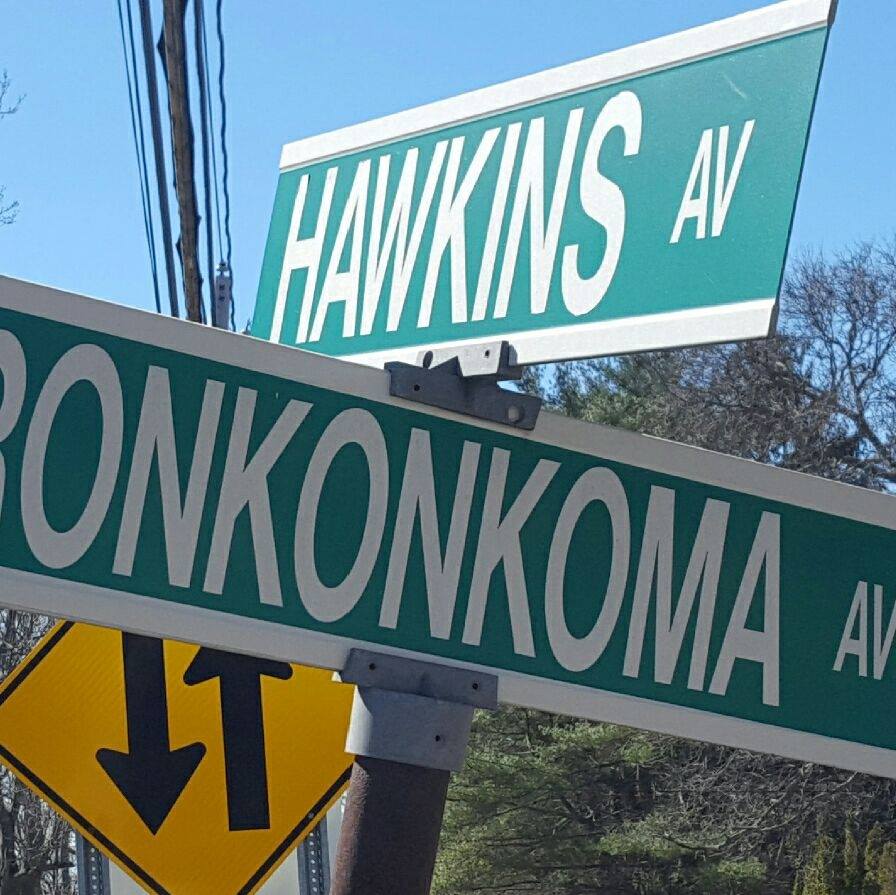
Interestingly enough, Jerry was born and raised in Lake Ronkonkoma, with the family living on Hawkins Lane. That street name was eventually changed to Hawkins Avenue, now considered the city business center. The Girardet patriarch came to America from France, where he also served in the Navy. Jerry, Muriel, and David are buried in the Lake Ronkonkoma Cemetery.

Some might ask what does this story have to do with Lake Havasu City? The answer is simple. There are thousands of seniors living here from all parts of the country. Undoubtedly, a good many have backgrounds much like the Giradets. In most cases, we’ll never know until they’re gone!

LADDER OF JOY

“I’ll try to reignite my holiday spirit by watching Hallmark Christmas movies with Joleen, yet I can only take so many repeated scripts and bad acting.”

I haven’t been totally filled with “Holiday Spirit” for some time now although the top is still within reach. I’m not talking about the free-flowing spirits with which many find necessary to celebrate Thanksgiving, Christmas, and New Year’s.

Some folks look for these three holidays—along with Labor Day, Memorial Day, the Fourth of July, and Donut Day—as a time to drink to their heart’s content. By the way, Donut Day falls on Friday, June 6, in 2025.

The holiday spirit or cheer I’m talking about is uncontained excitement such as what kids experience in elementary school right before Christmas, knowing that classes will soon be put on hold until after the first of January. Brightly wrapped presents underneath the tree go along with this.

I don’t need to be reminded of the real reason for the season: Christmas. It’s the birthday of my Lord and Saviour, Jesus Christ. That alone is reason enough to continue celebrating life and be filled with joy.

In my book, Thanksgiving began when the Pilgrims broke bread with Indigenous American Indians, while New Year’s means another year has passed. It’s also a time to look to the future.

Like so many older people, I tend to now look at holidays with a touch of sadness. I often think back to the time when parents, grandparents, aunts and uncles, and good friends were still here to celebrate.

I’m elated to still be around and take in activities with my own children, grandchildren, and pals, yet the elimination of debilitating back pain and other physical ailments in my body would make for a bit more elation. Only those going through such will understand.

My wife and I decorated for the first time in several years mainly because the grandchildren were coming for Thanksgiving. I had our Kansas-manufactured, metal Saguaro cactus wrapped in red, green, blue, and white LED lights which entailed working off a ladder in the back of our truck.

A few close calls were made going up and down it. The Made in China faux Christmas tree in our living room was safely put together and thankfully has built-in bulbs. I’m sure these decorations will be up through a portion of the new year.

Christmas cards are still a part of our holiday experience although only a few now get sent. We’ve got boxes and boxes of them, enough to last ’til the dinosaurs come home.

Sadly, finding cards in our mailbox is slowly dying much like people we know—five this year alone. A friend was just diagnosed with stage 4 pancreatic cancer. His doctor recommended that the family be notified immediately. That news is never easy to take.

I’ll try to reignite my holiday spirit by watching Hallmark Christmas movies with Joleen, yet I can only take so many repeated scripts and bad acting. Last week, two movies in a row had basically the same plot. I can generally predict the outcome.

Not to totally change subjects, but Albertson’s recently had Martinelli’s sparkling apple cider on sale and I purchased eight bottles for the holidays alone—two at a time because this was the limit. Being nonalcoholic—there’s plenty of carbonation in this juice to bloat a whale.

Of course, gas is an unwanted byproduct of carbonation. On the positive side, apple juice supplies seniors with a sufficient amount of fiber.

After downing my share of the delicious fruit elixir, watching Christmas movies with anyone on New Year’s Day wouldn’t be a wise idea. A solo walk in the desert will work best to start 2025 off on the right foot.

It’ll also be a good opportunity to thank God for all his blessings, reflect on the past, pray for friends and family, and pray for this country’s future. If 2025 starts as well as 2024 ends, my holiday spirit should move up another rung on the ladder of joy!