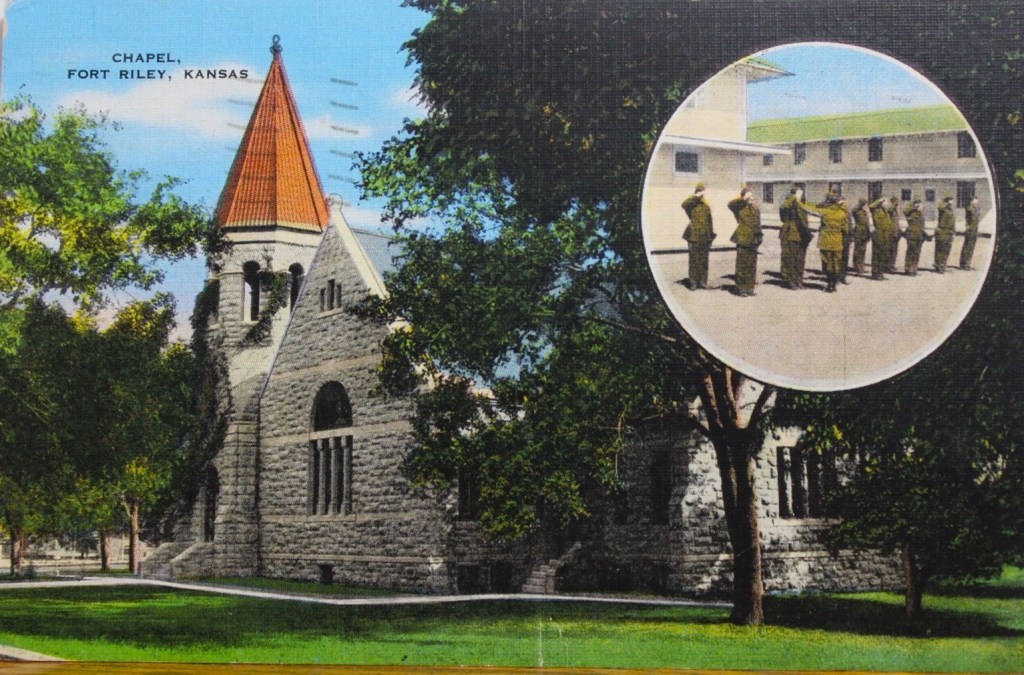
“A postcard sent from Fort Riley on July 20, 1942, turned out to have great historical significance.”
FORT RILEY, KANSAS
During World War II, Fort Riley served as a major training and mobilization center for the United States Army. Thousands of soldiers passed through its gates, preparing for deployment overseas. The fort was home to several divisions and specialized units, and its facilities were expanded to accommodate the surge in personnel and activity.
Fort Riley was also notable for its contributions to military innovation and leadership, with many officers and enlisted men receiving advanced training. The base fostered a sense of community among soldiers and their families, despite wartime challenges. Its strategic location and resources made Fort Riley a key asset in the nation’s WWII efforts.
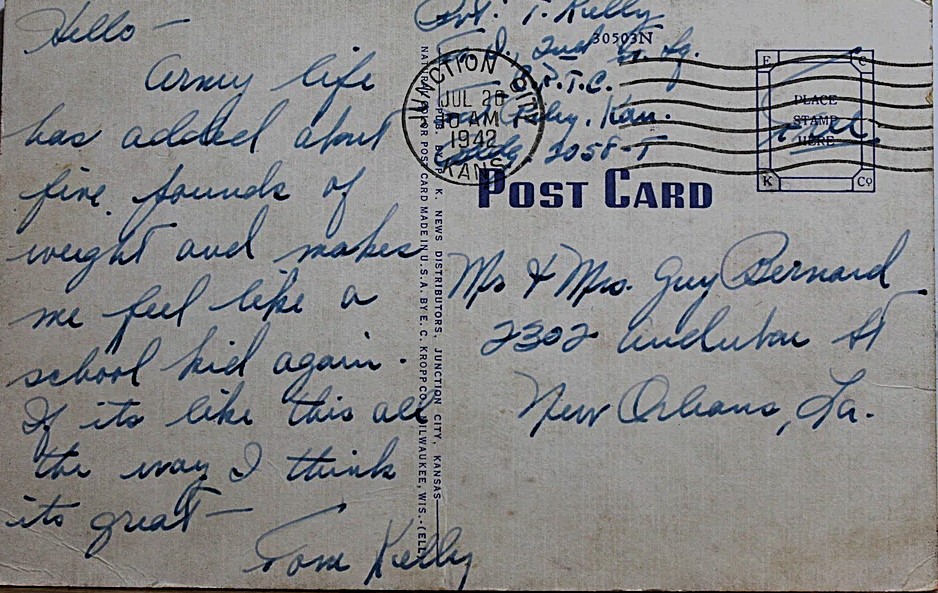
A postcard sent from Fort Riley on July 20, 1942, turned out to have great historical significance. Junction City, Kansas, is the town closest to Fort Riley, and is where the picture postcard was postmarked. A photo on the front shows the Fort Riley Chapel and some soldiers standing at attention.
The nicely penned message within, sent by Tom Kelly to Mr. and Mrs. Guy Bernard in New Orleans, Louisiana, offers a bit of insight into what the new recruit was going through. Unlike some soldiers who were unhappy, Tom was just the opposite
“Hello – Army life has added about five pounds of weight and made me feel like a school kid again. If its like this all the way I think its great. – Tom Kelly”
In the upper right-hand corner is Kelly’s rank and the Army company and unit he was with. It appears he enlisted as a private, but with four years of college, he was quickly moved up to 1st Lieutenant. This was quite common at the outbreak of the war.
The postcard recipients, Guy Bernard and his wife, undoubtedly meant something special to the soldier for Tom to write them. Guy Bernard was a music teacher, with Thomas Kelly evidently one of his students.
Thomas W. Kelly Jr. attended Loyola University, majoring in music. He went by the nickname “Tom” to friends. Archived newspapers show that he played the trumpet and was involved in numerous college musical presentations.
Prior to enlisting, Tom had been briefly married to Elva Cullen, but sadly, she divorced him before he left for war. Part of Kelly’s training took place at Camp Ibis in California, a mere 60 miles from where I live. Camp Ibis now exists only as a ghost base, with some building foundations still remaining. General George Patton was the head of Kelly’s 4th Armor Division.
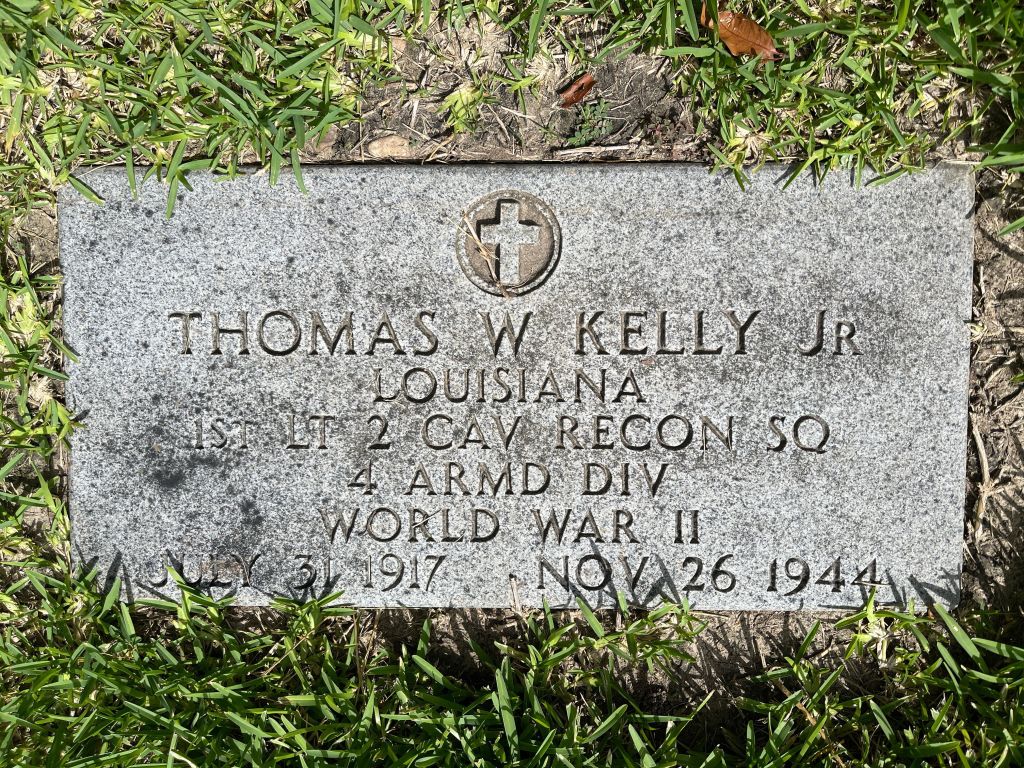
Tragically, 1st Lieutenant Thomas W. Kelly, born on July 31, 1917, was killed in action during the Battle of Normandy on November 25, 1944, at the age of 26. He was initially laid to rest in France, with his remains eventually returned to the States and reburied in Texas, most likely at the request of his parents. I would label him a hero.
Records show that his ex-wife, Elva, who was remarried at that time, tried to apply for military death benefits from her late ex-husband. It does not appear that she was successful.
Lt. Kelly was posthumously awarded the Purple Heart, the American Campaign Medal (Europe/Africa), and the WWII Victory Medal (Middle East). A cross atop his tombstone indicates he was a Christian.
The postcard recipient, Guy Frank Bernard, was born May 21, 1905. His wife’s name was Henrietta, although she went by Nettie. Mrs. Bernard was from Texas. Guy Bernard remained a music instructor up until his retirement. Guy died on March 12, 1982, while Nettie passed away on May 14, 1985.
Tom Kelly’s postcard, mailed to the couple 84 years ago, must’ve meant something special to them—for it to have survived!
“The surname Hankins is a family name with deep historical roots, primarily found in English-speaking countries.”
Stephen Green Hankins
Digging into one’s family history can be both interesting and challenging at the same time. I was interested enough, early on, to ask my grandparents about their kin, but unfortunately, I didn’t retain it all. Thanks to modern genealogy research tools and old newspapers, I’m able to fill in some blanks, going all the way back to 1420.
I did a good amount of investigating on my own, but the majority of this digging was actually performed by my late Aunt Dora Hankins-Guyton, as she traveled to courthouses and old libraries to track information down. Thankfully, she passed this data along to my brother and me. Dora was helped by other relatives, including my Cousin Pat Wheeler-Smith.
The surname Hankins is a family name with deep historical roots, primarily found in English-speaking countries. Understanding the origins and evolution of the name Hankins provides insight into genealogy, migration patterns, and cultural history.
Hankins is generally considered to be of English origin. The name is a patronymic form, derived from “Hankin,” which itself is a diminutive of the Middle English personal name “Han” or “Hank.” The suffix “-kin” was commonly added in medieval England to indicate “little” or “son of,” so “Hankin” would mean “little Han” or “son of Han.” Over time, the patronymic “-s” was added, forming “Hankins,” which denotes “son of Hankin.”
The name Hankins began to appear in written records in England during the Middle Ages, especially in regions such as Gloucestershire, Warwickshire, and London. Surnames became increasingly necessary as populations grew and communities expanded, helping to distinguish individuals with common given names.
During the 17th and 18th centuries, bearers of the surname Hankins migrated to North America, Australia, and other parts of the British Empire, spreading the name further afield. In the United States, the name became established and can be found in census and vital records dating back to colonial times.
Variants of the surname include Hankin, Hankinson, Hankins, and Hanks. These names share similar origins and often appear in historical records in overlapping regions.
Today, the surname Hankins is most commonly found in the United States, the United Kingdom, Canada, and Australia. In the U.S., it is especially prevalent in the southern and midwestern states.
While not as common as some other surnames, Hankins has maintained a steady presence in public life, with bearers contributing to a variety of fields, including sports, academia, literature, and the arts.
The first Hankins in my direct line is William Hankins. Born in England in 1420, he died there at a relatively young age in 1460.
Reverend Thomas Hankins was the Vicar of Dymocke in the Church of England. Born in 1462, he died in 1538. Buried in England.
John Hankins was born in 1515. He died in 1597 in England.
William Hankins was born in 1545 in England, with the exact date of his death unknown. Buried in England.
William Daniel Hankins was born in 1565 and passed away in 1619. Buried in England.
Thomas William Hankins lived in England. He was born in 1590 and died in 1639. Buried in England.
Charles Richard Thomas Hankins is the first of my kin mentioned as being in America. Born in Berkshire, England, in 1610, he most likely came here around 1630. He died in Monmouth, New Jersey, in 1692.
Richard Hankins. Born in Virginia in 1652, he died in New Jersey in 1749.
Thomas John Hankins. Born in 1700, he died in 1748. Buried at the Hankins Cemetery in New Market, Tennessee.
Richard Hankins. Born in 1733, he died in 1800. Buried in the Hankins Cemetery in Lamar County, Alabama.
John Alvin Hankins. 1775 – 1843. Buried in Old Hankins Cemetery in Lamar County.
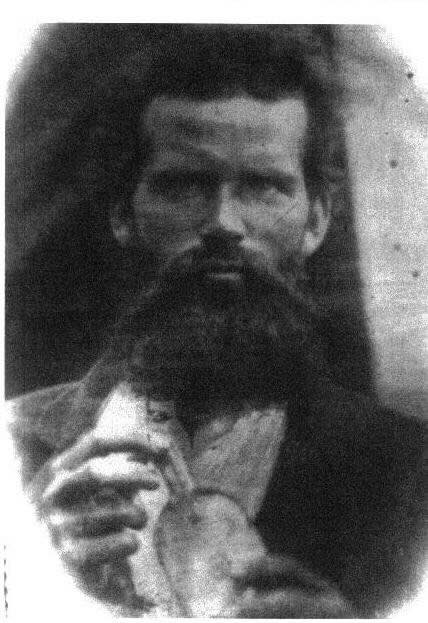
Stephen Green Hankins. Born in 1805, he had 13 children via two wives. Three of his eight sons died in the American Civil War. Stephen had a large plantation and owned slaves. After the war, he set them free and gave each a portion of land. Stephen died in 1870. Buried at Oakes Cemetery in Lamar County.
Shelby Allen Hankins. 1849 – 1922.
James Burton Hankins. 1869 – 1952. A deeply religious man, I was told by my parents that he often preached at a small church in Lamar County, Alabama. James died two years before I was born.
Houston Alexander Hankins (my initial grandfather on a list of 15). My father’s father. 1900 – 1966. Buried in Lamar County.
I have so much more information on our family, but I wasn’t trying to write a book here. On a side note, there was a time when I thought I was the only Michael Hankins in the US. Turns out there are 264 of us.
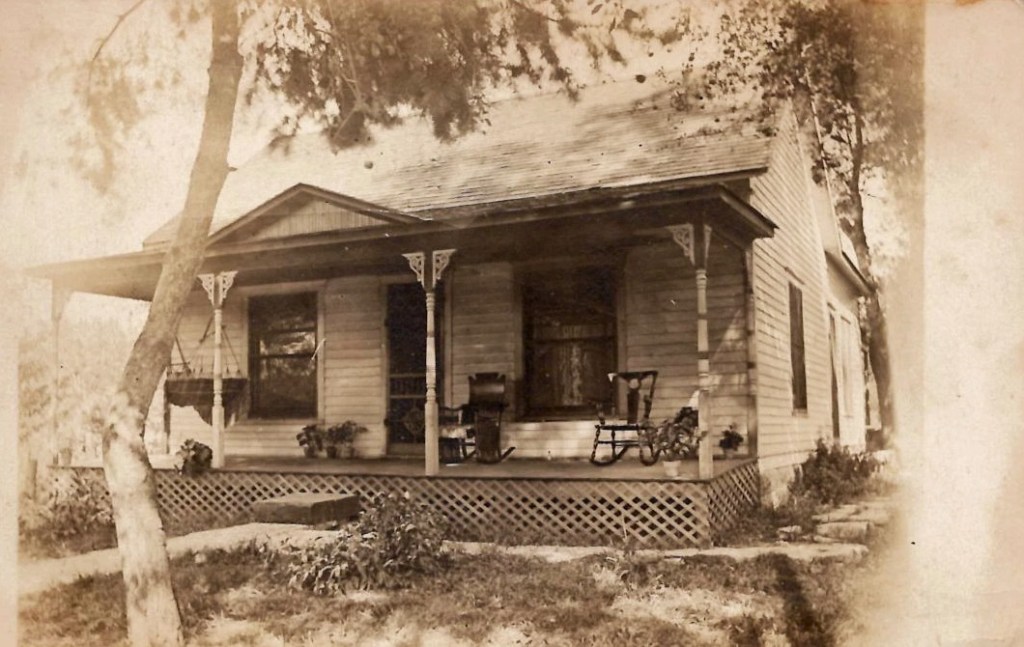
“A picture postcard mailed from Dunlap, on January 3, 1910, has a photograph of the residence of W.H. Robinson.”
William H. Robinson’s home in Dunlap, Kansas
Dunlap, Kansas, is a small, unincorporated community with a rich history marked by its role in post-Civil War migration and its unique place in the story of African American settlement in the Midwest. Located in Morris County, Dunlap’s legacy is intertwined with the Exoduster movement and the settlement of freed individuals seeking new opportunities after emancipation.
Dunlap was founded in the late 19th century, named after Joseph G. Dunlap, an early settler and entrepreneur who played a significant role in the community’s establishment. The area was originally part of the Great Plains, inhabited by various Native American tribes, including the Kansa and Osage, before white settlement began in the region.
The arrival of the Atchison, Topeka, and Santa Fe Railway in the 1870s spurred more rapid development. The railway provided crucial access to markets and transportation, encouraging settlement and economic growth in the area.
One of the most significant chapters in Dunlap’s history began in the late 1870s and early 1880s with the influx of African American settlers known as “Exodusters.” Fleeing racial violence and economic hardship in the post-Reconstruction South, many Black families migrated to Kansas, inspired by its reputation as a free state and the legacy of abolitionist John Brown.
Benjamin “Pap” Singleton, a prominent African American leader and former slave, played a pivotal role in encouraging this migration. He and others led groups of Exodusters to settle in Dunlap and surrounding Morris County, establishing one of the most significant Black farming communities in Kansas. These settlers built homes, churches, schools, and businesses, creating a thriving and resilient community despite facing significant social and economic challenges.
By the 1880s, Dunlap had become a vibrant town with a diverse population. The African American settlers established their own churches, including the St. Paul African Methodist Episcopal Church, and built schools such as the Dunlap Colored School, which provided education for Black children in the community.
The town supported several businesses, farms, and social organizations. Despite segregation and discrimination, the Exoduster community in Dunlap achieved a degree of self-sufficiency and prosperity, contributing to the broader story of Black migration and settlement in the American Midwest.
Dunlap’s fortunes began to decline in the early 20th century. Economic hardships, including the Great Depression and the Dust Bowl, led many residents to leave in search of better opportunities elsewhere. The consolidation of rural schools and the decline of the railroad also contributed to the town’s dwindling population.
By the mid-20th century, Dunlap had largely ceased to function as a distinct town, and many of its historic buildings were lost or fell into disrepair. However, the legacy of the Exodusters and their descendants remains an important part of the region’s history. Efforts to preserve and commemorate Dunlap’s past continue through historical societies, reunions, and educational initiatives.
Today, Dunlap is an unincorporated community, a ghost town, with only a few remaining residents and structures. The nearby cemeteries, such as the Dunlap Cemetery and the St. Paul AME Cemetery, serve as reminders of the town’s unique heritage and the enduring legacy of the African American pioneers who once called it home.
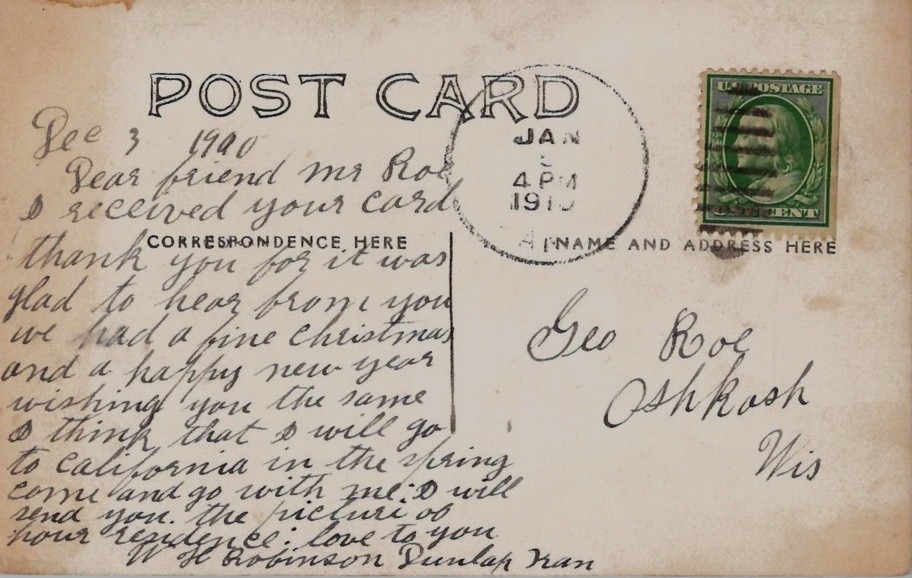
A picture postcard mailed from Dunlap, on January 3, 1910, has a photograph of the residence of W.H. Robinson. This card was sent to his friend, George Roe, in Oshkosh, Wisconsin. A nicely written message, transcribed as written, says:
“Dec 3 1900
Dear friend Mr. Roe
I received your card. thank you for it was glad to hear from you. we had a fine Christmas and a happy new year. wishing you the same. I think that I will go to California in the spring. come and go with me: I will send you the picture of our residence: love to you
W.H. Robinson Dunlap Kan“
Mr. Robinson was somewhat confused, as the card was mailed in January, although it was supposedly written in December. He also corrected the date from 1900 to 1910.
William H. Robinson was born in Ohio in 1844. He married around 1885 to a woman from Illinois named Mary. The couple had two children, Arthur and Sarah. William was a farmer and horticulturist.
William and Mary moved to Long Beach, California, in 1919. William H. Robinson passed away in 1924, while his wife died in 1936.
George Roe, the postcard recipient, was born in England on November 22, 1882. He was a woodworker by trade, owning a small shop in Oshkosh. George married wife, Lydia, around 1917. They had three children, Evelyn, Rexford, and Lydia. George died in 1959, with Lydia passing away in 1983 at the age of 97.
Unlike the Robinsons, who moved to California from Kansas, the Roes stayed put in Wisconsin. Both are buried in the small city of Omro.
“Citizens were encouraged to write the soldiers for encouragement and to lift their spirits.”
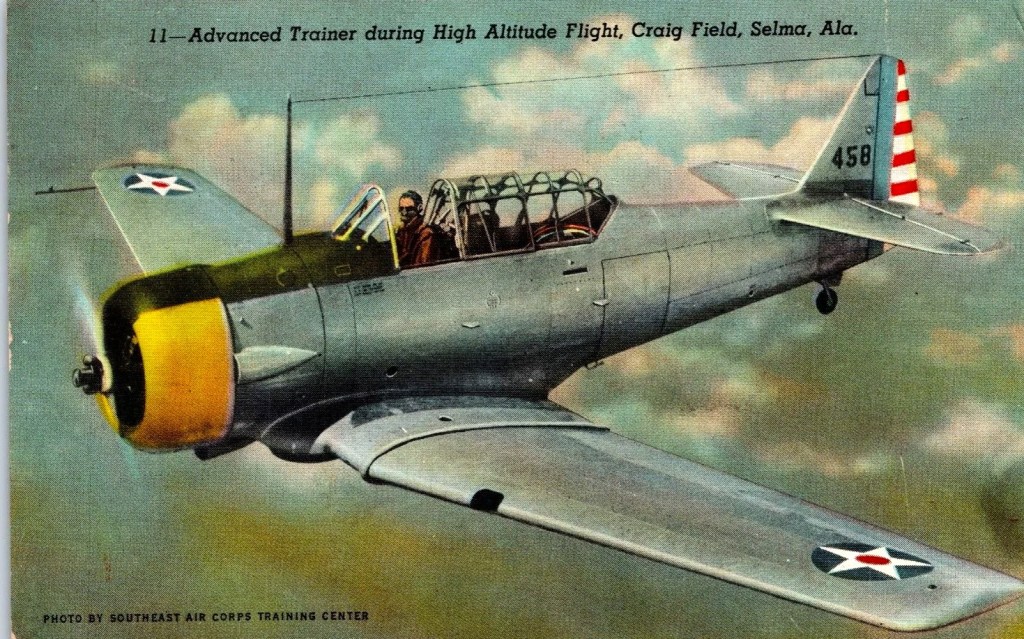
Craig Field AT-6 trainer
A picture postcard showing an Army Air Corps training airplane on the front was sent to Miss Sue Howard of Mt. Vernon, Illinois, on September 16, 1942. The sender was Private Anthony “Tony” J. Infantino, who was at the base during this time. Infantino’s postcard has a Selma postmark. His message to Sue was a polite and cordial one.
“Stopped here and will soon be on our way to Texas by plane. Will write later. Your pal, Tony”
Craig Field, located near Selma, Alabama, was a significant military airfield during World War II. Established as part of the United States’ rapid expansion of air training facilities, Craig Field played a vital role in preparing pilots for combat and supporting the broader war effort. This overview explores the history, operations, and legacy of Craig Field during the WWII era.
The base was constructed in 1940 as the threat of global conflict grew and the United States recognized the need to train a vast number of aviators. Named in honor of Lieutenant Bruce K. Craig, a military aviator who lost his life in service, the field became operational in early 1941. Its primary mission was to serve as an advanced pilot training base under the Army Air Forces’ Southeast Training Center.
During WWII, Craig Field was primarily dedicated to advanced flight training. Cadets, having completed basic flight instruction elsewhere, arrived at Craig for rigorous, comprehensive training on advanced aircraft.
The base specialized in transitioning pilots to operate single-engine fighter planes and multi-engine bombers, crucial to the Allied air campaign. Training included instrument flying, formation maneuvers, navigation, and aerial combat tactics.
Thousands of American and Allied pilot trainees passed through Craig Field during the war. The influx of personnel brought economic growth and increased activity to the surrounding Selma community. The base employed both military and civilian workers, fostering a sense of shared purpose in the national war effort.
Craig Field operated a variety of aircraft, including the North American AT-6 Texan, which was widely used for advanced pilot training. The field was equipped with modern runways, hangars, and support facilities, reflecting the technological advancements of the era. The curriculum emphasized proficiency in the latest aviation technology and combat readiness.
The pilots trained at Craig Field went on to serve in every theater of World War II, flying missions over Europe, the Pacific, and North Africa. The field’s rigorous training programs ensured that aviators were well-prepared for the challenges they would face in combat. Craig Field thus played a pivotal role in the overall success of the U.S. Army Air Forces during the war.
With the end of WWII, Craig Field continued to serve as a training and operational base, adapting to the needs of the emerging U.S. Air Force. Its contributions during WWII are remembered as a key chapter in the history of American military aviation, and the field’s legacy endures in both the region and the broader context of air power development.
Craig Field’s history during World War II is marked by its critical function as a center for advanced pilot training, technological innovation, and community involvement. Its legacy reflects the determination and teamwork that underpinned the Allied victory in the air war.
At Craig Field for a brief time, Pvt. Anthony Infantino was probably on his way to Randolph Field near San Antonio for further training. He was born on July 22, 1919, in New York. Enlisting in the Army at the age of 23, tragically, Tony was killed in action (KIA) while parachuting into enemy territory in the Netherlands.
This happened on March 24, 1945, with his remains not brought back to the States until 1948, where it was interred in his hometown of Pawling, New York. Flags were lowered to half staff, with quite a few residents turning out for the service. Tony’s young friend may have never known.
Sue Howard was much younger than Tony, and judging by the context of the postcard message, their relationship was strictly one of friendship. Perhaps she was more of a pen pal than anything. Citizens were encouraged to write the soldiers for encouragement and to lift their spirits. This nationwide campaign was called V-MAIL, or Victory Mail.
Miss Betty Sue Howard married Eugene L. Delves on March 27, 1954. The couple stayed together until their deaths. Eugene passed away in 2011, and Betty Sue, seven years later, in 2018.
Private Anthony “Tony” InfantinoBetty Sue Howard-Delves1954
“I just don’t like the idea of someone going through our mail and then writing a story about what they found.”
A while back, I started compiling vintage postcards and then researching the people who had sent them, including those on the receiving end. My goal was to dissect 50 postcards and then stop, which I did. Since stopping—I’ve been asked to continue my work with a book offer on the table.
There are postcard books out there, yet none that I’ve found where the book author went so far as to do background searches on people mentioned in the cards. “Postcard People,” as I call them. I’m sure someone will come along and do exactly that, but it won’t be me.
I get more satisfaction out of people reading my discoveries for free rather than trying to make an extra dollar hawking this material. Folks read my blog by the thousands, with payment being a like, thumbs up, or nice comment. Those gestures alone keep me writing.
The pressure of compiling another book turns me off more than anything, especially with book marketing almost non-existent for the little guy or gal. “Who you know” plays a big part in the literary field just as it does in music.
Some celebrities, sports stars, and politicians hawk their latest books on late-night television, although the finished product might stink. That global marketing reaches millions of people and sells tons of books.
A best seller doesn’t always mean it’s a good read—only that it was well promoted. I’ve purchased a couple of expensive best-sellers and stopped reading them less than halfway through. With that said, it’s time to get back to talking postcards, or is that postcards talking?
The act of sending postcards has long been a cherished tradition around the world. From the late 19th century to the present day, postcards have captured moments, shared stories, and connected people across distances. I’ll lightly touch upon how postcards evolved from simple pieces of mail into treasured keepsakes that reflect social, cultural, and technological changes throughout the years.
The concept of the postcard emerged in the mid-1800s as postal services expanded and literacy rates increased. The first known postcard was sent in 1840 by writer Theodore Hook in London, but it was not until 1869 that the Austrian postal service officially introduced the “Correspondenz-Karte.” This innovation offered a cheap, convenient way for people to send short messages without the need for an envelope, revolutionizing personal communication.
The idea quickly spread across Europe and beyond. By the 1870s and 1880s, countries such as Germany, France, and the United States had adopted postcards as part of their postal systems. Early postcards were typically plain, but soon, decorative illustrations and photographs appeared, turning them into miniature works of art. The Golden Age of Postcards, spanning from the 1890s to the 1910s, saw millions of postcards exchanged annually, capturing travel scenes, local landmarks, holidays, and personal messages.
Postcards played an important role in social life, offering a quick and accessible method for people to stay in touch. Travelers sent postcards to family and friends as souvenirs or updates from their journeys. Soldiers used them to communicate with loved ones during wartime, providing comfort and maintaining connections across great distances. Postcards also became tools for advertising, political campaigns, and public service announcements.
The rise of telephones and, later, digital communication methods such as email and messaging apps led to a decline in postcard usage. However, postcards remain popular among collectors and enthusiasts, and many people still send them as a personal touch from travels or on special occasions. The advent of customizable and digital postcards has allowed the tradition to persist in new forms, blending nostalgia with modern convenience.
Sending postcards has become more than just a way to convey information; it represents a unique intersection of art, culture, and personal expression. Collectors prize vintage postcards for their historical value and design, while contemporary aficionados appreciate the tangible connection they provide in an increasingly digital world. Count me in with that group.
Postcards continue to serve as artifacts of social history, capturing snapshots of everyday life and commemorating important events.
The history of sending postcards reveals a fascinating journey from simple cards to beloved keepsakes. While the way people communicate has changed dramatically, the postcard endures as a symbol of connection, creativity, and shared experience—reminding us of the enduring value of a personal message sent across the miles.
Mom and her two sisters loved to send postcards when they went on trips. My brother did as well. Joleen and I sent postcards, but over the past 20 years, we’ve mailed very few.
Some of the cards that Mother sent, I still possess, including several from other folks. I’ll hang onto them and make sure they don’t go public or are sold on eBay. Not that there’s anything shady lurking in my family’s past, that I know of, but I just don’t like the idea of some writer going through our mail and then composing stories about what they uncovered. There should be a law against it, or perhaps there already is 😊
“Imagine that you are Miss Ruby Ellens, having just received this card, or better yet, Ruby’s father.”
Main Street – Yuma, Arizona
Yuma Army Air Field, located near Yuma, Arizona, played a significant role during World War II as a key training base for military aviators. Established in 1942, the airfield was part of the United States Army Air Forces’ rapid expansion to meet wartime demands for skilled pilots and aircrew.
Throughout the war, Yuma Army Air Field hosted advanced flight training for thousands of cadets, specializing in single-engine aircraft. Its vast desert terrain provided ideal conditions for year-round flying and rigorous training exercises. The base operated various aircraft types, including the AT-6 Texan and P-40 Warhawk, and contributed to the preparation of pilots for combat missions across multiple theaters.
In addition to flight training, the airfield supported gunnery and bombing practice, further enhancing the capabilities of U.S. air forces. After the war ended in 1945, the base was deactivated but later reopened and evolved into today’s Marine Corps Air Station Yuma, continuing its legacy as a vital military aviation facility.
Private C.W. Hilleboe was assigned to the Yuma airfield at the start of WWII. I know this much because I have a picture postcard the private sent Miss Ruby Ellens in Sioux Falls, North Dakota, from Yuma, 71 years ago, on October 1, 1944. The card has a color shot of Yuma’s Main Street on the front, also showing older automobiles of the period.
Before I go any further, let me say that I’ve come across numerous vintage newspaper articles along with postcards having racist undertones. For the most part, I don’t include them in my stories, but in this case, the message that Pvt. Charles William “Bill” Hilleboe sent Ruby Ellens may have been the very reason this couple didn’t stay together.
I decided to print his short note, as written, to prove my point. Imagine that you are Miss Ruby Ellens, having just received this card, or better yet, Ruby’s father. Perhaps Bill didn’t mean what he said, but unfortunately, things came out wrong, especially where drinking alcohol is concerned.
“10-1-44
It isn’t that clean, believe me.
Here’s the card I promised to send you. I would have sent it sooner but last night was my first night in town, also my last. The town is no good. All you see are Mexicans and halfbreeds. One thing though they have plenty of liquor. Believe it or not, I didn’t touch it last night. I am waiting until I get home. Will write you a letter soon. Love, Bill.”
Ruby Jean Ellens was born on February 16. 1922, in Minnehaha, South Dakota. She came from a very religious family, and she was highly active in church as a young person.
Charles William “Bill” Hilleboe was born on March 5, 1924, in Minneapolis, Minnesota. Enlisting in the US Army on June 27, 1942, at the age of 18, he was only 20 when he wrote Ruby Ellens.
Pvt. Hilleboe served as a radio operator on B-17 and B-24 bombers during WWII. He married Barbara Ellen Doherty on June 29, 1946, but that marriage didn’t last. They divorced on May 19, 1950.
Bill then wed Iva Maurine McKinney on October 9, 1950. After leaving the service, he worked as a depot agent for Union Pacific Railroad for 37 years before retiring. Mr. Hilleboe was also mayor and city councilman of his hometown in Idaho, and an active Lions Club officer and participant. The couple had three children.
Bill and Maurine stayed together for 53 years before she died in 2004. Bill died one year later, on May 10, 2005, at the age of 81.
For those wondering what happened to Miss Ruby Jean Ellens, stay tuned for my next story, “Yuma Blues – Part Two.”
“The word Blythe alone doesn’t conjure up an oasis or vacation destination for me.”
Lonely and desolate
During WWII, there were several airfields in and around our neck of the woods. My mother always used that term when describing her hometown in Alabama. Works for me here in Arizona, although there are no woods within sight; only rocks and sagebrush out my back door, along with the lake.
Lake Havasu City had yet to become a dream in developer Robert McCulloch Sr’s eyes when a military airfield was built on what’s now called “The Island.” That facility was simply named Site 6 and was used as a recreational site more than anything. On occasion, a civilian airplane experiencing engine trouble landed there for repairs.
Yucca had a military base, as did Kingman and Yuma. What some people don’t realize is that an Army Air Base at Blythe, California, played a significant role during World War II as a training and operational facility for the US Army Air Corp.
Established in 1942, the base was strategically located in the desert of Riverside County, which provided an ideal environment for flight training due to its generally clear weather and vast open spaces.
Blythe Army Air Base primarily served as a training ground for bomber crews, including those assigned to fly B-17 Flying Fortresses and B-24 Liberators. The facility was part of the larger West Coast airfield network, supporting the war effort by preparing air crews for combat missions overseas. Personnel stationed at Blythe underwent rigorous training in navigation, bombing techniques, and aerial gunnery.
In addition to its training functions, Blythe Army Air Base supported various operational units and hosted several temporary deployments. Its airstrips and facilities were also used for aircraft maintenance and logistics operations. The base contributed to the overall readiness of the Army Air Forces, helping to ensure the effective deployment of trained airmen to the European and Pacific theaters.
After the end of World War II, Blythe Army Air Base was deactivated and eventually repurposed for civilian use, becoming Blythe Airport. Today, its legacy endures as a reminder of the region’s contribution to the nation’s wartime aviation history.
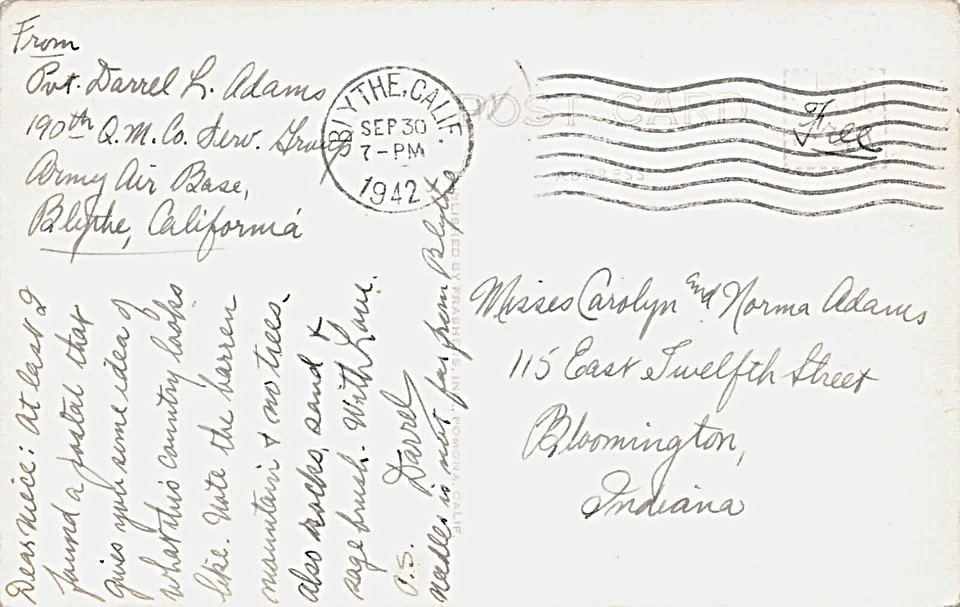
A postcard I acquired was sent by Pvt. Darrel L. Adams to his two nieces in Bloomington, Indiana, Carolyn and Norma Adams, while the private was stationed at Blythe Army Air Base in California. The message on this card briefly describes his surroundings:
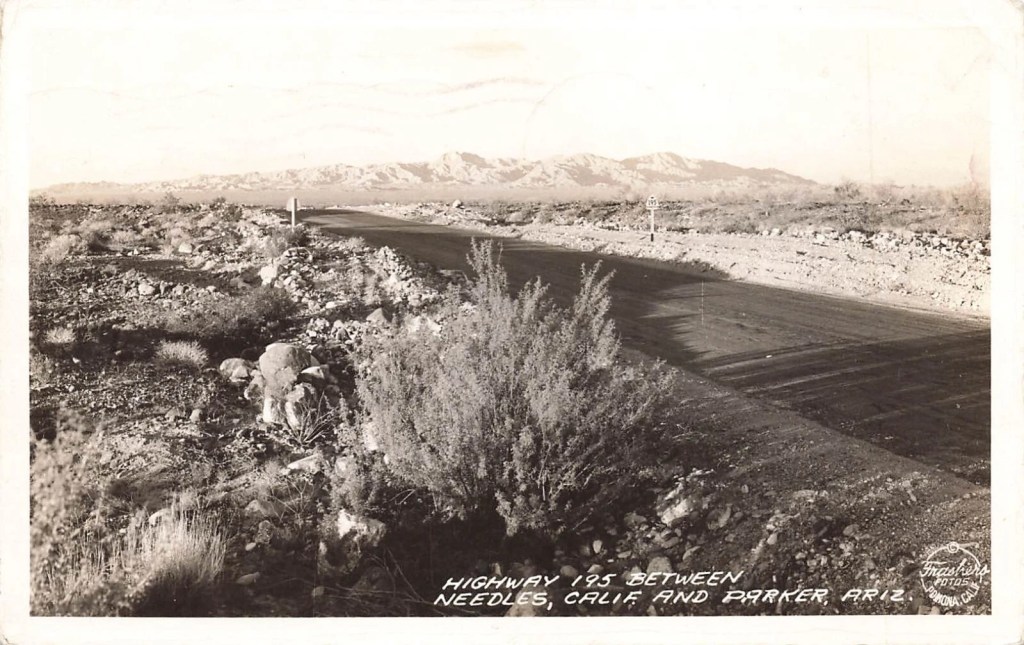
“Dear Niece: At last I found a postal that gives you some idea what this country looks like. Note the barren mountain & no trees, also rocks, sand, & sage brush. With love, Darrel. P.S. Needles is not far from Blythe.”
Darrel’s black & white postcard shows a picture of a bleak section of Highway 195 from Needles to Parker. The word Blythe alone doesn’t conjure up an oasis or vacation destination for me. This vintage postcard was postmarked in Blythe on September 30, 1942, with the return address being,
Pvt. Darrel L. Adams
190th. Qm. Co. Serv. Group
Army Air Base
Blythe, California
I wasn’t sure what I’d find regarding the card sender and recipients, greatly hoping that Pvt. Adams made it through the war alive. Thankfully, things turned out well for all three people.
Private Darrel Adams was honorably discharged from the US Army in 1945 after WWII ended. Adams went on to become a custodian for an office building. Previous to enlisting in the service, he declared his occupation on a 1940 census report as a professional projectionist. Born in 1921, Darrel Lewis Adams died in 1988 at the age of 77.
Carolyn June Adams was born August 24, 1925, and would’ve been 17 when Uncle Darrel sent that postcard to the girls. Carolyn’s sister, Norma, was only 14, having been born on March 7, 1928.
Carolyn married Roy Henry Torbit on May 5, 1944, while her sister Norma wed a guy named Ted Lee Fox in 1948. A previous marriage for Norma had failed. Carolyn died in 2000 at the age of 75, with younger sister Norma outliving her, passing away in 2012 at the age of 84.
I found nothing outrageous or controversial about Darrel, Carolyn, or Norma Adams. Their lives were what I call routine where ‘postcard people’ are concerned—much unlike “The Adams Family” of television fame.
Postcard people is a new terminology I’ve given to the sender and recipients of vintage postcards. If things catch on, there’s a very slight chance it’ll go viral!
“With the name of Lucksley, Virginia’s husband should’ve also been on that Vegas trip.”
Flamingo Hotel – Las Vegas, Nevada
Las Vegas, a city celebrated for its neon-lit nights, high-stakes glamour, and ceaseless entertainment, owes much of its iconic identity to one particular establishment: the Flamingo Hotel. Steeped in both glitz and intrigue, the Flamingo was more than just a hotel—it was a turning point in the transformation of Las Vegas from a dusty railroad town into the entertainment capital of the world.
The story of the Flamingo Hotel begins in the mid-1940s. At that time, Las Vegas was a modest settlement with a handful of casinos clustered in its downtown area. The seeds of expansion, however, had been planted by several visionaries, among whom Billy Wilkerson stood out.
Wilkerson, publisher of The Hollywood Reporter, dreamed of building an opulent resort outside the city limits on a stretch of highway that would become the world-famous Las Vegas Strip. He envisioned a luxury hotel with fine dining, lavish entertainment, and a casino that catered to Hollywood’s elite.
Construction on Wilkerson’s dream began in 1945, but he soon ran into financial trouble. It was at this critical juncture that the infamous Benjamin “Bugsy” Siegel entered the picture. Siegel, a notorious figure in the world of organized crime, saw the potential in Wilkerson’s project. Backed by mob syndicate funding, Siegel took over the construction and poured money into the venture, determined to create the most dazzling resort Las Vegas had ever seen.
The Flamingo Hotel and Casino officially opened its doors on December 26, 1946. The opening was anything but smooth. Construction delays, budget overruns—reportedly ballooning to $6 million, a staggering sum at the time—and a rainstorm that dampened opening night festivities made for a rocky start. The unfinished hotel failed to impress its celebrity guests, and the casino lost money in its first few months.
Despite these setbacks, the Flamingo was a marvel of its time. It boasted luxurious accommodations, lush gardens, an Olympic-sized swimming pool, and a showroom that would host some of the biggest names in entertainment. The hotel’s pink neon sign and tropical motif set it apart from the Western saloons and low-slung casinos of downtown. Siegel was determined to make the Flamingo succeed and spent lavishly to cement its reputation as the finest resort in Las Vegas.
However, the financial troubles continued. By June 1947, the Flamingo still had not turned a profit. The mob investors grew impatient, and on June 20, 1947, Siegel was assassinated in Los Angeles. With Siegel’s death, Gus Greenbaum took over management, and the Flamingo finally began to thrive.
The Flamingo’s success reshaped the Las Vegas landscape. Its location—a couple of miles south of downtown along Highway 91—became the blueprint for future resort developments. Soon, other lavish hotels followed: the Desert Inn, the Sands, the Sahara. The Las Vegas Strip was born, and the Flamingo stood as its glamorous pioneer.
Throughout the 1950s and 1960s, the Flamingo played host to a who’s who of entertainers: Frank Sinatra, Dean Martin, Sammy Davis Jr., and Judy Garland graced its stage. The hotel became synonymous with high-class entertainment, drawing crowds from across the country. Its casino was the playground of gamblers and celebrities alike, and its poolside gardens became the ultimate symbol of postwar leisure.
Over the decades, the Flamingo underwent numerous expansions and renovations. The original low-rise wings were demolished in the 1960s to make way for larger towers, as the hotel adapted to the boom in Las Vegas tourism. The property changed hands several times—first to Kirk Kerkorian, who acquired it in the late 1960s, and then to Hilton Hotels Corporation in the 1970s. Each new owner invested in upgrades, ensuring the Flamingo remained competitive with newer resorts.
By the late 20th century, the Flamingo had become a sprawling complex, with over 3,600 rooms, sprawling gardens, and one of the largest casinos on the Strip. However, it always maintained its signature pink and tropical theme, a nod to Siegel’s original vision.
In the 1990s, the Flamingo became part of the Hilton chain, and later, following a series of mergers, was operated by Caesars Entertainment. The resort continued to reinvent itself to meet changing tastes, introducing new restaurants, nightclubs, and entertainment options.
One of the Flamingo’s most charming features is its famous wildlife habitat—a lush sanctuary filled with Chilean flamingos, swans, ducks, koi, and turtles. This tranquil oasis offers a refreshing contrast to the bustling casino floor and continues to delight visitors today.
The Flamingo’s entertainment legacy lives on, now featuring successful residencies and shows such as Donny and Marie Osmond, RuPaul’s Drag Race Live!, and other acclaimed productions. Its wedding chapel remains a popular choice for couples seeking a touch of Vegas glamour on their special day.
The Flamingo occupies a unique place in the cultural imagination. Its beginnings are entwined with the lore of the American mob, the glamour of Hollywood, and the rise of Las Vegas itself. While the building itself has been replaced and expanded many times over the decades, its name is a direct link to the city’s storied past.
In film and television, the Flamingo has appeared as a backdrop to countless stories—its neon sign a beacon in the desert night. Its association with Bugsy Siegel and the mob has been immortalized in movies such as “Bugsy” (1991) and in numerous books and documentaries about Las Vegas.
Today, the Flamingo stands as both a monument to the past and a vibrant part of Las Vegas’s present. While new mega-resorts have risen on the Strip, the Flamingo remains a favorite for those seeking the nostalgia and charm of classic Las Vegas. Its pink facade, iconic signage, and tropical grounds continue to invite guests into a world of fun, fantasy, and history.
More than seven decades after its opening, the Flamingo Hotel and Casino has seen triumph and tragedy, reinvention and renewal. Its history is the history of Las Vegas itself—a story of visionaries, risk-takers, and dreamers who turned a patch of desert into a playground for the world. As long as the neon lights shine on the Strip, the Flamingo’s legacy will endure, a symbol of glamour, resilience, and the ever-evolving magic of Las Vegas.
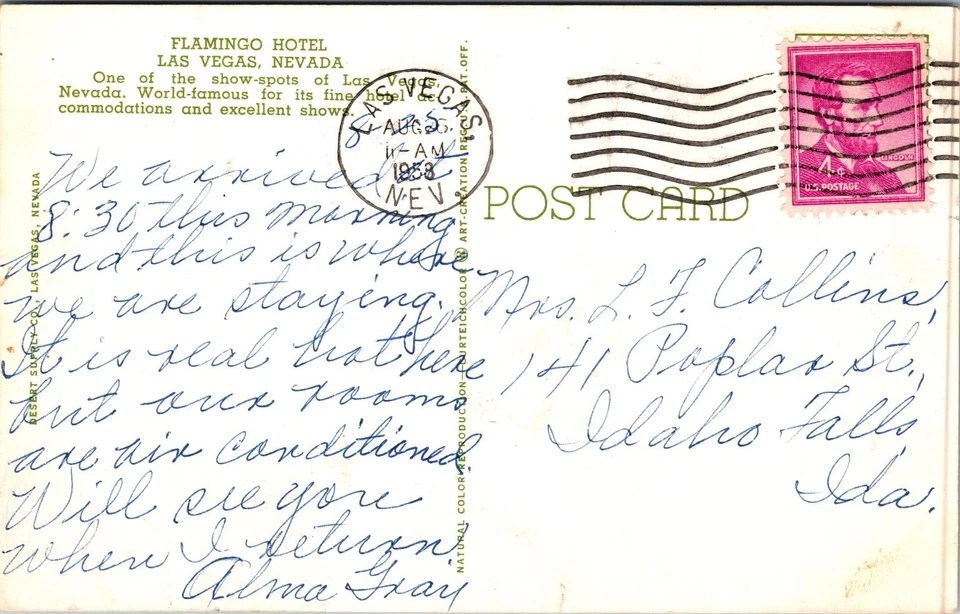
On August 26, 1958, Alma May Gray, of Idaho Falls, Idaho, visited Las Vegas for perhaps the first time. Only two years prior, on May 8, 1956, she’d lost her husband, Charles Thaddeus Gray. The couple had been married for 33 years.
I can only speculate here. Friends and family undoubtedly told Alma after Charles died that she needed to get out of the house more often, “Take a trip!” they said. Finding a good deal on a bus excursion from Idaho Falls to Las Vegas, she did just that. Alma’s postcard to Mrs. L.F. Collins described what she found once she got there.
“We arrived at 8:30 this morning, and this is where we are staying. It is real hot here but our rooms are air conditioned. Will see you when I return. Alma Gray.”
The person Alma wrote to, Mrs. L.F. Collins, was Virginia Grahame Parsons Collins. She went by her husband, Lucksley F. Collins, initials as many women did back in the day. With the name of Lucksley, Virginia’s husband should’ve also been on that Vegas trip.
Alma Mae Gray lived to be 91, passing away on June 26, 1989. Hopefully, she got to see more of the country before getting too old to travel. Her friend, Mrs. L.F. Collins, made it to 94, dying on July 30, 1980. It’s possible that Alma Gray and Virginia Collins eventually went on bus tours together, with Virginia’s husband, Lucksley, passing away in 1964.
On a bright note, the Flamingo Hotel still stands, a popular stopping off point for tour buses, automobiles, and air travelers from throughout the world.
The former Collins house in Idaho Falls, Idaho, is now undergoing new siding replacement
“Maude, Harry, and Minnie took that private information to the grave.”
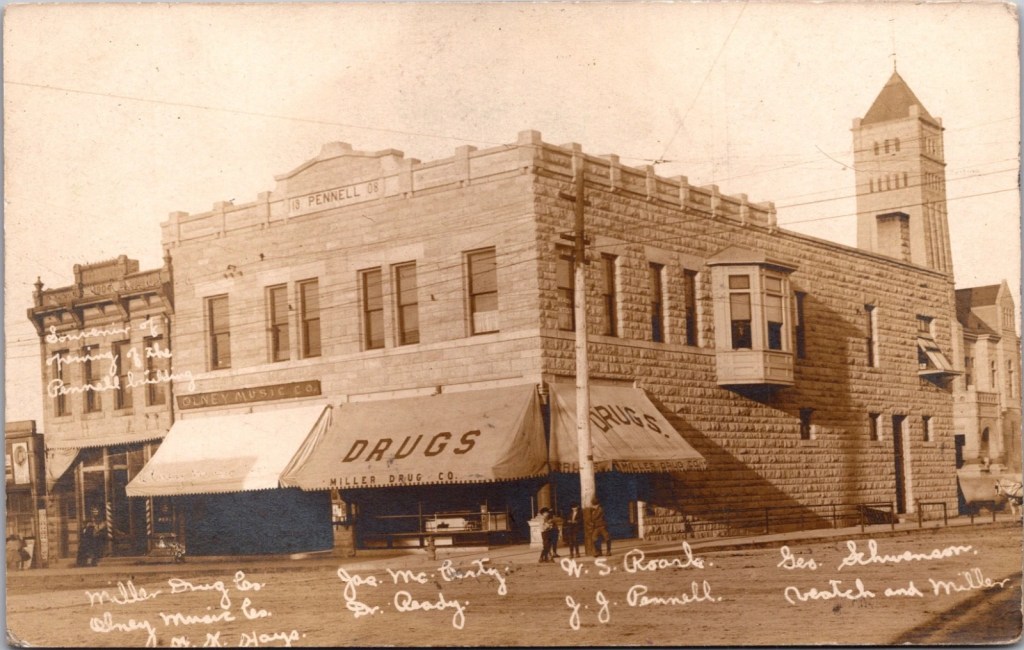
Pennell Building – Junction City, Kansas
An interesting old 1910 postcard I came across is actually a celebratory announcement of the opening of a new commercial building in Junction City, Kansas. The card sender was Maude K. of Junction City, with the recipient, Mr. Francis Bowman of Chapman, Kansas.
Given my familiarity with this structure and my wife’s birth in Junction City, I felt it was worthy of a full historical review of both entities. I’ll get to the biography of the sender and recipient at the end of my writing.
Located in the heart of Junction City, Kansas, the Pennell Building stands as a testament to the city’s commercial evolution and architectural heritage. For over a century, this structure has witnessed the ebb and flow of local history, entrepreneurship, and community life, earning its place as a cherished landmark in Geary County.
Junction City, founded in the mid-19th century at the confluence of the Republican and Smoky Hill Rivers, blossomed as a hub of trade and transportation thanks to the arrival of the railroad. As the city’s population and economic ambitions grew, so did the demand for more commercial square footage. It was against this backdrop, in 1887, that the Pennell Building was constructed.
Commissioned by William Pennell, a notable local entrepreneur and investor, the building was designed to be a prominent fixture in the city’s burgeoning downtown district. Its construction reflected both the optimism of Junction City’s business community and the Victorian architectural trends sweeping the nation during the late 1800s.
The Pennell Building quickly distinguished itself through its stately brick façade, tall arched windows, and intricate ornamental details, features that set it apart from the simpler wooden storefronts common at the time.
Upon completion, the Pennell Building became a prime location for a variety of businesses. Its ground floor was home to general stores, mercantile shops, and other retail ventures that catered to both locals and travelers passing through Junction City by rail or stagecoach. The upper floors housed professional offices, including lawyers, doctors, and real estate agents, further cementing the Pennell Building’s reputation as a commercial nucleus.
Throughout the late 19th and early 20th centuries, the building evolved alongside the city’s changing economic landscape. As Junction City grew, so too did the diversity of enterprises within the Pennell Building. It became home to everything from specialty boutiques and financial institutions to printing presses and small manufacturing companies. The building’s adaptability mirrored the resilient spirit of Junction City itself, which weathered economic booms and busts, wars, and periods of rapid growth.
Beyond its role as a commercial center, the Pennell Building played an integral part in the social and cultural fabric of Junction City. Its upper floors were often used for meetings, gatherings, and even small performances. Community organizations, fraternal orders, and social clubs found a home in the building’s spacious rooms, making it a lively gathering place for local residents.
The Pennell Building’s location on Washington Street, one of Junction City’s main thoroughfares, made it a focal point for parades, celebrations, and public events. Its distinctive architecture provided a charming backdrop for photographs and festivities, endearing it to generations of townspeople.
Its original brickwork, decorative cornices, and grand windows are characteristic of Victorian commercial architecture—a style that emphasized both function and beauty. Over time, the building underwent several renovations, but much of its historic character has been carefully preserved.
Local preservation efforts in the late 20th and early 21st centuries recognized the Pennell Building’s significance. When many historic structures in small-town America faced demolition, Junction City’s leaders and citizens rallied to protect their architectural heritage. Restoration projects ensured that the building’s façade remained true to its 19th-century origins, while interior spaces were modernized to accommodate new businesses and offices.
In recent decades, the Pennell Building has experienced a renaissance, reflecting broader trends in downtown revitalization across the United States. Its street-level spaces have been home to a range of businesses—from cafes and antique stores to local service providers and boutiques—each contributing to Junction City’s vibrant small-business ecosystem.
All upper floors, once the domain of professionals and organizations, have been adapted for modern offices and, in some cases, residential lofts. This adaptive reuse has breathed new life into the historic structure, attracting entrepreneurs and residents who value its unique blend of old-world charm and contemporary amenities.
Today, the Pennell Building remains a cornerstone of Junction City’s downtown district. Its red-brick silhouette continues to evoke the city’s storied past, while its bustling storefronts and renovated interiors signal a commitment to the future. For longtime residents and newcomers alike, the Pennell Building is more than just an old structure—it is a living symbol of the city’s resilience, adaptability, and sense of community.
Few buildings in Junction City encapsulate the city’s history as completely as the Pennell Building. Over more than a century, it has weathered fires, economic challenges, and changing urban landscapes. In doing so, it has provided a sense of continuity and identity for the community.
Its preservation is a testament to the dedication of local citizens who recognized the importance of maintaining connections to their shared heritage. Educational tours, historical exhibits, and community events held in or around the building continue to foster appreciation for the city’s past.
The story of the Pennell Building is, in many ways, the story of Junction City itself. Born of entrepreneurial vision, shaped by the currents of commerce and community, and preserved through collective effort, the building remains a vital part of the city’s cultural landscape. As Junction City grows and changes, the Pennell Building stands as a reminder that history is not only something to be remembered but something to be lived—brick by brick, generation after generation.
From its prominent architectural features to its ever-changing roster of businesses and its enduring role as a community gathering place, the Pennell Building exemplifies the rich tapestry of Junction City’s evolution. Its walls have witnessed the ambitions, struggles, and celebrations of countless residents, and its continued presence ensures that the city’s heritage remains a living, breathing part of daily life.
A message on my vintage postcard, written to Francis Bowman, reads as follows:
“November 28, 1928
Dear Cousin – Please tell those people that we will be out Thursday if it does not storm for the turkeys. Guess me will find you. And oblidge.
Maude K.”
Born on April 16, 1873, Mr. Francis Bowman was a farmer living in the Rinehardt agricultural area of Chapman. Several wealthy ranchers and farmers resided in the vicinity, including Joseph Strickler Hollinger and John Hiram Taylor. These two distinguished gentlemen are buried in the Rinehart Cemetery.
Francis and his wife Emma eventually moved to Woodbine in 1913, a distance of approximately 15 miles from Chapman. They had a son one year later, whom they named Martin. Newspaper accounts have Francis listed as a wealthy and industrious farmer. An interesting thing I found printed about his farming operation was that he purchased a manure spreader in 1913. This bit of news was perhaps placed in the newspaper as a form of subtle humor.
Francis Bowman died on December 1, 1936, at the age of 63. His wife Emma passed away in 1974, living to be 93. They’re both buried in Woodbine Cemetery. Their son, Martin, was a retired Rock Island railroad conductor. He died in Alabama on June 28, 2010, at the age of 95. His body was brought back and interred in Herington, Kansas, in Dickinson County.
Maude K. or Maude Kipperling was, of course, a cousin to Francis Bowman. She, along with husband Harry Hoover Kipperling, farmed in the Junction City area. There wasn’t much found about them in local newspapers, yet a 1940 census report had a ‘servant’ living with them, Minnie Stiner. That in itself seems unusual.
Minnie Stiner appears to be someone they knew who lost her husband. It also appears that the Stiners kindly took her in, with Minnie helping out around the house as payment. Why she told a census taker that she was the Kipperling’s servant seems most strange, almost humorous. My guess is that she didn’t want it to seem as if Harry had two wives.
The Ancestry.com website shows Harry Kipperling was born in 1878 and died in 1949. His wife, Maude, was born in 1893 and passed away in 1949. Minnie Stiner was born in 1893 and died in 1943.
With Minnie only living with the Stiner’s for a short time, perhaps she was not in good health? My research did not disclose such, with Maude, Harry, and Minnie taking that personal information to the grave.
“There’s no satellite dish on the side of her house, nor does there appear to be an air conditioner.”
Martha Ann Mann-Amos
For many of the postcards that I’ve analyzed thus far, the people who either wrote or received them, I’ll eventually see in Heaven. This I know after reading about their lives in either census reports, newspaper articles, church records, and most importantly, obituaries.
Sadly, these days, some family members no longer compose an obituary for their loved one. An obituary can be a powerful testimony to those unsaved souls reading it, describing how and when this person came to know the Lord.
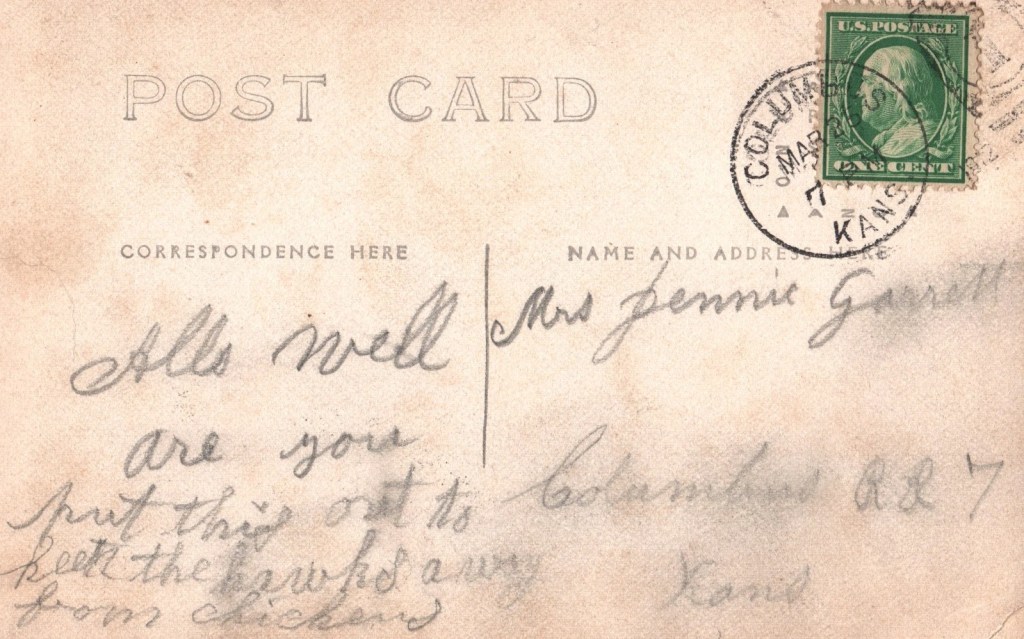
A postcard mailed from Ann Amos to Mrs. Pennie Garrett doesn’t say a lot on the outside, word-wise, but after researching both people, I discovered what I really wanted to know: they were believers.
Martha Ann Amos lived in Columbus, Kansas, and it’s easy to see in the photo on the front that she didn’t have it easy. There’s no satellite dish on the side of her house, nor does there appear to be an air conditioner. It can get very hot and humid in Kansas during the summer.
A brief note on the back of the card explains why the dog is sitting in her lap. It doesn’t appear that Mrs. Amos or the hound wanted their picture taken, judging by the photograph on the front.
“Alls well
are you
put this out to keep
the hawks away
from chickens”
Pennie Angy Garrett and her husband Edmund lived on small farms in Columbus, Kansas. Just like Ann Amos and her spouse, John, they were struggling farmers right up until the great depression hit, with the disastrous ‘Dust Bowl’ following soon after.
For those unaware of this, the Dust Bowl was caused by farmers stripping the land of almost all native vegetation. Winds then took over, making for what’s called a haboob in the desert. Dust and dirt were so thick that humans and animals struggled to breathe. Plants wouldn’t grow due to a lack of natural fertilizer.
Jennie Brown was born on August 21, 1871, in Kansas. She married Edmund Armson Garrett on December 12, 1895. Their first child didn’t arrive until 1897, with three others soon following. Jennie was the secretary/treasurer of their Baptist church.
On June 27, 1907, the Garretts lost one of their children. Little Ralph was a little over two years old. His obituary was most sad, with a touching poem at the end. Jennie passed away 12 years later, on September 23, 1919. She was only 48.
Jennie’s husband, Edmund, lived to be 82, dying on April 19, 1946. He never remarried. Interestingly enough, the farmer was born in London, England, before deciding to settle down in Kansas.
Martha Ann Mann-Amos lived a much different life from her friend, Jennie. Born in 1852 in Indiana, she came to Kansas already married to her husband, John. Their first child had died at birth.
With her most likely not able to bear children, in 1891, John and Ann eventually adopted a three-year-old boy. Named William Thacker Amos, sadly, in 1914, at the age of 23, while still living at home, “Willie” was struck in the head at his worksite and eventually died. Martha Ann passed away just 10 years later, on June 19,1924.
According to a census report from 1930, John Thacker was no longer working, with his home valued at $500. John died on July 19, 1934, at the age of 82. Enough was written about both the Amoses and the Garretts to tell me they were followers of Jesus Christ.
Were these people poor folk? It depends on who you ask. Despite all of the sadness found during my investigation, I tend to believe that before they left this world, the Amos and Garrett elders were happy, knowing without a shadow of a doubt they’d see their loved ones again. That’s worth far more than financial standing. Philippians 3:7-8











 I like to write junk...