“Everyone goes to Walmart, including the Clintons…”
I might be running out of good material to write about, as the low-hanging fruit in our town and neighborhood has already been picked. ‘Low-hanging fruit’ refers to topics or ideas that are easy to write about because they’re familiar, straightforward, and commonly discussed.
These include personal anecdotes, popular trends, well-known events, and topics extensively covered in the media, such as Joe Biden and Kamala Harris. Taking the easy way out, I tackled these subjects first because they required less research and creative effort compared to more complex, obscure, and off-limits topics, such as family and friends.
Telling my wife, Joleen, that I finally reached writer’s block, a goal I’ve not achieved before, she suggested a few topics, with Walmart being one of them. I’ve never written about our trips to Walmart, figuring they weren’t print-worthy.
Everyone goes to Walmart, including the Clintons, with nothing out of the ordinary ever happening there, at least I’ve never seen or read about anything terribly strange occurring at ours.
People sometimes walk the wrong direction in Walmart aisles, yet they do that in all stores. The right side is for all traffic going forward, while the left is for the opposite. This might not seem like a big deal, but it can be if a person’s not paying close attention.
I’ve never had a big problem because I walk slowly, as older people are expected to. With a fully loaded buggy and wheels that don’t easily turn, moving too fast without brakes is an invitation to sideswipe someone. Thankfully, that’s never happened to me, but I have lightly ‘tapped’ the back of a few shoes, namely, Joleen’s.
Folks sometimes wear strange clothing in these stores, with the Walmart in Kingman easily beating out the one in Lake Havasu City in this department. That might have something to do with I-40 being close by Kingman and lots of California travelers dropping in.
During the last holiday season, just for kicks, I walked up to a life-size cardboard replica of Patrick Mahonnes in Walmart, jokingly asking where the Pop-Tarts were. Joleen saw what I was doing and quickly scurried ahead to escape the embarrassment.
A kindly female employee with red hair, who’s been there for many years, evidently overheard my question and walked over, telling me, with a straight face, that they were next to the cereal section. Caught off guard, I didn’t expect this, with me saying, “Thank you!” in return.
Strangely enough, that woman didn’t act as if ‘my comedy routine’ was anything out of the ordinary. Joleen later told me that some Walmart shoppers undoubtedly chatted with that cardboard replica all the time, and that it was no big deal to workers. To that seasoned clerk, I was just another one of their “special customers.”
“You would’ve never known it because she was the most beautiful girl with brown hair.”
I’ve never held a grudge against someone that I know of, but have had a few crushes on people in my life, thankfully, always someone of the opposite sex. One of them involved a college-age girl who worked at a Pizza Hut in Spenard, Alaska. The year was 1970.
I don’t believe I was the only one taking a liking to her, as my friend Jeff saw the same merits in Tracy Turnbull as did I. We were just high schoolers back then, but this young lady talked to us with sincerity, knowing, yet not saying, that we were much too young for her.
Part of our intrigue was that Tracy told us her dad had taught her how to work on cars, and she didn’t mind getting grease under her fingernails. You would’ve never known it because she was the most beautiful girl with long brown hair. Jeff and I each saw her as a perfect girlfriend, yet there was no jealousy or competition between us.
We haunted Pizza Hit as often as our money held out, generally opting for the cheapest thing on their menu: splitting a ham or turkey sandwich. Water was our beverage of choice because it was free. There came a time when we both became terribly sick from food poisoning, a ham sandwich the culprit, no fault of Tracy’s.
I seriously thought about asking this gal out, that is, until we bumped into her in a Carr’s grocery store with her boyfriend. Jeff and I were riding bicycles that day. Knowing both of our names by then, Tracy introduced us to her fiancé as good friends. The guy was athletic and tall, and I believe on the University of Alaska – Anchorage basketball team. I saved myself some future embarrassment by seeing this.
A crush, unlike a grudge, is a strong but often short-lived feeling of romantic attraction or infatuation that someone experiences toward another person. Having a crush usually involves thinking about the person frequently, feeling excited or nervous around them, and admiring their qualities, even if the feelings are not reciprocated or openly expressed.
A grudge is a persistent feeling of resentment or anger toward someone, often due to a past incident or perceived wrongdoing. Holding a grudge means you continue to harbor negative emotions and refuse to forgive, which can affect relationships and personal well-being.
Letting go of grudges is important for emotional health and is often encouraged in teachings like Ephesians 4:26-27, which emphasize resolving conflicts promptly.
My wife once asked me why I held no grudge against a family member who had basically robbed me of a few thousand dollars. When I say robbed, I mean that I invested money with the person on the promise that I’d get it back. That never happened. I just took things in stride here, knowing better than to let it happen again. Afterwards, we still talked as if nothing had ever happened.
Going back to my teenage years, a crush could leave an almost exhilarating feeling, making me happy to be alive. Grudges, on the other hand, according to doctors and also the Bible, have negative connotations that can take years off a person’s life. Thankfully, I was wise enough to get the message early.
God tells those holding grudges to resolve their conflicts before the sun goes down. I’ve always done this, especially with my spouse and children, not wanting the stress from lingering conflict to prematurely age me and shorten my time with loved ones. It’s worked according to God’s plan thus far.
I’m not sure I’ll ever have another crush, at least not of the human variety. I did see a vintage unrestored truck at a local car show with a “for sale” sign in its front window—the brown patina immediately catching my attention. Crush, lust, call it what you want. All I know is that I loved that rust!
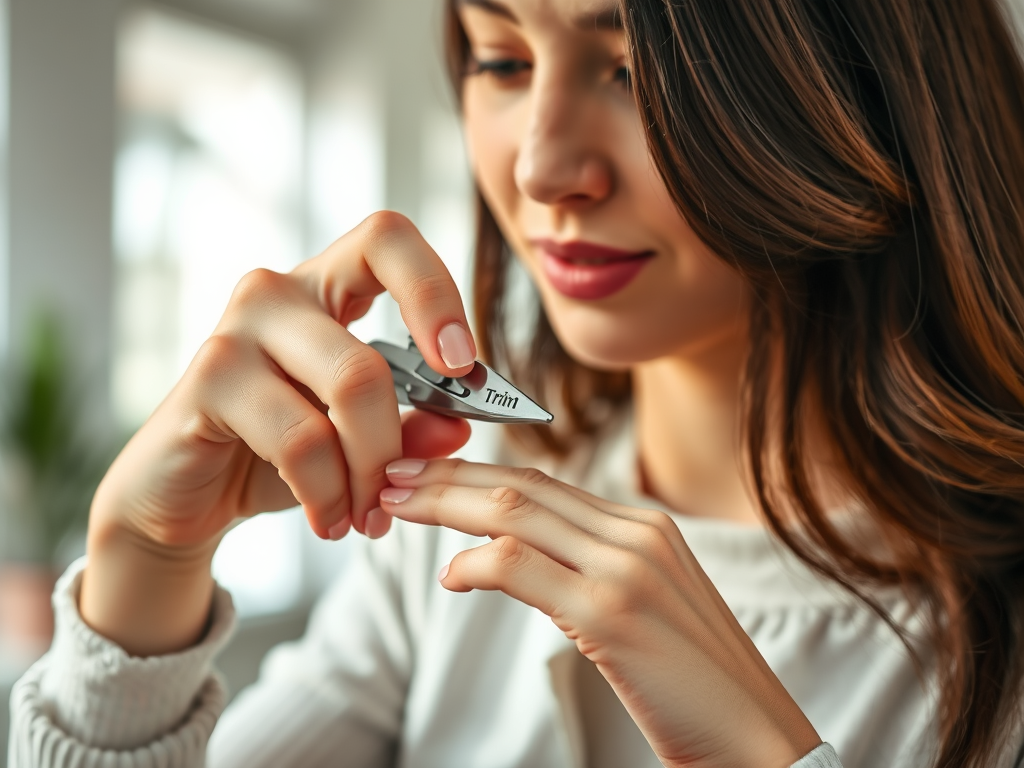
“The other night at home, Joleen and I were watching a movie when I heard the unmistakable sound of nails being clipped.”
A pet peeve is a particular behavior, habit, or occurrence that someone finds especially annoying or irritating, even if it might not bother others. These are often minor frustrations that can trigger disproportionate reactions in certain individuals.
Some common pet peeves are loud chewing or slurping, people who interrupt others mid-conversation, leaving dirty dishes in the sink, talking during movies, slow walkers blocking the sidewalk, not using turn signals while driving, using a phone during meals, leaving lights on in empty rooms, not replacing the toilet paper roll, and people who show up late.
While these are some of the most common pet peeves, everyone has their own unique list of things that bother them. Before I go into mine, I decided to research uncommon pet peeves, figuring there had to be some real doozies out there. This is what I found:
People who use excessive punctuation in texts, when someone moves your belongings slightly out of place, finding a tiny sticker left on fruit after peeling or slicing, when socks are mismatched or twisted inside shoes, group text messages where the conversation spirals off-topic, plastic packaging that’s difficult to open, unnecessary background noise in videos or audio recordings, people who walk slowly in the fast lane of a grocery store, when someone leaves a tiny bit of food or drink in a container and puts it back in the fridge, receiving flyers or advertisements tucked under windshield wipers.
I’m happy to report that none of these uncommon pet peeves are mine, because I’m guilty of creating a good number of them. Does anyone really care if socks are mismatched? The Stevie Wonder and Paul McCartney song, “Ebony and Ivory,” comes to mind here. Some of you will get it.
On the common list, drivers not using turn signals is a pet peeve, along with dirty dishes in the sink. That’s about it for me. I can think of a couple of others that weren’t mentioned on either list.
Going to car shows and hearing someone tear down another person’s ride is a pet peeve. I always think back to my days in school, when some kid was critical of another, only because they had low self-esteem and were trying to build it up at the expense of another. It’s a psychology thing.
My top pet peeve, and one that hasn’t happened for some time, is hearing someone cut their nails during church service. I’m talking fingernails here. In Anchorage, we always sat in the front row on the balcony. Perched up there, I could perfectly hear the music and preaching, yet also catch any oddities that happened along.
Watching someone being fast asleep in the pew while others stood to sing was quite common. It was generally the children and the older people who failed to rise. That’s understandable.
It’s amazing from up high, the bald spots folks had that weren’t visible at ground level. That’s one reason alone I didn’t sit down below. Getting back to the nail cutting. “Snip, snip, snip” for whatever reason bothered me more than anything. Once this noise began, my radar instantly began to pinpoint the location.
One might think it’s easy to find the culprit, but it wasn’t. Most were sly, quickly clipping a nail and then hiding the clippers. Several seconds later, and they’d snip another. Silver clippers were much easier to spot than black ones, which were next to impossible.
Not once did I find a man cutting his nails with it always being females; age not part of the equation. Once spotted, there was nothing I could do other than burn a hole through their head with my laser eyes. That still didn’t keep them from clipping.
Our pastor was good at finding congregation abnormalities while preaching, such as stopping his sermon in mid-sentence to ask someone to cease talking, or to get off their electronic device, but not once did he catch a nail cutting in progress.
Oh, I could’ve told him after church who was doing the snipping, but what good would it do me at that point? I’d merely be labeled a snitch by the person I snitched on. These days I don’t sit on the balcony, so it’s no problem.
The other night at home, Joleen and I were watching a movie when I heard the unmistakable sound of nails being clipped. Looking over at my wife—I saw that one of her hands grasped a cup of coffee—so I knew it couldn’t be her.
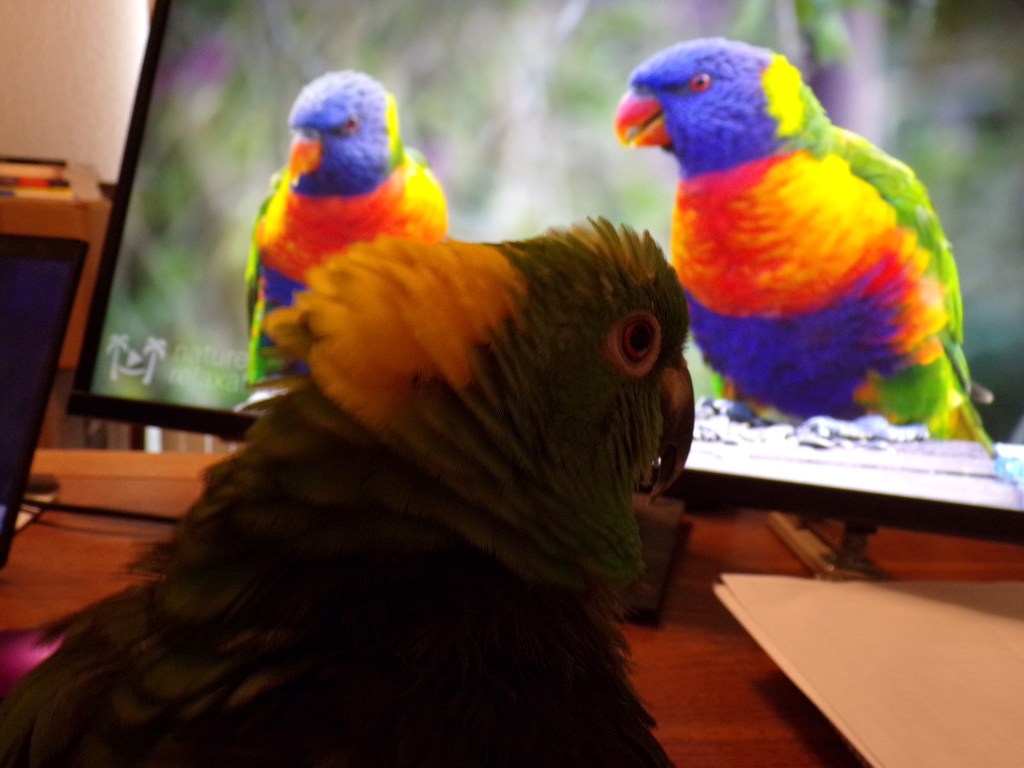
We have two parrots, Jess and Aldo, who’ve been with us going on 40 years now. Jess is very good at mimicking sounds, and he coughs exactly as we do when we’re sick. Our Yellow-naped Amazon thinks it’s funny.
Evidently, he’s now able to mimic the sound of fingernails being trimmed, which annoys me more than anything. Joleen believes that he’s merely rubbing his beak sections together, and it isn’t intentional. I don’t know this for sure, with Jess not saying.
The only thing I can do to drown out the noise is turn up the television volume. Last Saturday during Supercross, the volume number was 35, and that still wasn’t high enough. “Click, click, click,” came through loud and clear.
At volume 40, the television speaker sounded as if it were about to blow—with our neighbors undoubtedly hearing the motorcycle race announced word for word. Finally giving up, I had Joleen turn things back down.
At this point, I did as I’d seen so many old men do in church over the years, I fell asleep. When I awoke, the race was over, with Joleen telling me that Eli Tomac had won. That’s all I needed to know.
As my wife covered our birds up, Jess had one last thing to say, “Ready to go nighty night?” How could anyone stay upset with a pet peeve like that?
“I believe a 1962 Pontiac station wagon with bad ball joints feels about the same pain—as that of a 64 year old man with bad hips.”
The phrase “grin and bear it” means to endure an unpleasant situation with good humor, without complaint. It suggests facing something difficult or uncomfortable with patience and a positive attitude, even if it’s not enjoyable.
Old age to me is something difficult and uncomfortable, and I’ve learned to grin and bear it over time. Several years ago, before he retired, my wife had me ask Dr. Thomas Wrona why I was beginning to feel so tired with aches and pains seemingly everywhere.
With a smirk on his face, the good doctor looked at me and answered. “It’s called old age, Mike. Get used to it because things won’t get better!”
As a former mechanic, I knew this and had told her that, yet Joleen didn’t like my self-prescribed analysis; she wanted a professional one. My experience working on many older vehicles during my career is the basis for my grassroots comparison.
I believe a 1962 Pontiac station wagon with bad ball joints feels about the same pain—as that of a 64 year old man with bad hips. I say this because I know someone who has undergone hip replacement surgery, and they were in great agony beforehand. Unfortunately, cars cannot express their torment as humans do, so we can only assume they feel the same.
Right now, my ankles, both elbows, and shins hurt. Thankfully, Dr. Ace Taminophen is on call 24 hours a day. Most folks know him as Dr. Ty, or Dr. Tylenol. A couple of his 500-milligram gel tablets seem to work best. I take them at bedtime so I can sleep.
Older people often feel more pain as they age due to a combination of factors. As the body ages, joints and tissues can wear down, leading to conditions like arthritis and reduced flexibility. Additionally, the body’s ability to repair itself slows, making it harder to recover from injuries or strain. These physical changes, along with reduced muscle mass and bone density, contribute to increased aches and pains.
Furthermore, inflammation tends to increase with age, making everyday movements feel more uncomfortable. Chronic health conditions, such as diabetes or heart disease, may also play a role in amplifying pain and discomfort. All of these factors together explain why many older adults like myself experience more frequent or intense pain as the years go by.
I recall reading about someone years ago looking for a fountain of youth. If there is such a place, I’d definitely take a long drive to investigate. It didn’t take me long to find information on this.
The legend of the fountain of youth is often linked to the Spanish explorer Juan Ponce de León. In the early 1500s, Ponce de León sailed to what is now Florida, with stories claiming he was seeking a magical spring that would restore youth and vitality to anyone who drank its waters. While there is little historical evidence that Ponce de León actually sought the fountain, the tale persists as a symbol of humanity’s desire to reverse aging and find eternal youth.
This myth has become a cultural touchstone, representing the hope and pursuit of ways to ease or escape the discomforts of growing old—much like the aches and pains I experience as I age. The story reminds us that even centuries ago, people dreamed of solutions to the challenges of growing older.
Unfortunately, it turns out the fountain of youth is on the same level as the fake news we’re now seeing on TV. Getting back to Dr. Wrona and his advice to get used to the aches and pain, I’m getting there. I’ll take both extremities over that of being permanently laid up in a hospital bed or an assisted living facility.
Walking my usual path at Rotary Park this morning, finally getting back to the truck, I was achy and sore. While resting and rehydrating, a familiar thought popped into my head. “Grin and bear it, Mike, things don’t get any better than this!”
At that point, I could’ve cried, but chuckled instead. That’s what we seniors need to do if we’re going to make it through the day, along with having a case of Tylenol, of course.
I recall my mother watching the soap opera “General Hospital” on a rare day off. Mom worked in a hospital, so I assume that’s the reason why. I was never one to watch soap operas, as I’d imagine most guys don’t—unless they’re closet viewers. Life has enough drama of its own without adding to it through television entertainment.
When my wife and I moved to Arizona, one of the main reasons was to escape the drama that was continually coming our way in Alaska, no fault of our own. Anchorage was rapidly deteriorating under leftist Democrat leadership, like so many big cities across the US. The time was ripe to move elsewhere.
Our Anchorage church had its own drama: primarily, competition for recognition among select members, and I believe most large churches still do. It’s a given that some people love the spotlight, but churches shouldn’t be a place to try to outshine others.
That didn’t keep us from going. It seems any large body of people has drama, such as PTA meetings, sports events, and even the Democratic National Convention. Drama, in a way, is purely human nature.
A few in our flock felt compelled to publicly proclaim they were doing well financially. For the most part, I could overlook this, since I was there for one reason—to soak up the message. Our pastor was good at preaching, so the distractions were overcome.
The friends I had and still do never flaunted their excesses, although most, if not all, did much better than we did. I was just, Mike to them, a faithful friend. Competition amongst the stuff we owned or were still paying for never entered the picture. It was all junk to me and still is. None of us takes our worldly treasures to Heaven.
There was no trying to outdo the Joneses in my life format, taking what came to Joleen and me with gratitude, no matter what it was. There were many times we made do with others’ discarded things. I was pretty good at fixing broken items that people tossed away, a bicycle comes to mind.
Drama in someone’s life typically refers to situations filled with heightened emotions, conflicts, or unexpected events that cause stress or excitement. It can involve arguments, misunderstandings, or challenges that disrupt normal routines and require attention or resolution.
Sometimes, drama arises from interactions with others, while at other times, it stems from personal struggles or circumstances. Some automatically attempt to lasso others into their drama. It’s best to steer clear here or totally escape the surroundings.
The Bible advocates for a life of “no drama,” urging believers to pursue a quiet life (1 Thessalonians 4:11).
I try my best to follow that Biblical rule and have been somewhat successful these past few years. Part of that has to do with not allowing drama to become a monkey on my back here in Havasu. Should any of this unwanted stress attempt to catch a ride, I’ll loudly say to myself, “Stop, drop, and roll.”
“I would’ve never thought that routine day-to-day accomplishments would someday reach an accolade level.
A sense of accomplishment is the feeling of pride, satisfaction, or fulfillment that arises when you achieve a goal, complete a challenging task, or reach a significant milestone.
This emotional response results from recognizing personal effort, persistence, and success, often motivating further growth and engagement in future endeavors.
The first time I felt a sense of accomplishment, that I can remember, was finally riding a bicycle without the need of training wheels. I was 13 at the time. That’s the bogus number I tell strangers just to see the shock on their faces. Actually, I was around five years old.
As time rolls on, a sense of accomplishment, or SOA, means much more to me than ever before. I was never one to come out tops in my school classes, other than perhaps in reading scholastics.
I was a fast reader, and my reading comprehension skills were excellent, so much so that I aced the SRA programs our elementary school used, way before the other students finished theirs.
There was one classmate almost as good as me. We somewhat competed, if you could even call it that. That speed came in handy, especially when writing school and college research papers.
A sense of accomplishment was felt on graduation from high school, passing my driver’s test after two attempts, and becoming I.M. Certified in Automotive Emissions Testing. This was a tough test to pass, and I had to do so every few years.
My bicycling days still continue, and at 71, I’m happy to be able to climb onboard and peddle without falling. One crash could result in disaster, so I’m more than careful, especially after tumbling off a ladder. The days of going fast stopped years ago.
Any running is also long gone, with simple walking much more enjoyable anyway. “Slow down and smell the roses” comes to mind here, although there are no roses where I walk. Sagebrush, cactus, mesquite, sand, and rocks align the desert trails I follow. More cool stuff is found just by walking like a turtle.
A sense of accomplishment can now be obtained with simple things. The ability to bend over and still tie my shoes is one of the biggest. I would’ve never thought that routine day-to-day accomplishments would eventually reach an accolade level.
The other afternoon, I watched a man and his wife park in front of a local Lake Havasu City restaurant in a handicap spot. The aged woman was helped from the front car seat to a collapsible wheelchair. I held the door open for them and was thanked by each.
The wife wanted to sit at the table next to her husband, while he was quietly insistent that she remain in the wheelchair. Finally able to convince him that she’d be just fine, the thin and frail woman slowly rose with his help and was gently assisted into a booth.
I’m sure the sense of accomplishment she felt that evening far surpassed any I’ve had. Sadly, there probably aren’t many more days left when the two can romantically sit together.
A sense of accomplishment is necessary to remain positive. The day this ceases will be one of the saddest days of my life. For now, I’ll continue counting my blessings one by one!
“I’ve been tempted to send Christmas cards in July, but thus far have resisted.”
Each Christmas, my wife takes the Christmas Cards we receive, opens and reads them, and then tapes them to a pantry door. My mother did the same, although she used a wall because we didn’t have a pantry.
After New Year’s is over, Joleen removes the cards and puts them back in their envelopes, so that she has a current address to mail ours the following year. People still change locations, so that’s an easy way to keep updated on their whereabouts.
There was a time we received close to 100 cars from friends, family, and businesses, but that number has slowly dwindled. I believe last year, in 2024, we got a total of 19. Some of the senders passed away, while others just don’t mail them anymore.
I recall my mom scratching her head, attempting to recall if so-and-so sent a card the previous year. With my wife keeping ours in a box, that’s no problem. Forty years ago, I came up with an idea so that people wouldn’t have that problem.
I took over the letter-writing department during Christmas, always making sure that our ‘form letter’ was bizarre and unforgettable. While Aunt Betty’s card and letter might not be remembered 30 days after getting them, I didn’t want that to happen with ours. I’ve had friends and family say that they think I’ve lost it, but at least they remember the card or letter. That’s what counts most!
We’ve sent out cards with our two parrots supposedly writing things, along with an attorney, a garbage collector, neighbors, a complete stranger, and firms that we supposedly paid to write because we were too busy. I even had a holiday form letter printed out with fill-in-the-blanks.
The phony lawyer’s office letter was 20 years ago, and I still recall the firm’s name: Bend, Ovar, and Takum. Another year, I had a rubber stamp made with our signatures in cursive, going on to let it be known the following year, in a Christmas form letter, that some folks were upset because we didn’t take time to sign them ourselves. It’s reminiscent of the Joe Biden autopen controversy.
The best cards we mailed were a select few that I took a propane torch to, scorching them just enough to make them look like they’d been in a fire. That card envelope was stamped, with me having to carefully draw black spiral lines across the stamps to make them appear as cancelled. I only addressed a certain number to family members.
A blackened card and envelope were then placed inside another plain brown envelope marked USPS, with an official-looking note inside, supposedly from the US Postal Service. The note said that the mail was damaged from being in a warehouse fire. We waited two months after Christmas to finally send them.
Family still talks about that, with a good majority believing that the warehouse fire actually took place. I suppose there is a question as to whether this act was legal, but the statute of limitations has long run out.
Back in the early 1900s, Christmas ‘postcards’ were quite common. I made my own one year, taking small 4×5 index cards and gluing a photo of Santa on the front, with him saying MerryChristmas.
There was little room to write a note on the back, with us just proclaiming, Happy New Year. I believe that’s the one we mailed right after Halloween. I’ve been tempted to send Christmas cards in July, but thus far have resisted.
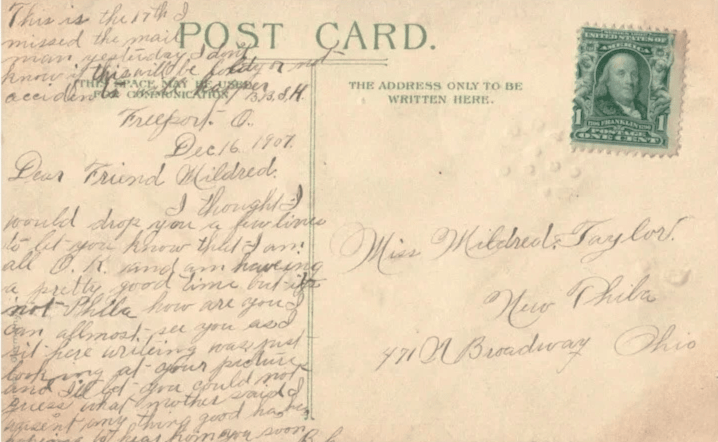
Finding an early Christmas postcard from 1907 on eBay, the person receiving it was Mrs. Mildred Taylor, who lived in New Philadelphia, Ohio. Someone with the initials B.L. from Kokomo, Indiana, sent it with the following cryptic letter. I’ve left words as written.
“This is the 17th. I missed the mailman yesterday. I don’t know if this will be today or not. Accident if it happen.
Freeport, O.
December 16, 1907
Dear friend Mildred,
I thought I would drop you a few lines to let you know I am all O.K. and am having a pretty good time but it’s not Philla. How are you I can almost see you as I sit here writing was just looking at your picture and I bet you could not guess what mother said, I suppose not anything good, ha. She suffering lot. Hear from you soon. B.L.”
Mildred A. “Mary” Peacock Taylor spent her entire life in New Philadelphia, Ohio, along with her husband, Earl. Hopefully, Mildred interpreted what her friend was telling her because anyone else reading this note wouldn’t totally understand. I suppose that’s intentional on the writer’s part.
Nowhere is there mention of ‘Merry Christmas’ or ‘Happy New Year’, although the front of the Victorian-style Christmas postcard does say, ‘A Peaceful Christmas’. The photo of a frazzled Santa with a large bag of toys makes it appear he isn’t having one!
“What seems so unreal is that I still remember part numbers from my days working at an automotive parts store.”
Desert Bar
I’ve always had a good memory, remembering small things from long ago. I chalk it up to never being dependent on recreational drugs or alcohol. Lately, what I seem to forget more than anything else is connecting names with faces.
I’ll watch an old movie and when some well-known actor comes on scene, oftentimes his or her name is on the tip of my tongue yet I can’t spit it out. This can be irritating, with it having me wonder if I’m becoming senile.
Whenever this happens, I quietly ask myself, “What is the firing order of a Chevrolet V-8 engine. Thus far, I’ve been able to rattle off 1-8-4-3-6-5-7-2 without hesitation. Car guys and gals know what I’m talking about here. As long as I get those numbers right, I have to assume all is good upstairs.
Last winter, I was with some friends at the Desert Bar near Parker. The name of this place can be misleading for those who’ve never been there. The rustic establishment is built around a former gold and silver mine, and it’s totally off-grid. I view it as more of a ghost town with a live band. It’s definitely family-friendly.
There are antique cars and old rusty mining stuff to be seen, including an awesome replica western day church, complete with a steeple. Yes, weddings can be arranged. The food is good, and I always make sure to bring cash because they don’t take checks or credit cards. Beer is served, but for guys like me, they have soft drinks as well.
On this last trip, a fellow and his wife walked up and recognized me. They knew my name and started up a conversation. All during that time, my brain was going, “I know these folks, but for the life of me, I don’t recall their names.” Seeing that I was confused, they helped give my memory a jumpstart.
Walking back to our table and repeating their names over and over, wanting them to permanently sink in, I informed my wife about my memory lapse. I told her that I’d make sure to remember their names next time. I have been doing so for several months now, even writing them down on a piece of paper. That paper is now hiding somewhere, and I don’t recall where I put it. 1-8-4-3-6-5-7-2.
They’re a nice couple, much younger than us, snowbirds, they come from Minnesota each winter, owning a home here. I can remember almost the whole conversation we had over coffee at Bashas. We planned on getting together when they came back and going metal detecting.
What seems so unreal is that I still easily recall part numbers from my days working in an automotive parts store. That was 40 years ago. The Spicer number for a 1975 Chevrolet Blazer constant velocity centering joint is 210782X. The Standard ignition number for Chevy points is DR2270P. Ford points are FD8183V. I could go on and on.
Why is it that I can still relate numbers to parts, yet faces to names is now escaping me? How do older ministers handle this problem? I suppose calling everyone brother or sister works, at least for a while.
Taking the herb Ginkgo biloba is supposed to help in the memory department, or at least a friend told me that eons ago. I believe at this point it’d do little good, and besides, one of my doctors said it’s not good to take this if you’re on blood thinners. Mark that off my list.
They say AI technology can recognize facial features. The police and other protective agencies have been using such for years. I believe the answer for older folks like me is for everyone to have a barcode stamped on their forehead. Keeping a scanner in my back pocket, I could then scan and say without embarrassment, “Hello, Joe, how are you doing today?”
I’m only joking here, but in reality, the world could be coming to that!
“Not any of my male friends that I’m aware of are concerned about wrinkles.”
Anthony and Gloria Aquaro – 1944
Singer and songwriter Glen Campbell had a hit tune in 1968 called “Dreams of the Everyday Housewife.” I was only 14 at the time, thus, this song and its lyrics meant little to me.
A couple of teenage girls I knew back then, undoubtedly, could relate Glen Campbell’s words to their mothers. I suppose they now do the same with their own lives. The first stanza has a powerful meaning, with the complete song a thought-provoker.
“She looks in the mirror and stares at wrinkles that weren’t there yesterday. And thinks of the young man that she almost married. What would he think if he now saw her this way?”
My mom, in comparison to the song, wasn’t an everyday housewife, although she probably desired to be such. Along with being a helpmate to Dad and a mother to my brother and me, she worked a full-time job to help make ends meet.
Housekeeping was added to this equation as well, although Jim and I helped out in this department. Despite both parents working, life wasn’t so bad for us boys. We had a tad more freedom than some kids, with them often being away.
I still recall my folks having to use Household Finance to obtain a loan, with the interest rate near 30%. That made it virtually impossible to pay this debt off, yet they somehow succeeded. Dad warned my brother and me about the pitfalls of borrowing money and told us to avoid doing so in our lives if we could.
In later years, my father mentioned that business loans were somewhat different, as long as the business owner was personally protected from litigation by placing things under a corporation. I’ve always remembered that advice — seeing it come into play several times with family and friends.
Housewife is considered a demeaning term by some left-leaning women’s rights advocates, portraying the term to mean an uneducated woman relegated to serving her husband and children with no interest in a career. I see their analysis as offensive. Stay-at-home moms should be celebrated just as much as those entering the workplace, perhaps even more.
Changing directions just a smidgen, senior citizens are constantly bombarded by commercials on television trying to hawk some type of wrinkle-erasing cream. It seems as if they’re directed at us anyway.
One such advertisement shows a daughter applying a cream under her aged father’s eyes. Before and after photos show a difference, yet small and barely readable printing at the bottom of the infomercial dictates that the result is not long-lasting.
Not any of my male friends that I’m aware of are concerned about wrinkles. Some women, on the other hand, are a different story. My mother used something called Oil of Olay. This company is now called Olay, and the product originated in South Africa. While there’s some mystique about the name, the main ingredient is simplistic lanolin. I get a dose of that every day when I wash my hands and face with soap.
Living in Arizona is hard on the skin, and one only has to look around to see the damage. I try to use skin protectants along with wearing hats to protect the sensitive scalp. Having burned my head in Hawaii years ago, I’ve never made that mistake again.
My wife always comments about a new wrinkle here or a new wrinkle there. I never see them unless she points things out. That unpreventable aging goes with a portion of the marriage vows saying, “For better or for worse.”
Looking at another set of lyrics from Glen Campbell’s song, “The photograph album she took from the closet and slowly turns the page. And picks up the crumbling flower, the first one he gave her, now withering with age.”
When a couple ties the knot, I highly doubt they’re looking down the road wondering how their mate is going to look in 50 years. That shouldn’t even enter their minds. Had that been the case, Joleen should’ve visualized a train wreck in me.
My looks have significantly changed for the worse, yet my persona remains not much different than when we married in 1977. She fared much better where aging is concerned, and her sense of humor or outlook on the future hasn’t suffered at all. Most of us geriatrics fit that bill. Our minds don’t seem to age at all, unlike our bodies.
Just recently, I read a story about a couple in New York who’ve been married for 80 years. Anthony and Gloria Aquaro are both over 100 years old and still live together in a home owned by their grandson.
Before and after photos of the couple are as expected, with time molding them into relatively healthy centenarians. Tony Aquaro had words of advice for keeping two people together for so long: “In a marriage, you can’t be a big boss. You have to respect each other’s wishes!” He went on to say that finding and keeping a good wife is the key to longevity.
Gloria mentioned that they did have disagreements, yet those arguments didn’t take precedence over their love and respect for one another. “Just never stop loving each other. I still love him as much as I did when we first met!”
Gloria Aquaro went on to explain that they were high school sweethearts and that she came to know Tony at a baseball game he was a player in. After winning the game, Tony asked for a kiss and was turned down. Despite this, it was love at first sight for both.
I can visualize Anthony Aquaro, in a croaky voice, singing the ending lines to Glen Campbell’s song and truly meaning every word of it. This stanza especially fits with many older men and women throughout the world.
“Oh, such are the dreams of the everyday housewife, you see everywhere, any time of the day. An everyday housewife who gave up the good life for me.”
Tony died in 2024 at the age of 103. Gloria resides in an assisted living facility.
“The way we treat people comes under this heading.”
Hobo Mark “Shoestring” Nichols
As I’ve gotten older the word legacy has become more and more important to me. What will I leave behind in my life that will positively enhance others? I find different interpretations of legacy in dictionaries and the Holy Bible.
Judaism indicates that legacy can be good or bad, with spiritual or Godly legacy foremost over that of monetary or material assets, such as real estate, stocks, and bonds. A bad father or mother can leave a blemished legacy where children are concerned. Thankfully, my parents don’t fit the bad mold and hopefully, I don’t either.
Godly legacy enriches people’s lives long after a person is gone. The way we treat others comes under this heading. I find evangelist Billy Graham and Mother Theresa fitting this definition more than anyone.
As a Christian—faith, values, and traditions much like the Jewish also take precedence over that of leaving behind wealth. Both religions make it clear that there’s nothing wrong with making sure your family is financially secure once you’re gone. Not everyone can do that.
A spiritual legacy is defined as non-material, such as stories, beliefs, values, and wisdom. That seems to fit with me, although I do strive to leave something of all three. Spiritual legacy can be left behind through videos, tapes, books, and even letters.
Being a writer, and loving to research the lives of people who have long since departed, in certain cases all I’ve uncovered is a decaying gravestone more than anything else. I find that sad.
Some of these men and women were one-time owners of huge companies, with the businesses now long gone and their establishment names no longer remembered. Other than an aging obituary telling more about their business accomplishments than anything, it appears these folks dropped off the face of the earth without leaving any lasting legacy at all. They seemingly followed the dollar more than God. I don’t want that happening to me.
Perhaps the saddest thing I’ve observed over my lifetime is encountering family and friends who’ve said to me, “I plan on letting my children make up their own minds about what religion to choose.” The scriptures don’t recommend this, with that leading me to believe these folks weren’t Bible readers, although they claimed to be. Years have now passed and I see the aftermath of their flawed philosophy. It wasn’t good in some cases although a few of these offspring finally came to their senses and saw the light.
I watch YouTube videos quite often, especially following the life of hobo “Shoestring” Mark Nichols. Mark was a military veteran and has been a hobo traveling the rails throughout the US for some time.
“Shoestring” documented his adventures via a blog he started around 1989, and then began videoing them. He had over 2,000 followers on YouTube. The man was paid well for his episodes and loved by many. In his videos, he comes across as a very caring person. In several episodes he calls out to God for help or thanks him for help received.
Mark Nichols unlike Billy Graham, Mother Theresa, or other noteworthy people still left behind a positive legacy despite his hobo lifestyle. I believe that everyone can do the same as it’s strictly a matter of choice.
Sadly, “Shoestring” suffered through cancer, diabetes, a bad back, and macular degeneration of the eyes, with liver failure believed to have led to his unexpected death. His stories live on through numerous writings and films.
I can only hope Mark Nichols knew Jesus Christ as Savior, and I believe he did, or his legacy becomes significantly dimmer. The Bible says this about legacy where our faith is concerned in Deuteronomy 6: 6 & 7 (KJV). Moses is speaking here about the Ten Commandments:
6. “These commandments that I give you today are to be on your hearts.”
7. “Impress them on your children. Talk about them when you sit at home and when you walk along the road, when you lie down, and when you get up.”
If parents heed these two verses alone and pass them on as instructed, I believe the legacy left to children and grandchildren far surpasses that of wealth and prosperity.
If I’ve achieved only that much—I deem my life to be successful.

















 I like to write junk...