I often hear people talking about years flying by. Such conversations generally resonate from senior citizens. Reluctantly I fit into that over 55 category.
When I think of grandparents, parents, and friends now departed, “Next!” pops into my head. Dragging my feet isn’t keeping me from inching closer. The world’s largest bulldozer will do absolutely nothing in stopping forward progress.
“Next!” is okay in a fast-food restaurant, bank, or DMV line. Where death’s concerned the command takes on higher meaning.
I’ve been told by family and friends,
“Age is merely a number.”
That cliché sounds sweet and non-concerning but unfortunately it’s far from reality. Each passing year signifies one less year to live.
Such a thought is probably depressing to some people. I suppose it would be if I didn’t know for sure where I was headed. Hopefully everyone’s picked the place where they’d like to reside in their eternal years. From what I’ve found there are only two choices. If there’s a third I didn’t find mention of it.
I vaguely recall when gospel and country western singer “Gentleman” Jim Reeves passed away in a plane crash. I do remember my mother being extremely upset. She loved his singing.
Researching the date it was July 31, 1964. I would’ve been 10 at the time. Jim Reeves was only 40 when he died. Because of constantly scheduled concerts and appearances the man lived a hectic and stressful life.
Jim Reeves was on the road up until his demise. Like many in the entertainment industry, he had demons and temptations constantly leading him astray. It’s said during the bleakest days of his life he prayerfully turned to Jesus Christ for help.
One song that Jim Reeves recorded lingers in my brain:
“This World Is Not My Home”
There’s something about the beginning lyrics that immediately grabbed my attention.
“This world’s not my home; I’m just passing through.
My treasures are laid up, somewhere beyond the blue.”
I was interested in knowing if Jim Reeves was the man who wrote that tune. Turns out he wasn’t. The music was composed by Albert Edward Brumley. Mr. Brumley composed over 800 gospel songs in his lifetime. Albert Brumley also penned the well-known gospel tune, I’ll Fly Away.
Jim Reeves sang I’ll Fly Away many times during his career. Lyrics towards the end of the song seem ironic to his destiny.
“Just a few more weary days and then I’ll fly away.
To a land where joy shall never end, I’ll fly away.”
Jim Reeves was in control of his small airplane when it crashed into the ground. I tend to believe his final resting place is not six foot under in a wood coffin.
If Reeves was sincere in his acceptance of Jesus Christ as Savior, there’s no doubt he’s in Heaven. The Bible shows how to get there via John 3:16.
“For God so loved the world that he gave his one and only Son, that whosoever believes in him shall not perish but have everlasting life.”
I know without doubt I’ll find unlimited joy in my Heavenly home. A place without death, sorrow, or pain sounds like the ultimate destination.
My decision in taking the high road was a no brainer. What other choice is there?
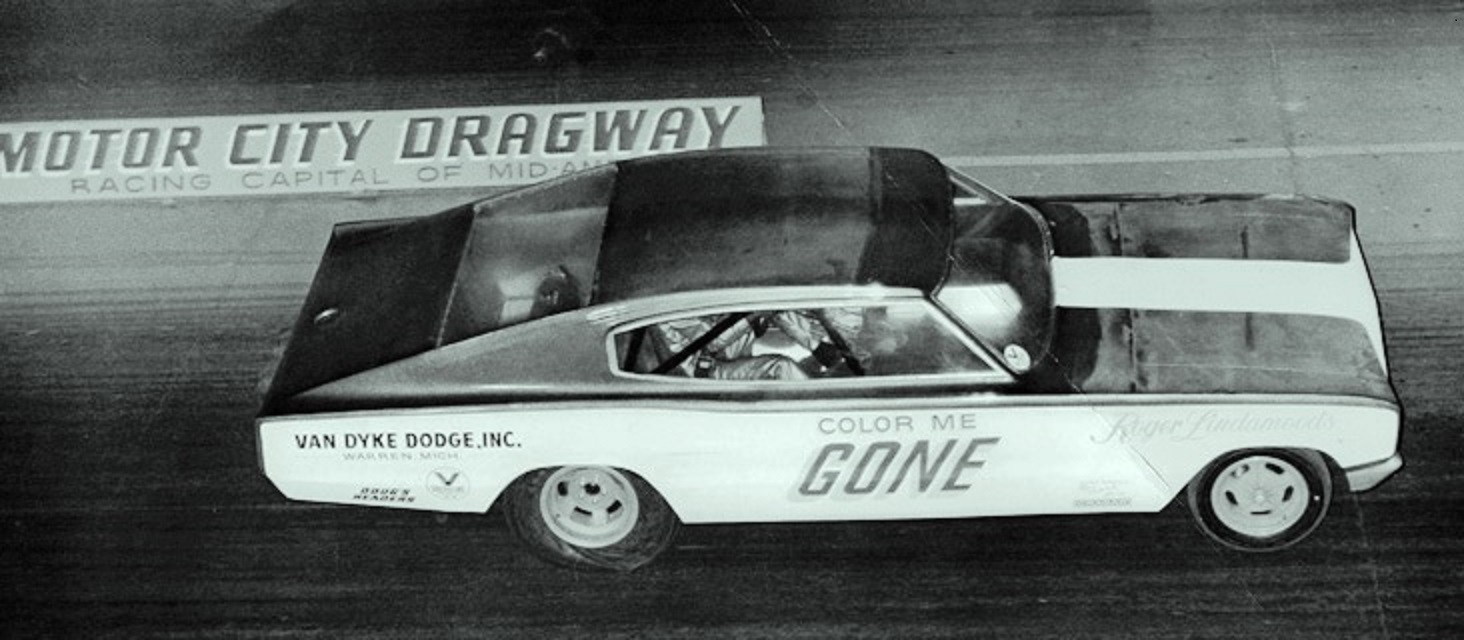
Roger Lindamood “Color Me Gone” Dodge Charger funny car.
I suppose every person has a favorite phrase, saying, or even single word they like to use over and over.
My mom often
vocalized the word jeepers to explain
surprise at something she didn’t know.
She’d also say, “A little birdy told me!”, to inform me or my brother how she knew we’d been up to mischief.
Dad would never fail to shout, “Bend over!”, when he found out.
At one time my pal Rod Sanborn used the single word bodacious to explain he was pleased. I believe he stopped using such after the 70’s.
My best friend Jeff Thimsen whispers, “Ohio”, to certain male friends, indicating he wants them to look at something without being obvious.
Fifth grade teacher, Mrs. Drake, informed her class she didn’t want any malarkey out of them. I believe that was a politically correct name for another word, yet I can’t prove such.
Of course the late actor and comedian Rodney Dangerfield wore out his famous line,
“I get no respect!”
I have to wonder if Dangerfield actually said that to people in real life? Had he moaned such to Mrs. Drake, the malarkey word would’ve been on her tongue like saliva.
I can’t think of any strange words or sayings that I use other than one,
“Color me gone!”
I didn’t coin the phrase! It came to me in the 1960’s after I started reading car magazines. Roger Lindamood owned a Dodge Charger funny car called, “Color Me Gone”. It was featured in almost every issue of Hot Rod Magazine. For some strange reason the racecar name stuck in my brain.
When I use such an expression only certain people know what I’m talking about. They realize I’m about to slide out of whatever it is I’m involved with.
If there’s more than 10 people at a function I become jittery. I’ll walk up to my wife at these events, even if others are around, and whisper those 3 words. Joleen knows I’m heading out the door yet those around her haven’t a clue.
I say the phrase to myself as well. Last time I did so was at a car dealership in Colorado Springs. A salesman kept badgering me without hesitation. Telling him I needed to use the restroom, under my breath I softly sighed,
“Color me gone!”
I suppose it seems strange to some that I write about this triviality. You are most correct. There is a purpose for the madness. One of these days my grandchildren will read this composition. My wish is for at least one of them to carry on Grandpas tradition.
Perhaps at some public gathering an obnoxious man will stroll up to them talking trash. Thinking back to dear old granddad a grin will suddenly appear. At that point they’ll look at the guy and politely say,
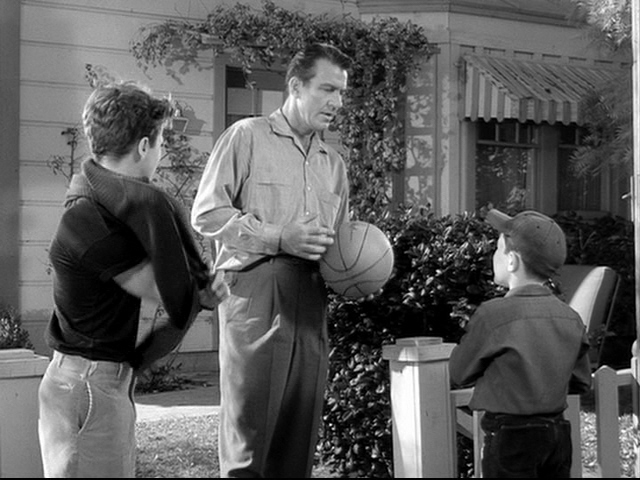
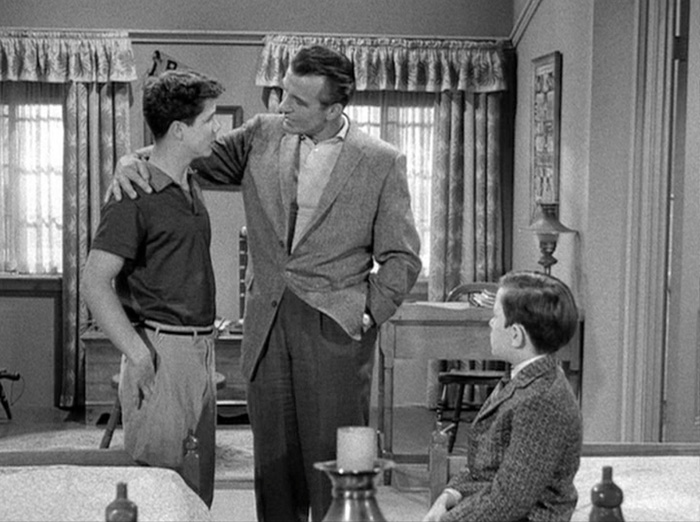
Hopefully, I’m not the only person remembering the name, Ward Cleaver. The late actor, Hugh Beaumont, played Ward in the long running TV series, Leave it to Beaver. I viewed Ward as the consummate dad. He was always there for sons Wally and Theodore “Beaver” Cleaver.
The same can’t be said for many fathers these days, both on television and in real life. To put it bluntly, some men prefer the title, ‘sperm donor’ over that of dad.
Leave it to Beaver focused primarily on youngest son Beaver’s childhood escapades. Beaver was constantly up to something, often times getting into situations he couldn’t handle. Ward Cleaver came along offering wholesome fatherly advice along with measured amounts of discipline. Ward’s articulate wife June was the softy, always giving her boys more leeway than ‘the old man’.
Hollywood does not portray fathers like they did in the 1950s and 1960s. Father knows Best!, was one of my favorites. Robert Young played Jim Anderson, an almost idyllic dad. You’d never hear obscene language coming from his lips.
In today’s world, it seems more and more men equate using disgusting words in a conversation as manly and macho. Actually it’s just the opposite. Studies prove that such males come across to others as having low IQ’s.
Thinking that you’re coming across as tough by dropping the “F-bomb” every other sentence is pure fantasy. Even in Hollywood movies, the tough guy with the filthiest mouth is generally the fellow going down the hardest.
My Three Sons, starred Fred MacMurray, as Steven Douglas, a widowed father raising three boys. Versatile and accomplished actor MacMurray played a loving and upbeat dad in this series.
The Adventures of Ozzie and Harriet was another wholesome television show our family watched. Ozzie Nelson was a real life father to sons Ricky and David.
The 1990s sitcom, Married with Children is a prime example of Hollywood intentionally demeaning the role of father. Although funny at times, the show’s main character, Al Bundy, was as disgusting and loathsome a dad as they come.
It’s truly unfortunate the new crop of television shows do not emulate people like Ward Cleaver and Ozzie Nelson. If anything, they’re highly critical of such characters. Ned Flanders on The Simpson’s cartoon series is another case of such objective stereotyping.
Liberal script writers constantly make Ned out to be a square religious buffoon. I believe that type of ‘created criticism’ penetrates children’s minds, helping fuel the hate towards people of faith.
My father was a strict disciplinarian. He believed children should behave or pay the price. Dad was not a perfect person by any means. I’m thankful to have had him even with the flaws. Hopefully, my kids look at me the same way.
Hollywood and secular America can make fun of Ward Cleaver all they want. Last time I checked, Ward and June’s two boys, Wally and Theodore, turned out just fine. Nowhere could I find where they smoked crack, robbed convenience stores, or went to prison for selling drugs.
They definitely weren’t living at home at 35. Ward and June Cleaver, although not a real couple, portrayed loving parents teaching their boys respect along with responsibility. That valuable life-lesson seems to be lacking in many households today.
The only perfect father I know is my heavenly father. Sadly, there aren’t more dads striving to be like him. I give Ward Cleaver an A for trying!
“Perhaps she went so far as to take activity money the following year and purchase pocket knives for the whole class, including girls.”
After my family moved to Texas in 1963, I attended Reese Elementary School near Wolfforth. I started 4th grade there. Reese Air Force Base was my father’s duty station and a mere stone’s throw from the school grounds. Jet airplanes often flew over our building, drowning out the teacher’s voice.
Living in Alabama beforehand, I learned as a kid how to take a piece of soapstone and, using a small pocket knife, bore a hole from one side to the other. If you did this multiple times, the rock turned into a sort of flute, crude-sounding as they were.
On the playground at Reese were soft rocks similar to soapstone. During one recess, out of curiosity, I took my pocket knife and started drilling. It was tougher going than Alabama stone, but I eventually got through.
I sat beside a brick wall of the building out of the sun, each recess making stone flutes. Another classmate came by one day wanting to know what I was doing. Continuing to whittle away, I told him,
“Making stone flutes.”
He wanted me to show him how, and I did. The next morning, the kid arrived with a tiny knife. We spent both recesses plus lunchtime drilling holes.
By the following week, most of the boys in Mrs. Hagan’s sixth-grade class were sitting beside us doing the same. The only ones playing like they were supposed to were the girls. One of them eventually joined our gang.
One morning, before class started, Mrs. Hagan informed her students that there’d be no more hollowing of stones during recess. All pocket knives were to be left in the desks during that activity. That put a damper on our recess for a short while.
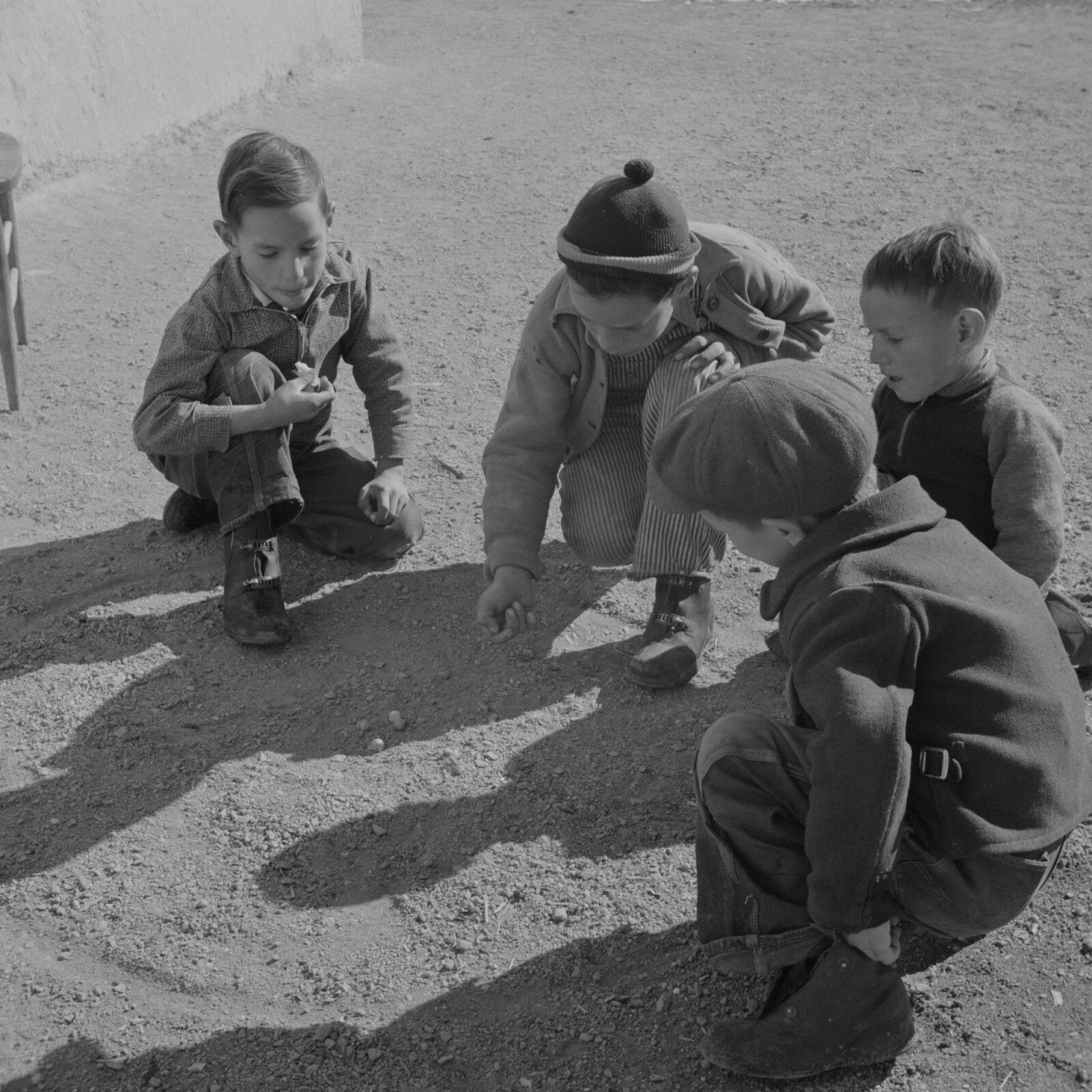
A kid whose name I no longer remember the name of brought a bag of marbles to school. He let several of us use them to play ‘chase’. That’s a game where you try to keep from being hit by an opponent’s marble. By the end of the week, almost every boy in Mrs. Hagan’s class had a bag.
Not satisfied with playing marbles in a circle, students began playing ‘chase’ for ‘keepsies’. That was a game term meaning: If your marble is hit by an opponent’s, that player gets to keep it.
‘Steelies’ were the prize marble to win. They weren’t actually marbles, but round ball bearings used in automotive and industrial equipment.
Things went well for several weeks until a few boys became aces. They were like the Tiger Woods of marble competition. These kids (me included) began cleaning up on lesser-skilled players. Because of this, fights were common.
I got into a fracas after hitting this boy’s huge steelie with my pearly. A pearly is an all-white marble. The steelie owner didn’t want to give up his gem, claiming we were playing ‘friendlies’. That was game terminology for giving back those marbles won. The teacher had to step in and put an end to our hostilities.
After so many skirmishes, Mrs. Hagan put a moratorium on playing marbles for keeps. The sport pretty much died after that. Excitement just wasn’t there.
We went back to jumping out of swings and hanging upside down from monkey bars, where kids often got hurt. One day, a classmate brought in a deck of cards.
Before he began dealing, Mrs. Hagan confiscated them. I suppose she saw potential harm in her students losing lunch money and other worldly possessions.
When I think back to making flutes out of stones while sitting quietly against a school building, I have to chuckle. There were no fisticuffs during that time. In fact, all was peaceful and quiet.
I moved to Alaska after 6th grade ended. I often wondered if Mrs. Hagan had regrets over curtailing flute making at Reese Elementary.
Perhaps she went so far as to take activity money the following year and purchase pocket knives for the whole class, including girls.
Mimeographing instructions on how to make stone flutes, the now much wiser teacher passed them out on the first day of school.
“You kids sit against the school building during recess and make flutes like the Indians. I’ll be sitting right next to you smoking my cigarettes and drinking coffee!”
“If you boys told me beforehand you were coming by, I would’ve went along with the gag!”
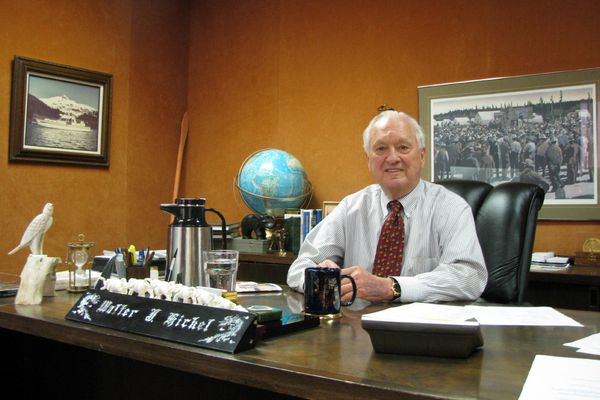
Mr. Hickel at his desk in the Hotel Captain Cook.
I first met, Dawson and Yvonne Lindblom, late summer in 1997. An appraiser from Antiques Roadshow was in Anchorage, Alaska, and I was at the Z.J. Loussac Library waiting to have my 1760’s Brown Bess musket appraised. The couple was standing in line directly behind me.
The appraisal event was a huge success, with curious antique owners lined up outside the main door all the way down several flights of concrete stairs. From there a mass of people wound around the sidewalk as well. Because of a loud gasp from one querulous attendee regarding my rifle, a security person walked over to check things out.
Asking to see my weapon, the man laboriously tried to peer into the barrel to see if it was loaded. A sharply pointed bayonet was still attached. Dawson Lindblom’s loud chuckle immediately caught everyone’s attention, especially his wife’s.
“That’s a flintlock. Lead ball goes in
from the other end. If it were loaded there’d be powder in the pan and the
frizzen cocked!”
Evidently this
was foreign language to the man; he quickly handed back my gun. Before
sauntering away the fellow quietly reminded me,
“Please don’t point it at anyone!”
That would’ve
been hard to do, as the Brown Bess stood over 7 feet tall from bottom of stock
to tip of bayonet. I cautiously held it upright to avoid poking folks.
Dawson Lindblom
and I began talking about things in general with Yvonne eventually joining in.
I believe they had several items for the appraiser to look at. The Lindblom’s
were extremely friendly people.
From the start
I felt at ease chatting with them. It was like we’d known each other for ages. Dawson
was a crackup. He would’ve been the life of any party. Eventually it came out
that Yvonne was former Governor Walter Hickel’s personal secretary. That piqued
my interest.
I told them a story about me as a teenager, deliberately turning into the Hickel’s circular Loussac Drive driveway one summer evening. This was directly after President Richard Nixon fired Mr. Hickel as Secretary of the Interior.
Rambling on, I mentioned my pal Jeff Thimsen and a couple of East High School classmates being in the car. Jeff told Michelle Giroux and Cathy Cook that my grandparents lived at the exquisite Loussac Drive residence. Of course the girls were smart enough to know he was pulling their chain. It was all for fun.
Dawson and Yvonne thought the story was funny. They wanted to hear more.
I stopped the car as Mr. and Mrs. Hickel came out their front door. Walter Hickel walked up asking what we were doing there. I told him we must be at the wrong address. We’re looking for my grandparent’s place. Michelle and Cathy in the backseat were trying to contain their laughter.
The Hickel’s spacious house was close to Cook Inlet with a creek running nearby. It was my favorite residence of all in Anchorage next to Robert Atwood’s place.
We drove by Mr. Atwood’s after leaving the Hickel residence claiming Jeff’s grandparents owned that dwelling. I believe a gate or sign kept us from driving in.
Mr. Atwood was proprietor of the Anchorage Times newspaper. His mansion at 2000 Atwood Drive was more like a villa than a residence, especially with a lily white gazebo sitting amidst huge green lawn during summer months. I met Bob Atwood as a boy when I delivered newspapers for him.
Mrs. Lindblom shook her head I suppose in amazement that someone would go to such lengths for a giggle. We were simply cruising around town that day. It was something kids did for harmless entertainment.
After
mentioning to Yvonne that I owned a newspaper article featuring Mr. Hickel
during his boxing years, and wanted to get it autographed, she gave me her work
phone number. The very soft spoken lady said to call and she’d arrange such.
A couple of
years went by and I still hadn’t made things happen. By that time I was working
closely with Governor Hickel’s former head of security, Robert Cockrell. One
day I told Bob Cockrell about my plan to have Governor Hickel sign the
newspaper, including an old governor’s license plate I’d recently come across.
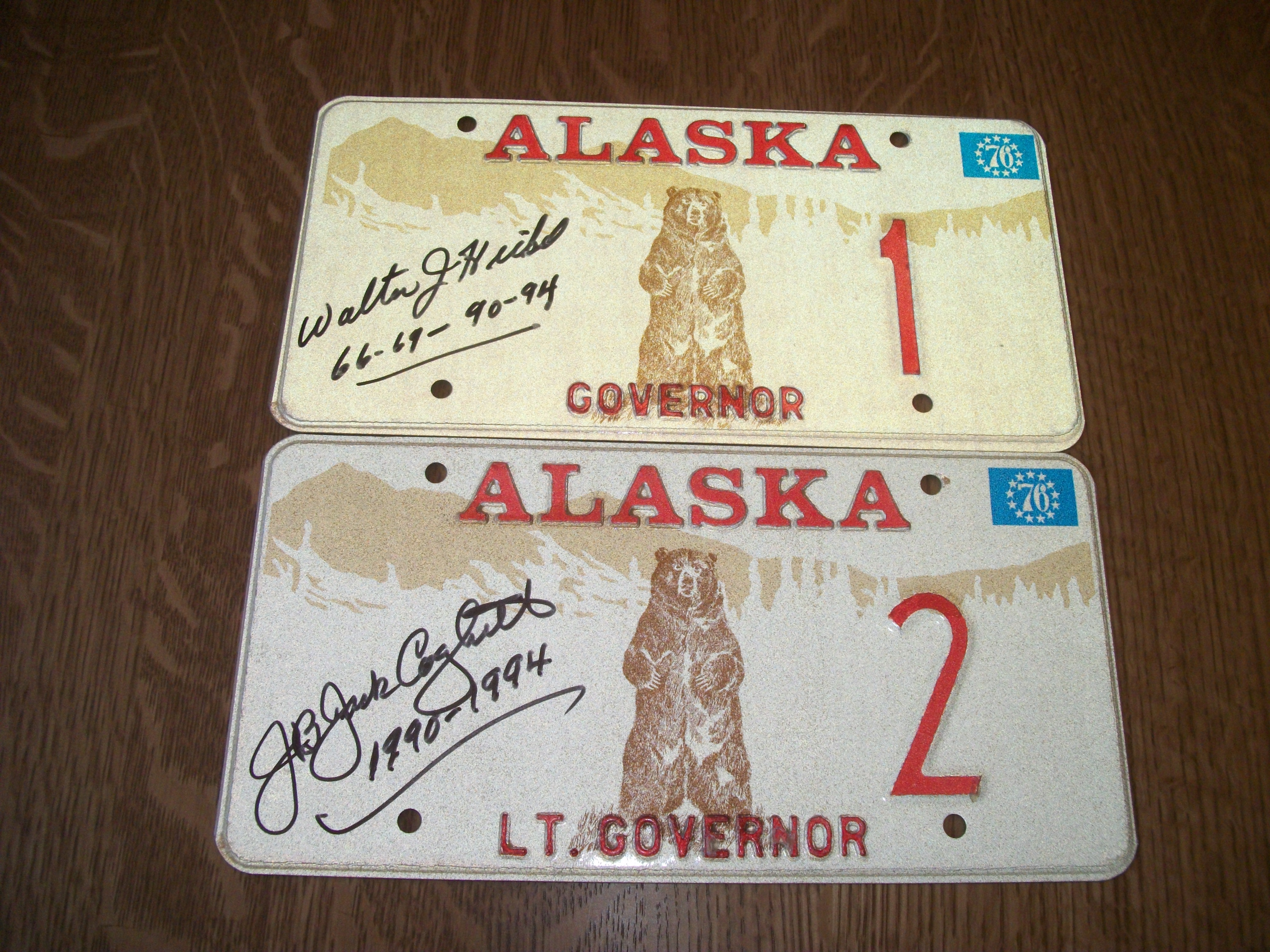
The license plate was totally unique. It came from one specific box of Alaska “Bear” plates sold at public auction. This was after the state stopped using the popular design. I’d been tipped off beforehand by a friend working at DMV, exactly what box contained the special ones. It had a small yellow X on the side.
Having the winning bid, I believed at the time the price was too high. The man bidding against me purchased all remaining inventory. Later on I read in the newspaper that the fellow used them to reroof a cabin. With original bear plates now worth upwards of $50.00 a pop, that’d be one expensive roof job.
Robert Cockrell set things up with Yvonne for me to meet the former governor. I was to stop by his office in the Hotel Captain Cook on Monday afternoon. I made sure to wear nice clothing and clean shoes as I’d heard Hickel was an impeccable dresser.
When I walked in the door Yvonne remembered me from our Loussac Library experience. We talked a few seconds before she introduced me to the Governor. He was sitting in his office in a black leather chair behind a nice oak desk.
The office was well organized. Everything was meticulously in place. A plaque on front of his desk in large letters boldly proclaimed, ‘Walter J. Hickel’. Yvonne had informed the governor beforehand on why I’d come.
After shaking hands, we conversed for a short spell regarding stuff I now can’t remember. I made sure to tell him my wife was also from Kansas. Handing him the newspaper article with his photograph on front brought forth a smile.
“I remember this story!”, he mused. “You know I still work out every morning!”
Walter Hickel looked extremely fit for someone in his early 80’s. The former boxer’s handshake was stronger than most of the younger guys I knew. He wrote a brief message on my newspaper with brown marker:
To Michael Hankins
God bless you for all your work.
Walter J. Hickel
1-19-98
I then pulled out the license plate. It was still in the original tan envelope.
“You really need Governor Hammond’s signature on this. These bears were issued during his stay in office.”
Walter Hickel was sharp as a tack on remembering such minute detail. It didn’t matter to me if it wasn’t the right year plate. For a brief second it appeared he might not autograph it. I was relieved when he asked Yvonne for a different color marker.
Mrs. Lindblom brought over a black one which Governor Hickel methodically signed with, adding to it the dates of his governorship. Telling him I also owned a Lt. Governor’s license plate, he said I needed to get Jack Coghill’s ‘John Henry’ on that one.
“Jack was my LG back then. He’s a
good man!”
Reaching into a desk drawer, he pulled out several political pins and some bumper stickers and handed them to me. Along with those items he presented me with an Alaska People Magazine with his photograph on the cover. He kindly autographed that as well.
I thanked him and was about to leave, when Hickel mentioned he had a question. Evidently Yvonne had told the governor about me cruising through his driveway nearly 20 years previous.
“So you took a liking to my place?”
With red face, I recalled the tale about how we tried to prank a couple of high school classmates. Mr. Hickel didn’t remember bumping into us in his driveway, or I’m sure he would’ve said something. The stately man had a comical reply to my obviously strange story.
“If you boys told me beforehand you were coming by, I would’ve went along with the gag!”
Walking back to my vehicle I realized I had something in common with Walter J. Hickel. As wealthy and powerful as he was, the man had a unique sense of humor not unlike my own!
* I was fortunate to get former Lt. Governor Jack Coghill’s signature on the corresponding plate. A friend, Ted Cadman, arranged such. Ted knew Jack and his brother Bill Coghill quite well. The old license plates are special to me. The two men signing them even more so!
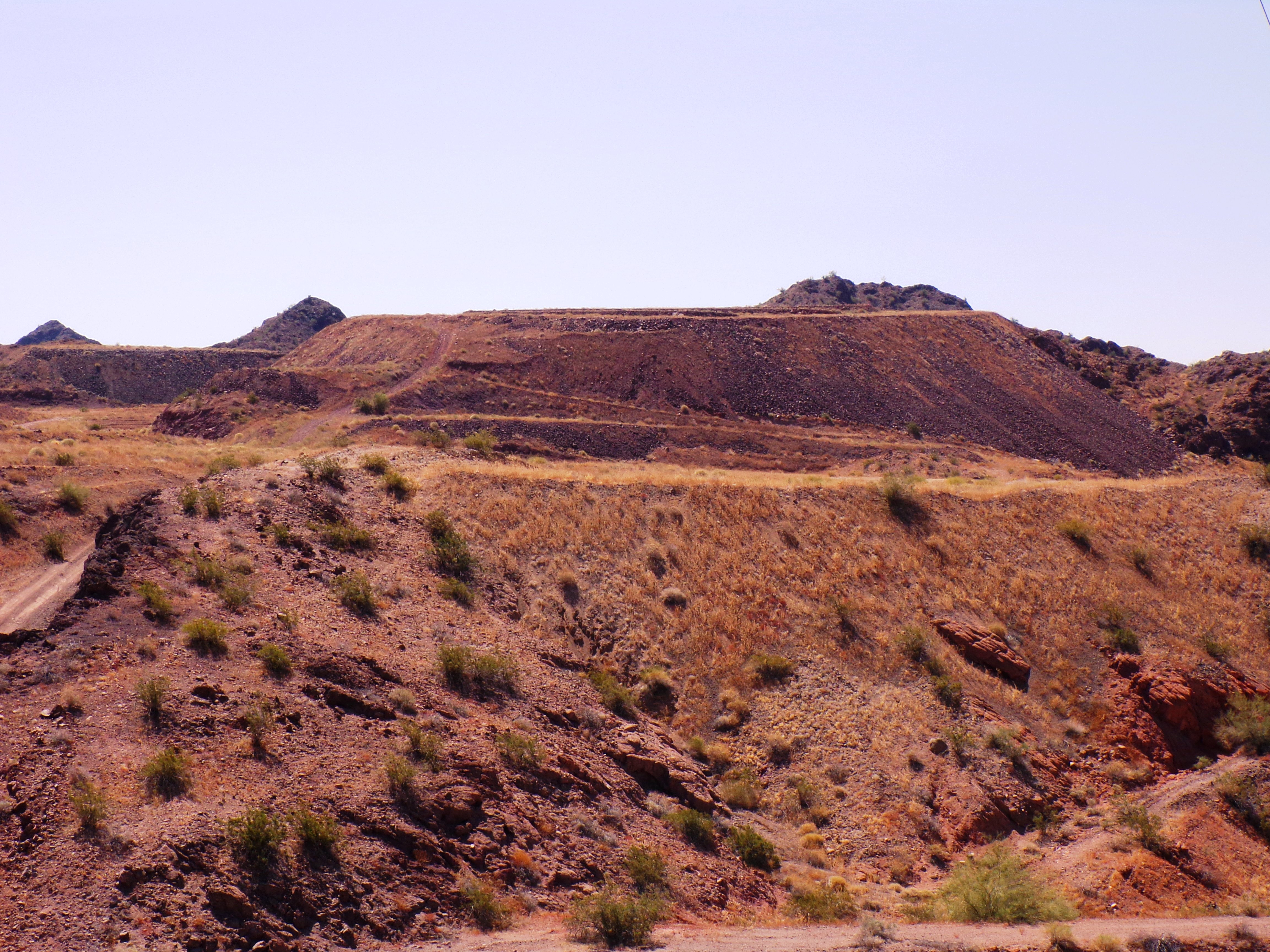
“Most people erroneously believe there was mining activity at the location.”
Uncompleted Max Dunlap construction project at Milepost 166.
August 9,
1974. It’s business as usual throughout Arizona. Not so in foggy and drizzly
Washington D.C.
President Richard Nixon just announced his resignation as Commander-in-Chief of the United States. A thoroughly investigated Watergate scandal brings him down.
“Tricky Dick” is caught with both hands in the cookie jar as they say. Vice-President Gerald Ford automatically takes office.
On the other
side of the country, massive Caterpillar dozers and scrapers are belching black
smoke. They slowly and methodically chip away at an unnamed stone mountain
approximately 20 miles south of Lake Havasu City. Sticks of dynamite are used
to persuade some of the toughest boulders to conform.
Political
unrest sweeping the country 2,400 miles away does not slow renowned Arizona
developer, Max Dunlap. It’s merely a distraction. After hearing the news on the
radio Max can only shake his head, repeating what most everyone else is saying.
“He didn’t cover his tracks!”.
Max Dunlap is creating yet another residential and business complex along the Colorado River. The mover & shaker has six such projects under his belt. Max is a successful builder from Phoenix. He and his wife Barbara are socialites and big-time players in the Phoenix horse racing arena. As a family, they often frequent the newly created Lake Havasu City with their seven children.
Max’s latest endeavor consists of chiseling a main access road up the rugged terrain to the very top. To do so, he relies on switchbacks to traverse the steep grades. At the mountain’s peak, a huge water tank will eventually be set in place to supply modular trailer homes and businesses with ample supplies of H2O.
View at the top of the hill is spectacular and unobstructed. Looking west, blue green waters of the Colorado are visible backed by the rugged Buckskin Mountains in California. The Whitsett Pumping Station is visible including Parker Dam.
At the
bottom of the planned community, alongside busy Highway 95, a gas station,
convenience store, and laundry will be located. Plans are to tap into the
constant flow of tourists cruising through the area, by constructing an RV park
on the lake side of the highway. Snowbirds converge on the area in winter
months, with Dunlap carefully calculating that all spaces will be taken.
An official
name for the project is yet to be announced but Max has one in mind. It will be
special like all the others. The legal description for his one-mile-square of
land is ‘Rabinowitz Section’.
The purchase price for the property is $500,000.00. Max obtains funding from long-time Arizona businessman and politician Kemper Marley Sr. The smooth-talking Dunlap borrows another 1.5 million from Marley for grading and improvements. Kemper and Dunlap are like father/son. They fully trust one another.
Years
previous, Max built a similar complex a few miles north of Parker. In partnership with Phoenix investor Robert
D. Flori, the two entrepreneurs create Lake Moovalya Keys near the Parker Dam.
It becomes a huge success aesthetically and financially.
Havasu Garden Estates in Lake Havasu City was also developed by Dunlap via his firm, Garden View Development. Lot sales are slow at the start. Max Dunlap is definitely not the type of person to rest on his laurels. His fingers are much like “Tricky Dick’s.” They’re constantly into something.
On June 2, 1976, at 11:34 a.m., Max Dunlap’s world literally comes apart. That’s the day Arizona Republic investigative reporter Don Bolles’ car blew up. Dynamite placed underneath Bolles’ 1976 Datsun 710 detonated as he slowly backed away from the Clarendon Hotel in Phoenix. The savvy newspaperman succumbed to his injuries 11 days later.
Bolles’
tragic story went global. Politicians from President Ford on down to city
councilmen and councilwomen vowed to find the killer. Investigative work by law
enforcement began before all acrid smoke cleared. Several key names popped up
over the next several weeks. Max Dunlap’s was one of them.
I cut to the
chase here as there’s ample court material on Don Bolles’ murder investigation
to fill a complete newspaper plus several more.
Max Dunlap was eventually convicted for ordering the hit on Don Bolles. He was sentenced to death. The courts later changed Dunlap’s verdict to life imprisonment. Max died in prison on July 21, 2009, at the age of 80. To his last breath, he claimed to be innocent of any wrongdoing.
There were
several other players in this crime besides Dunlap:
In a plea
bargain, John Adamson admitted to placing the dynamite under Bolles’ Datsun.
Adamson was sentenced to 20 years in prison. When Adamson was released he
disappeared from sight under the federal witness protection plan. A few years
later he elected to forego such. Adamson died at an undisclosed location in
2002.
James Robison was convicted of helping John Adamson trigger the bomb. He was later acquitted. Robison eventually pleaded guilty on trying to have John Adamson rubbed out. He was sentenced to five years in prison for that deed. Both Robison and Dunlap were upset at John Adamson for spilling the beans. Robison was released from prison in 1998. He moved to California dying there in 2013.
Kemper
Marley Sr. was looked at from all directions. Authorities could never find
enough hard evidence to lock him up. He was a rich and powerful man. Hiring the
best lawyers was no problem for Mr. Marley.
The
reasoning behind Don Bolles’ death allegedly hinges on his detailed
investigative articles. Over the years Bolles uncovered many unscrupulous deeds
related to people in high places. His investigative tenacity knocked some folks
off their high horse. Because of such he quickly developed enemies.
It was
thought by many that Don Bolles was hot on the trail of another case involving
politicians and mobsters. This supposedly went all the way to Washington. What
information Bolles had was tragically taken to the grave!
The 50th anniversary of this tragedy is August 9. The next time you drive to Parker from Lake Havasu City, look to your left near Milepost 166. You’ll see the rock mountain that Max Dunlap laid claim to. It’s extensively chiseled and shaped from heavy equipment and explosives, with roadway and home site areas easily visible. Most people erroneously believe there was mining activity at the location.
The mountain
is permanently scarred much like an explosion hit Don Bolles’ car. The project
itself came to a grinding halt when Max Dunlap went to the slammer. Snowbirds
use the property in winter months to park their RV’s. I’m sure most are totally
unaware of the tarnished history behind their squatter’s oasis.
Interestingly enough, Mohave County tax records show this property belongs to the State of Arizona. The county tax number is 101-44-001 for those wanting to check specifics.
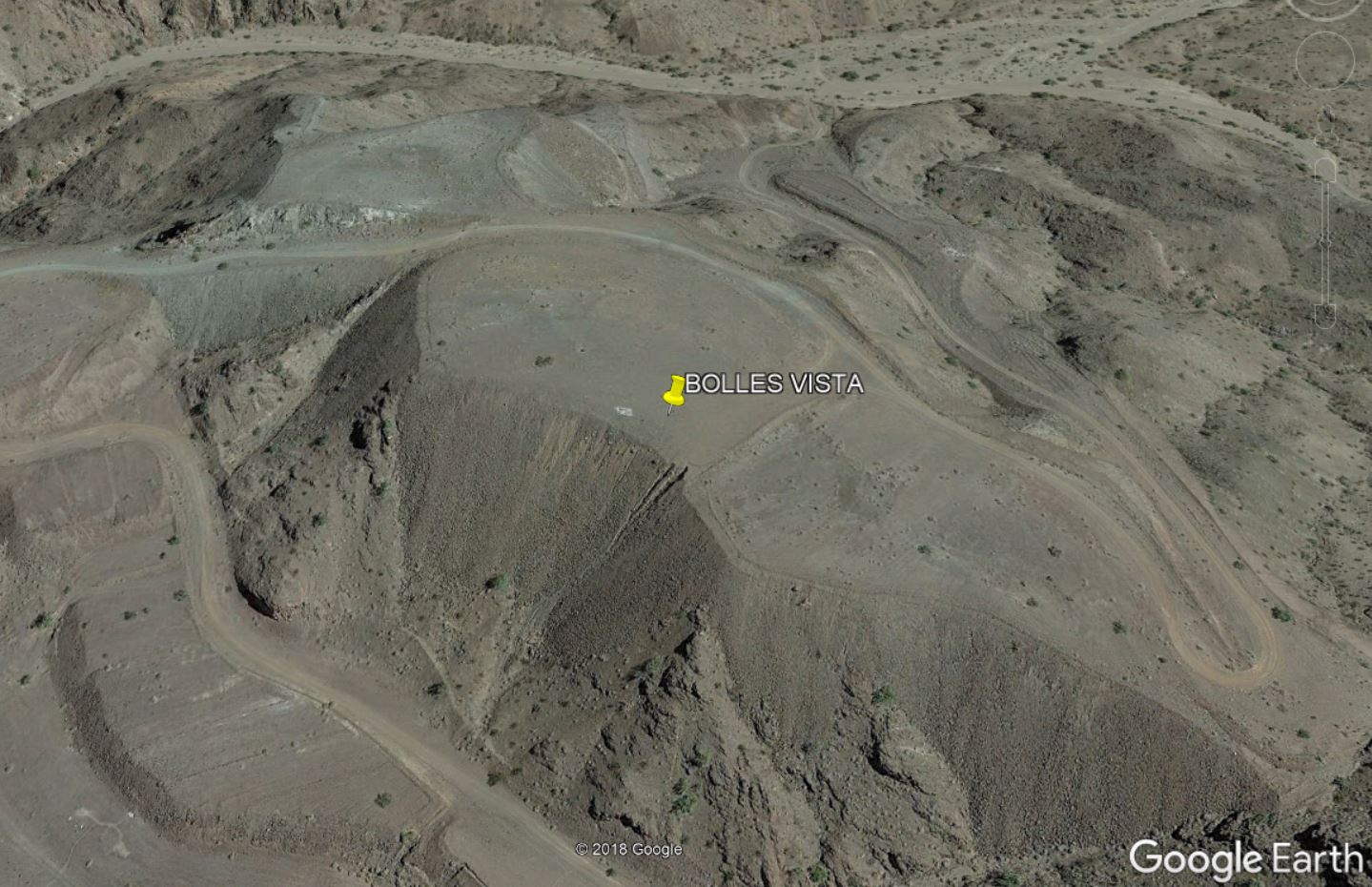
Perhaps someday another developer full of zest and zeal will finish what Max Dunlap started. Part of the stipulation in the state selling this land should be that Don Bolle’s name permanently be connected with it. The small mountain could geographically be titled Bolles Vista. That would be a fitting testament to Don’s life and career. His name then etched forever into the ground formerly owned by one of his killers.
For the time
being this plot of land will continue to sit battered and scarred, labeled by
those in the know as tainted ground.
* Some still believe that Max Dunlap was innocent. Two different juries saw things differently. Max Dunlap went to prison, while Kemper Marley Sr. avoided steel bars. It was rumored that Marley was the kingpin behind Bolles’ murder, yet there was never enough evidence to prosecute him. Kemper Marley continued to do business as usual until he died in 1990.
An excellent book on the Don Bolles’
murder is available for online reading. It’s titled, “The Arizona Project” by
Michael F. Wentland. I highly recommend reading Wentland’s story. If anything,
do it for Don Bolles’ memory!
Google Earth view.Looking towards Whitsett Pumping Station at Milepost 166.
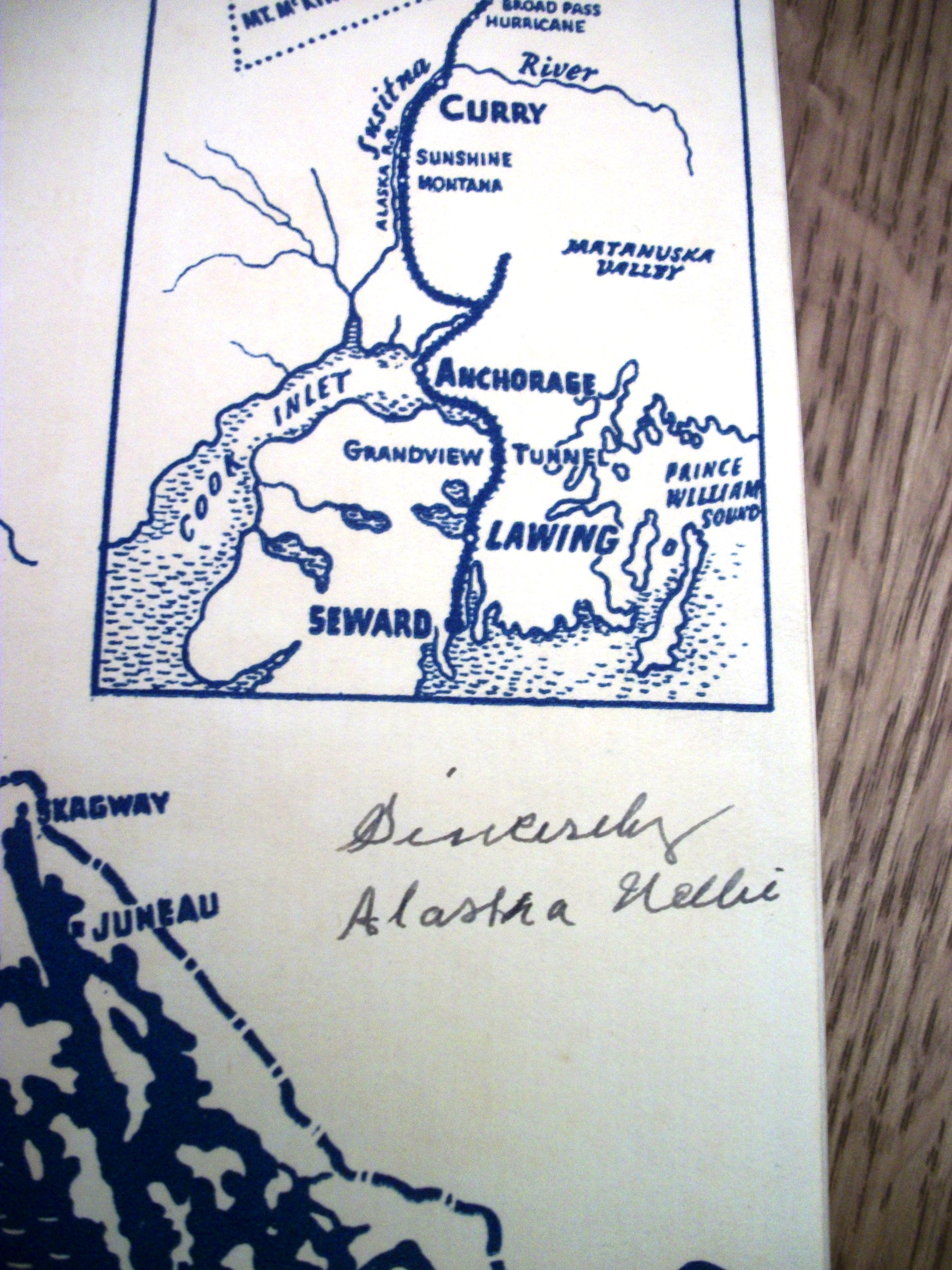
Rare 1941 second edition of “Alaska Nellie” with Nellie Lawing and Percy Blatchford signatures.
Over the past several years, I composed two short stories regarding a couple of well-known Alaskans.
Nellie Trosper-Neal-Lawing (“Alaska Nellie”) was a rambunctious little girl, born July 25, 1873, to parents Robert and Jennie Trosper. The family lived near Weston in Platte County, Missouri. Weston’s just a stone’s throw from Leavenworth, Kansas. Young Nellie grew up on a farm understanding the virtues of hard work.
After leaving home, Nellie married a fellow Missourian that quickly developed the need for alcoholic beverage. Reading between the lines in her bio, husband Wesley Neal was most likely a physical and verbal abuser while under the influence. The couple set up residence in the rip-roaring mining town of Cripple Creek, Colorado.
Things went
well for a short time before their marriage unraveled. After separating, Nellie
Neal journeyed north to leave emotional trauma behind. A divorce ultimately
followed.
Nellie’s
claim to fame was operating several roadhouses along the Alaska Railroad during
its earliest years. She wrote a book about such called, Alaska Nellie.
The woman loved to hunt and fish more out of subsistence than for sport. Most all trophies that she had hanging on cabin walls were secondary to the harvested meat. She oftentimes traveled in the winter via dogsled spending many nights under flickering stars.
During summer months she hiked hundreds of miles in bear infested country with mere backpack and gun. Mrs. Lawing was a tough individual enduring countless hardships in life. She was also a woman of faith.
Nellie was
engaged and about to remarry, when her fiancé Kenneth Holden was killed in an industrial
accident. A little over a year later she married the deceased man’s cousin,
William (“Billie”) Lawing. Billie proposed
to her by mail.
They were husband
and wife only 12 years before tragedy struck. On a blustery March day in 1936,
Nellie found Billie dead of an apparent heart attack outside their log cabin.
He’d been cutting ice and shoveling snow near the edge of Kenai Lake. The unfortunate
widow was devastated.
My story regarding Nellie Lawing is not so much about her life. It’s about a railroad trip a friend and I took to one of her former roadhouses. I traveled there to survey the surroundings for my story. The short composition is called, Grandview Station.
******************
Percy John Blatchford was born at Golovin, Alaska, October 9, 1920. He was full-blood Inupiaq Eskimo. At the young age of 20, Percy joined the United States Army eventually seeing action in WWII. After Japan surrendered and the conflict officially ended, Percy left the Army, reenlisting in the Air Force. Sgt. Percy Blatchford fought in Korea and Vietnam where he was a highly decorated soldier.
Percy was an expert at parachuting into dangerous locales where others dared not go. Because of his vast knowledge and skill he taught survival courses to many Air Force personnel. One of Percy’s most unusual accomplishments was training Beluga whales for the U.S. Navy.
Percy
“Noseemo” Blatchford was a feared boxer holding the heavyweight crown for
Alaska. He sparred with another fighting legend, Joe “The Brown Bomber” Louis.
Like Nellie, Percy was also a staunch believer going back to his childhood
days.
I worked
with Percy for several years after his illustrious military career ended. Hands
down he was the toughest guy I’ve ever met. My short story about him is titled,
Percy Blatchford – Alaska Legend.
******************
There’s plenty of information about Nellie and Percy’s life on the internet. Historian Doug Capra of Seward wrote a wonderful piece detailing Nellie’s rise to fame. In sluicing for data I never came across records showing where Nellie and Percy met. With Alaska being so large it seemed unlikely to me such a meeting occurred. I was wrong.
A while back
I decided to read for at least the fifth time, Alaska Nellie. I’ve had the old book 30 years or longer. After
briefly thumbing through the first few pages I came across a hand written
inscription:
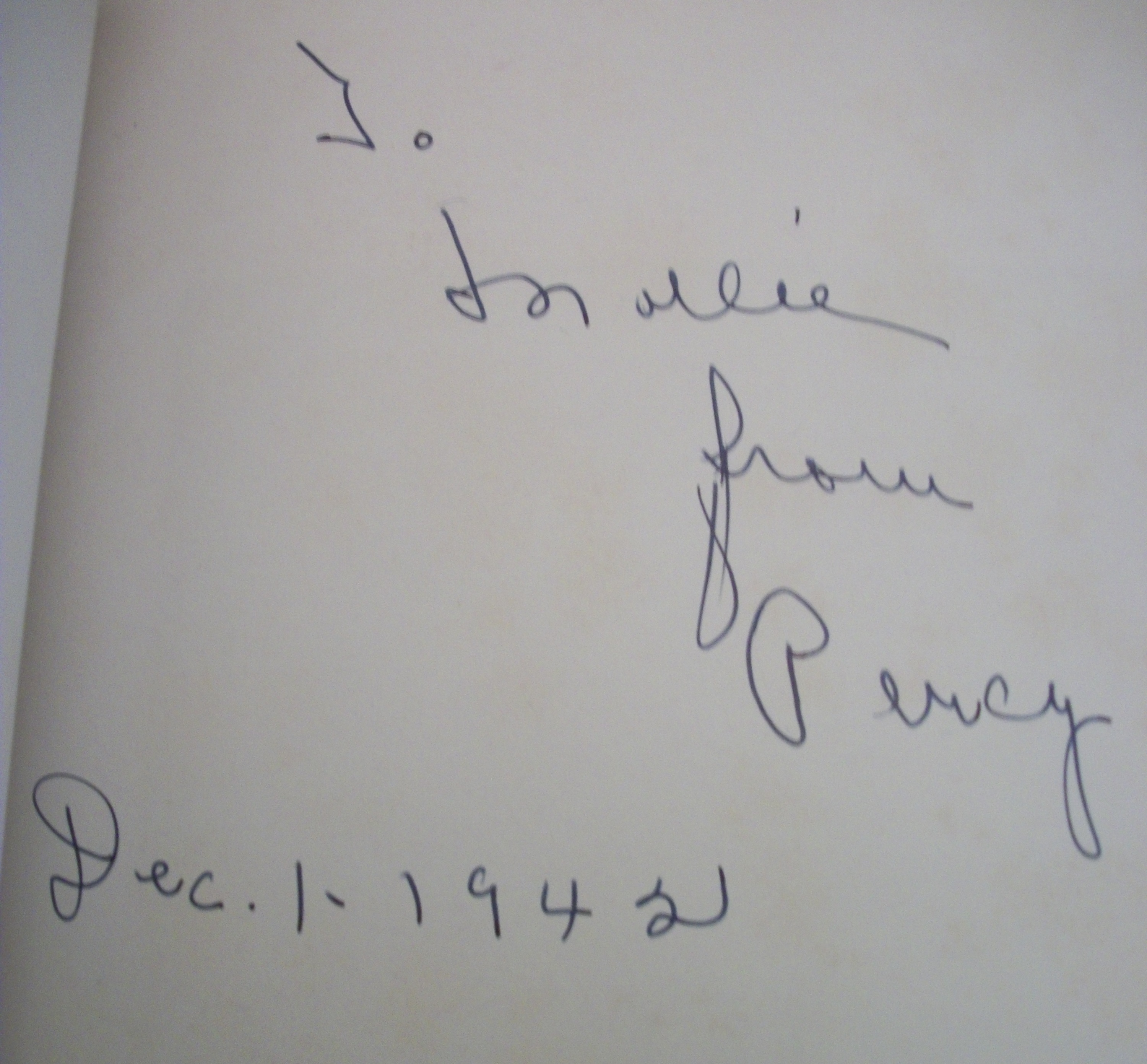
“To Mollie from Percy. December 1, 1942.”
I’d never noticed the entry before. Without question the names referred to Percy Blatchford and his younger sister Mollie Blatchford Galvin. A comparison of Percy’s handwriting confirmed such. Percy gave Mollie the book several weeks before Christmas. This was after he’d entered military service in 1941.
Nellie Lawing sold her books and postcards from a combination railroad station – roadhouse, post office, residence, and wildlife museum on Kenai Lake. It was called Roosevelt Station. Eventually the name changed to Lawing. The location is 23 miles northeast of Seward. She also traveled 15,000 miles by bus throughout the U.S. pedaling them, plus giving lectures in many towns and cities on Alaska.
Nellie and Billie’s place was a popular stopping point for travelers and tourists alike, with many dignitaries such as actress Alice Calhoun, President Warren G. Harding, and author/comedian Will Rogers visiting. At lake’s edge was a boat service including ferry for vehicles. The road from Anchorage to Seward did not go all the way through back then.
The books sold like hotcakes. While Nellie lived in Lawing Alaska Nellie went through six printings. It has since been reprinted for the seventh time by Patricia A. Heim. The specimen I own is a second edition released in 1941. Nellie Lawing autographed this one,
“Sincerely Nellie”
Percy Blatchford evidently traveled to Seward on military or personal business. He would’ve stopped by Nellie Lawing’s place on the way to or from Anchorage. He had relatives living in the small fishing community so trips to Seward weren’t uncommon. With several younger siblings and Christmas only three weeks away, Percy undoubtedly purchased more than one book. That’s pure speculation on my part knowing the man always put others before himself. With Percy being an accomplished hunter I’m sure he and Nellie found plenty to chat about.
A good friend of mine, Britt Behm, mentioned that my copy of Alaska Nellie had come full circle. She’s basically correct in that analogy, although I believe there’s still a portion of the circle yet to fill. The book ultimately needs to go to a museum or Blatchford family member. Unless another manuscript surfaces, this rarity is perhaps the sole survivor with both Nellie and Percy’s signature.
I’ve decided to pass things on to Cecil & Anne Sanders. I’ll leave it up to them on what to do with the book. The young couple own Last Frontier Magazine. Without their assistance my stories regarding Nellie and Percy would’ve never saw ink.
I’ve been the book’s caretaker for some time now. Alaska Nellie had a nice vacation in Arizona languishing inside my gun safe. Time’s ripe for her return to “The Last Frontier”.
After
finding out the manuscript’s historical significance, I didn’t want it ending
up in a Saturday morning garage sale. I don’t recall where I purchased it, but
most likely an Anchorage yard sale or second hand store was the place.
Alaska Nellie is an excellent reference book
regarding early 1900’s life in territorial Alaska. Hopefully Cecil and Anne
take time to read it. Professor Michael Burwell once told my creative writing
class,
“Books belong in hands, not on
shelves!”
I’m sure Nellie, Percy, and Mollie would agree. They’d delight in knowing the 78-year-old early Christmas present is still making the rounds. The circle is almost complete!
In a May 11, 1956 Fairbanks DailyNews-Miner newspaper article written after Nellie’s death, it was reported that she sold 3,000 Alaska Nellie books the first printing. That would make for a total of 18,000 over the six editions. In 1980, the St. Joe Gazette (Missouri) interviewed Nellie’s nephew, Everett Trosper. He told a St. Joe reporter that 2 million books had been sold for $2.00 each. Some stories, much like the length or weight of a caught fish, seem to grow through the years.
A couple of days after shipping the book to Cecil and Anne Sanders, I decided I wanted an inexpensive and decent edition of Alaska Nellie for reading purposes only. Arriving in the mail a few days later, I was stunned to find my replacement came from the private library of Leonhard Seppala. Things like that don’t just happen! Over the years I’ve truly been blessed by God in this area. Miracles do happen!
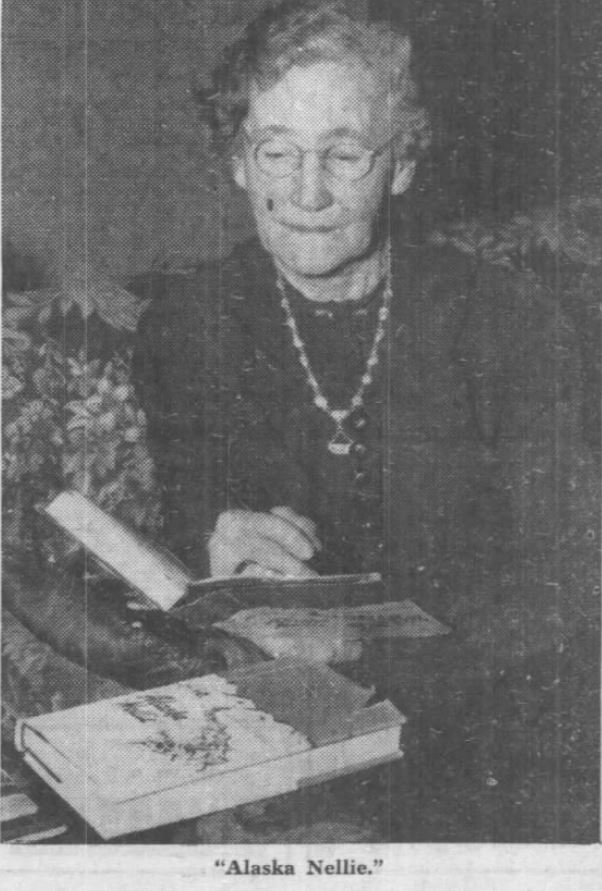
Written inside the cover of my replacement.Nellie Lawing autographing copies of her book, “Alaska Nellie”.
Sometimes in researching a story, I come across bizarre leads taking me all different directions. This happened again just recently.
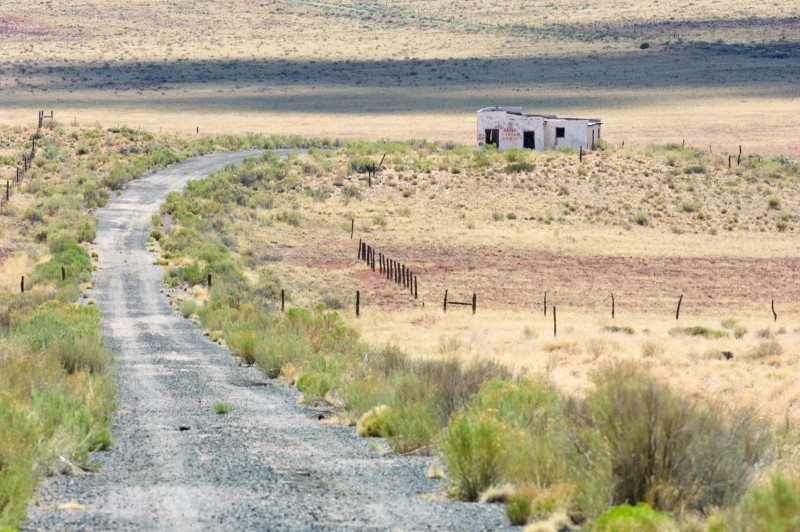
It’s not like I was looking to write about a couple of WWII veterans. I was seeking specific information about a long-abandoned business near Holbrook, Arizona called, ‘Painted Desert Trading Post’. This place has mega historic significance where old Route 66 is concerned.
On February 5, 1957, a semi-truck loaded with frozen meat blew a right front tire while traveling along Route 66. Out of control, the rig careened off the highway and headed straight towards Painted Desert Trading Post.
The truck crashed into the wood and stucco structure doing considerable damage. A still attached trailer rolled over squashing a pickup truck and car. No one was seriously hurt. Newspaper articles stated that meat, ham, and bacon went flying.
Driver of the semi was a fellow named Floyd A. Austin. Intuition told me to pursue Mr. Austin’s background. Sometimes an inner voice tells me to do strange things like that where my research is concerned.
Records show that 10-years prior, on December 20, 1947, Floyd Austin was involved in a similar accident with a totally different outcome.
Floyd and good friend, Army Pvt. Jess Scroggins, were hitchhiking out of Needles, California with their wife and girlfriend. Both men had recently returned from fighting in WWII.
Pvt. Scroggins was still in the military stationed at Fort Kelly, Texas. Pvt. Floyd Austin had just mustered out of the service. More than likely they were all headed home to Illinois for Christmas.
A diesel truck loaded with barrels of oil stopped and picked them up. The two girls jumped in the cab while the guys climbed onto the trailer. Being it was a tight fit back there, most likely they squeezed between the heavy metal drums.
Near the California/Arizona border at Topock, a wheel suddenly came loose sending truck and trailer tumbling off the road. Pvt. Jess Scroggins was crushed and killed instantly while Floyd Austin sustained severe head injuries. The Needles newspaper called it a ‘freak accident’.
I dug further on Floyd Austin’s background. He fully recovered from his physical injuries. Mr. Austin stayed married to Edna until his death in 1970. Floyd’s wife never remarried.
I stopped my research after finding son Floyd Austin Jr. tragically drowned at an early age in Missouri. Once again it was a freak accident. That was enough tragedy for a story I hadn’t planned on writing to begin with.
Hopefully there are family members still remembering these two veterans. I would’ve never known their names had I not been prodded to dig deeper. I’m glad I did.
There’s nothing more I can say about Pvt. Austin and Pvt. Scroggins other than,
For me, bidding farewell to family and friends can be tough, even if it’s for short periods of time. The same can be said about leaving mouthwatering cuisine behind.
Mom had a saying about certain foods. Generally it dealt with breakfast items. A good example being,
“Oatmeal will stick to
your ribs!”
I took that remark quite literally in my early years; easily assuming that’s where oatmeal ended up. Some other rib sticking items on her list were hot cereals such as wheat germ and puffed rice.
Mother also had a list of comfort foods. Those included grits, eggs, bacon, biscuits & gravy, mashed potatoes and gravy, fried chicken, and chicken pot pie. Mama Haynes taught her daughter (my mother) how to make the best chicken pot pie hands down.
Now that I’ve put on a few extra pounds, comfort foods take on an entirely different meaning. In an effort to shed a few ounces, my list of essential food items has shrunk.
Cookies definitely stick to the ribs along with other places. Our Albertson’s grocery store makes the best cranberry and walnut cookies. They come in a box of 8 and are labeled, “Gourmet’. Price of them is considerably higher than regular cookies I suppose because of the fancy title.
When I wheel through a checkout stand with a box of “Gourmet” cookies, I know the checker realizes this fellow understands quality. At 250 calories per cookie I cut one in half to lessen any rib sticking. The first half is downed with a glass of 1% milk. I then wait at least 30 minutes before consuming the other. With sadness I now have to bid them,
“Goodbye”.
Pizza is a big rib sticker. I generally ordered thin crust.
The word ‘thin’ is a key ingredient because it means fewer fat calories. Hawaiian
is my favorite with round slabs of Canadian bacon, a truckload of mozzarella,
plus gobs of pineapple. I’d come to the conclusion that Hawaiian is the healthiest
pizza to eat because of the sweet fruit. A nutritionist told me different. Hearing
such, I had to inform my 16 inch pal,
“Too-da-loo!”
Other comfort foods on my list include burritos, tacos, and enchiladas. I try to avoid sour cream, substituting salsa instead. My wife claims salsa is healthy to eat all by itself. Not wanting it to be lonely, I always added a bowl of chips to the salsa for company. Not anymore.
“Adios!”, my crispy friends.
Someday I hope to be reunited with those departed comfort foods. They’ll always be welcome in my house for others to enjoy, even if I don’t partake of them.
The other day my wife brought home a new item from a drive-thru Chinese restaurant. They’re called ‘pot stickers’. I wasn’t sure what they were until looking the word up. Pot stickers are basically bread dough fried in a pan. They have different ingredients inside but pork is the most common meat.
I’m not sure if pot stickers would be considered rib
sticking or comfort food? The Chinese don’t use such labels. I asked my wife what’s
with the pot sticker name. She didn’t have a clue.
I downed near the whole box. There were only four left. Late that evening I was bound up tighter than an overly twisted rubber band. Hours later, after my intestinal pain subsided, a light came on.
I knew exactly why the Chinese named them that.
Before tossing all remaining pot stickers in the trash I sternly warned them,
“Hasta la vista my little fiends. Don’t let the door hit you on the way out!”















 I like to write junk...