“It all came to an end in some schools when a few parents complained that they couldn’t afford to buy a bag of Valentine cards to begin with.”
Handing out cards on Valentine’s Day is no longer allowed in some schools. Cupid misfired an arrow, and it accidentally ended up hitting an errant target. Because of that one unfortunate incident—some school administrators saw fit to cancel things altogether.
I looked forward to Valentine’s Day, especially the making of a special box or sack for all of the cards to go in. Unfortunately, not all students received the same number of cards. Kids can be cruel without even knowing it.
A way around this was that a Valentine had to be given to everyone in the class, with teachers making sure this took place. That was extra work for them. It all came to an end in some schools when a few parents complained that they couldn’t afford to buy Valentine’s Day cards to begin with. Cigarettes and beer, no problem, but cards for their kids were a different story.
Psychologists soon entered the fray, claiming that Valentine’s Day was leaving a permanent mental scar on some of the lesser liked students. These experts said this was a form of bullying. There’s always someone out there to protect those whom they think need protecting.
That’s why 5-gallon buckets have warning labels on them to prevent small children from drowning. I’m sure it still happens on rare occasions. What one-year-old infant would pay attention to such a sticker to begin with? I’m surprised warning labels didn’t appear on Valentine boxes or bags years ago saying, “Caution – Could Cause Hurt Feelings.”
Thankfully, these overly protective individuals left ‘Valentine giving’ amongst teens and adults out of their concern. For Edna S. in Knoxville, Maryland, hurt feelings most likely occurred soon after she sent a card to Mr. M.H. Haupt in Middletown, Maryland.
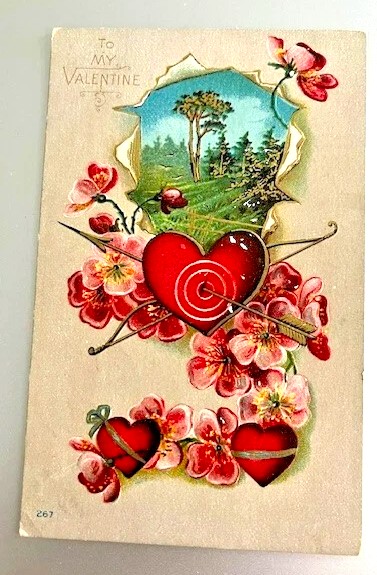
The card is dated February 11, 1910, and was mailed from Knoxville, Maryland. Knoxville is known for its beautiful Magnolia flowers. The short message shows some concern on her part:
“I believe you have forgotten me so I thought I would send you another card.
Your friend,
Edna S.”
This colorful Valentine’s Day card with a nice message features Cupid with his bow, along with what appear to be Magnolia flowers, and a nature scene that I believe to be a growing field of flowers. “To My Valentine” appears on top.
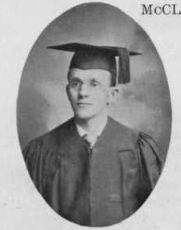
Research shows that McClure Hamilton Haupt declined Edna’s Magnolias and picked Daisies instead. He married Daisy Gladhill on July 16, 1913. She taught in the same school as him, and they must’ve taken a liking to each other.
Some will find this sad. Perhaps it is, but I like to think that God had someone else in mind for Miss Edna. Searching through data from different sources, I couldn’t crack the egg and find what her last name was.
My guess is that it was a former classmate, yet no Frederickburg County yearbooks from the 1890s were available to me. I’ll continue searching through new resources as they become available.
The Haupt’s stayed together until he died in 1953, with her passing away at 101 years of age in 1983. Edna’s card must’ve meant something special to M.H. Haupt; otherwise, it wouldn’t have survived. Undoubtedly, it was hidden away among his special treasures!
“When Mrs. Steinhardt sent that card in 1949 to someone she either personally knew or met, the woman and her husband were finishing up a three-week cruise to Alaska.”
If I had a dollar for every time someone called me Michael Hawkins, I’d be a rich man. I stopped correcting folks on the pronunciation during my earliest days. While in school, if a teacher from another class said, “The Hawkins boy did it! — I knew immediately they were talking about me.
I believe the Hawkins name has a good ring to it, although I didn’t learn until much later that John Hawkins, the pirate, was also a slave trader.
Throughout the year, someone will write my wife and accidentally spell her first name, Jolene, when in fact the correct spelling is Joleen. It sometimes perturbs her, but I always say, at least they’re thinking of you. The analytic way to look at this is that they had a 50-50 chance at spelling things correctly, yet still got it wrong.
Alaska and Arizona names are perhaps the trickiest to spell or pronounce, with me often having to look online or in my old, 1964, “Dictionary of Alaska Placenames.” Yes, I have an original such book, and it’s one of my prized possessions. Speaking of dictionaries, what are those companies that print dictionaries doing now?
There’s a big push to change easy-to-pronounce town and geographical names of Native origin. The Inupiaq name for Barrow is Uqtiagvik. I doubt the younger Inupiaq population can even pronounce it, let alone me.
Kasilof is an Alaskan name of Russian origin. It’s supposed to be pronounced “kuh-SEE-lof,” but I’ve heard pioneer Alaskans say, “ka-SEAL-off.” It makes no difference to me because I know what they’re talking about.
Chemehuevi is an Arizona Indian tribe, and I often get tongue-tied trying to say it, with a street here in town named that. The correct way to pronounce it is “cheh-mih-WAY-vee.
The Hualapai Mountains are near Kingman, Arizona, and instead of me trying to remember this, let alone butcher the spelling or pronunciation, I often say to people, “Those mountains near Kingman.” Folks know what I’m talking about.
Mt. McKinley has been called Mt. McKinley going back to 1896. That’s the name I was taught throughout school. History shows it was called Buishale or Bulshaira before then, with it being named that by Russian explorers. Some will tell you that it was called Denali going way back.
Neither the Inuapiq nor the Koyukun Athabascan Indians nor any other Alaska and Canadian tribes had a written language. They did have a word for it in their language, meaning tall mountain. Somewhere along the way, in the latter stages of history, the sound uttered by Indigenous people was interpreted by European translators to be Denali.
I’ve found the Buishale or Bulsharia names in old newspaper articles going way back and documented them. The often-used newspaper term, “It’s here in black and white,” is hard to dispute.
President Obama officially changed McKinley to Denali in 2015. Trump officially changed it back to McKinley in 2025. It makes no difference to me what it’s called, Buishale, McKinley, or Denali. I’ll know what you’re talking about.
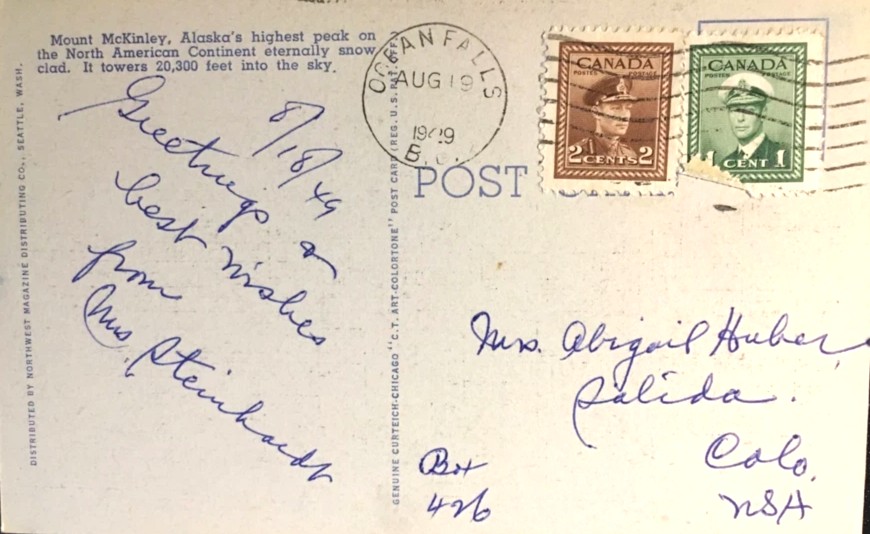
A vintage postcard from the 1940s has a picture labeled Mt. McKinley on the front. These days, that same postcard would undoubtedly be printed with Denali.
The short note inside with both sender and recipient names caught my attention. I wasn’t expecting to find anything unusual about either person. Initially, I misinterpreted one name to be Steinholdt when in fact it was Steinhardt. That made a big difference.
Mrs. Steinhardt sent the card from Ocean Falls, British Columbia, on August 19, 1949, to Mrs. Abigail Huber in Salida, Colorado. The one-cent and two-cent stamps are Canadian in origin. A short message written in perfect cursive says,
“8/18/49
Greetings & best wishes from Mrs. Steinhardt.”
Mrs. Abigail Leffingwell Huber lived a normal life, it seems, passing away in 1967 at the age of 87 in California. I make this assumption, finding nothing controversial or outrageous written about the woman in newspaper articles.
Abigail was born in Vermont in 1880, marrying Jacob Manley Huber in 1901. They lived in Minneapolis, Minnesota. Due to Jacob’s ill health, the family moved to Colorado in hopes that it would help. That’s where Jacob died in 1914.
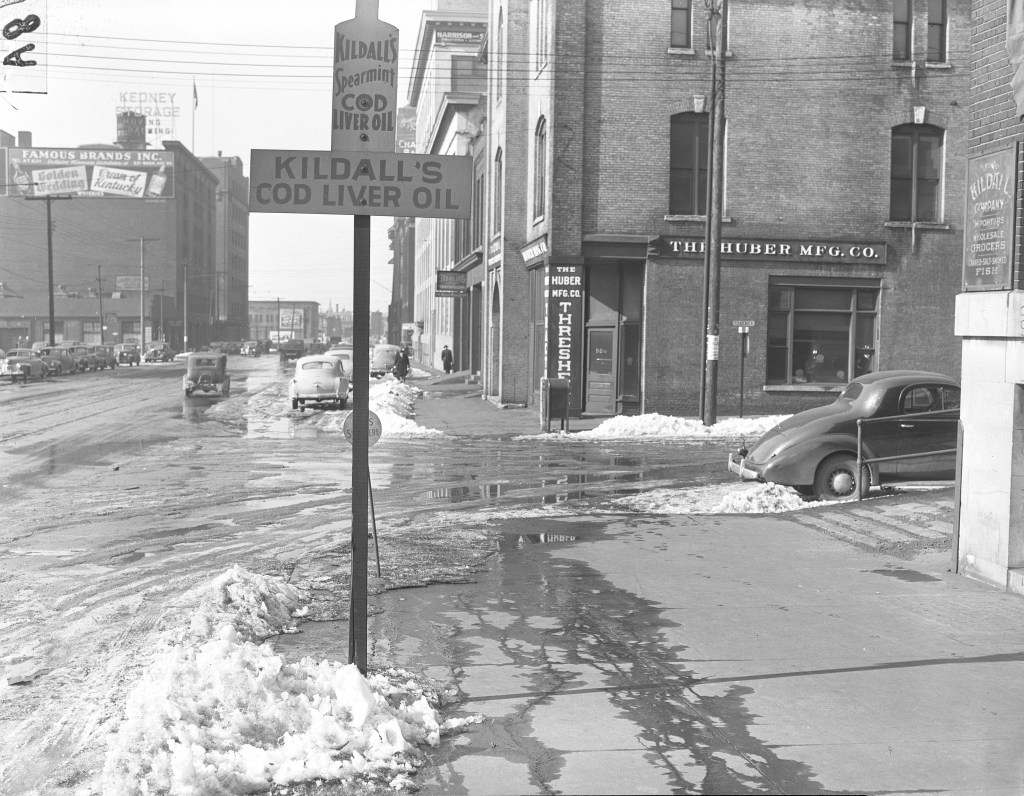
J.M. was a partner in Huber Brother Manufacturing Company. The family was quite wealthy. They made washing machines and powered wagons, along with farm implements. Abigail continued to reside in Minneapolis before relocating to Colorado, and then on to California in 1954 to live with a daughter. After Mrs. Huber passed away, her remains were shipped back to Minneapolis to be interred next to her husband.
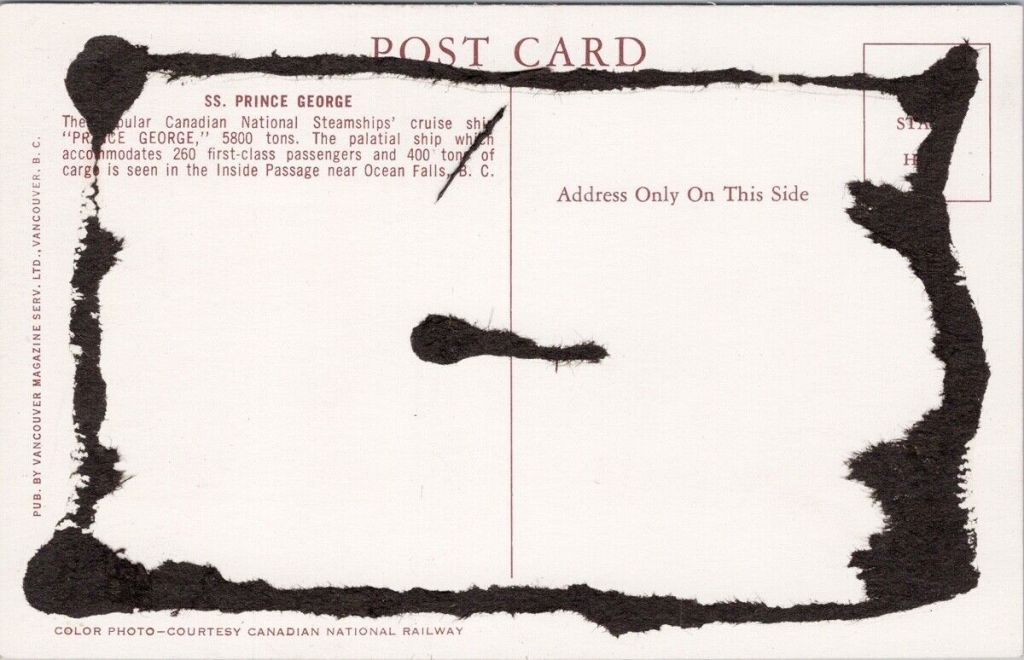
When Mrs. Steinhardt sent that card in 1949 to Mrs. Huber, Dulcie Steinhardt and her husband and daughter were finishing up a three-week cruise to Alaska. Their ship, the Canadian National Steamship SS Prince George, was only commissioned for service in 1947. It regularly stopped in Ocean Falls, British Columbia, Canada, where the postcard was mailed. It seems reasonable that she sent out quite a few cards from there.
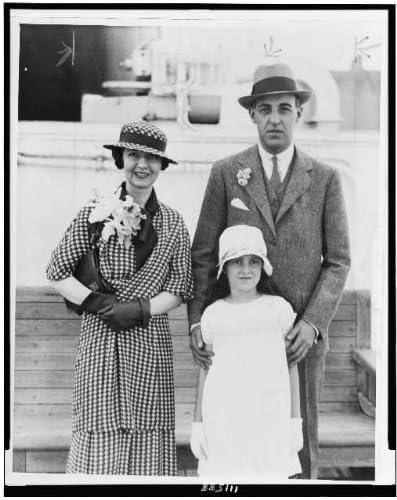
Laurence Adolph Steinhardt was the United States Ambassador to Canada at that time, and his wife, Dulcie Cecile Steinhardt, along with the couple’s 24-year-old daughter, Dulcie Ann, made that trip. A newspaper article from July 19, 1949, substantiates the Alaska vacation. Mr. Steinhardt had previously been ambassador to Peru, Turkey, Russia, and Czechslovokia. The family was well accustomed to traveling.
On March 28, 1950, only 7 months after their Alaska adventure, sadly, Ambassador Laurence Adolph Steinhardt perished in an airplane crash in Ramsay, Ontario, Canada.
This was big news, making all the newspapers, as Mr. Steinhardt was a prestigious man, well-liked in political and military circles, and a Nobel Peace Prize recipient. Steinhardt is buried in Arlington Cemetery. Six months later, his daughter married Allan Arthur Sherlock, a distinguished pilot during WWII.
Mrs. Steinhardt (Dulcie Cecile Hofmann Steinhardt) eventually remarried, but when she died in 1974, she too was laid to rest in Arlington beside her first husband.
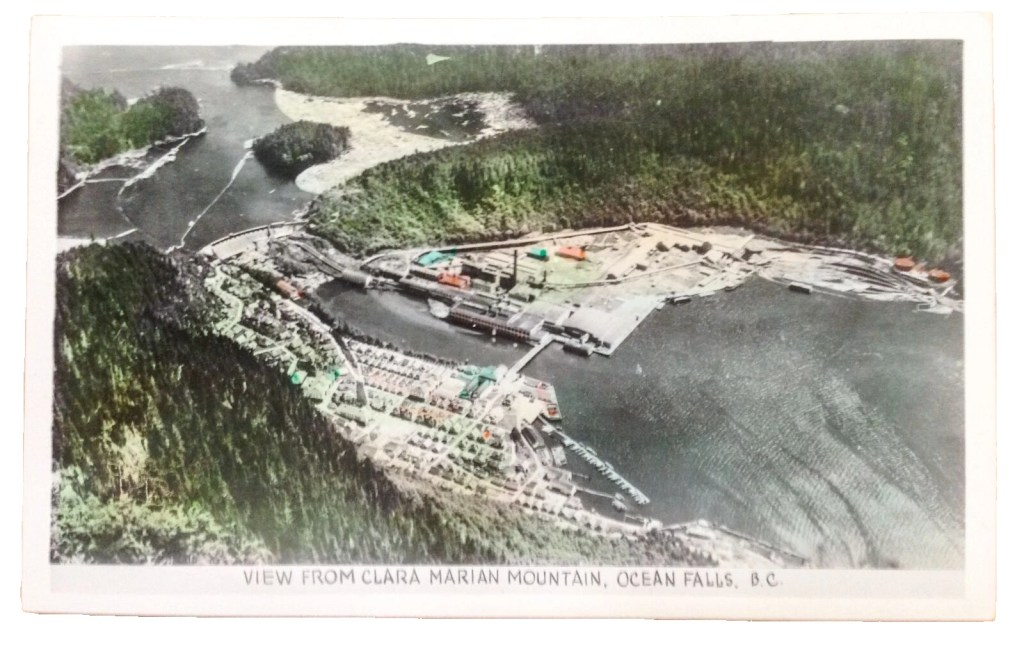
Ocean Falls is a water or seaplane accessible town in British Columbia built by the Crown Zellerbach Paper Company in 1906. The company provided residences for its employees and even had a company store, barber shop, hospital, school, and post office. At one time, 3,900 people lived there.
When it became too costly to keep the pulp mill running, Crown Zellerbach shut things down in 1973. Buildings were left as is, and over time, succumbed to the constant rain.
Many of the structures were removed, with others now rotting away. It’s estimated that a few dozen people currently live there year-round, with the post office remarkably still open. It’s now as close to being a ghost town as a town can get!
Ocean Falls (circa 1950)Laurence, Dulcie Cecille, And Dulcie Ann SteinhardtSS Prince George outside Ocean Falls, B.C. – 1949SS Prince George final demise in 1995. The vessel sank as it was being towed to Hong Kong for scrap.Huber Manufacturing (Huber Brothers) – 1942
“I’ve been tempted to send Christmas cards in July, but thus far have resisted.”
Each Christmas, my wife takes the Christmas Cards we receive, opens and reads them, and then tapes them to a pantry door. My mother did the same, although she used a wall because we didn’t have a pantry.
After New Year’s is over, Joleen removes the cards and puts them back in their envelopes, so that she has a current address to mail ours the following year. People still change locations, so that’s an easy way to keep updated on their whereabouts.
There was a time we received close to 100 cars from friends, family, and businesses, but that number has slowly dwindled. I believe last year, in 2024, we got a total of 19. Some of the senders passed away, while others just don’t mail them anymore.
I recall my mom scratching her head, attempting to recall if so-and-so sent a card the previous year. With my wife keeping ours in a box, that’s no problem. Forty years ago, I came up with an idea so that people wouldn’t have that problem.
I took over the letter-writing department during Christmas, always making sure that our ‘form letter’ was bizarre and unforgettable. While Aunt Betty’s card and letter might not be remembered 30 days after getting them, I didn’t want that to happen with ours. I’ve had friends and family say that they think I’ve lost it, but at least they remember the card or letter. That’s what counts most!
We’ve sent out cards with our two parrots supposedly writing things, along with an attorney, a garbage collector, neighbors, a complete stranger, and firms that we supposedly paid to write because we were too busy. I even had a holiday form letter printed out with fill-in-the-blanks.
The phony lawyer’s office letter was 20 years ago, and I still recall the firm’s name: Bend, Ovar, and Takum. Another year, I had a rubber stamp made with our signatures in cursive, going on to let it be known the following year, in a Christmas form letter, that some folks were upset because we didn’t take time to sign them ourselves. It’s reminiscent of the Joe Biden autopen controversy.
The best cards we mailed were a select few that I took a propane torch to, scorching them just enough to make them look like they’d been in a fire. That card envelope was stamped, with me having to carefully draw black spiral lines across the stamps to make them appear as cancelled. I only addressed a certain number to family members.
A blackened card and envelope were then placed inside another plain brown envelope marked USPS, with an official-looking note inside, supposedly from the US Postal Service. The note said that the mail was damaged from being in a warehouse fire. We waited two months after Christmas to finally send them.
Family still talks about that, with a good majority believing that the warehouse fire actually took place. I suppose there is a question as to whether this act was legal, but the statute of limitations has long run out.
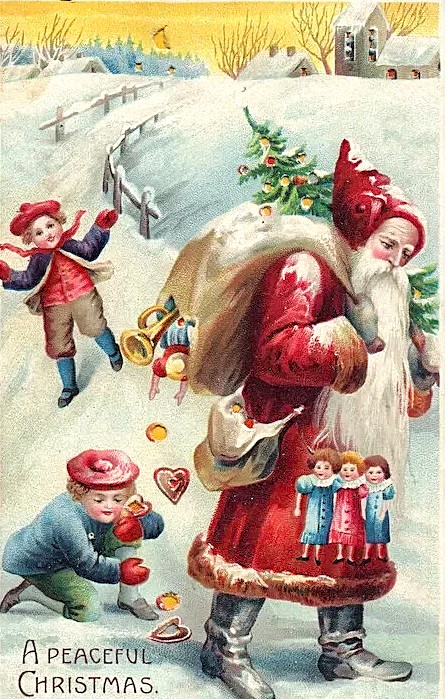
Back in the early 1900s, Christmas ‘postcards’ were quite common. I made my own one year, taking small 4×5 index cards and gluing a photo of Santa on the front, with him saying MerryChristmas.
There was little room to write a note on the back, with us just proclaiming, Happy New Year. I believe that’s the one we mailed right after Halloween. I’ve been tempted to send Christmas cards in July, but thus far have resisted.
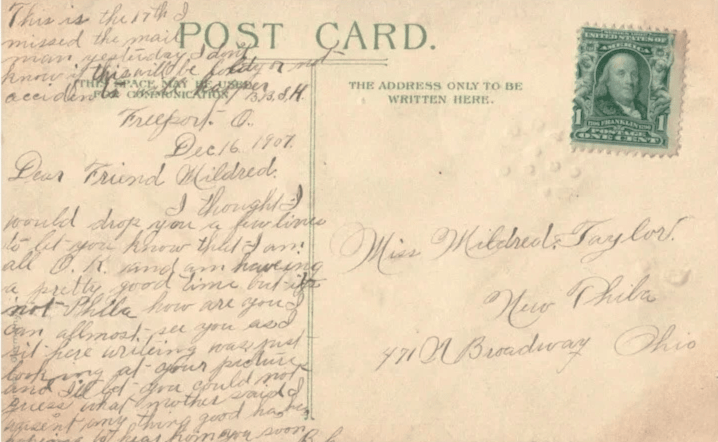
Finding an early Christmas postcard from 1907 on eBay, the person receiving it was Mrs. Mildred Taylor, who lived in New Philadelphia, Ohio. Someone with the initials B.L. from Kokomo, Indiana, sent it with the following cryptic letter. I’ve left words as written.
“This is the 17th. I missed the mailman yesterday. I don’t know if this will be today or not. Accident if it happen.
Freeport, O.
December 16, 1907
Dear friend Mildred,
I thought I would drop you a few lines to let you know I am all O.K. and am having a pretty good time but it’s not Philla. How are you I can almost see you as I sit here writing was just looking at your picture and I bet you could not guess what mother said, I suppose not anything good, ha. She suffering lot. Hear from you soon. B.L.”
Mildred A. “Mary” Peacock Taylor spent her entire life in New Philadelphia, Ohio, along with her husband, Earl. Hopefully, Mildred interpreted what her friend was telling her because anyone else reading this note wouldn’t totally understand. I suppose that’s intentional on the writer’s part.
Nowhere is there mention of ‘Merry Christmas’ or ‘Happy New Year’, although the front of the Victorian-style Christmas postcard does say, ‘A Peaceful Christmas’. The photo of a frazzled Santa with a large bag of toys makes it appear he isn’t having one!
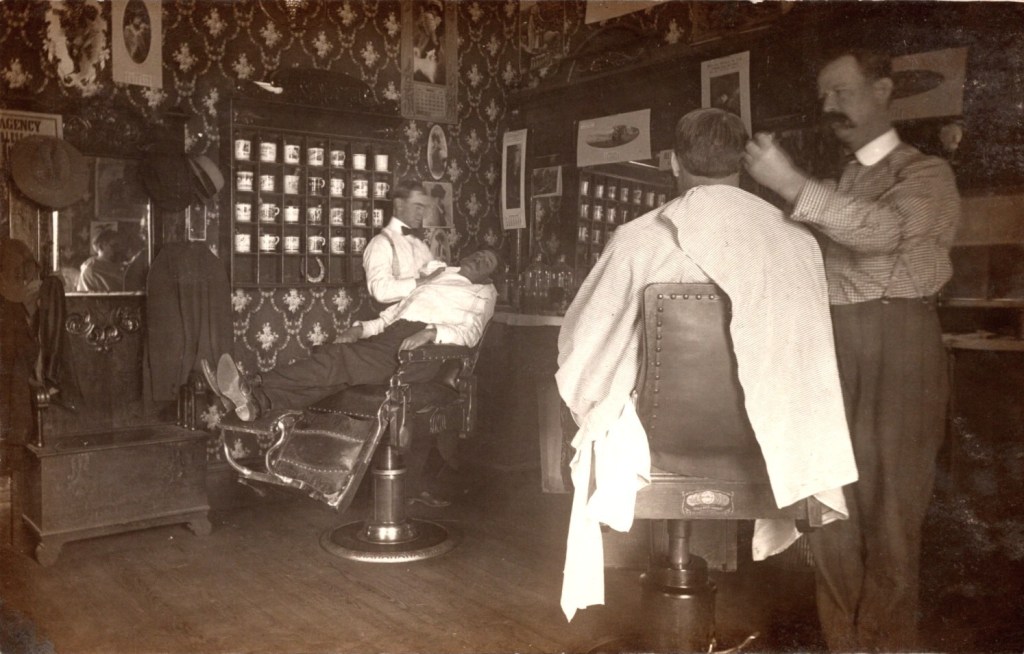
“I can easily sensualize the smell of shaving cream and men’s cologne merely by looking it over,”
Argonia, Kansas, barber shop
Argonia is a small town in Kansas, located in Sumner County, in the eastern part of the state. The Chikaskia River flows nearby with tracks of the Burlington Northern Santa Fe Railroad heading east and west through town. The 2020 census showed 456 people living there, which is 9 more than reported in 2024.
This place is known for having the first woman mayor in the US, Susanna Madora Salter. Alfred E. Parker proposed the name of Argonia in 1881, this name coming from the Argonauts of Greek mythology. Jason and the Argonauts mission was to find the Golden Fleece.
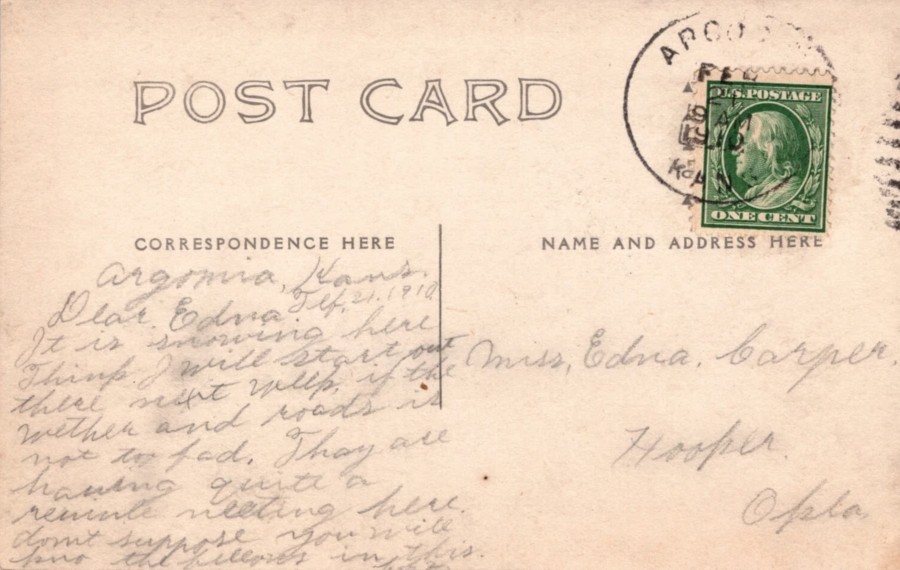
A vintage postcard on eBay I came across was mailed from Argonia, with a postmark of February 21, 1910. The recipient was Miss Edna Carper in Hooker, Oklahoma. A message to Miss Carper was transcribed from me with typos and misspelled words left as is.
“Argonia, Kans
Feb. 21, 1910
Dear Edna,
It is snowing here. Think I will start out there next week if the wether and roads is not to bad. Thay are having quite a reunite meeting here. Don’t suppose you will kno the fellows in this shop?”
There is no sender’s name or even initials to identify this person. I have to assume that if Miss Edna Carper was a school teacher, she knew exactly who sent it based upon the sloppy handwriting. These days, with arthritic fingers, I can’t do much better, although my spelling is still quite good thanks to AI.
On front of the postcard shows a vintage barber shop in Argonia. One man appears to be getting a shave while the other comfortably sits in a chair with his back to the camera. The barbers are nicely dressed, with one of them wearing a bow tie.
Eight shaving mugs sit on a shelf along the wall, and I have to assume they were for sale. It’s an excellent photo, and I can easily sensualize the smell of shaving cream and men’s cologne merely by looking at it. I miss those barber shop days, now cutting my own hair, what little that’s left.
Research shows that young Edna Rae Carper was indeed a school teacher, teaching in Hooker starting around 1906 for a few years before moving on to Goddard, Kansas. Newspaper articles report that she was ill quite often and had to relinquish her teaching duties several times.
While living in Goddard, she met George L. Hubbard. George Hubbard owned a drug store, so logic tells me it’s highly likely she romantically met him there.
The couple married in 1915, staying in that town before moving to Wichita in 1931. They purchased a drug store before selling out in short time and starting Hubbard’s Market. Their residence was at 437 S. Fern Street. The Victorian-style house still stands.
The Hubbards operated that grocery store with help from their sons, George Hubbard Jr. and Charles William Hubbard. It appears the store closed soon after Edna’s death. Both boys went on to similar careers, with George entering military service and retiring as a Lieutenant Colonel. He then became a teacher and educational administrator like his mom.
Charles William Hubbard also entered the military, serving in WWII, and then reenlisted before ultimately retiring as a Lieutenant Colonel. Charles “Charlie” Hubbard became a teacher and administrator after that, while also being a leader in his church.
Edna Rae (Carper) Hubbard was born in 1886 and died on January 30, 1945. She was only 58. George Lewis Hubbard Sr. was born in 1856 and passed away in 1950. He was 76 years old. Both are buried in Pleasant Ridge Cemetery in Goddard.
“Residents were imprisoned in their homes for an extended period, waiting for the storm to pass.”
Niagara Falls – 1920
The “Roaring Twenties” got off to a frigid start, especially in New York, when one of the worst blizzards to ever hit the area in February of 1920 dumped 17 ½ feet of snow in New York City alone over 72 hours. Streets were plugged, and the Hudson River frozen, thus barges and boats couldn’t bring in much-needed coal. Five people died in New York City because of the extreme cold.
Temperatures dropped down to -1°F with winds up to 45 MPH, making the wind chill factor even lower. Residents were imprisoned in their homes for an extended period, waiting for the storm to pass. Because of this, many businesses remained closed.
On the flip side of things, it was a beautiful sight for taking pictures with snow covering the ground and the Hudson River nearly frozen solid. The Niagara Falls was spectacular, with the water-fall seemingly frozen in time, as the front of a vintage 1920 postcard dictates.
The recipient of this postcard was Mrs. Howard Frank. The card is addressed to her at Mountain Park Sanitorium, Wausau, Wisconsin. Postmark date is March 11. A sanatorium is a place where sick people go to recuperate, while Marathon County Insane Asylum was for the mentally ill. The two buildings were located next door to each other with a cemetery out back.
Mrs. Howard Frank’s first name is Minnie, and her maiden name is Quade. Someone named Helen sent it to her, indicating in the correspondence that her husband or boyfriend was named Hubert. That greatly helped me to identify this person. I’ve transcribed things from the postcard exactly as written with typos.
“March 8th, 1920
Dear Minnie –
Hubert & I went to see winter scene on other side last Sunday at Niagara Falls. It surely is a wonderful sight. This will give you an idea of how cold it is here at present. Everyone it simply disgusted with the long cold winter – Helen.”
Tuberculosis was running rampant during the early 1900s, with Spanish flu coming along in 1919 – 1920. Minnie Frank likely had TB, as Mountain Park Sanitorium was set up as a tuberculosis recovery center. Most people who had the Spanish flu were quarantined at home.
Minnie Quade Frank was born on February 17, 1862, during the middle of the American Civil War. She died on April 3, 1927, seven years after Helen sent her that card. Minnie’s obituary indicates that she passed away from a lingering illness. That fits the description of tuberculosis. Both US presidents James Monroe and Andrew Jackson died from TB.
Tuberculosis is a horrible disease. It can cause significant damage to the lungs, such as permanent scarring, cavities, and decreased lung function. When it was first discovered, doctors relied upon iron lungs to help do the breathing for patients.
Immunization for TB first came to be in 1921, after French scientists Albert Calmette and Camile Guérin discovered that their BCG vaccine could help protect infants and young children from getting the disease in infants. That vaccination is still recommended by reputable pediatricians. Unfortunately, it doesn’t work for adults.
The card was sent by Mrs. Hubert (Helen) Eliason of Atlanta, Georgia. She was living in Atlanta at that time. Helen attended Minnie Frank’s funeral, all the way from Atlanta, so it’s possible they were close friends or related.
Minnie’s buried in Pine Grove Cemetery, alongside her husband in Wausau, Wisconsin. The couple had one daughter, Irene, who passed away in 1990.
Tuberculosis is unfortunately making a strong comeback. Where, at one time, it was practically eliminated from this country, infected immigrants illegally crossing our borders helped bring things back. Add to that the many ignorant parents who no longer have their children immunized makes for a deadly situation.
I’m so thankful that my folks had my brother and me inoculated against TB, measles, diphtheria, and other infectious diseases. My children responsibly did the same for our grandchildren. Where tuberculosis is now concerned, it boils down to one thing.
TB or not TB? That’s a question for our politicians and medical professionals to quickly answer.
New York City – February 1920Where Minnie Frank spent timeCirca 1919 – This building was torn down with all medical records destroyed
“I’m sure Robert Lefever’s mom, Blanche, was tickled pink to get this message from her youngest boy.”
For the past couple of months, I’ve been on intense writing projects involving old postcards. I’ve learned some history lessons from the pictures on front, while encountering funny and sadness from those people writing them, including the recipients.
It’s like being able to legally read someone’s mail, or eavesdrop on a personal phone call. I did that a few times as a kid when we had a party line. That form of entertainment came to a grinding stop when Mom caught me. She grabbed the phone and apologized to the person on the other end. My bottom was toasted soon afterwards.
This project has also allowed me to use psychological insight into how and why some of these cards were written. Some folks might ask after that last comment, “Do you have a background in psychology, Mr. Hankins?” The answer is no. I’m just an old man with an opinion. There’s a mess of us out there.
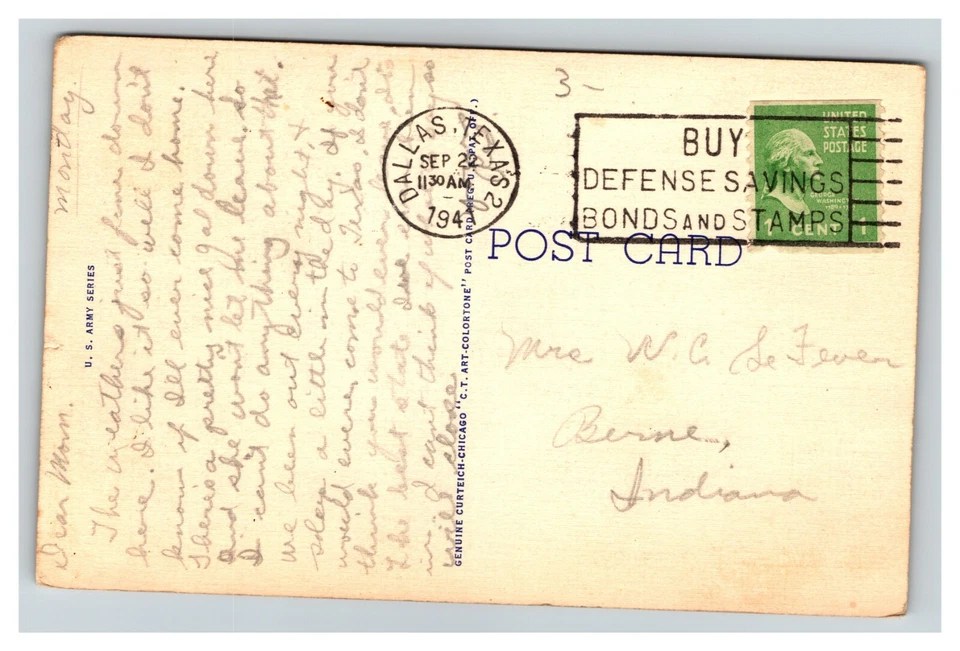
Before I go further, let me reveal things about my latest project. The card is postmarked from Dallas, Texas, September 22, 1941. Beside the circular stamp is another rectangular one marked, ‘Buy Defense Savings Bonds And Stamps.’ WWII hadn’t officially started, but tensions were high between the US and Japan.
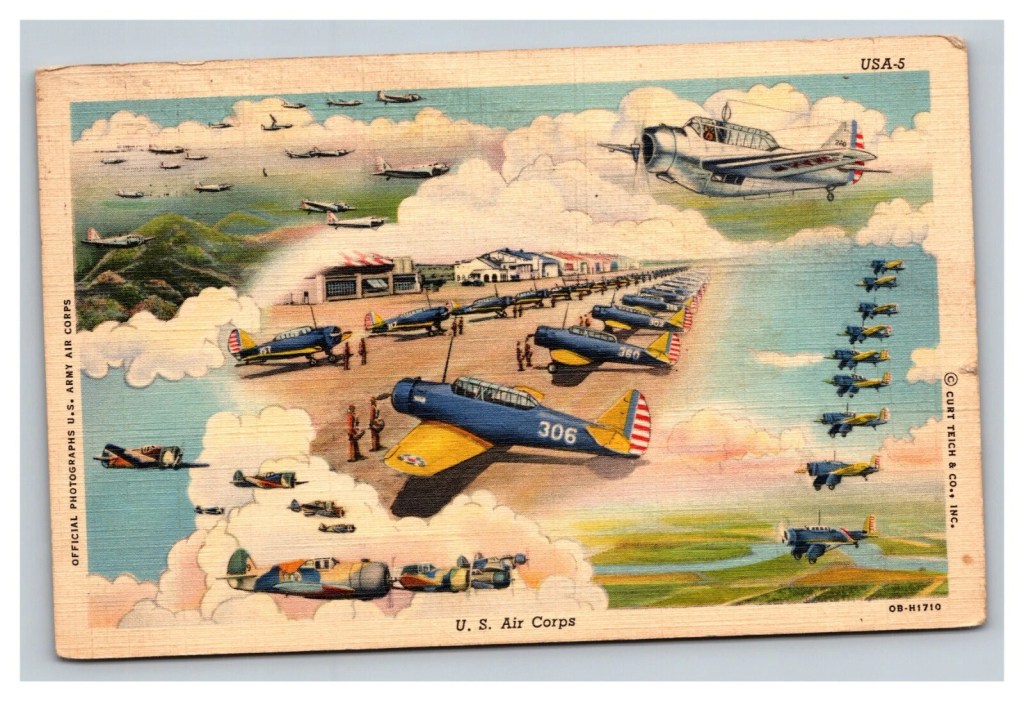
On the front of this lithographed postcard is a color picture showing training airplanes of the Army Air Corps. This branch of the military was called such before being renamed the United States Air Force in 1947. The recipient of the card is Mrs. W.C. Lefever in Berne, Indiana. The pencil-written message goes as follows, with typos and errors left unchanged:
“Dear Mom, Monday.
The weathers just fine down here. I like it so well that I don’t know if I’ll ever come home. Theres a pretty nice gal down here and she wont let me leave, so I can’t do anything about that. We been out every night + sleep a little during the day. If you would ever come to Texas, I don’t think you would ever leave. It’s the best state Ive ever been in. I cant think of what else to say so will close. Your son Robert”
I could just barely read the sign-off because the postmark covered it. There were enough readable letters to finally make things out. I’m sure Robert Arnold Lefever’s mom, Blanche, was tickled pink to get this message from her youngest boy.
William Clarence Lefever, Robert’s father, wasn’t mentioned in the correspondence, although both parents were still alive in 1941 and living together, as records indicate. The objective of the card and the way it was written is quite clear to me.
Robert was evidently having problems with his dad and saw this as a way to get back at the old man. What better way to say I love you than by letting both parents know that he was ‘sowing his wild oats’ and he’d never see them again.
Before the start of each Indianapolis 500 race, the late Jim Nabors sang, “Back Home Again in Indiana.” I believe the tradition is still being fulfilled by other singers. One or two word changes to the first four lines of this song can be made to reflect most anyone’s former home. For me, that would be switching Indiana for Alabama, Alaska, or Arizona.
“Back home in Indiana
And it seems that I can see
That gleaming candlelight is still shining bright
Through the sycamores for me.”
Research shows that Robert A. Lefever didn’t stay in Texas, eventually returning home to Indiana and marrying a local woman named Lillian in 1949. Robert’s buried in a Fort Wayne cemetery with his wife. Someone chose to spell their last name the old way on their gravestone, Lefevre.
Both parents, along with older brother Russell and his wife, Nora, are laid to rest 45 miles away in Berne. There’s no record of Robert serving his country during the war, yet there is a Russell Lever from Fort Wayne who was deployed and safely returned.
This research reminds me of Luke 15:11-32. This is the story of the prodigal son. A father has two sons. One is responsible, while the youngest is just the opposite. This immature boy asks his dad for his inheritance and then goes out and squanders it. After all of the money is gone from frivolous and foolish living, he comes crawling back home, expecting to live with the pigs.
Instead, his father puts on a big feast, which the older son finds to be a great disappointment. He can’t believe his father is doing this, for after all, he was the mature one. The older child is angered by this lavishness, yet goes along with things, while the father is delighted that his lost son is now returned.
Is that how Clarence Lefever saw things after Robert finished sowing his wild oats in Texas and came back home? I’d like to think so!
“What seems so unreal is that I still remember part numbers from my days working at an automotive parts store.”
Desert Bar
I’ve always had a good memory, remembering small things from long ago. I chalk it up to never being dependent on recreational drugs or alcohol. Lately, what I seem to forget more than anything else is connecting names with faces.
I’ll watch an old movie and when some well-known actor comes on scene, oftentimes his or her name is on the tip of my tongue yet I can’t spit it out. This can be irritating, with it having me wonder if I’m becoming senile.
Whenever this happens, I quietly ask myself, “What is the firing order of a Chevrolet V-8 engine. Thus far, I’ve been able to rattle off 1-8-4-3-6-5-7-2 without hesitation. Car guys and gals know what I’m talking about here. As long as I get those numbers right, I have to assume all is good upstairs.
Last winter, I was with some friends at the Desert Bar near Parker. The name of this place can be misleading for those who’ve never been there. The rustic establishment is built around a former gold and silver mine, and it’s totally off-grid. I view it as more of a ghost town with a live band. It’s definitely family-friendly.
There are antique cars and old rusty mining stuff to be seen, including an awesome replica western day church, complete with a steeple. Yes, weddings can be arranged. The food is good, and I always make sure to bring cash because they don’t take checks or credit cards. Beer is served, but for guys like me, they have soft drinks as well.
On this last trip, a fellow and his wife walked up and recognized me. They knew my name and started up a conversation. All during that time, my brain was going, “I know these folks, but for the life of me, I don’t recall their names.” Seeing that I was confused, they helped give my memory a jumpstart.
Walking back to our table and repeating their names over and over, wanting them to permanently sink in, I informed my wife about my memory lapse. I told her that I’d make sure to remember their names next time. I have been doing so for several months now, even writing them down on a piece of paper. That paper is now hiding somewhere, and I don’t recall where I put it. 1-8-4-3-6-5-7-2.
They’re a nice couple, much younger than us, snowbirds, they come from Minnesota each winter, owning a home here. I can remember almost the whole conversation we had over coffee at Bashas. We planned on getting together when they came back and going metal detecting.
What seems so unreal is that I still easily recall part numbers from my days working in an automotive parts store. That was 40 years ago. The Spicer number for a 1975 Chevrolet Blazer constant velocity centering joint is 210782X. The Standard ignition number for Chevy points is DR2270P. Ford points are FD8183V. I could go on and on.
Why is it that I can still relate numbers to parts, yet faces to names is now escaping me? How do older ministers handle this problem? I suppose calling everyone brother or sister works, at least for a while.
Taking the herb Ginkgo biloba is supposed to help in the memory department, or at least a friend told me that eons ago. I believe at this point it’d do little good, and besides, one of my doctors said it’s not good to take this if you’re on blood thinners. Mark that off my list.
They say AI technology can recognize facial features. The police and other protective agencies have been using such for years. I believe the answer for older folks like me is for everyone to have a barcode stamped on their forehead. Keeping a scanner in my back pocket, I could then scan and say without embarrassment, “Hello, Joe, how are you doing today?”
I’m only joking here, but in reality, the world could be coming to that!
“My research shows that 2nd Lt. Robert L. Young Jr. got his wish.”
Craig Air Force Base in Selma holds a special place in my heart, as does the city. My father was stationed there for several years. When I came across a vintage postcard from Craig Field showing an AT-6 trainer airplane, I decided to investigate and see who the sender and recipient were. Before I proceed, it is worth noting that Craig Field was renamed Craig Air Force Base in 1947.
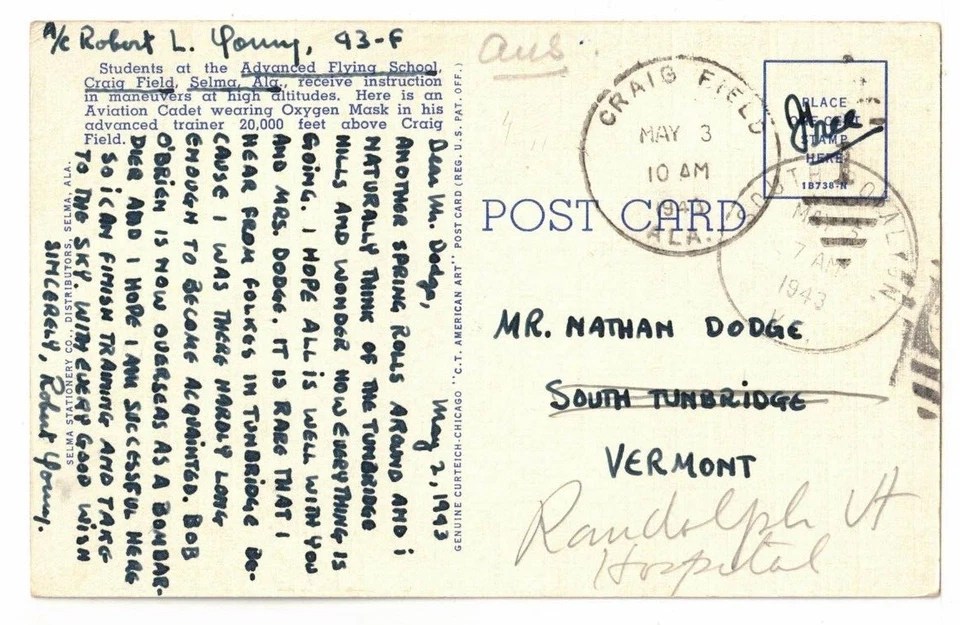
The postcard is postmarked “Craig Field, May 3, 1943.” This was a Monday, and World War II was still raging. Air Cadet (A/C) Robert Young mailed the card to someone named Nathan Dodge in South Tunbridge, Vermont. The postcard was then forwarded to the Randolph, Vermont, Hospital.
I had to search WWII records to find a pilot named Robert L. Young. Being such a common name, only one person fit the bill. Robert Lincoln Young was the only son of Robert Lincoln Sr and Kathryn Young of New Jersey. The postcard he mailed to Mr. Dodge contains the following message as written with no corrections:
“A/C Robert L. Young 43-F
Dear Mr. Dodge, May 2, 1943
Another spring rolls around and I naturally think of the Tunbridge Hills and wonder how everything is going. I hope all is well with you and Mrs. Dodge. It is rare that I hear from folkes in Tunbridge because I was there hardly long enough to become acquainted. Bob O’Brien is now overseas as a bombardier and I hope I am successful here so I can finish training and take to the sky. With every good wish.
Sincerely, Robert Young”
My research shows that 2nd Lt. Robert L. Young Jr. got his wish. He completed 14 successful missions as navigator on the B-24 Liberator named ‘Ready Willing and Able’. During this time, he was awarded 2 medals, the Purple Heart and Oak Cluster.
Mission number 15 was a risky one, as groups of bombers were destined to fly into dangerous German territory before dropping their bombs on Berlin. Heavily damaged, ‘Ready Willing and Able’ successfully dropped its load and headed back to Wendling Field in England, where the crew was based.
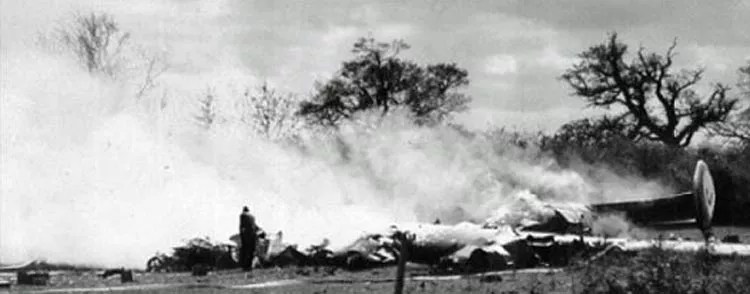
As it flew overhead, circling the runway waiting to land, the twin-engine airplane suddenly exploded in a huge ball of fire, killing all 11 crewmen on board. 2nd Lt. Robert Lincoln Young Jr. is buried at Cambridge American Cemetery and Memorial. This place of internment lies in Cambridge, England.
Nathan Dodge, the person that Robert Young sent the card to, was a teacher and administrator, and also a farmer. It’s fair for me to assume that Mr. Dodge had been Robert’s teacher.
As previously stated, the postcard that Young mailed to Nathan Dodge was postmarked May 3, 1943, with the educator sadly passing away 16 days later on May 19 of the same year. It’s unlikely the young man knew of Nathan’s illness while he was in Selma. Nathan Dodge’s unfortunate death came from a case of appendicitis.
An obituary for Nathan Dodge painted a picture of him being a great instructor and a person deeply concerned for his students. One line from this lengthy article pretty much sums things up here.
“Mr. Dodge never failed to give good and wise counsel to young men who brought their problems to him like a big brother.”
Robert Young thought highly enough of his former teacher to take the time and write a letter. I doubt many students do this these days. The young man was undoubtedly counseled on his entering military service by Nathan Dodge.
There is one additional person mentioned on the postcard by Robert Young, Bob O’Brien. This fellow was probably a classmate of Young and a student of Dodge. Bob O’Brien took the most research to pin down, but thankfully, Robert Young mentioned the guy as being a bombardier, and that helped me immensely.
1st Lt. Robert Emmett O’Brien served as a bombardier on a B-24 Liberator in WWII and made it back home alive. After finishing up his education, he started a successful business with his wife, called KOB Carpet in Atlanta, Georgia. After retirement, he and his wife lived in Pompano Beach, Florida, for a spell. Bob O’Brien died in 2007, at the age of 84, and is buried in Scottsdale, Arizona.
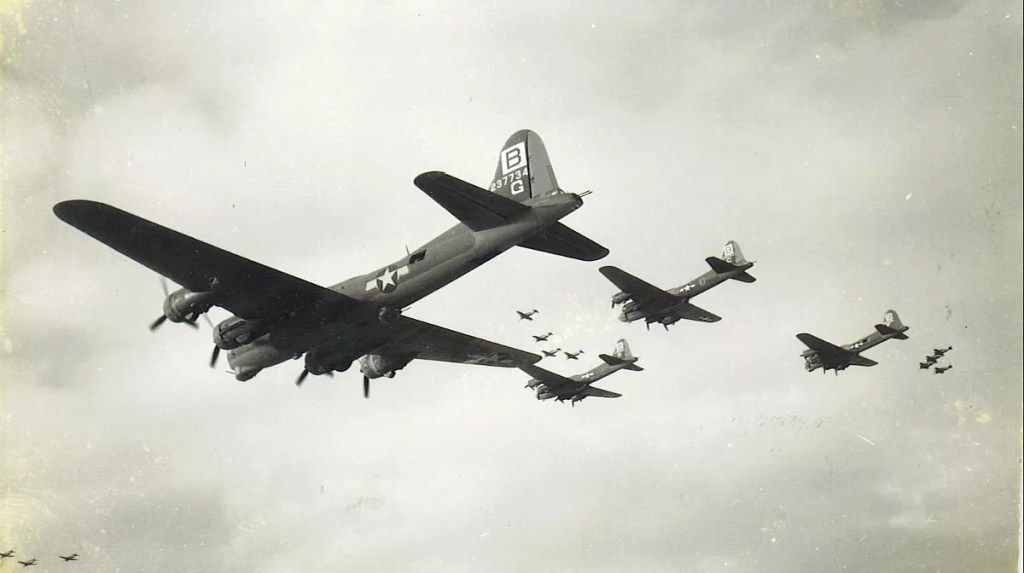
Group of B-24 Liberators on a bombing missionCrash site of “Good Ready and Able” (41-29427)Cambridge American Cemetery and Memorial2nd Lt Robert Lincoln Young Jr.
My mother made it a point to always mail family and friends, postcards, whenever she traveled. I kept a few of these cards to pass on to my grandchildren. This was quite common back in the day, but not as many people have followed through on the tradition these days. It’s much like Christmas cards.
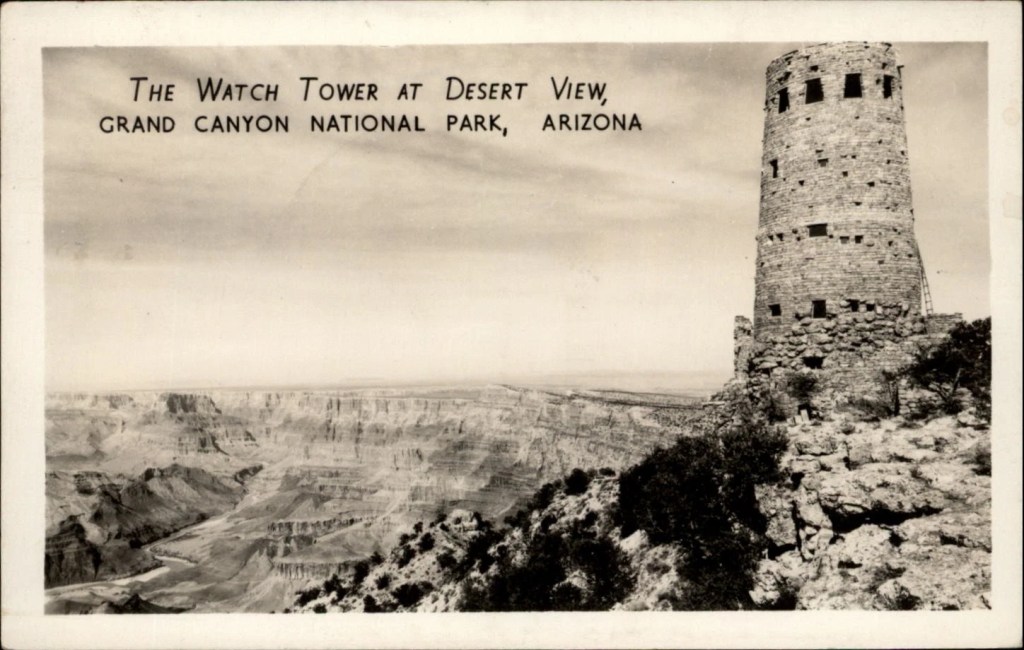
The featured postcard in this writing is one from the Grand Canyon National Park in Arizona. It shows a building called The Watch Tower. I remember this structure from visiting the place almost 38 years ago, and I was quite impressed with it. The tower was very busy, and we had to wait in line to go in. The rock and steel structure is also known as Desert View Watchtower and Indian Watchtower.
The late Jimi Hendrix had a hit song called “All Along The Watchtower.” Released in 1968, yet written in 1966 by Bob Dylan, this was some 48 years after the Grand Canyon tower was constructed.
I doubt this song was written about Dylan’s visit to the national monument, but he did spend considerable time in the state, living in Scottsdale with his wife. Some say that the tune has Biblical meaning, with Isaiah 21:5-9, mentioning such a dwelling. “Watchtower” is also the name of a magazine published by the Jehovah’s Witnesses religious organization.
The Grand Canyon tower was conceived by Mary Holter, an employee of the Fred Harvey Company. It was completed in 1932, becoming a major attraction to park visitors. It was designed by Mary Holter to resemble an ancient Puebloan watchtower, but the overall size is much smaller than the real thing.
Today, the lower floor is a gift shop, while the upper is designed for tourists to take in the spectacular view. Millions of visitors over the years have visited this structure and undoubtedly came away awestruck. The canyon itself had a lot to do with that.
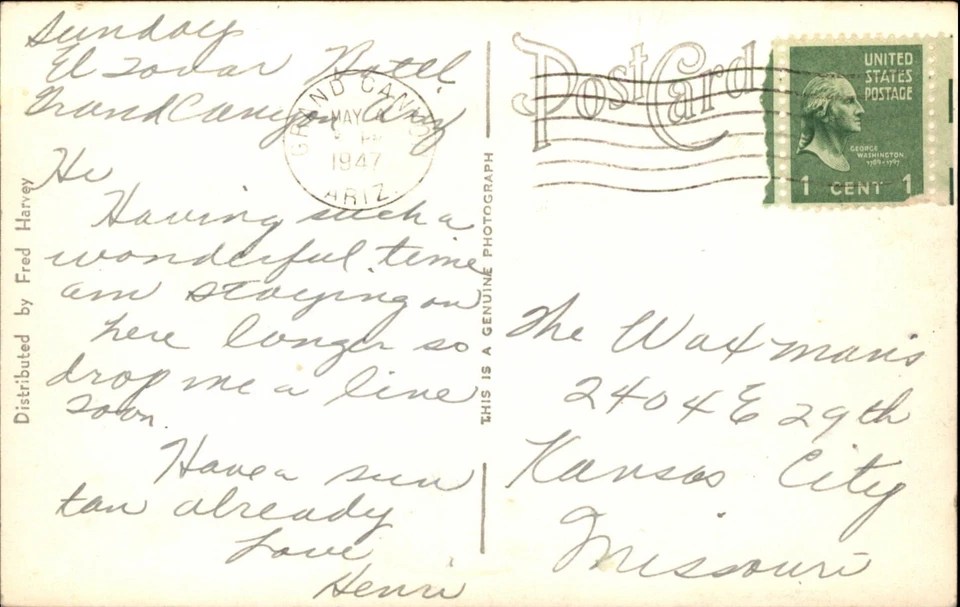
Someone named Henri visited the Grand Canyon in 1947. He mailed this postcard to The Waxman’s in Kansas City, Missouri. As I always try to do with addressed and cancelled postmark cards. I attempt to track down the sender and recipient, with it not always being easy.
In this case, the recipients were Meyer & Fannie Waxman. They lived at 2404 E. 29th Street in Kansas City. I can visualize Meyer retrieving the card from his mailbox, with Fannie reading it out loud to her husband.
“Sunday
El Tovar Hotel
Grand Canyon, Arizona
Hi
Am staying here longer so send me a line soon
Have a sun tan already
Having such a wonderful time
Love Henri”
Afterwards, the Waxmans talked about how they should visit Arizona before getting too old. Maybe they already had? It was only 9 years after getting the card that Meyer died in 1956. Fannie outlived him another 41 years, living to be 103.
Unfortunately, for now, Henri will have to remain a mystery in my postcard history.
“Our letter must’ve touched a frayed nerve on this subject.”
I’ve heard the phrase “you people” for a good part of my life, although I’ve observed it used more often these past 20 years. Generally, the words pop up when someone is angry. Young folks have been known to use such language when talking about the older generation, and vice versa.
My AI helpmate, the lovely, but imaginary, Miss Purdy, tells me the following about what ‘you people’ means:
“You people is a phrase that can be interpreted in many ways, but it often carries negative connotations, especially when used to refer to a specific group of people, like an ethnic or racial group. It can create a sense of distance or division, implying an ‘us vs them’ mentality.
Miss Purdy went on to say this happens quite often on Facebook, with me not even realizing she was on social media. She went on to explain that the phrase, while not inherently offensive, its usage is often viewed as disrespectful, condescending, or even racist, depending on the context and the speaker’s intent.”
Years ago, my wife and I mailed out Christmas cards with a religious message, as we always do. Several weeks later, our card and letter came back from one individual, all marked up in red ink with negative language. The words ‘you people’ were included several times in their scathing remarks.
Our letter simply stated what Joleen and I, along with our children, had been doing. I didn’t brag or boast, basically talking about what the kids were up to in college. We ended it with God Bless and have a Happy New Year, as we’d done for perhaps 30 years.
The recipient made it clear that they didn’t think we practiced what we preached regarding how a Christian should act. Our letter must’ve touched a frayed nerve on this subject. They made sure to end things by saying, “Never send me one of these hypocritical letters again!”
After reading things, with the hair on the back of my neck standing at full attention, recklessly on my part, I fired a scathing reply back via our postal service. It was like tossing gasoline onto an already burning fire. Thinking about things later that night, I wished that I could’ve stuck my hand in the mailbox and retrieved that angst. I believe many people have done the same.
Looking back on the incident with a bit more wisdom, I should’ve waited, digested exactly why this person was upset, and then perhaps called them instead. Eventually, this did take place over the phone, although permanent damage had been done. Our relationship was never the same, with bipolar disorder on their part a big reason why.
The other day on television, I watched an agitated older actor use the term,” You people!” He was directing it at MAGA supporters. Robert DeNiro’s message wasn’t taken as offensive like I might’ve viewed it only a few years ago. I actually chuckled—seeing it as more of a compliment than an insult.
Getting back to that person belittling our family card and letter at Christmas in 2002. Had I been tuned in to the Bible more than I was, I would’ve seen that Jesus has an answer for such in Matthew 5:11. “Blessed are you when people insult you, persecute you, and falsely say all kinds of evil against you because of me.”
Had that Biblical lesson been known by me, I would’ve refrained from retaliation. My hasty action and need to ‘speak my mind’ were far more damaging to this person than her angry words to me.
Proverbs 12:18. “The words of the reckless pierce like swords, but the tongue of the wise brings healing.”
















 I like to write junk...